
Violinist James Zabawa-Martinez | CHASING CRESCENDOS
Special | 10m 50sVideo has Closed Captions
Born in Austin, James knew from an early age that he wanted to play the violin.
Violinist James Zabawa-Martinez opens up about his life as a musician, reflecting on long practice sessions, battles with stage fright, and the passion that keeps him performing. Born in Austin, James knew from an early age that he wanted to play the violin. Now, he is particularly inspired by seeing young people in the audience, reminding him of why music is important.
Problems playing video? | Closed Captioning Feedback
Problems playing video? | Closed Captioning Feedback
Major series funding for GREAT PERFORMANCES is provided by The Joseph & Robert Cornell Memorial Foundation, the Anna-Maria and Stephen Kellen Arts Fund, the LuEsther T. Mertz Charitable Trust, Sue...
Violinist James Zabawa-Martinez | CHASING CRESCENDOS
Special | 10m 50sVideo has Closed Captions
Violinist James Zabawa-Martinez opens up about his life as a musician, reflecting on long practice sessions, battles with stage fright, and the passion that keeps him performing. Born in Austin, James knew from an early age that he wanted to play the violin. Now, he is particularly inspired by seeing young people in the audience, reminding him of why music is important.
Problems playing video? | Closed Captioning Feedback
How to Watch Great Performances
Great Performances is available to stream on pbs.org and the free PBS App, available on iPhone, Apple TV, Android TV, Android smartphones, Amazon Fire TV, Amazon Fire Tablet, Roku, Samsung Smart TV, and Vizio.
Buy Now
Great Performances Newsletter
Subscribe to the Great Performances newsletter to keep up with the latest full episodes to stream, exclusive content, and more!Providing Support for PBS.org
Learn Moreabout PBS online sponsorshipMore from This Collection
Explore the preparation and processes of New World Symphony’s young musicians in Miami as they work alongside soloists, conductors and mentors to prepare for live concerts and train for professional orchestral positions in this new digital series from Great Performances on PBS.
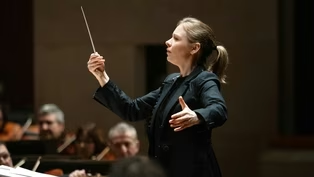
Conductor Gemma New | CHASING CRESCENDOS
Video has Closed Captions
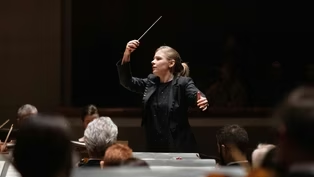
Conductor Gemma New leads the orchestra with a focus on creating a collective musical experience. (11m 25s)
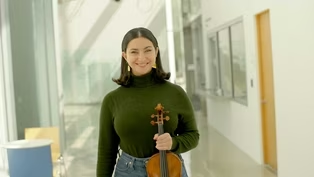
Violinist Allison Taylor | CHASING CRESCENDOS
Video has Closed Captions
Violinist Allison Taylor traveled to India, where she realized she didn't know about the instrument. (11m 4s)
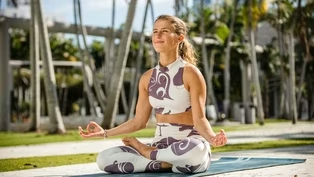
Bassoonist Eleni Katz | CHASING CRESCENDOS
Video has Closed Captions
Bassoonist Eleni Katz shares a glimpse of her musical journey at New World Symphony. (11m 11s)
Providing Support for PBS.org
Learn Moreabout PBS online sponsorship(ominous music) JAMES ZABAWA-MARTINEZ: I have this pre-concert ritual.
Well, I wouldn't say that it's by choice, but I usually will throw up before I go on stage because I'm so terrified.
My whole body is shaking.
You have to force yourself to be vulnerable on stage.
You do have to let that guard down and allow yourself that openness.
(dramatic classical music) (audience applauding) (waves lapping) (bright classical music) (bright classical music continue (bright classical music continue (energetic violin music) We have so many concerts here that stage fright is a huge, huge concern of mine.
Particularly, my first season here was terrifying.
And New World is a place that we give concerts every weekend.
You have no choice but to, like, get with the program.
(somber violin music) On average, I spend about four hours a day practicing.
When I get my music, I'll come back to my apartment.
I will usually put on a practice mute and run the entire symphony with my practice mute on and with the recording on the Bluetooth speaker.
And if there's any hard spots that I, like, just can't play at all, then I'll mark it with a pencil, and then I'll go back and work on this stuff slowly.
(somber violin music) (somber violin music continues) I was born in Austin, Texas.
So I lived in Austin until I was about 15, and then I moved to Minnesota.
(somber violin music) I think as far as I can remember I've wanted to play the violin.
For some reason, my parents always said that I was gonna be a violinist.
It just seemed predestined for me, at least with them.
My parents didn't make a lot of money, so when they had any extra funds, they would go to Goodwill and find me, like, a variety of different violin things, like these little electri violins that are about this big and when you put the bow on the string it starts to play like, Eine Kle There was even, like, a violin ashtray at one point that I received, which was nice.
I do feel like maybe I was born to be a violinist, even though that does sound cliche.
But what they did definitely help.
(bright classical music) (bright classical music continue (people chattering) GEMMA NEW: Good morning.
It's great to see you all.
Welcome.
Let's start with th Tchaikovsky from the very top.
(dramatic classical music) (dramatic classical music continues) So he does not write a crescendo at two after B, but then he writes one into the third bar of B. Yes, so this we need to come out.
And then he writes one four after B.
(imitating classical instruments) (soaring classical music) (soaring classical music continues) That was really good.
Can we have just the upper strings two after E?
(dramatic classical music) Yeah, the issue is, sometimes when we wan something to dance and prance, when we have a down bow, you stop the bow, and it kills the sound.
Could I suggest that we do down, up, down?
GEMMA NEW: Okay.
JAMES ZABAWA-MARTINEZ: Just so we could get some lift, perhaps?
GEMMA NEW: Ah, yes.
If it's hooked, its... that's why we're stopping.
- It's a little, yeah, GEMMA NEW: Let's.
Yes, please.
Down, up, down.
(dramatic classical music) Yeah, that's much better.
Okay.
Yes, well keep that.
(dramatic classical music) (dramatic classical music continues) (dramatic classical music continues) I love this.
This is really waltzing.
For the firsts and violas though, you can have more nudge in your hairpins.
And then for the trombones and horns: two after D, these are like bells that should come out.
For this, violins, see that line that connects from one to the other?
Let's get more connection here.
Two after F, we must b singing through the note more.
You are dying on these notes.
They are long, but they need to feel growth throughout.
(dramatic classical music) I love Tchaikovsky's Fifth Symphony.
(dramatic classical music) It's actually a work that I was pretty unfamiliar with before we started studying it.
The darkness in this Symphony, it's not lost on me.
Tchaikovsky's life was much more difficult than my life, but I really do my best to put myself in those shoes and try to relate my own experiences to them.
(mellow classical music) (people chattering) Yeah, that's what I was gonna figure out.
Like, are we gonna do it the second time?
MARIO RIVERA: Yeah.
What does this mean?
-Where was that?
Yeah, yeah, like... (bright violin music) And then the second one.
(bright violin music) I'm rushing so much.
I had a more stressful experience with Tchaikovsky's Fourth Symphony last season.
So, when I saw that I was assigned again to Tchaikovsky Five, I was a little bit nervous, and I had a little bit of, you know, “is it Tchaikovskys just a curse for me, you know?” So leading into my rehearsal today, I was feeling a little bit nervous, like, my heart racing and stuff.
I need to try to keep going up from here with this week's rehearsal, so I have some work I need to do tonight.
(bright violin music) My mom played saxophone starting in middle school through high school.
And my dad, I think he really had a shot at doing something with athletics.
He was a basketball star at the school.
That all kind of got cut short because they had me when they were in high school.
(mellow classical music) You know, it was kind of an up-and-down situation.
Like, sometimes my family had money.
I mean, not like money money, but sometimes we could afford to have an apartment.
But things like that always went up and down.
There was times where we lived in my family's car for a little bit.
But I feel like my parents did a really good job of being kind of like a hydraulic system of like catching all of the trauma for me.
(mellow classical music) I started listening to violin recordings pretty early.
My mom bought me like a cassette that I would play on repeat Paganini's 24 Caprices.
I believe at the time, we were living in the car, because I remember being very comfortable in the car and popping the cassette into the player in the car.
And I remember the first note— well, I can't even say note because Paganini's First Caprice is just so crazy that it was the first, like, 20 notes.
(lively violin music) I was blown away by the sound.
It's not the usual string sound.
It was something crazier.
It was choppy.
It was exciting.
It was electric.
(lively violin music) (mellow music) When you play concerts and you look into the audience and you see the amount of young people, it feels very motivating.
Even if it's one person changing their life through classical music, I would say that it's like doing its job.
It never gets old to see like, people's hands and faces just, like, clapping, and you think, like, is that for me?
You know?
And it is.
(mellow classical music) (audience cheering and applauding) (mellow classical music) (dynamic music) (dynamic music continues) (dynamic music continues) (dynamic music continues) (dynamic music continues) (dynamic music continues) (dynamic music continues)
Video has Closed Captions
Preview: Special | 36s | Explore the preparation and processes of New World Symphony’s young, gifted musician. (36s)
Providing Support for PBS.org
Learn Moreabout PBS online sponsorship

- Arts and Music
The Best of the Joy of Painting with Bob Ross
A pop icon, Bob Ross offers soothing words of wisdom as he paints captivating landscapes.










Support for PBS provided by:
Major series funding for GREAT PERFORMANCES is provided by The Joseph & Robert Cornell Memorial Foundation, the Anna-Maria and Stephen Kellen Arts Fund, the LuEsther T. Mertz Charitable Trust, Sue...