
The State of Sound
5/20/2021 | 29m 10sVideo has Closed Captions
Mark McDonald visits with Lance Tawzer about The State of Sound exhibit
Mark McDonald visits with Lance Tawzer at The State of Sound exhibit in the Abraham Lincoln Presidential Museum.
Problems playing video? | Closed Captioning Feedback
Problems playing video? | Closed Captioning Feedback
Illinois Stories is a local public television program presented by WSIU
Illinois Stories is sponsored by CPB, Illinois Arts Council Agency, and Viewers like You. Illinois Stories is a production of WSIU Public Broadcasting.
Support provided by:


The State of Sound
5/20/2021 | 29m 10sVideo has Closed Captions
Mark McDonald visits with Lance Tawzer at The State of Sound exhibit in the Abraham Lincoln Presidential Museum.
Problems playing video? | Closed Captioning Feedback
How to Watch Illinois Stories
Illinois Stories is available to stream on pbs.org and the free PBS App, available on iPhone, Apple TV, Android TV, Android smartphones, Amazon Fire TV, Amazon Fire Tablet, Roku, Samsung Smart TV, and Vizio.
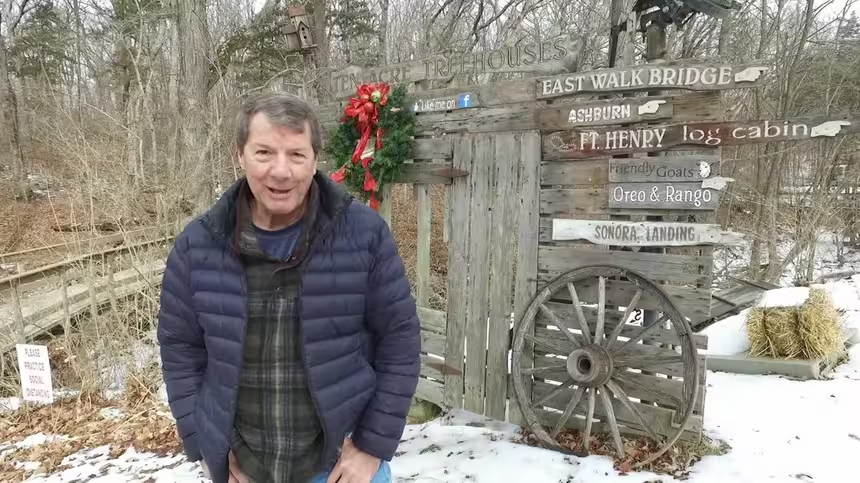
Illinois Stories
Join Mark McDonald as he explores the people, places, and events in Central Illinois. From the Decatur Celebration; from Lincoln’s footsteps in Springfield and New Salem to the historic barns of the Macomb area; from the river heritage of Quincy & Hannibal to the bounty of the richest farmland on earth.Providing Support for PBS.org
Learn Moreabout PBS online sponsorship(upbeat music) - [Narrator] Illinois Stories is brought to you by The Corporation for Public Broadcasting, Illinois Arts Council Agency and by the support of viewers like you.
Thank you.
- Hello, welcome to Illinois Stories.
I'm Mark McDonald in Springfield.
At Abraham Lincoln Presidential Museum.
In front of the exhibit hall.
And this exhibit hall has been closed for over a year.
It's open again now, with the State Of Sound and this is quite a departure from what you might normally see here at this museum.
And it's a concept that's very interesting Lance because when you started thinking about this, you started thinking, you know what, Illinois has been the seed for a lot of different types of music.
And it's spread from Illinois all over the world, in many cases.
So that's really what you're focusing on here, is not only what music was developed here in Illinois but how it all got spread around the world.
- Right, yeah.
It was a kernel of an idea at the beginning.
We have, you know, round table discussions about what sort of exhibits we should put on in this gallery.
And we actually call it the Illinois Gallery because it gives us an opportunity to talk about things that are little, other than Lincoln.
I mean, we can still do a Lincoln exhibit in here.
But our mandate also is to interpret Illinois' history as well.
So, this idea, sorta was dropped on the table, we talked about it a little bit and we thought, oh my gosh, that's a really big topic.
Can we do that in this space?
And so, we came up with the concept that we thought really celebrated music.
But also talks a little bit about, sort of making an argument about what you just said.
Where's Illinois' place, in sort of the soundtrack?
And what have we offered the globe in the world?
And I think this exhibit actually gives, you know, a patron that maybe has a kernel of an idea of what music from Illinois really is.
But it should really broaden their horizons, let me tell you.
- But the first thing you see are these massive speakers.
And of course a bunch of headphones over here, that you could feel free to grab and play with.
But these really draw your attention.
- Yeah.
- And they give you a real good clue to what you're about to see.
- Yeah.
In fact, we wanted to do something out here in the Plaza that sort of, really would attract the attention of the patrons.
- Yeah.
- And really project the idea that this is all about sound.
This is all about music from Illinois.
One of the engineering issues we had was, we had so many stories to tell.
We couldn't control the sound in the gallery.
3000 square feet sounds like a lot.
But when you have 13 different stations making noise, there's no engineering way of controlling the sound.
In fact, we reached out to the people at Shure, who were gonna loan us some microphones for the exhibit.
And we told them a little bit about the challenges that we were facing and said, look, we just worked with another museum, they have a similar problem.
They tried all these different directional speakers that are supposed to work like a shower.
You stand underneath it, you can hear it.
And if you step out, you don't hear it.
And after trying every single one, they came back to us and we ended up providing headphones for them too.
So the people had sure knew their stuff.
And in the end they have donated quite a number of headphones for our patrons to use, so that they can experience the different stations in the exhibit.
- Let's go in.
And this is interesting too.
Because when you go in, you're going backstage.
- Right.
- Okay.
And so you're pointed to everything that might be going on behind.
Behind the scenes.
- Right, so we came up with the idea that the immersive experience in the gallery should be a backstage experience.
And that means that we developed and really trimmed out the gallery space, not to look like an art exhibit but to really look sort of industrial.
These three roll-up doors are not really roll-up doors.
In fact, not only are there three roll-up, sort of doors, as if, you know, trucks are backing up, we actually have a door that has like a window in it where you can see trucks backing up.
To give patrons an idea that this space, in this environment you're in, should be sort of like that frenetic, chaotic backstage experience.
All the beam work, all the brick work, the lighting trusses, the road cases, the materials, all designed to sort of create an atmosphere that allows the patron to kind of, dive into what it might be like as they're making their way through sort of, a relatively condensed sort of working space, if you will.
- We'll come back and we'll delve into these genres There's a little more as we go.
But let's just take a breeze through here.
- Right.
These little stations are where people will plug in their headphones to learn about a particular genre.
The exhibit is really divided up by genre.
Now I will say this, if you ask a recording artist, they don't like being categorized.
They make the music that they make.
- Yeah.
- But for the sake of the patron experience.
For the sake of the reader, we went about, basically telling this story by genre.
So, starting with gospel, all the way through to hip hop and alternative and punk, I mean, every music style that you can possibly imagine, is in this.
And so we ended up having to sort of make that curatorial decision about grouping them together.
- [Mark] Sure.
- Sort of to make it a little bit more digestible.
- Right, right.
I mean, not everybody's an expert and they're gonna be able to have to categorize this in their mind, to be able to, sort of, de-compartmentalize what they're seeing.
- So one of my favorite features of this exhibit, is the fact that we decided that the delivery method for music to the masses, for a long time, was radio.
And, so we wanted to at least dip our toe in the history of radio in Illinois.
But at the same time, I wanted to give our patrons sort of a fishbowl experience.
I wanted to also figure out a way to make a living history experience.
So we decided that we would invite radio DJs from all over the state and all different music genres, to come to Springfield and spend their drive time, their morning show, their midday show, broadcasting from this little studio here, which has actually been kitted out with vintage radio equipment, all made in Illinois as well.
- [Mark] Can we go in?
- Yeah, let's have a look.
- Thank you.
The real thing, huh?
- It is.
Now, this equipment, this board is not being used by the DJs.
Although you can see the VU meters going.
'Cause the patrons are listening to an internet streaming station with our partner, the Illinois Rock & Roll Museum on Route 66, up in Joliet.
They have a streaming radio station that plays nothing but Illinois music.
So, it was ready made for us.
So when we don't currently have a DJ in here, broadcasting, we can still provide patrons with essentially, some content.
Now having said that, the museum decided to create a podcast series of our own.
We made a lot of friends putting this exhibit together.
We have a lot of stakeholders and we contacted them and said, would you consider hopping on and doing an interview, talking about, not only, you know, your music and your career but your connection to Illinois?
And also talking about the artifact that you loaned us.
So it gives us kind of an interesting pivot point to say, you know, thank you for loaning us your Grammy award but also tell us a little bit about what it meant to you growing up in Illinois.
And how did that foster your love of music?
How did that foster, you know, your drive or whatever it was.
And so, we're looking for, you know, these stories, to sort of be organically Illinois and yet, kind of an interesting take.
And maybe it's a couple of questions these people haven't been asked, at least in that certain way.
And so we're looking forward to continuing our podcast series.
So we've already taped one with REO Speedwagon.
Front man, Kevin Cronin.
And we've interviewed the singer of a punk band called, Rise Against, who's a huge band I didn't really know that much about but, a more contemporary story.
So, this studio I'd love to say, is going to be this opportunity for us to keep talking about the exhibit, during the run of the show.
Because hopefully these chairs are gonna be filled with people from all over the state.
Sort of, talking about the music and talking about the exhibit.
- Interesting project.
Okay let's go pick off one of these genres.
Where do you wanna start first?
- Let's start with the blues.
- Alright.
Muddy Waters, everybody's heard that name.
- Yeah, well of course we wanted to make a big deal about Muddy Waters 'cause he sort of, is seen as one of the primary figures in the blues migration story.
This idea that people came from the South, reinvented their music when they got to the Chicago area, for the most part.
And then, one could argue that, that particular phenomenon of these blues artists coming from the South and settling in Chicago and reinventing their sound and electrifying their sound, had a global impact.
And so, sort of putting Illinois as ground zero, Muddy Waters is one of those important characters.
While we were in the middle of discussing materials that we could borrow of Muddy's, from his son, Joseph, when unfortunately Joseph passed away about six months ago of a heart attack.
And he was actually a rising star himself, in the blues scene.
So, we made sure that we had a few materials in the exhibit.
But we realized that, that family needed to continue to mourn.
- [Mark] Yeah.
- And it was inappropriate for us to try to pursue borrowing artifacts from the family.
- [Mark] Yeah.
- But one of the artists I definitely wanna talk about is, Howlin' Wolf.
Again, another one of these really amazing blues artists.
He had a signature voice.
If you've ever heard what Howlin' Wolf sounds like, he was like six-foot-two, six-foot-three, 250 pounds.
And his heart came out of his mouth.
And he had this amazing, amazing voice.
Now, he passed away in the early 70s.
And his daughter, Betty, was an amazing, sort of, champion of her father's work.
But unfortunately she didn't have a ton of artifacts.
And when I think of artifacts, I think of usually, tangible, dimensional materials.
- [Mark] Yeah.
- And she just said, well, I just didn't get a lot of stuff.
It's just, you know.
People didn't make as much money back in the day, you know.
And so she looked through the materials she had and we talked a little bit about what she had.
And she said, well I've got a couple of things that are very personal, that really kind of humanize him and I'd rather loan you those materials.
So one of the things we have, is one of his harmonicas.
It's actually a harmonica in the key of a, which is a big blues key.
We actually have his gun license.
So, his name was Chester Burnett.
Chester Burnett and he used to carry a handgun because the world of blues and the blues circuit, sometimes you needed to protect yourself.
Even if you were six-foot-three and 250 pounds.
Also have his shaving brush.
Obviously he was born around the turn of the century.
This is, would have been something he would have normally used.
The Rock & Roll Hall of Fame induction plaque, was given to him posthumously.
He had already passed away.
Betty's mother and Betty went to the ceremony.
And then in the 1990s, they did the U.S. postage.
- [Mark] The U.S. postage stamp.
- Yeah, did a Howlin' Wolf stamp.
This wasn't everything she had but it was most.
And I just feel very, very privileged that she entrusted these materials, no matter how small they are, they're not as sexy as guitars and things.
But I'd like to think people would, you know, really get something out of it.
- Almost everything in here is on loan from family and friends.
And this is one wild looking guitar.
- Yeah, so, you know, Buddy Guy is sort of the last of those blues migration artists still around.
And he's in his 80s.
And the polka dot he picked up because it was sort of an homage to his mother.
His mother used to wear polka dots.
And he has a black and white polka dot.
And Fender now makes his signature guitar.
And he pretty much plays his signature guitars, his regular touring guitar.
This is one that he played regularly at his club, Legends, in Chicago.
And the other thing that I really wanted to point out was, they actually make a polka dot wah-wah pedal, that is a signature, Buddy Guy and sorta has this.
But he actually went one step further and it had it completely blinged out and bedazzled or whatever you wanna call that.
You cannot buy that, in fact, he played it once and realized he was worried, bits were gonna fall off.
- Yeah.
- Or it wasn't gonna.
So he really just played that wah-wah pedal once and then he just coveted it.
And when we talked to him about what he'd like to loan, he goes, well, I think people need to see this.
You know, you can't really tell a story that has been on any big tours or anything though.
- Yeah, yeah.
- He says, I love it.
And I just was worried about using it.
- [Mark] He loves it so much he won't even stop on it anymore.
- So of course the blues and Chicago, we feature Alligator Records, Chess records, Willie Dixon.
Willie Dixon's family loaned us this great plaque that celebrated his 75th birthday and some handwritten lyrics from one of his songs.
I mean, made on a Ramada Inn stationary, you gotta love that.
Nothing more blues than having handwritten lyrics on motel stationary.
- [Mark] John Prine, Lance, just recently passed away.
And you have much of his collection.
You have quite a bit.
- Well, the interesting thing about this little collection of items, it may not seem particularly impressive when you first look at it.
And we reached out to the family, after kind of an appropriate amount of time and said, we want to make a big deal out of John.
He's a treasure to Illinois.
What would you suggest?
What should we put on display?
And one of the things that they thought of right away was the fact that, when he got sober, he used to put this sort of collection of materials on little card tables onstage, when he was feeling a little anxious about playing.
He would glance over and look at these materials and it would sort of recenter himself.
And they couldn't think of a better collection of objects than to have these, what you would normally see as pretty mundane, little chotchkies.
- [Mark] Yep.
- Pocket knife, pics, coins.
There's the set list.
Some funky little hotdog award.
I mean, nothing that anyone would go, oh my gosh, you know.
But this collection of materials meant so much to the family.
And I just really appreciate the fact that they thought through it so well.
- Extremely personal.
- Yeah.
- Yeah.
And look over your shoulder.
- I know.
- I didn't know Carl Sandburg even knew what a guitar was.
- Oh, no, no, so Carl Sandburg, as well as being a poet, he did this amazing collection of folk songs, called "The Great American Songbag".
And he toured the country and played what most people would consider, you know, traditional folk music, you know, sort of that, Willie Lomax era, Lead Belly kind of stuff.
And this particular guitar, is one of his prettiest.
It's actually made in Chicago by the Washburn company.
And it's bell shaped and it's ornate and it's beautiful.
And the people at the National Park service site that run the Carl Sandburg home, loaned it to us.
- [Mark] That's neat.
- It's a treasure.
- [Mark] Now we're talking about some real heavies here, aren't we Lance?
- Yeah, the jazz section really, I think, people will connect with.
And one of the prize exhibit pieces in here is the trumpet from Miles Davis.
It is one that was made for him in the early 1980s.
It was really the last sort of professional trumpet he played.
'Cause he died in early 90s.
So this was sort of in that era when he had just sort of come as a cultural icon.
And people recognized him with his big glasses and his moodiness.
He would never even like look at the audience when he played.
And so we're amazed.
I mean, just the look of having this glowing red trumpet from Miles Davis.
- [Mark] Yeah.
- The other thing, sort of on the antithesis side of that, is Benny Goodman's clarinet.
So Benny Goodman is a homegrown Chicago, the "King of Swing".
You know, the band leader.
And his daughter Benjie, loaned us this clarinet.
Actually, the program next to the jacket, is actually Benny's Memorial.
When, after he passed away, they had this huge party in New York.
And all these speakers talked about his greatness and the program itself, had a clarinet read as a bookmark.
And even the cleaning rag had his monogram on it, for his clarinet.
So again, very personal elements there too.
Another amazing jazz legend from Illinois, is Herbie Hancock.
He actually starred in a movie in the 1980s, where he played, oddly enough, a jazz piano player.
But a jazz piano player in Paris in the 1950s.
And that was the jacket that he wore.
- [Mark] Oh, wow.
- But more contemporarily, this is one of his core keyboards from the mid 2000s.
And, again, an amazing piece to have here.
- [Mark] Yeah.
- So he's so recognizable for being such an amazing jazz keyboard player.
And another amazing jazz keyboard player, is Ramsey Lewis.
And Ramsey Lewis, really thought about what he wanted to loan us.
And it turns out that he had done a performance, sort of celebrating Abraham Lincoln at Ravinia.
And so he felt he wanted to loan us his performance score, the program, the DVD and even his marked up charts.
And so, again, I really appreciate the fact that he took the time to think about what he wanted to loan us, to help represent him here in the exhibit.
- [Mark] Okay, now we're in the rock section.
- Right.
Yeah, we're in the Midwest.
This is Midwest rock.
We had to make sure that this section was really cool.
We actually have a guitar from both Tommy Shaw and James Young from Styx, from two different eras.
The Les Paul on the right, was actually Tommy Shaw's guitar when he first joined Styx in 1973.
He was in another band in Chicago.
He's got a great story about this guitar accidentally getting rolled over by a car and breaking the neck off.
- Oh no.
- And then the other guitar from James Young, is actually from when Styx sort of reformed in 1990.
You know, he sort of was an endorser of these Kramer guitars.
And so that particular guitar is very iconic for him.
Around the corner you've got another great Chicago band, Survivor, "Eye of the Tiger".
This is Frankie Sullivan's guitar.
Actually, it's an Anderson made guitar, a very custom made guitar that he plays.
And then you can't talk about Chicago and Chicago rock, without the band, Chicago.
- [Mark] Right, right.
- So, Lee Loughnane is the trumpet player.
They had such a signature horn sound.
We felt it was important to feature one of them.
This is actually one of the trumpets that he played in the 1970s at their height of using the horns.
And so he was very excited to show us this.
And then of course, one of the big records they ever made was "Chicago 17".
This is a quadruple platinum award for "Chicago 17".
- [Mark] Yeah.
- And then over here, actually, this one really tugs at your heartstrings, Dan Fogelberg from Peoria.
This was his go-to guitar.
His widow Jean, is a lovely, lovely lady, who lives on Deer Isle in Maine.
About as far away as you can get and still be in America.
We reached out to her early on.
And we said we wanted to do an exhibit, that we really wanted to feature Dan.
And did she have any materials that she could consider loaning us?
And she said, well, I do have his main guitar, which he called Buck.
But it's never left the house.
She was really apprehensive about loaning it to us.
And I said, look, don't feel pressured, if you feel that you'd like to share it with us and share it with our patrons, we would be honored for us to feature it in the exhibit.
And she took a while to really think about it.
But when she came back, she actually said, well I think it's really important for people to see the guitar.
But I also think it's important for people to understand a little bit about the relationship between Dan and his father, who was a band conductor.
And he was the inspiration for Dan's song, "Leader of the Band".
And so we actually have a copy of a letter that Dan's father wrote to Dan, which is very poignant.
And talks about how proud he is of Dan.
And we actually have his father's baton, his conducting baton.
But in the end, Jean Fogelberg drove three hours from her house in Maine, in order to get this to a place where our, sort of, art shipper could pick it up.
And so, we are again, deeply grateful and privileged to be featuring this and having our patrons be able to, be sort of in the presence of essentially Dan's DNA, which still lives on these strings.
- Yep.
Lance, we saw you pick up the headset when you came in.
And of course everybody would get one if they wish.
And these stations are for them to be able to to hear what they're watching.
- Right, so we created these little video, little mini documentaries, if you will.
But we needed a way for people to listen along.
And this is called the State of Sound for a reason.
And one of the issues with those overhead speakers I was talking about before was, the sound quality was terrible.
And we wanted people to experience good sound quality 'cause the music's really great.
So, a patron will pick up one of these on their way in and they will use it throughout.
And these little stations go with every single genre.
So depending on whether you want loud, medium or a soft volume, you would plug in and listen to the documentary or listen to the narrator of the documentary.
And it kinda gives you this, much more in depth, these are like three, four or five minute long, sort of videos, that talk about, not only the music genre but the important artists that are featured in there.
And so, you know, it becomes a more personal experience.
I really enjoy seeing people just standing there in front of these, watching this.
And then they glance over and look at some of the artifacts while they're.
- And we watching Earth, Wind & Fire.
And that's really, we've got a demonstration here, don't we?
- Nice segway, so, Earth, Wind & Fire sort of, first makes it's appearance in our exhibit in the R&B category.
But a lot of people think about them as sort of a disco band.
They transitioned from a funk R&B into a disco band.
And this stage costume was loaned to us by the Rock & Roll Hall of Fame in Cleveland.
And we wanted to make sure that people knew what an 8-track tape was too.
We have every type of music medium in this exhibit.
So lots of records, 78s, 45s, 33 RPMs.
There's cassette tapes and CDs.
And yes, 8-track tapes.
So super cool, over the top costume.
But the important thing about this section, house and disco, was that, as disco started to die, a new music genre emerged from Illinois, called house music.
Sorta taking its name from the Warehouse, which is a club in Chicago.
And the King or the Godfather of house music, is a guy named Frankie Knuckles.
And this is one of his turntables.
One of his contemporaries was Derrick Carter, who is an international star.
His manager is actually out of England because, he mostly does performances internationally.
And then another big remixer is Steve "Silk" Hurley.
He's remixed everybody from Madonna to, every pop artist wanted somebody like Steve "Silk" Hurley to turn their pop tune into a dance remix, long extended play.
- [Mark] Yeah.
- And so, this particular music genre, is sorta unique to Illinois.
It sort of emerged from here.
And another important artist I think is worth mentioning among some of the really important hip hop artists that have come out of Illinois, including, Chance the Rapper and Kanye West, is Common.
Talk about someone who is very socially conscious.
Very, you know, critically acclaimed.
So in 2015, he not only starred in the movie, "Selma" but he co-wrote the song, "Glory".
- [Mark] Okay.
- And then was given the opportunity to perform it at the Oscars in 2015, with John Legend.
And he loaned us the custom Prada suit that he wore at the performance, as well as the performance score that the orchestra conductor used.
As well as a couple other movie props.
And so, you know, Common's a good, you know, a good sort of, homegrown story, you know.
Born in Chicago, you know, really got a street credibility.
But his talent just rose to the top, as being an actor and a musician.
So we're really proud to feature these materials in the exhibit too.
- [Mark] Well, Lance, Mahalia Jackson may have been the most famous gospel singer ever.
And she spent much of her life in Chicago, didn't she?
- She really did.
And I think one of the things that is a true testament to her steadfast devotion to making gospel music, is more emblematic here.
So Decca records took a chance on her early on.
And she created this wonderful gospel record.
It didn't sell particularly well.
And they tried to convince her to transition into more secular music.
And she stuck to her guns and walked away from this record contract.
Only three years later, she released another record that was also gospel, that blew up and really made her career.
We actually have a performance contract from Town Hall.
We actually have a score, performance score, for the song, "It's All Right".
Originally produced by "The Impressions", that Curtis Mayfield sang on.
We also have an early record from "The Soul Stirrers" which featured Sam Cooke on lead vocals.
And I would also say that the gospel is still very much alive.
You have "The Staple Singers", "Pops" Staples.
And we have a Gospel Fest banner from 2000.
It is still the largest Gospel Fest in the country, yeah.
So even though this is seen as sort of a historic music, it is still very much alive.
- Lance, we just mentioned Curtis Mayfield.
This is a pretty hot property here.
- Yeah, so obviously we wanted to make a big deal about Curtis Mayfield.
And we did reach out to his son, Cheaa, who loaned us this Grammy award nomination plaque from the soundtrack to the movie, "Superfly".
But we wanted something a little bit more dimensional as well.
And so, the Rock & Roll Hall of Fame in Cleveland had this amazing paisley matching vest and pant suit from that "Superfly" era.
And I think, really kind of exemplifies, sort of the flare that Curtis had.
And that sort of idea of soul, R&B and funk.
And that era was just so rich in culture.
And I can't mention him without mentioning somebody as cool as Chaka Khan, who had this amazing huge record, "I Feel For You".
But her start was with the singer of the band, Rufus.
And the song, "Tell Me Something Good" won a Grammy in 1974, for best R&B single as well.
And some of the other important soul actors, include Lou Rawls, with that great deep voice.
- [Mark] Oh man, he was something.
- Sam Cooke, we mentioned him in the gospel section.
An amazing voice.
Earth, Wind & Fire shows up here in R&B.
And of course, Tina Turner, who just got nominated for the Rock & Roll Hall of Fame.
She and Ike really based their operations out of East St. Louis.
And I can't forget to mention Jennifer Hudson, who graciously loaned us this huge portrait of her as Aretha Franklin, that actually is featured in the upcoming movie, Respect.
And this was hanging in her house.
And I literally drove to her house and picked this up and took it out of her garage and brought it here to this museum.
So it's a really cool story and a great piece.
And I think, you know, the soul section is super important to the Illinois story as well.
- The State Of Sound.
You can't see this whole thing in 30 minutes, you'll have to come down and see it.
Is at the Abraham Lincoln Presidential Museum, through January.
And one point to note, that if you have your vaccination, your COVID vaccination, you get in free during the month of May and June.
With another Illinois Story in Springfield, I'm Mark McDonald.
Thanks for watching.
(upbeat music) - [Narrator] Illinois Stories, is brought to you by The Corporation for Public Broadcasting, Illinois Arts Council Agency.
And by the support of viewers like you.
Thank you.
(upbeat music)







Support for PBS provided by:
Illinois Stories is a local public television program presented by WSIU
Illinois Stories is sponsored by CPB, Illinois Arts Council Agency, and Viewers like You. Illinois Stories is a production of WSIU Public Broadcasting.