
Mideast experts assess escalation in U.S.-Iran conflict
Clip: 7/14/2026 | 7m 42sVideo has Closed Captions
Middle East experts assess latest escalation in U.S.-Iran conflict
As the U.S. and Iran battle for control of the Strait of Hormuz, Nick Schifrin discusses the latest developments with Alan Eyre and Miad Maleki. Eyre was part of the Obama administration's negotiating team for the Iran nuclear deal and is now at the Middle East Institute. Maleki was born and raised in Iran and is now at the Foundation for the Defense of Democracies.
Problems playing video? | Closed Captioning Feedback
Problems playing video? | Closed Captioning Feedback
Major corporate funding for the PBS News Hour is provided by BDO, BNSF, Consumer Cellular, American Cruise Lines, and Raymond James. Funding for the PBS NewsHour Weekend is provided by...
Mideast experts assess escalation in U.S.-Iran conflict
Clip: 7/14/2026 | 7m 42sVideo has Closed Captions
As the U.S. and Iran battle for control of the Strait of Hormuz, Nick Schifrin discusses the latest developments with Alan Eyre and Miad Maleki. Eyre was part of the Obama administration's negotiating team for the Iran nuclear deal and is now at the Middle East Institute. Maleki was born and raised in Iran and is now at the Foundation for the Defense of Democracies.
Problems playing video? | Closed Captioning Feedback
Where to Watch PBS News Hour
PBS News Hour is available to stream on pbs.org and the PBS app.
Providing Support for PBS.org
Learn Moreabout PBS online sponsorshipNow, to assess all these developments, we're again joined by two of our Iran watchers.
Alan Eyre worked in the State Department and was a senior member of the Obama administration's negotiating team for the 2015 Iran nuclear deal.
He's now at the Middle East Institute.
And Miad Maleki was born and raised in Iran.
Until last year, he was the associate director for sanctions targeting in the U.S.
Treasury Department with a focus on Iran.
He's now a senior fellow at the Foundation for the Defense of Democracies.
Thanks very much.
Welcome back, both of you, to the "News Hour."
Miad Maleki, let me start with you.
As we just reported, today, the U.S.
relaunched its blockade on Iranian ports.
We're in the fourth straight night of us attacks on Iran again.
And the U.S.
has reimposed sanctions to prevent Iran from selling oil.
What's your reaction to this series of steps the president has taken?
MIAD MALEKI, The Foundation for Defense of Democracies: Thanks for having me again.
Just very quickly, I think what we're seeing happening here is really just U.S.
responding to Iranian regime's decision to go from getting a very generous offer from the U.S.
government to launching attacks again in the Strait of Hormuz.
The memorandum of understanding gave Iran what Iran didn't have since 2012.
And that's selling oil, petrochemicals, petroleum products, and getting paid in U.S.
dollars.
That was a very major leverage that Iran got out of the memorandum for understanding.
Yet, when they felt like they can't really control the Strait of Hormuz, and when they kind of failed to face the reality of the domestic pressure that they have to deal with and the fact that they can operate better in a state of war, and the Strait of Hormuz is something that they kind of view as a U.S.
vulnerability, they went back to this conflict, and I think the U.S.
government is just rightfully responding to that.
NICK SCHIFRIN: Alan Eyre, is the U.S.
government rightfully responding?
ALAN EYRE, Middle East Institute: I think the U.S.
government unfortunately is strategically flailing.
Yes, it is in fact the case that Iran insists on operational control of the Strait of Hormuz because it doesn't trust the U.S.
And so it sees control of the strait as strategic leverage.
And that's why, when it looked at that very ambiguous article five of the MOU, it decided to press its point, because, for Iran, the whole game is strategic deterrence and preventing future attacks.
And it thinks it can only do that by insisting it control the strait, which is why it was attacking those ships hugging the Omani coast that were trying to leave the strait with U.S.
air cover.
NICK SCHIFRIN: As opposed to leaving through the strait closer to the Iranian coast, which is what the IRGC wanted them to do.
ALAN EYRE: Right.
The new normal, right, which, again, we can talk about that.
So it's regrettable, but it's understandable, that once again both sides have fallen back to what they do best, Iran holding international commerce hostage, the U.S.
doing strikes that are tactically efficient, but perhaps strategically insufficient.
NICK SCHIFRIN: Miad Maleki, the U.S.
goal here, stated goal, is to try and prevent Iran from being able to attack these ships, to feel more pain if it decides to keep on attacking these ships in the Strait of Hormuz.
Can these steps actually accomplish that?
MIAD MALEKI: Well, I mean, it's very clear that Iran's ability to conduct these attacks has been on the decline.
As a matter of fact, General McKenzie made it clear... NICK SCHIFRIN: Former Central Command commander who designed, at least in the last decade, some of these Iran war plans.
MIAD MALEKI: Yes, sir.
He made it very clear that, based on the assessments of CENTCOM -- and I remember those -- the expectation was much higher as far as Iran's ability to close the Strait of Hormuz or the scope of the attacks.
So it really shows that CENTCOM has been able to really effectively degrade those operations by the Iranians.
Oil is flowing out of the Strait of Hormuz.
There were -- U.S.
energy secretary today said that 15 million barrels of oil is coming out of the Strait of Hormuz.
There were oil tankers that were coming out of the Strait of Hormuz last night, kind of coming closer to the coast of Oman.
So, Iranians' ability has been degraded to really -- to do what they were able to do at the beginning.
And I think if you continue with these strikes, you're going to see that Iranians kind of that -- the arm of their threat to the Strait of Hormuz being rolled back.
I think CENTCOM has the ability to do it.
I think you're going to see these airstrikes continue to target those launching pads, naval assets, and then it could be possible that CENTCOM, U.S.
Central Command or NAVCENT, they're going to get more involved in escorting the ships out of the Strait of Hormuz.
NICK SCHIFRIN: Alan Eyre, has Iran's ability to attack targets in the Strait of Hormuz been degraded?
ALAN EYRE: Yes, it has been degraded.
I agree with my friend Miad 100 percent.
Has it been sufficiently degraded?
No.
Is it able to be sufficiently degraded, given how little military hardware it takes to threaten ships going through the strait?
I don't think so.
And, again, the U.S.
isn't providing air cover.
It's providing route passage and coordination.
So the question becomes can the U.S.
maintain pressure by degrading these shore assets, rockets, missiles, fast attack craft, enough to allow enough oil and products to come through the strait to keep the world economy going, so that the blockade can take its chunk out of Iran and force Iran to bend the knee and accept moving its red lines?
I don't think so, because we reset -- we reset Iran's ability to withstand the blockade back to effectively zero by this period of the cease-fire.
They were able to export and they are able to empty their storage.
NICK SCHIFRIN: Miad, let me just get both of you in the last minute-and-a-half I have on this.
The president has said this evening that Iran and the U.S.
are talking again.
That presumably means the U.S.
negotiators.
Quickly, you pointed out today you don't -- you believe that Iran is negotiating not to make a deal, but to manage pressure.
Is there a deal that can be had?
And, again, just quickly in the last minute that we have.
I mean, my friend Alan here is probably one of the best spokespersons that I have seen in U.S.
government.
And he's done a great job presenting the case for diplomatic rapprochement with Iran and cutting deal with this regime.
And I got to tell you, they had the best deal they could have gotten.
As part of this MOU, they could have been selling oil now and getting paid in U.S.
dollars, yet they chose a different path.
So, yes, my point is the Iranian regime will never engage in negotiations to resolve problems.
They only engage to manage pressure and continue to export their revolutionary ideology and to compensate for the domestic failure by winning on this side of fighting the Great Satan and the West.
NICK SCHIFRIN: Yes.
Alan, just 20 seconds left on that.
ALAN EYRE: Yes, I agree with Miad.
Iran loves to substitute process for progress when it comes to diplomacy.
And I also agree that, at this point, it's probably too late for diplomacy, even if we had the best U.S.
diplomats possible at table.
So we're in this sort of bardo and limbo zone of neither war nor peace.
We will see what shifts.
NICK SCHIFRIN: Alan Eyre, Miad Maleki, thank you very much to both.
ALAN EYRE: Thank you.

Ex-election commissioner on Trump's effort to control voting
Video has Closed Captions
Ousted Election Assistance Commission chair on Trump's effort to control voting (6m 33s)

Inflation eased in June, but U.S. still faces high prices
Video has Closed Captions
Inflation eased in June, but Americans still feel pressure from high prices (5m 30s)
News Wrap: Warsh says inflation will be 'thing of the past'
Video has Closed Captions
News Wrap: Fed Chair Warsh pledges inflation will be 'thing of the past' (5m 34s)

Sen. King: Locals need role in ICE shooting investigation
Video has Closed Captions
Maine Sen. King says feds lack credibility, locals need role in ICE shooting investigation (8m 10s)
Simon Kuper joins Geoff Bennett on 'Settle In'
Video has Closed Captions
Simon Kuper and Geoff Bennett discuss the World Cup on 'Settle In' (3m 51s)
Supreme Court justices make case for more security funding
Video has Closed Captions
Supreme Court justices make case for more security funding (3m 56s)
The unconventional career of AG nominee Todd Blanche
Video has Closed Captions
The unconventional career of attorney general nominee Todd Blanche (7m 43s)
U.S. launches more strikes as Iran hits Gulf allies
Video has Closed Captions
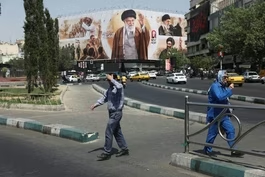
U.S. launches more strikes, tightens naval blockade as Iran hits Gulf allies (3m 15s)
Providing Support for PBS.org
Learn Moreabout PBS online sponsorship New Episode
- News and Public Affairs

Today's top journalists discuss Washington's current political events and public affairs.

- News and Public Affairs

FRONTLINE is investigative journalism that questions, explains and changes our world.
 New Episode
 New Episode
 New Episode
 New Episode
 New Episode
 New Episode
 New Episode
 New Episode
 New Episode
Support for PBS provided by:
Major corporate funding for the PBS News Hour is provided by BDO, BNSF, Consumer Cellular, American Cruise Lines, and Raymond James. Funding for the PBS NewsHour Weekend is provided by...