
Capitol View | March 12, 2026
3/12/2026 | 26m 46sVideo has Closed Captions
Jeff Williams host this week’s top stories with analysis from Dan Petrella and Jason Piscia.
Jeff Williams host this week’s top stories with analysis from Dan Petrella with the Chicago Tribune and Jason Piscia from University of Illinois, Springfield.
Problems playing video? | Closed Captioning Feedback
Problems playing video? | Closed Captioning Feedback
CapitolView is a local public television program presented by WSIU
CapitolView is a production of WSIU Public Broadcasting.
Capitol View | March 12, 2026
3/12/2026 | 26m 46sVideo has Closed Captions
Jeff Williams host this week’s top stories with analysis from Dan Petrella with the Chicago Tribune and Jason Piscia from University of Illinois, Springfield.
Problems playing video? | Closed Captioning Feedback
How to Watch CapitolView
CapitolView is available to stream on pbs.org and the free PBS App, available on iPhone, Apple TV, Android TV, Android smartphones, Amazon Fire TV, Amazon Fire Tablet, Roku, Samsung Smart TV, and Vizio.
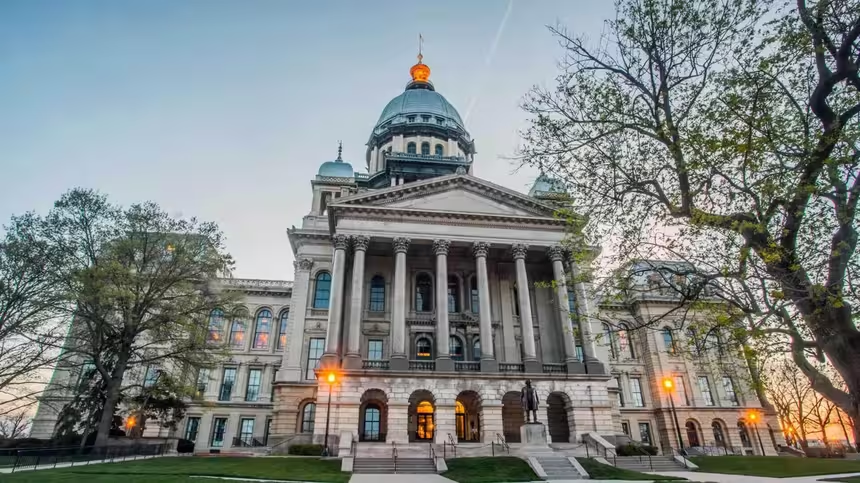
CapitolView
CapitolView is a weekly discussion of politics and government inside the Capitol, and around the state, with the Statehouse press corps. CapitolView is a production of WSIU Public Broadcasting.Providing Support for PBS.org
Learn Moreabout PBS online sponsorship[MUSIC] >> Welcome to Capitol view on sci U. I'm Jeff Williams sitting in this week as we take a look at what's making news around the state in Illinois politics.
Illinois's March primary election is less than a week away.
We'll check in on some of the top ticket races in the state.
Also, another legislative deadline is coming up in the Illinois Senate as the spring legislative session rolls along.
We'll take a closer look at those stories, and I'm sure a few more this week on Capitol View to help lead our discussion.
Our Dan Petrella, political writer for the Chicago Tribune, and Jason Piscia, director of the public affairs reporting program at the University of Illinois, Springfield, and a former state House reporter.
Welcome back to the program.
Good to see you both today.
>> Good to be here.
>> All right.
Well, Illinois's March 17th Primary election is on Tuesday, and if my mailbox or your mailbox is any indication, all these last minute campaigns are in in high gear.
Um, earlier this week, the Democratic candidates, or at least the leading Democratic candidates vying for the nomination for the open U.S.
Senate seat that, uh, is Dick Durbin when he is retiring.
They met in their final debate before the election.
It was hosted by WttW Chicago tonight.
Uh, Dan, I believe you you covered that debate.
How would you assess the candidates in their final public performance leading up to the election?
>> Yes.
It was very interesting because I was there for the first one they did back in February, I believe it was.
And I was there for this final one.
And, uh, um, they very much, uh, stuck to, to the same script throughout all of these, uh, televised, uh, forums and debates that they've done.
Um, you know, really the, um, the candidates positions on the issues are, you know, there's, there are differences among them.
You know, I'll take the issue of the minimum wage, for example, which, um, you know, they didn't actually get into very much in this debate.
But, you know, Juliana Stratton, the lieutenant governor, wants to raise $25, uh, right away.
And, uh, Congressman Raja Krishnamoorthi and Congresswoman Kelly want to raise it, but only to $17 over time.
So really, it's, it's a matter of, um, you know, differences of, of policy on some of those issues that are, um, significant, but not really necessarily substantial or don't differentiate them, you know, in extreme ways.
Um, you know, there's varying degrees about how they talk about immigration in terms of abolishing Ice or abolishing Trump's ice or dismantling the Department of Homeland Security and, and rebuilding it all.
So I think they've really kind of, um, you know, stuck to those familiar scripts throughout.
And it's really, um, amazing how much, uh, campaign finance and campaign fundraising has become an issue in this race with particularly Stratton and Krishnamoorthi attacking each other relentlessly over, uh, who's money is more, uh, linked to the Trump administration or the Maga movement and, you know, the various political action committees that are backing the candidates.
You know, Governor Pritzker has put $5 million into a super PAC that's backing Stratton.
And now Krishnamurthy's supporters are paying through ads through these other PACs.
And so it's really become a sort of a a bloody back and forth.
Um, and in the debate, you know, they got into that as well.
And, and what's been interesting is in this last week or so, Robin Kelly is really trying to, um, set herself as sort of above the fray or beside the fray and say like, look, these two are bickering about money and I just want to talk about the issues that matter to voters.
It's, you know, a little bit of a late push.
I'm not sure if it will be enough to, uh, to be decisive or swing enough voters in her way to win.
But it's an interesting strategy to see her pursuing late.
She did it in the debate Monday and then launched a TV ad that sort of, uh, did it on, on Tuesday.
So it's been very fascinating to, to watch.
>> Yeah.
As you mentioned, the three leading candidates more or less kind of staked out their ground in, in that, in that first in that first debate.
Um, and again, kind of carrying, carrying through was there.
Um, I hate to even has to ask this, but was there anything new or anything different nuanced now that we're getting, like we say on final messaging points going into the, into the primary?
>> Yeah.
You know, other than Kelly sort of, as I said, sort of trying to set herself as, as aside from this fighting about money, I think the issue of the, uh, the fairly new but ongoing war in Iran is one that was not on the table at the beginning of this race.
And I think that just goes to show in politics.
You never know what events are going to happen, what geopolitical occurrences that are going to shape the race.
Um, the discussion there was over future funding for an ongoing war.
Um, both Kelly and Stratton said in the debate that they wouldn't vote for, you know, future supplemental funding for the war in Iran.
Um, Krishnamoorthy didn't quite say that, but he also, you know, pointed to the fact that he voted for the War Powers Resolution that would have ended the fighting which was narrowly defeated in the House.
Um, and he also has called for opening the strategic petroleum reserves to, to help combat gas prices.
So that was kind of interesting, that sort of a late breaking issue in the race.
And I'm not sure when that's going to be, um, decisive for, for voters, but interesting to see how, you know, these unexpected events can, um, can work their way into the, into the discussion late in an election cycle.
>> Yeah.
And a couple other points I wanted to on this rate, just the amazing amount of money being spent.
I saw a stat I think I read in the paper this morning, um, you know, there have been more than $50 million worth of ads from the candidates themselves and PACs putting money in TV ads for this Senate race.
And as you might predict, uh, a lot of that, almost three quarters of it has been spent by Raja or Raja forces.
Uh, he's been on TV since last summer, so, uh, that makes sense.
A lot of money moving around.
And then the other point, I think that got some play this week was the fact that, uh, pro Krishnamoorthy forces have been putting money towards, uh, pro Robin Kelly adds, uh, to try to prop up her campaign.
If you look at the polls, it's Stratton and Krishnamoorthy sort of neck and neck.
Uh, Kelly is sort of third place, very solidly third place.
So, uh, the thought is there to, uh, for Krishnamoorthy to prop up Kelly's campaign a bit and maybe siphon some votes away from Stratton to, to give him an advantage.
So we'll have to see how that works out.
>> Yeah.
There's been what did I read like 15.
Was it $15 million or so spent on in this primary so far by the by those three leading Democratic candidates there.
Um, there are what seven other Democratic candidates officially in the race.
Um, have any of them made any, headway that may have any impact on on the top three.
And how the votes may may scatter on Tuesday.
>> You know, I think it's been really hard for for the others to break through just because of the amount of money that has been raised and spent by the sort of top tier candidates and their supporters.
You know, Congressman Krishnamoorthi started 2025 with $17.1 million in his Congressional Campaign Fund before he declared his intention to run for the Senate.
Um, the rest of the Illinois congressional delegation, the other 16 members had a combined $17.4 million at that time.
Um, which just shows you, you know, the amount of money that he was stockpiling for this race.
And he's gone on to, to raise a total of, I believe it is 30.5 million.
He's the second highest fundraising federal candidate anywhere in the country.
Uh, that's on the ballot this year.
So it's really hard, you know, when you have that and then you have a two term lieutenant governor who's backed by her billionaire, two time running mate for folks to really break through and, uh, and get, you know, attention to voters.
I mean, it'll be interesting to see if, you know, anybody, uh, pulls, you know, in the high single digits or anything like that and really affects the outcome.
Um, I'm not sure that that's going to happen, but, you know, any, any votes that go to one of those other candidates is a vote that doesn't go to one of the top three.
So it could, depending on, um, you know, whether there's any significant share that goes, any of those folks affect the outcome.
>> Um, on the, on the GOP side, there are six candidates vying for the nomination at this point.
Uh, either Dan or Jason are former Republican Party chair Don Tracy and Chicago attorney Gene Evans.
Would they be considered the frontrunners in the on the Republican side of of this ticket?
>> You know, I would I would think so.
There's not been a lot of, uh, good polling really in, in either of these races, but, um, you know, Tracy has, has some name recognition, like you said, from, uh, you know, running for, for statewide office before, for, from being especially in a primary, from being chair of the Republican Party.
Um, you know, he was a chair that was, uh, not retained by, by folks within the Illinois Republican Party.
He was sort of ousted a couple of years ago.
So it'll be interesting to see whether voters in the primary are willing to support him.
Um, whoever comes out on top.
The other side is going to have a very difficult road ahead, um, in the general election, obviously with Illinois being a still an overwhelmingly blue state and obviously, uh, whichever one of these candidates on the Democratic side wins is going to have a lot of resources at their disposal to, to run a general election campaign as well.
>> Um, you touched on a little bit earlier, but there seems like there is, um, a large amount of, I guess, what they call other money being spent on these races, either not directly given to the candidates, but, but spent, uh, on, on behalf of them.
Is this.
normal to see in a in a primary election, in this this, this day and age?
>> I think so.
I mean, with, you know, with the super PACs that are out there, you know, sort of asserting their own voice into the political process, um, you know, as you know, we have the citizens, Citizens United Supreme Court decision from some years back that, uh, you know, where the, the court equated money with speech and, and allowed, you know, took all spending limits off superPACs from being able to spend as much as they want on these on these races.
Um, there's a rule in there that these superPACs can't formally coordinate with the candidates on, on what they're going to say.
Um, but still, uh, the voters themselves don't differentiate, I think between when the candidate has an ad saying something about him or herself.
And if there's a superPAC out there saying something about the candidate.
Uh, so they, the, the voter just sees lots of speech happening about, about politics and, uh, it can become, you know, overwhelming a bit with the amount of it.
But, uh, it's definitely a trend that's moving toward, uh, toward that just because there's, there's no limits on, on, on how much those superPACs can spend.
>> Yeah.
And that idea of coordination is really interesting too, because there's this trend of what's called red boxing, where candidates will put basically a set of instructions on their campaign websites to tell their superPAC supporters, these are the points we want to hit.
These are the talking points we want you to use.
And then you see in the case of Stratton, um, you know, her superPAC is largely funded by the governor, run by, uh, political operatives and spokespeople associated with the governor.
You see the governor one day standing with the lieutenant governor, uh, taking questions from reporters at a, at a state event endorsing her candidacy, talking about how he wants everybody to support her.
And the next day appearing in a commercial paid for and produced by that superPAC supporting her.
So, you know, these lines of coordination are very blurry, and I'm not suggesting anything untoward happened there.
I think it just goes to show.
Um, you know how how murky this whole world of super PAC spending is in this post-citizens united world that Jason was talking about.
>> Yeah, the another one of the top ticket races is the Republican nomination for governor.
There are four candidates vying for the GOP nomination.
Former state Senator Darren Bailey, businessman Ted Dombrowski of DuPage County Sheriff James Mendrick and businessman Rick Heitner.
Um, Bailey Dabrowski have recently been on kind of a barnstorming tour of of Southern Illinois in this in this final stretch headed into the into the primary.
I wonder, I wonder, has Dabrowski done enough to raise his profile downstate?
And has Bailey done enough to be welcome or raise his profile in in the suburbs?
>> Yeah, I think, uh, I've seen a lot of.
I live downstate, obviously in Springfield.
I've seen a lot of Dabrowski ads on my TV lately?
Not so much.
Darren Bailey adds Darren Bailey from the outset said, you know, realize that one reason he lost four years ago is he didn't connect with Chicago as well as he should have.
Uh, and he sort of made a pact there at the beginning of this campaign to get into Chicago more and connect with those voters.
He picked a running mate that from the suburbs to hope to connect to that area better.
Um, I read a story, uh, in the last few days about how, you know, his travel records show from his campaign that he really hasn't done the, uh, you know, wasn't in-person in Chicago as much as maybe he thought he should have been.
Um, so there's that issue.
And then, uh, you know, Dabrowski has, um, like I said, been on TV a lot here, although, uh, I noticed his TV ads are really focusing on the suburbs.
He's hit Bailey hard, noting that, uh, basically saying Bailey is unelectable to people in the suburbs.
So that if Republicans want a chance to beat JB Pritzker in the fall, they're going to need to elect him.
Uh, just because, uh, Bailey is, uh, can't get the job done, as was evidenced four years ago, according to him.
So, um, a lot of, you know, suburb versus downstate versus city play in this race, uh, and we'll see how it turns out.
>> Yeah.
And, you know, I think the appeals that that Bailey is trying to make in the Chicago area are going to matter much more if he gets to the general election than maybe they are going to be.
They're going to in a in a GOP primary, you know, um, four years ago, he won pretty handily, I think at a six person, uh, gubernatorial primary field on the Republican side.
And the mayor of Aurora, which is a large suburb, second largest city in the state, was, was one of the other candidates on the ballot.
So, um, you know, Bailey, I think goes into it with built in name recognition from having been the nominee before.
And I think that's what you see.
Um, you know, Dabrowski fighting against, you see some former Bailey backers, uh, you know, have have switched over to Dabrowski and are trying to make the argument that Jason is saying that he doesn't have, you know, the appeal to folks up here in the northeast corner of the state to win in a general election.
But, um, you know, we'll see how Republican primary voters feel about it.
I think, um, you know, the two of them are sort of the ones really duking it out at the top.
And, um, you know, I think, uh, Dabrowski, you know, despite the fact that he has done ads and, and been campaigning all over the state, still doesn't have the level of name recognition, uh, even among Republican primary voters that, that Bailey has from being a high profile lawmaker and then the previous nominee.
>> Yeah.
Dan, do the other two candidates have, have, I would assume would have a little more name recognition in the northern part of the, of the state?
>> You know.
>> I would think that folks in DuPage County, um, have, have, uh, familiarity with Sheriff Mendrick, but neither he nor Heinrich have really run much of a robust campaign.
You know, it's, um, got into the game very late.
Montjuic was actually the first one, I think, to declare his candidacy, but neither of them have really run the um.
You know, the type of campaign that I would think would be necessary to win in a statewide primary.
Um voters may surprise us.
They, they sometimes do.
Um, but, you know, I think, um, you know, my colleague Rick Pearson had a story in the paper this past Sunday about just the lack of big money on the Republican side, which is kind of a contrast to what we're talking about in the, in the US Senate race.
But, um, you know, four years ago, we saw $50 million from Ken Griffin backing Richard Irvin in the GOP primary.
We saw money from, uh, Richard Uihlein, uh, that was helping Bailey.
And we're not really seeing any of that this time around.
So it'll be interesting to see, uh, you know, I doubt we'll see a flood of money from, from any of those big donors.
Um, and it'll be interesting to see if any of them or others like them line up behind whoever the nominee is on March 18th.
>> Yeah, yeah.
>> I will note as much as I'm seeing Dubrovsky as down here, I'm seeing just as many, if not more ads for JB Pritzker himself.
He's already looking ahead to the fall election and sort of skipping over, you know, this whole primary.
Obviously he can since he's unopposed in the primary, but he's already, you know, setting the stage for his accomplishments as governor and and how he can help for another four years potentially if he, if he does all four years.
>> Yeah.
One of the other races I wanted to touch on, it seems that the race for the Democratic nomination for state Comptroller is heating up at least a little bit.
State Representative Margaret Crook has been endorsed by the governor, while outgoing Comptroller Susana Mendoza has endorsed Lake County Treasurer Holly Kim.
And then also in the mix are State Senator Karina Villa and State Representative Stephanie Keiffer.
With either one of you, what's your assessment of this race headed into the into the primary?
>> You know, this is a.
>> Really interesting one.
And I think Villa just got sort of a little bit of a head scratching endorsement from us Senator Bernie Sanders, uh, within the last few days, which is I'm not quite sure, um, why, why Bernie is interested in who signs the checks here in the state of Illinois.
But, um, you know, it's, this is one of the more interesting races on the ballot as well, an office that doesn't get a lot of attention.
And as we've seen from, uh, Mendoza and her predecessor, uh, not her immediate predecessor, but one of her predecessors, Judy Baar Topinka, you really have to work hard to get attention when you're the state comptroller.
Um, and, you know, getting folks to pay attention to this race for this relatively, um, you know, obscure office is, is challenging, but it's one, you know, it's a statewide office.
It's been a platform for, for folks in the past to seek other higher offices further down the line.
So, um, you know, it'll be interesting to see whether the Pritzker endorsement and backing helps Croke or whether, you know, folks are concerned about, um, you know, the governor sort of, uh, picking his people for, for all these various offices when you see him backing Stratton for the Senate and Croke for the, for the comptroller's office.
Um, and there's been a little bit of a um, a frosty at times relationship I think between Pritzker and Mendoza.
So it'll be interesting to see how that plays out in the minds of voters and their various supporters within this broader Democratic Party in Illinois.
>> Yeah.
And with an office like controller where I think maybe the average citizen maybe doesn't fully understand what the controller is or does or what it's for.
You know, I think a lot of it comes down to name recognition and money and TV exposure.
And, uh, at least again, down here in downstate Illinois.
Margaret Croak has had a lot of, uh, television exposure thanks to all the support she's getting from the Pritzker campaign.
Um, but I do think it's interesting, um, you know, the current comptroller, Susana Mendoza, has, uh, endorsed Lake County Treasurer Holly Kim.
Uh, Pritzker has made his endorsement.
And then, you know, the Bernie Sanders endorsement as well.
Uh, so, you know, we have sort of these Democratic heavyweights, medium weights, uh, you know, all picking different people, which I think is, is, you know, good for democracy to sort of not force one person down everyone's throat.
So we'll see where it goes.
>> Yeah, really interesting.
>> To, you know, seeing as you lay out those endorsements, sort of a breadth of the, the spectrum of the Democratic coalition from Mendoza, who's sort of tacked toward the center or the right as she prepares for a possible run for for Chicago mayor.
And then Pritzker, who's sort of that, uh, left, center left, uh, progressive, but moderate on some things kind of category.
And then you have Bernie Sanders, obviously, who's sort of in the left flank of the party there, too.
>> Sure.
Well, one thing I wanted to one thing I wanted to touch on early voting is, is underway in Illinois.
And obviously voting on on primary day on, on Tuesday.
Um, Jason, if people are still interested in doing early voting, maybe a little primer on, on how this works.
Can, can they still do it?
>> Yeah.
Early voting, which is going in person, most likely to your county clerk's office or county building, uh, to vote early before election Day is still a possibility.
Uh, many of the county clerk's office will be open this weekend for extended hours.
So check the State Board of Elections website or your county website for the the hours on that.
And you can go vote if you don't want to worry about getting it done on Tuesday.
Um, it looks like, you know, according to the state Board of elections, about 167,000 people already have voted early.
Uh, that's a fraction of the 8.3 million active registered voters in Illinois, but still still a significant number.
Uh, and then there's, you know, mail in option as well.
Uh, I believe the ability to request a mail in ballot, uh, is expiring or has expired.
Uh, but if you do have a mail in ballot sitting on your kitchen counter, uh, it's been advised.
Uh, there's been some news conferences this past week advised to get that in the mail as soon as possible.
There's been some postal changes over the past several months to where there may be a delay from the time you drop the ballot in the mailbox, and it gets postmarked by the post office.
It needs to be postmarked by Election Day in order for it to be counted.
So you don't want to get caught of, you know, the postmark happening a day after Election Day.
And again, according to the state Board of Elections stats, about three quarters of a million ballots have been requested by mail, and about a quarter million have been returned.
So there's still about a half a million mail in ballots still floating around out there.
So we'll see how many of those actually come back in over the next few weeks.
>> And I believe for.
>> Folks who are concerned about those postmarking issues, you can, um, if you decide you don't want to mail in your ballot, take it to your polling place on election day and, and surrender that to the election judges and request a ballot to vote in person.
>> Sure.
In the three and a half or so minutes that we've got left, I wanted to just touch on the legislative session still obviously going on.
One of the major, um, deadlines is coming up this week in the Senate to get major bills out of, out of committee.
Uh, I know we've talked before about the real work is going to kick up after the primary.
But as we kind of sitting and looking at the at what's going on right now, um, anything of note to, to keep an eye on in the next coming weeks here after we get out of the election?
>> Very little, uh, you know, they've been, they've been having some committees, they've been canceling a lot of committees and trying to move some bills through, as you mentioned, there's a, the Senate's in this week, the House is not.
And the Senate has a deadline this week to get bills moved out of committee.
Uh, but, you know, just remember those deadlines don't mean much.
If lawmakers do want to get something passed after the deadline, they definitely can do it by, you know, taking one of the bills that's been passed through committee and ripping all the contents out of it and replacing it with the language that they want for whatever they want to pass and can move the, the, the proposal through that way.
Um, so yeah, we're and again, we expect action to pick up once people get their minds off the primary election and sort of get back to work of putting together a budget and, you know, getting out of here on time for the May 31st legislative deadline.
>> Yeah.
Dan, anything in particular you're keeping an eye on?
>> Yeah, I was.
>> Going to say like, like Jason said, these these deadlines are somewhat arbitrary.
I think really sometimes it's more of a member management tool on the, on the part of the leaders to, um, you know, when there's individual legislators who have initiatives to, to get them to work their bills early and try to get them, uh, you know, uh, out of, out of the committee so that there's less of a logjam at the end of the session, but there's always a logjam at the end of the session.
Uh, so really the main thing I'm watching and people are probably sick of hearing about this topic is what happens with the, uh, the legislation related to the property tax changes that the Chicago Bears are seeking, this mega projects development bill that passed out of a House committee a couple weeks ago.
And, um, is, you know, still under discussion and debate.
And I'm sure we'll be one of the major topics, uh, probably much to the chagrin of folks in the rest of the state.
Uh, as, as we move forward through the rest of the legislative session.
>> Yeah.
Is there is there more pressure now that Indiana, the state of Indiana has taken some of the action, preliminary steps that it's taken to try and attract the team across the border?
>> You know, I think so.
>> And I think that was a part of the bears calculus there.
I do think there's also some resentment that's been drummed up among some folks, especially key Chicago lawmakers, whose votes they need to pass anything in Springfield about the way that was all handled.
>> Yeah.
And I just think it's interesting how quickly it all moved.
I mean, for for months, uh, the bears said they wanted money and the Pritzker administration and others were like, no, no, thank you.
We're not interested.
And then as soon as Indiana entered the fray, that whole dynamic changed very quickly.
And now we see sort of Illinois getting on its horse and and trying to make things work.
>> All right, gentlemen, we are out of time for this week's edition of Capitol View.
Dan Petrella with the Chicago Tribune.
And Jason Piscia, director of the public affairs Reporting program at the University of Illinois, Springfield.
Thank you both for joining us this week.
And I'm Jeff Williams.
Thank you for watching Capital View this week.
Remind you to go out and vote.
Have a good week.
[MUSIC] [MUSIC]

- News and Public Affairs

Top journalists deliver compelling original analysis of the hour's headlines.

- News and Public Affairs

FRONTLINE is investigative journalism that questions, explains and changes our world.












Support for PBS provided by:
CapitolView is a local public television program presented by WSIU
CapitolView is a production of WSIU Public Broadcasting.