
Capitol View | June 4, 2026
6/5/2026 | 26m 46sVideo has Closed Captions
Jeff Williams host this week’s top stories with analysis from John Jackson and Jeremy Gorner.
Jeff Williams host this week’s top stories with analysis from John Jackson of the Paul Simon Public Policy Institute and Jeremy Gorner of the Chicago Tribune.
Problems playing video? | Closed Captioning Feedback
Problems playing video? | Closed Captioning Feedback
CapitolView is a local public television program presented by WSIU
CapitolView is a production of WSIU Public Broadcasting.
Capitol View | June 4, 2026
6/5/2026 | 26m 46sVideo has Closed Captions
Jeff Williams host this week’s top stories with analysis from John Jackson of the Paul Simon Public Policy Institute and Jeremy Gorner of the Chicago Tribune.
Problems playing video? | Closed Captioning Feedback
Where to Watch CapitolView
CapitolView is available to stream on pbs.org and the PBS app.
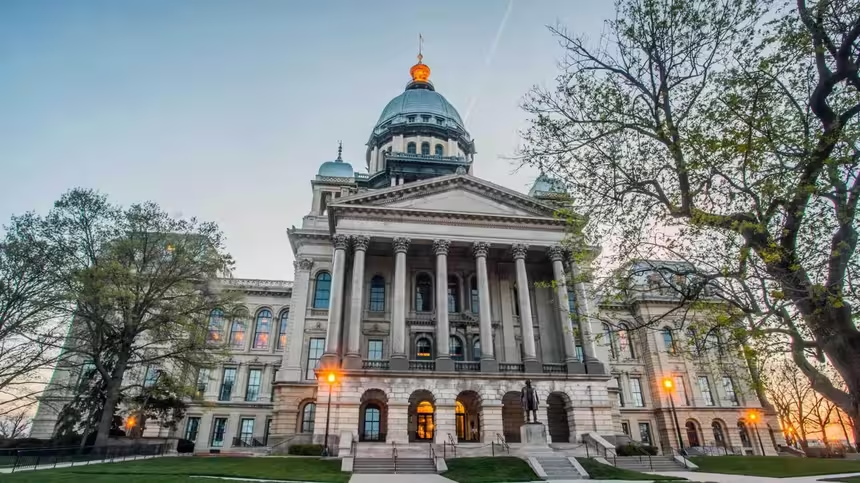
CapitolView
CapitolView is a weekly discussion of politics and government inside the Capitol, and around the state, with the Statehouse press corps. CapitolView is a production of WSIU Public Broadcasting.Providing Support for PBS.org
Learn Moreabout PBS online sponsorship[MUSIC] >> Welcome to capital view on WSIU.
I'm Jeff Williams sitting in this week as we take a look at what's making news around the state in Illinois politics.
At the top of the News feed this week, the conclusion of Illinois's spring legislative session, we'll take a closer look at what passed, what didn't, and what still may be in progress, and likely some other topics as well.
To help lead our discussion this week are John Jackson, visiting professor with the Paul Simon Public Policy Institute.
John, joining us in the studio today, and Jeremy Gorner, state Capitol reporter for the Chicago Tribune.
Gentlemen, welcome back to the program.
>> Glad to join you.
>> Jeremy.
I hope you've managed to get some sleep since the end of the session early Monday morning.
>> A little bit, I think I'm recovered or I'm on the mend.
>> Okay.
Obviously, there's a lot to a lot to unpack.
The good news is that the state does have a budget, about a $56 billion spending plan.
There were several significant bills that did make it through to the governor's desk.
And we'll take a closer look at those here, here shortly.
But first, I'd like to take a look at one of the major bills this session that it drew a lot of attention.
It took up a lot of legislative energy, but in the 11th hour it just wasn't quite ready for prime time.
And that's the Megaprojects Chicago Bears incentive bill.
Jeremy, I know a version of it passed the House.
There were some issues in the Senate.
And then what?
Basically the clock kind of ran out on an 11th hour attempt.
So where do things stand now?
>> Well, so the House has its version of the bill that it passed, like you just mentioned, Jeff.
And that was in April and the Senate passed its version, um, which is completely different than the House version.
So neither side could come to an agreement.
So basically what that means is that there is no resolution.
And, um, you know, you know, legislative leaders had said that this is something that, um, they'll work on over the summer, um, for fall veto session as of now, doesn't look like there would be a special session.
You never know.
Um, but what it does, um, you know, but what this does, because there was no resolution to, um, whether the legislature would incentivize a bears move, you know, away from soldier Field, but within the state of Illinois, um, northwest Indiana is in play, as you know.
Um, you know, the bears organization, um, they were, they've said publicly they've been considering two locations all along Arlington Heights, um, in the suburbs of Chicago and, um, Hammond, Indiana, which is just over the border from Illinois.
Um, you know, and the bears have also said that they would make a decision by late spring or early summer.
Well, here we are, I mean, it is late spring.
Early summer.
Um, I, I know that there is some concern among people involved in this process in Springfield that, you know, because there's no resolution, the bears just might choose Indiana.
But, you know, it's also a never say never type thing.
I mean, there's also an attitude that, um, because, um, because, you know, you have two plans in place that have, um, the mega projects planned that passed the house and then a separate plan by the Senate that would, that would allow municipalities with 70,000 or more people, which would, um, in Cook County, um, you know, to, to, to create its own stadium authority to go over financing.
And, you know, the municipalities would go over financing and construction and whatnot so that the team wouldn't have to pay property taxes.
That's also on the table.
So they got two plans that they're trying to mull over.
It doesn't look like the mega projects plan, though, from the house is going to go anywhere.
Um, that was a real sticking point for senators, particularly from the city of Chicago.
They did not want to incentivize, um, the bears to move out of the city limits, as you know, a sizable percentage of Chicago legislators.
Um, you know, comprised the Senate and the House, you know, and their votes are needed to pass a lot of, um, big ticket legislation.
But with this, um, but with the legislation that came out of the Senate, um, when you talk about towns that are over 7000 people, you're talking about Arlington Heights, but you're also talking about Chicago.
So because, um, you know, so because you have Chicago in play, all of a sudden, you know, to be, you know, for the to be an option for the bears to stay put the way the legislators see it.
That's why they voted this, um, bill out of the Senate.
But again, we'll see what the bears do.
We don't know if they agree with this plan that came out of the Senate about the stadium authority.
Um, you know, you know, because like we said, they've they've said it's two options all along.
Arlington Heights and Hammond.
Um, will the, will the bears be patient enough to wait until maybe veto session to see if the bears actually, um, or to see if the legislature actually passes a plan through the House and Senate, um, to incentivize, you know, their construction of a new stadium.
We'll see.
But so far they've said that an announcement would come late spring, early summer.
So yeah, that could come soon.
>> It seems when this debate has come up in the past in terms of getting incentives for the Bears or Chicago sports teams, the mayor and the governor have been on the same page.
It doesn't seem like the mayor and the governor have been on the same page with this one.
>> No.
And I think, um, so so the governor has argued the the governor has argued look, you know, the bears are a corporation.
They're a big business.
It's not unusual for the state of Illinois to give big business, you know, some kind of incentive or tax breaks.
But we're talking about a couple billion dollars here, um, for, um, a billionaire football team.
And when you have a sizable percentage of the House and Senate who are progressive Democrats from the city of Chicago, you know, we're, you know, this isn't 1988 when the legislature voted on incentives to give the Chicago White Sox to stay in Chicago to build a new Comiskey Park.
You know, nowadays, progressive Democrats just don't have an appetite for giving a multibillion dollar sports team, um, tax breaks at a time when affordability has really been an issue for Democrats and Republicans.
I mean, you know, when you talk about health care costs, when you talk about costs for education, just cost of living, gas prices, this is something that the legislature is is really worried about.
>> Yeah, yeah.
John, from a from a 30,000 zero foot view.
And looking at the state of Illinois talking about big incentive plans like this.
Are there implications that need to be considered for for municipalities and other places down downstate that are outside of that immediate area that need to be considered?
>> Well, downstate is always a player in this, but I want to talk a little bit about the process rather than the product.
And the process, I think was chaotic at the end.
And this bears thing really emphasized it more than anything else.
What we've accomplished this term has been, in my estimation, incremental and not revolutionary by any stretch.
Governor Pritzker said consistently that his emphasis was on fiscal responsibility and another balanced budget his eighth, he claims, and there is some support for that because he's got nine.
I think it is credit upgrades by the New York Bond houses.
He tried revolutionary on the budgetary front with the attempt to do a graduated income tax, and that was, I think, comparable to Ogilvy changing us to the income tax to begin with.
In 196869, this is not inconsequential, but taxes that are there, as I understand it, are taxes on social media, fantasy sports and crypto currency transactions.
And those are important, but not at all revolutionary.
And the chaotic ending, I think, is due to some things that are 300 zero feet, but worth noting.
All of this is indicative of how deeply divided the Democrats are.
Never mind the Republicans, because you've got Progressives versus pragmatic or more moderate.
You've got Chicago Central City sometimes versus the suburbs and always northeast Illinois versus downstate.
And, uh, they couldn't even agree on getting to work the same week.
I mean, the president of the Senate and the speaker of the House had their their group in on different weeks.
Uh, Miller wrote a really good column on this recently.
And I agree entirely with Rich that, uh, that's so basic to the legislative process.
Uh, it used to be worse in some ways that is sitting here at the university, we wouldn't get a budget often until way into July, which is bad for getting the fall budget in place.
That's because they had June 30th in mind, which was then.
So they backed it up and now you get the same drill.
Even worse, this time for May 31st.
They know from the governor's state of the Union and the budget address that he gave all along, and he pretty much stuck with that.
And he stuck with.
I'm going to give the bears help with infrastructure, but nothing else.
My conclusion is this does not reflect well on the legislative process in Illinois.
It does not help people's confidence in the legislative process.
And never mind the Congress, which is a total mess.
And we look really organized compared to the US Congress.
They still don't have a budget for Homeland Security, and it's well into way over in the fiscal year.
So only in comparison with the Congress, does the Illinois legislature look that good right now in my estimation.
Editorial comment.
>> Well, in the in the wee hours of of Monday morning.
John.
The General Assembly did approve the FY 27 state budget, about $56 billion or so.
I think it's one of the largest, if not the largest budget in state history.
Jeremy, help unpack some of this.
What are some of the major points that that are in this spending plan?
>> Well, one of the things they put in there was, um, you know, a digital, a tax on digital advertising.
I mean, that's something that progressives really had pushed for.
Um, whether it's something that's going to immediately work its way into the budget, um, I think remains to be seen.
Um, there's been legal issues with such a plan.
It's been tried before, I believe in a couple other states.
Um, but it's also part of this progressive revenue, this so-called progressive revenue push that we've been seeing play out in the last couple of years.
Um, in Springfield where you have, um, you have a group of progressive lawmakers who have, you know, been talking about raising money in the state budget for, um, more social services at a time where there's uncertainty coming out of Washington as to whether the Trump administration Hoare just to what degree they're going to cut off Illinois from federal funding.
Um, you know, obviously the one big, beautiful bill act that, um, Trump championed last year, uh, there's going to be cuts to Snap benefits.
There's going to be cut, you know, there's, that's, that's been starting to shape up already cuts to Medicaid, the Medicaid cuts are, you know, really going to, um, I think Illinoisans are really going to feel that, you know, starting next year, I've been told by one of the budget negotiators here in Springfield.
Um, so state state government has had to act.
And, you know, so, um, they were a little more so lawmakers and Pritzker were a little more accommodating to, um, you know, instituting some of this progressive revenue.
And moderates, you know, are or pragmatic.
Um, Democrats, as John talked about, also kind of joined the fray in that regard.
But, um, some of the highlight, but to get to some of the highlights, um, you know, Democrats are creating like a $70 million program to direct food assistance to, to residents who were booted from, um, you know, the Snap program because of new work requirements, for example.
Um, these would be like, you know, one time payments of $400 automatically going to people who lost, you know, their benefits because of these new federal work requirements.
Um, there's also as far as like, um, you know, there was some money that was diverted into the general revenue fund, um, from, uh, from sales tax on gasoline.
Um, I believe it was, um, $200 million in new, uh, and there's also $200 million in new revenue on a per user tax on large social media companies.
There's, um, $300 million from extending a cap on corporate deductions for operating losses on state taxes and about $60 million.
So currency brokers.
Um, and then, um, there's also, um, there was also talk that, um, a lot of concerns from, um, Mayor Brandon Johnson in Chicago and other mayors around Illinois that, um, that municipalities would see a smaller share of, um, of income taxes from the state that they get every year.
It's called the local government distributive fund.
Basically, these municipalities use a pool of state money to pay for services for their municipalities.
And it used to be 10% during the the Quinn year during the Governor Quinn's years, but that's down to 6.47%.
Um, and the state and Governor Pritzker wanted to lower that to 6.28%, but he did not do that.
Um, it's still 6.47%.
So, um, it didn't get worse for these municipalities.
Um, and then there's also a six month pause on the inflation based increase of a separate gas tax.
Um, so, so there's been some, you know, there's been some tax relief, but also more taxes, um, like newer taxes coming into this budget kind of as, as a balance.
And, um, so Pritzker is, you know, likely going to use, you know, this as part of his, you know, campaign for a third term.
You know, he obviously has aspirations for president and he wants to show that with a budget like this, um, depending on how people, you know, there's obviously Republicans who disagree, but he feels like, um, budget wise, Illinois is in a much better place than they were when he took office in 2019.
And you know, that he's going to probably use that argument by pointing to some of what he believes are successes in this budget.
>> Yeah.
So just looking through here, I think the K through 12 budget 10.8 billion.
So they got I guess about what they wanted.
And they did fully fund the evidence based funding formula there.
And I think higher ed got what about a 1% increase.
>> So yeah, higher Ed's a little.
Yeah.
So the higher ed thing I think is pretty status quo.
Um, as you probably know, and I'm sure it's been talked about on this show, there's been a move.
So you talked about the $350 million increase for the evidence based funding formula for K through 12 education.
So there's a movement in Springfield to do to try to do the same thing for higher education, um, especially for some of these regional universities like John, like John and I have talked about this issue, like at Siu, Carbondale and Edwards, you know, and Siu Edwardsville, uh, particularly like Western Illinois University, Eastern Illinois University are seeing, um, are hurting when it comes to, um, you know, when it comes to money that, you know, they're, they would be entitled to under a so-called college F formula if it were to happen.
So we've seen higher education advocates really try to push for this formula, and it just has not happened.
So as a as an alternative, you're seeing like the 1% increase in funding, you know, for these colleges and universities, which really doesn't amount to much when you think about it because of the economic times we're in and inflation.
So that's why these colleges and universities have really been pushing for more.
>> Yeah.
>> Can I just.
>> I mean, you've you've been around the university budgets for a long time, a long time.
>> I wanted to mention I've spoken to John about this.
I know he has opinions.
>> Is there, is there is there a need for this and how do you think it would work?
>> Oh, I think there's a need for it.
And I think it would work.
Well, as the bill stands, it's it's really modeled on what we've done for K through 12 and the outlines the same thing.
The arguments are the same and we've shown already that you can do this.
And the template is what the universities have adopted.
Just briefly, this is a part of Illinois's long disinvestment in higher education, starting with Blagojevich and all the way through Rauner, the state decreased or failed to live up to anything like the budget process needed to produce for the universities.
Not much different from K through 12.
They fixed that finally.
But now universities are saying we want the same thing.
What we did was when I came here, there was more than 70% of the.
Of the budget at the University's general fund provided by the state.
Now it's under 30 at least, maybe even around 20, but it's very low now.
And what we did, we made up with it with increases I always increasing in the tuition and the fees.
And now the legislators and the governor and everybody else doesn't like that.
So we've had to raise more money in other ways, like in the endowment and foundation raising and all of that.
But still, all of the universities save the U of I, I think were on board all of us, others, we're the regionals, we're the Directionals, but the U of I is the U of I champagne, the U of I, Chicago and the U of I Springfield.
They used to get half the budget big numbers and we'd get the rest.
And that's how you would get the second part.
And we'd do okay, probably 10% of what was left.
But in order to stop all of that, this is what the new plan is.
Senator, former Senator Dillard had an article in our local paper just last week in favor of this.
So it's going to come back around, but it's got to be something that the University of Illinois signs off on.
I don't think there's any doubt about that.
And they would never they haven't been willing to sign off on this, so far as I understand it.
>> As I understand them.
Jeremy, you can correct me.
This is kind of an expensive process.
I've heard anywhere from 135 to $180 million annually on top of the regular, on top of the regular IBC budget.
Is there a funding mechanism for this, or is it just one of those things, like with K through 12, we just got to do it because it needs to be done.
>> So I got to say, like I covered this issue last summer and as of last summer, there was no funding mechanism for this.
I would imagine not a lot has changed since then, although it seemed like there was more of a promising movement to get something passed.
So yeah, I mean, that's, that's, you know, something that obviously needs to be hashed out in any legislation.
Um, because yeah, I mean, that's a lot of money.
I mean, it's, um, um, you know, but, but at the same time, I, you know, a lot of these, um, you know, advocates, um, feel like the clock is ticking because they're seeing more and more college bound high school graduates going to school out of state, I guess more so than the last 20, 25 years.
And, um, you're seeing, um, you know, I know that the Pritzker administration has liked to tout that, you know, there's been an increase in enrollment in these universities, in these public universities in the last couple of years.
I mean, we're talking, you know, maybe single digit percentages, but in the last 20, 25 years, it's not the case.
I mean, if you look at just how enrollments dwindled so drastically at these institutions because of a lot of, you know, just because of the economic hardships we've seen in Illinois and around the country in the last two decades.
So now you're trying, you know, to put in 135 to 180, like you said, million a year.
On top of that, it's no easy feat.
And I think it kind of explains a lot, especially in the economic times we're in with the state that the economy is in.
That's why we didn't see any kind of, um, college version of the F formula advanced this spring.
>> Yeah, yeah.
We've got about, uh, about four minutes or so left.
I want to shift our focus just a bit.
Um, last week, the mayor of Chicago, Brandon Johnson, and a delegation of Chicago area leaders met with Pope Leo the 14th at the Vatican.
John, I know you've observed this story with with interest.
This was obviously a significant event not only for the city of Chicago, but also for the state.
>> Well, we've been on a bummer run for so far right now, but I do want to say something positive as we close.
And this is a great story for Illinois and for Chicago.
And it took a unique historic event to make it happen.
That is the naming of an American pope and him being from the South Side of Chicago.
And it's a great story for everybody.
And to his credit, the mayor of Chicago decided to take advantage of it.
He took a delegation to visit the Vatican and to visit with Pope Leo from the South Side.
Got lots of publicity, lots of good ink.
The gifts even became an issue because they had White Sox and Cubs baseball caps that they took, among other things.
I do want to add, though not as well publicized, was there was a role model where Brad Cole and the Illinois Municipal League organized an earlier one.
And yeah, former mayor of Carbondale, now IMF CEO, he took a group out in last of March, 1st of April.
They had a private meeting with the Pope.
They carried him presents and they went to mass, and that basically set the way and you put the two together.
We've really gone out of our way as a state and the city of Chicago saying, Leo is one of us.
It's been a great advantage to have him.
The only ones that weren't happy about it was Donald Trump.
And I don't think the delegation had gotten back to Chicago before Trump was on social media condemning the pope and condemning the mayor of Chicago.
And he threw in JB Pritzker for a shot.
And he just went on about how they should not be practicing foreign policy, and the Pope should just shut his mouth.
The Pope's been pretty cool, I'd have to say, about how he's handled the constant barrage from the president.
He's emphasized basic Catholic teaching about peace, about how you treat the poor, about how you treat immigrants.
And that's the way he responded.
So I think overall, we have a moral compass there because of an American pope that really is historic and that the city and the state can be proud of.
And I just think it's one of those things where, uh, Brad Kohl's delegation and the mayor's delegation did everything right, all the formalities and all of the ceremonial, and it rebounds to the credit of the city and the state, in my estimation.
Mhm.
>> Well, John, I'll let you have the last word.
We are once again out of time for this edition of Capital View.
John Jackson with the Public Policy or Paul Simon, Public Policy Institute, and Jeremy Gordon.
Wait a minute.
Pulitzer Prize winning Jeremy Gorner of the Chicago Tribune.
>> And the Tribune with the Tribune.
>> Thank you.
Thank you both for for joining us today.
>> Thanks, John.
>> And thank you for tuning in to this edition of Capital View on WSIU stations.
I'm Jeff Williams.
Make it a great week.
[MUSIC] [MUSIC]
 New Episode
- News and Public Affairs

Top journalists deliver compelling original analysis of the hour's headlines.

- News and Public Affairs

FRONTLINE is investigative journalism that questions, explains and changes our world.
 New Episode
 New Episode
 New Episode
 New Episode
 New Episode
 New Episode
 New Episode


 New Episode
Support for PBS provided by:
CapitolView is a local public television program presented by WSIU
CapitolView is a production of WSIU Public Broadcasting.