
Capitol View | June 18, 2026
6/18/2026 | 26m 46sVideo has Closed Captions
Jeff Williams host this week’s top stories with analysis from Hannah Meisel and Mawa Iqbal.
Jeff Williams host this week’s top stories with analysis from Hannah Meisel of Capitol News Illinois and Mawa Iqbal of WBEZ.
Problems playing video? | Closed Captioning Feedback
Problems playing video? | Closed Captioning Feedback
CapitolView is a local public television program presented by WSIU
CapitolView is a production of WSIU Public Broadcasting.
Capitol View | June 18, 2026
6/18/2026 | 26m 46sVideo has Closed Captions
Jeff Williams host this week’s top stories with analysis from Hannah Meisel of Capitol News Illinois and Mawa Iqbal of WBEZ.
Problems playing video? | Closed Captioning Feedback
Where to Watch CapitolView
CapitolView is available to stream on pbs.org and the PBS app.
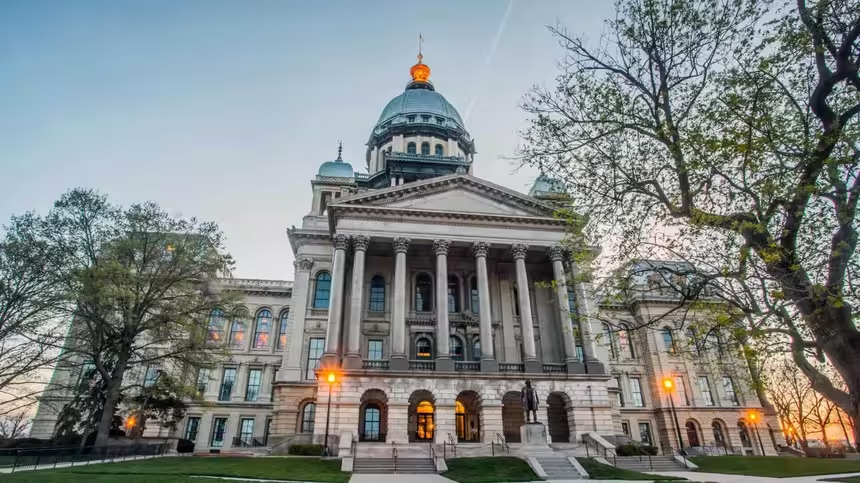
CapitolView
CapitolView is a weekly discussion of politics and government inside the Capitol, and around the state, with the Statehouse press corps. CapitolView is a production of WSIU Public Broadcasting.Providing Support for PBS.org
Learn Moreabout PBS online sponsorship[MUSIC] >> Welcome to capital view on.
See you.
I'm Jeff Williams sitting in this week as we take a look at what's making news around the state in Illinois politics.
At the top of the news feed this week, governor JB Pritzker signed the state's $56 billion fiscal year 27 state budget, the largest budget in Illinois history.
We'll take a closer look at it, along with some other news out of the state capital.
And to help lead the discussion this week are Hanna Meisel, State House in Chicago, reporter for Capitol News Illinois, and Mawa Iqbal state House reporter for WBEZ and for our Illinois public radio stations.
Welcome back to the program.
>> Thanks for having us.
Thanks for having us.
>> All right.
Well, the the governor signed the budget on Tuesday of this week.
It goes into effect on obviously on July 1st.
$55.9 billion and some change, some I think 3700 pages or so.
Obviously, the governor and Democratic lawmakers are touting it as a as a balanced budget that supports, according to the governor's office, working families, how it provides housing support, food assistance, tax relief, investments in health care, along with fully funding K through 12 and expanding the Map program or the monetary award program for Illinois College students.
As you might imagine, Republicans, on the other hand, have decried this as another kind of bloated budget with $800 million or so in new taxes, primarily aimed at businesses such as social media platforms, sports betting, prediction markets.
And I think decoupling from the federal tax breaks, making the cost of living, in their opinion, worse for Illinois citizens.
Obviously, everyone has a different perspective on this.
Either one of you help us, help us unpack this budget that's been signed and is now, I guess, the largest in state history.
>> Yeah.
Like you mentioned, it's a $56 billion budget.
And it's something that a lot of lawmakers have been saying throughout the spring legislative session was that this was going to be a pretty tough budget year.
Just given that inflation is increasing the cost of many things including medical supplies and medical services, is a big reason, but also just the fact that, you know, we have a federal administration that is passing a lot of different economic policies that are affecting Illinois's fiscal outlook, right?
So that could be anything from tariffs to, you know, some of the funding cuts that that President Trump has, has suggested implementing, um, in response to various policies that Illinois is enacting usually around immigration.
Um, but so, you know, like lawmakers and Democratic leaders in Springfield have long said that this will be a very tight budget.
We're going to be cinching our belts when it comes to spending.
And it is what it is, right?
Like that, that it's definitely a very tight, um, spending budget.
Right.
So so the state does commit to funding the F model, which for those who don't know, that's the public school funding model that lawmakers passed, uh, actually over ten years or about ten years ago.
Um, essentially targeting schools that are the most underfunded.
And it commits to that, that same dollar amount that it has been committing to the past ten years.
There's also they've created this new program.
It's called, um, like the fresh program.
And basically, if you or someone who's been kicked off snap, um, which is the federal program for people who need food assistance, then you can apply for this one time sort of emergency fund, and it's about $400 per family.
Um, they've also paused the escalation, the inflation escalation on the sales tax, on the gas tax.
Um, so, you know, the Pritzker has said that this is an answer, a response to the fact that gas prices are continuing to rise.
You know, much of that is due to this this war that President Trump and Israel have launched in Iran.
And so it's, um, you know, there's quite a few things in there that that are new as well.
So, so like you said, there's also, um, some new taxes on social media platforms.
And then lawmakers have also created a framework for, um, in the future.
You know, uh, taxing prediction markets.
So, uh, services like call she, but also, um, like digital ads and the reason why they haven't actually put a mechanism into tax it now or like, like instituting new tax on them now is because those, um, two taxing methods are still being litigated in court in other parts of the country.
So lawmakers have said that once, you know, the court comes back with the final decision on that, if they rule in our favor of being able to tax prediction markets and digital ads, then we will have this framework.
Now that's in this budget to actually institute these taxes.
Um, there's also a tax holiday for those who are looking to go back to school and do some back to school shopping in August.
So there's quite a few things in there.
But, but definitely the, the overall theme is that, you know, it's getting pretty hard for people to live, right.
And, and especially for the state of Illinois to, to keep funding some of these programs.
It's, it's going to continue to get harder just given what's been happening at the federal level.
>> And this is also it goes along with, um, Democrats nationally, um, you know, trying to, uh, be on the same page in terms of messaging, in terms of affordability.
Um, of course, uh, in 2024, um, we were still suffering from pretty record inflation back in 2022.
And, um, Republicans were able to, um, hammer home this message that, you know, Democrats are out of touch and it was all about the economy.
And of course, you know, elections are never simple, especially, um, presidential elections.
But, uh, and so, you know, there's, there's many factors that were at play in 2024.
However, uh, Democrats are really trying, um, you know, in this midterm election cycle to hammer home on this message of affordability and say, you know, look, look how Republicans, particularly President Trump, has betrayed that message by, uh, implementing tariffs, um, you know, at almost every country on earth, although, you know, at this current moment, um, the tariffs are kind of all over the place.
And of course, um, you know, launching in conjunction with Israel, this war in Iran that has not only caused gas prices to jump significantly, uh, but also, uh, you know, there's going to be coming affordability, um, uh, Uh, concerns, uh, later in the year.
I mean, like things like, uh, fertilizer, uh, in that critical spring planting season has been backed up in the Strait of Hormuz.
And, uh, you know, people are very concerned about food prices rising as a result of farmers not being able to plant as many crops as they normally would.
Um, and we also have, uh, you know, a administration that has been extremely friendly to artificial intelligence companies.
And, um, you know, these AI companies have been able to kind of, um, uh, get these large contracts with, um, you know, computer chip companies and as a result, and, you know, all of these things going toward building AI infrastructure.
And as a result, consumer electronics, computers, phones, everything that requires computer chips, which is, you know, almost everything these days.
Um, ah, you know, we are already seeing prices rise on things like laptop.
I listened to a New York Times Wirecutter podcast yesterday that highlighted just how, uh, expensive laptops have already gotten.
And of course, you know, if you're heading back to school or, you know, if you're maybe starting college in the fall or if you're starting a new job and, you know, maybe if you're, uh, you know, you lead a company and you need to buy a whole new kind of set of computers for your workers, uh, that's going to cost you.
And so like I said, Democrats are trying to hammer home, uh, hammer home this message of affordability.
Um, and, you know, these are very, very small things, uh, you know, pausing the gas tax.
Um, I think back in 22, 2022, we also might have done a pause on the sales tax for like back to school shopping.
Um, it's small things, but, um, if it allows Democrats to get a sound bite.
Uh, they believe it might help.
>> Yeah.
One of the things that's in this budget is the 3.2% annual pay increase for state lawmakers and state elected officials.
And at least for our downstate Republicans.
I think that was in every one of their news releases after the governor signed the budget, that they allowed this to happen.
But my understanding is that unless the legislature acts, that's that's an automatic thing tied to the tied to the cost of living.
How exactly does that that function.
>> That's correct.
Every year this becomes an issue.
Um, you know, for many years lawmakers, um, had blocked that automatic pay increase.
Um, it's just a function of how, um, you know, basically the, uh, language in the Constitution works.
Um, and, you know, lawmakers have been strategic about when they do or do not allow it to go forward.
Um, again, it becomes an issue every year.
Um, should they have maybe paused it this year.
Not really for me to say uh, it might have been uh, better on their message of affordability, but yeah, I mean, it's not like they are approving for themselves a raise, but, you know, if we ever do get a new constitutional convention, our new, uh, our next opportunity to do that is in 2028, then maybe people might consider, uh, a new sort of framework because again, it becomes an issue that, uh, it's kind of an albatross around people's necks every year.
And also like, we have to write dumb stories about it every single year.
>> Republican leader that definitely, um, I want to say it was leader Ryan Spain during a committee hearing, was asking the Budgeteers when they were presenting the the budget proposal.
Like, what will you will you choose to strike or pause this, um, this salary increase while many of our constituents are struggling with affordability, right?
So struggling to pay, you know, their gas prices, struggling, struggling to pay at the pump, at the grocery stores, you know, and getting priced out of their homes.
And the Budgeteers didn't really have a good answer to that.
I don't think they were willing to consider that at all.
But it definitely did become a talking point for a lot of Republican lawmakers.
>> Yeah, we've had some of the talked about some of the things that are that are in this plan.
Is there anything that stands out in your mind that that did not get into this, this budget plan that either may be revisited in the veto session or, or something that maybe they just may need to try again in, in the upcoming upcoming sessions.
>> You know, it's interesting.
The, um, so actually, what did get into the budget plan that was not part of the governor's proposal.
So the governor had proposed a cut to the LGDF, which is the local Government distributed fund.
And, um, I'm sure many of our viewers know that towards the end of the session, uh, I want to say probably in the last few weeks, there was this large contingent of mayors and local leaders that came down to Springfield essentially to lobby against that cut.
Right.
Saying that this is definitely needed for local governments at a time when property taxes are so high for people, you know, we're talking about people being priced out of their homes and people having to pay such exorbitantly high property taxes.
The LDF will help keep some of those taxes down.
Um, and so, you know, they, they definitely did their, did their thing.
They worked the hallways, they had a press conference, they talked to the lawmakers and they were able to get the LDF funding restored for, for this year.
But, um, I definitely, you know, one of the messages that a lot of the mayors were talking about when they came down in Springfield was that LDF funding has been cut from the state for a while now, or it has been minimal.
And so this is this is kind of like an ongoing battle with, with the, with the municipalities in the state.
And, and, you know, Illinois is such a unique state in that regard, where we do have many, many, many, many municipalities and townships and villages and counties.
So the political power that local leaders have in Illinois is pretty, pretty strong, especially when you consider the fact that a lot of state lawmakers started from local government to.
Right.
They have these local government backgrounds.
>> Sure, sure.
Uh, obviously this this, this time of year, there a lot of, of new laws and regulations that, that, that take effect on July 1st.
That's, that's just around, around the corner.
Um, from this session, the new things that are even from previous sessions, new things that what's taking effect on, on, on July 1st force that we all need to be aware of.
>> I will point out two from previous sessions that are taking effect.
Uh, actually, I think before July 1st on the, uh, this first one, uh, the, uh, regional Transit Authority, uh, which runs Metro regional trains, um, Chicago Transit Authority trains and buses and pace, which runs suburban buses.
Um, as viewers might recall, there was basically like two years of angst about like, what are we going to do?
Uh, we have this transit funding cliff.
And as part of the deal that passed during, uh, I believe it was veto session, um, back in the fall, um, there was a transformation to the, uh.
Which, uh, at this very moment.
I'm so sorry.
I am not recalling the exact, uh, acronym that stands with Amal.
Can you help me out here?
>> I think it's, uh, the Northern Illinois Transit Authority.
>> Uh, okay.
Yes, the Northern Illinois Transit Authority.
Um, and, you know, one of the knocks on the, you know, various proposals, uh, especially from the previous RTA, uh, was like, you know, you're asking for this money, but you're not willing to be reformed.
And, you know, the RTA, particularly Metra in the past has been, um, the source of, you know, some irresponsible spending, uh, you know, back in, I think it was 2014, there was a bit of a hiring scandal at Metra also.
Uh, and so, um, you know, RTA becomes an ITA and they are restructuring.
It's not, it's not an immediate thing, but, um, it's something to watch for.
And the other thing is that, uh, this, uh, assisted suicide, although this is not, of course, the preferred term for advocates medical aid in dying.
Uh, that was, um, a law that passed, uh, in 2025 that is set to go into effect, however, within the last week, um, there was a federal lawsuit, uh, launched to try to stop the, uh, stop its implementation.
Um, you know, just as a refresher for viewers.
Um, you know, Illinois is far from the first state to do this, you know, back, uh, you know, years ago, Oregon.
And then I think California joined, um, to allow this medical aid in dying.
Um, but, you know, for, especially for people who are, you know, terminally sick with cancer or other, you know, horrific diseases.
Um, but there, of course, uh, were some opponents, um, you know, such as religious groups, but also, um, groups that represent people with disabilities who worry that, you know, people with disabilities might be either, you know, talked into something or their families might be talked into something.
Um, or they're going to, you know, sign something that they don't understand to basically end their life without fully understanding, um, or, you know, being fully informed of what their options are or, you know, being kind of misled as to, um, you know, what their quality of life could be, um, you know, under different treatment that they don't currently have access to.
So I thought those two were very interesting.
But yes, plenty of new laws that actually did pass this year.
I'll pass the buck to Mala on those.
>> Yeah.
Yeah.
There were a couple.
The one.
>> Oh yes.
Um I was just going to say that, that the one um new law that passed this session that definitely stood out, which I think um, you know, I visited my, my parents up in the Chicago suburbs, uh, this past weekend and, and their neighborhood, we saw a lot of young kids riding on these motorized bicycles, right?
That, that go really, really fast in residential streets.
And, you know, my parents were telling me that, that they've, these, these children have been getting pulled over by the police because their, their are bikes there.
E-bikes are going at such high speeds that that is actually creating a safety risk on the roads.
So lawmakers this session passed a framework which was actually pushed by Alexi Giannoulias, Secretary of State office, where essentially it would like create new, like, I guess, safety frameworks for, for different e-bikes, like depending on like how high of a speed they can get to just kind of, you know, addressing some of the, the, the incidents that we've seen, you know, the Giannoulias was talking about how there have been some deaths as well in Illinois with young children or just people riding on these motorized scooters and bikes and getting into accidents and like injuring themselves and even in the worst cases, passing away.
And so the this law will seek to address that.
There's also, um, a new law that's going into effect that would, um, speaking of driving to, um, that would make it basically end discrimination for older drivers.
So right now or back before July 1st, right.
So currently Illinois, um, requires that if you reach a certain age, you have to take your driver's test again, if you want to renew your license, you also have to take vision tests and other tests.
And so, um, this law would essentially eliminate the need for an age based, um, system, right.
And it would only go off of like how skilled you are as a driver versus like how old you are.
Um, and yeah, but those are the two that come to mind as far as the most significant ones going into effect.
>> I wanted to, um, shift our focus just a little bit in time that we, that we've got left.
The U.S.
Attorney's office in the Northern District has, has been in the spotlight of late, most recently with the with the Broadview six, those six protesters who were indicted by a federal grand jury on conspiracy and assault charges related to a demonstration last September outside of the ice processing facility there in Broadview.
More or less, the cases has collapsed in the past month or so because of prosecutorial misconduct and some other odds ins.
Hannah, I know you've been been following these cases and trials throughout the last few months.
Kind of bring us up to speed on, on, on this one.
>> That's right.
Like you said, this case basically collapsed in very dramatic fashion.
Uh, just a few days before, uh, the remaining four defendants because two were released from, uh, you know, all the charges were dropped on them.
Uh, in March, they were set to go to trial.
Um, you know, the on the remaining misdemeanor counts.
Now, um, back in, I think it was late April.
Um, prosecutors in a surprise move, dropped the, uh, felony conspiracy charge.
So all that was left was, were these misdemeanor charges, which were basically like, um, simple assault of a federal officer, which does not actually require any physical contact with that officer.
Basically, what, uh, you know, this is all about is in late September, like you said, um, when a few weeks into Operation Midway Blitz and the ice processing facility in, uh, Chicago's near west suburb of Broadview was the epicenter of protests.
Um, early on a Friday morning, uh, people were out there protesting and this ice, uh, basically SUV drove through the crowd at very low rate of speed.
And the protesters gathered around the vehicle and tried to, you know, stop it.
Pushed on its windows, banged on the windows.
Um, there was damage to the vehicle, allegedly.
Um, but, uh, there's no one specific, uh, alleged to have done that, uh, because there was just a crowd of, you know, basically a hundred plus people.
Now, these six people were picked out from the crowd.
The U.S.
Attorney's Office says that it was because they were the, you know, most recognizable, uh, according to the video.
Um, but they also happen to be, um, local elected officials, um, uh, and candidates, um, you know, and Democratic activists, um, including, uh, former second congressional, um candidate Abu Ghazala, who was of course the most recognizable of the six.
And, um, you know, so what happened was, um, we now know that in late April, um, the judge had asked for unredacted transcripts from the grand jury to see what went on.
Um, and, you know, these grand jury transcripts, the grand jury process in general is extremely secretive.
and usually it's extremely, extremely rare for a grand jury transcripts to ever, you know, be seen by a judge or defense, let alone the public, which is what has happened.
Um, and it's because what was revealed in there was, um, three types of prosecutorial misconduct, at least three types, um, uh, by a veteran prosecutor who had been with the office for nearly 20 years.
Um, and, you know, basically it was like, you know, I wouldn't bring these charges unless they were serious.
And it was, you know, uh, talking to grand jurors outside the grand jury room, which is a huge no no.
And, um, also dismissing grand jurors who disagreed with the government's case.
And we have now seen that in, like I said, the transcripts that have become public.
Um, and this was instead of, um, you know, Having the judge see those transcripts.
Um, it became clear to those inside the U.S.
Attorney's Office.
Um, U.S.
Attorney Andrew Boutros, uh, in particular that this had gone on.
And so he, uh, authorized the dropping of that felony conspiracy charge.
And then, you know, later in May, when those four were meant to go to trial, um, the judge finally did take a look herself at the, um, at the grand jury transcripts.
She saw what was in there, and she called off the whole trial.
And then Andrew Boutros himself, in a very, very rare move, went in to the courtroom and, um, and said, you know, we're dropping all of the charges.
Basically the case is over, but the case is not actually over because there is, you know, a whole, um, you know, kind of second life to it, um, wherein the former defendants are pushing to get, you know, um, more things, um, uh, made public.
And just last night as we were filming this on Wednesday morning, uh, the former defendants have filed to, uh, have the appointment of a special prosecutor in this case to investigate and possibly, um, you know, charge the, uh, prosecutors who were involved in this, uh, with wrongdoing.
So this has a very, very long life.
It also has ripple effects across the country.
For example, in Minnesota in January, um, former CNN journalist Don lemon and other, uh, you know, had followed protesters inside a church in, I believe, Saint Paul.
Um, when, uh, you know, Ice and Border Patrol activity was at its peak there.
And, uh, they were charged with a conspiracy there.
And, uh, attorneys in that case cited the Broadview case.
Uh, you know, basically to say, release these grand jury transcripts for now.
That has been blocked.
But suffice it to say, this is huge.
Um, and it's not going anywhere.
>> All right.
Well, Hannah, we'll let you have the, the have the last word as we're out of time for this edition of Capital View.
Hannah Meisel with Capitol News Illinois and Mawa Iqbal at WBEZ.
Thank you both for joining us this week.
>> Thank you.
>> Thank you.
>> And thank you at home for tuning in to Capital View on the WSIU stations.
I'm Jeff Williams.
Have a good week.
[MUSIC]
 New Episode
- News and Public Affairs

Top journalists deliver compelling original analysis of the hour's headlines.

- News and Public Affairs

FRONTLINE is investigative journalism that questions, explains and changes our world.
 New Episode
 New Episode
 New Episode
 New Episode
 New Episode
 New Episode
 New Episode
 New Episode
 New Episode
Support for PBS provided by:
CapitolView is a local public television program presented by WSIU
CapitolView is a production of WSIU Public Broadcasting.