
Capitol View | July 9, 2026
7/9/2026 | 26m 46sVideo has Closed Captions
Brian Sapp host this week’s top stories with analysis from Charlie Wheeler and John Jackson.
Brian Sapp host this week’s top stories with analysis from Charlie Wheeler from the University of Illinois, Springfield and John Jackson from the Paul Simon Public Policy Institute at SIUC.
Problems playing video? | Closed Captioning Feedback
Problems playing video? | Closed Captioning Feedback
CapitolView is a local public television program presented by WSIU
CapitolView is a production of WSIU Public Broadcasting.
Capitol View | July 9, 2026
7/9/2026 | 26m 46sVideo has Closed Captions
Brian Sapp host this week’s top stories with analysis from Charlie Wheeler from the University of Illinois, Springfield and John Jackson from the Paul Simon Public Policy Institute at SIUC.
Problems playing video? | Closed Captioning Feedback
Where to Watch CapitolView
CapitolView is available to stream on pbs.org and the PBS app.
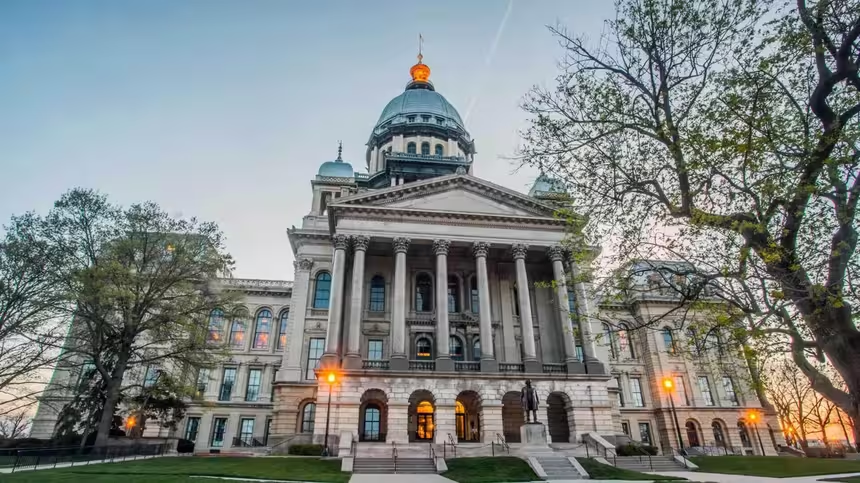
CapitolView
CapitolView is a weekly discussion of politics and government inside the Capitol, and around the state, with the Statehouse press corps. CapitolView is a production of WSIU Public Broadcasting.Providing Support for PBS.org
Learn Moreabout PBS online sponsorship[MUSIC] >> Welcome to the capital view on WSIU.
I'm Brian Sapp.
This week the nation is celebrating 250 years since the signing of the Declaration of Independence.
We'll talk with our guests about the celebration and Illinois's role in our democracy nationally.
We'll also talk about Illinois steps into regulation of AI, as well as the resignation of Harry Harry Benton last week.
Joining us this week to talk about these issues is Charlie Wheeler.
He's the emeritus director of public affairs reporting program at the University of Illinois, Springfield.
And here in the studio with me is John Jackson, the visiting professor for Paul Simon, Public Policy Institute.
Charlie and John, welcome to the program.
>> Thank you for having me.
>> So we'll start with you, Charlie.
We're just going to have a little bit of some topical stuff.
And then we're going to get into talking about this 250 year celebration.
First this week, uh, seems to be everywhere.
Everybody's talking about AI.
The legislature passed this spring a bill on AI, and the governor signed it this week.
Can you give us a little bit of background of the bill that the governor signed?
>> Yeah.
This is it's been described as the most stringent regulation in the in the whole country, uh, mostly because other states have tried to put guardrails around AI.
Mega developers like OpenAI, anthropic.
But we go a step further in that we would require annual independent audits of these operators, which other states have not done.
Mhm.
And it requires these, what are called large frontier developers, those that generate at least 500 million in yearly revenue, uh, to create, publish, and adhere to safety plans to stave off dangerous uses of the rapidly advancing platforms.
According to the legislation, they have to lay out how they're going to mitigate, quote, catastrophic risk resulting from AI, anything that could contribute to the death or serious injury of anyone.
And they have to report dangerous situations almost immediately to the state.
And if they don't, they face million dollar penalties.
And this was supported by by some of the leading AI, uh, operations because they want to have guardrails in place themselves.
And they testified in favor of this.
This law passed with basically almost unanimously the vote in the House was 111 to nothing, and in the Senate it was 52 to 5.
Five Republicans voted against it because they I guess they didn't want to halt innovation, but it's go to.
Well, the law is effective January 1st this year, but all the requirements for the developing the catastrophic plans, etc., and the independent audits, they'll take effect in a year from now.
>> Okay.
And I think that was one of the things I just wanted to touch on a little bit.
Lots of people are talking about AI data centers and all of that.
And even before we were talking, we talked about how something that I thought is new Google, we talk about Google.
Now when you Google something, you get those AI answers.
And I found it interesting that it was a bipartisan vote and that the AI companies were asking for some of these guardrails as they were trying to look forward to innovation.
So thanks for the update on that.
And I think we'll just have to kind of keep an eye and see what these reports look like.
And if there's even a national framework that's developed.
>> You mentioned that.
And in my case, in doing research, one of the things I wanted to know was what was the population of Illinois in 1970?
And I figured, okay, I've got a collection of blue books.
I could go back and look for it, but I googled it and AI gave me the answer.
And it also gave me half a dozen places that I could go to find out for myself.
And I found it was easier to to rely on Google saying this was Illinois's population.
And back in 1970, rather than go to the Census Bureau website and dig through all their stuff.
So I guess I'm kind of adapting to it also.
>> Yeah, we all are.
And as you say that, you talk about it previously, you would get some of the citations and the resources, but I this is what I appreciate about this innovation and how it's growing.
It adapts and you get to see the changes as they they evolve.
And adding those citations is a new thing.
And I think that helps people have questions about the veracity of AI.
I think that was one of the concerns.
So hopefully, yeah, hopefully things like this can help us, you know, keep pushing forward and find a way to make it work for us, I think would be the big thing that people want.
So we're going to move on now.
As I said, July 4th, the nation celebrated the signing of the Declaration of Independence.
This week we're celebrating more because 250 years ago, the rest of the nation was beginning to hear this declaration and what that meant.
We have John Jackson here, and he's going to talk to us a little bit about this, John, as I think the Declaration of Independence is considered the birth date of our country.
Is that right?
>> Yeah.
This is the celebration of Mr.
Jefferson's document and the, declaration that we are free and that we will be our own self-governing nation.
Uh, and he talked about the, uh, charges against the crown and against monarchy.
And he asserted that we have the right to self-government.
And that, of course, has been our position ever since.
Uh, and the potential for self-government by colonies like this was unprecedented at the time.
And I think to put it in context, it's worth the celebration of the bicentennial in 1976.
I remember it pretty clearly because at that point, I'd been teaching political science, the American presidency, and that sort of thing for seven years.
And I remember clearly the tall ships in the harbor, in the area around the Statue of Liberty and how they then sailed up.
I guess it's the Hudson River.
What a spectacular sight that was.
And I also saw that repeated in the coverage of the New York celebration this year.
So there was continuity.
And on the positive side, I think New York and a lot of other cities celebrated somewhat like they did in 19 in 1976.
Uh, I think the difference, however, was, um, we had a celebration then that included, uh, CBS news and they had the celebration of the centennial minute with Walter Cronkite.
Now there's a towering figure in the media from the past, and they talked about things that were to celebrate we should be proud of.
It was a unifying minute every night on the news.
So that was kind of neat and always very positive, and none of it was ever partisan.
None of it was ever, uh, sort of negative.
And I think the split screen of the celebrations in that day on the fourth between the pictures coming out of New York and the pictures coming out of Washington are really telling and really, uh, very important for us to take that difference because the celebration in Washington was chaotic.
It was, uh, clearly the divisions within us these days were very much on display.
And the weather obviously added to how chaotic it was.
But I think for comparison, go back to 1976 and who was president, and that was Gerald Ford.
And Gerald Ford was a low key, nice guy, never planned to be president in the first place.
He's happy in the House, but he got picked to be vice president.
And then, of course, Watergate came along.
Nixon was forced to resign.
And there's an important note about that.
Nixon was forced to resign over the crimes of Watergate because Hugh Scott, who was the minority leader for the Republicans, and Barry Goldwater, who was Mr.
Conservative and had been the standard bearer back when Barry Goldwater ran against Lyndon Johnson, went down to the Oval Office and told Richard Nixon that if he didn't resign, that he would be impeached, and that his base of support after the tapes were revealed had dissipated and Nixon resigned the next day.
Today, that would never happen.
And today, uh, Watergate would be pales in comparison.
I don't join the vice president in much.
I think it would have been more than a one news cycle.
But nevertheless, the difference is, is remarkable.
We're much more polarized today, especially at the elite level and especially at the leadership level, especially at the presidential level, especially at the Congress and the party level.
Uh, we had two parties and they were very partisan back in those days.
But, uh, there were limits to their partisanship.
And there were liberal Republicans, moderate Republicans, conservative Democrats, moderate Democrats, not much of that anymore.
In fact, the middle has shrunk to very, very few in that moderate middle.
And the polarization is evident there.
The other thing that's changing is what political scientists like to call regime level or system level norms.
What are the norms among people and especially among the political leadership class that we have to have to have a to have a real democracy?
And they start at the top with respect for the outcome of the elections.
We have totally undermined that respect for the elections.
We're still going on about 2016 and 2020.
And what happened then?
The other thing, the polls show the respect for the other party.
Uh, you just don't hear much of that anymore.
You hear them about two operatively condemned as being communists or Nazis or whatever.
And the upshot of that was it was very difficult to it is now very difficult to get compromised to move legislation, and that shows in the legislation, there's very little of it coming out of Congress this time or the last session.
And the one that came out that was bipartisan was the housing bill, and Trump threw them a curve on that when they thought they had that all nailed down.
But it wasn't his his law.
And it's not clear at all if it will become law or if it will become law without his signature.
So that's just typical of how badly we have drifted into legislative chaos in the Congress.
So the pivotal figure in all of this, clearly, Donald Trump, he's dominated American politics and world politics for that matter, but particularly domestic politics since 2015, which is now 11 years ago.
And we can all remember in our mind's eye, he came down the golden or at least gold plated escalator in Trump Tower.
He declared his his candidacy, and there were 17 other Republicans running.
And I confidently thought, whoever it's going to be, it won't be Donald Trump.
Well, I was wrong.
And, uh, now, obviously so were a lot of other people, but I certainly got that one wrong.
Never run for office, never held office, and not all that interested in politics for a long time.
I taught the presidency for a long time, and what he has done is absolutely different from in kind, almost, of how much power he has pulled to the presidency.
He has followed the playbook on what's called unitary, a unitary executive.
His attorney general from the first term, Barr wrote a letter to the editor when he was campaigning for the AG position, talking about how the president and the executive branch have got to be the first branch.
They've got to run the government, they've got to do all they can to dominate the government.
Separation of child, of powers and checks and balances have been massively changed in the equation and in the balance.
Some things that are mostly gone now, for example, are the whole question of what the Republican Party will do, if anything, to rein in the power of the presidency even occasionally, and 1 or 2 times the Supreme Court reining them in.
But, for example, the emoluments clause is totally dead letter law.
Now, the president and his family have made whatever it is, 404, is it 400 billion or whatever they have now decided he's made just the time he's been in, and they've got that decision that let Trump negotiate with Trump about what his powers would be in spending the money that comes off of that decision.
And there's the whole question of whether or not it will be a slush fund.
All of that's up in the air.
And so the Congress is mostly out of the picture now, but not entirely.
And the courts are a mixed bag just starting at the bottom.
The district courts have had a number of courageous decisions against the president.
And I'd say it's about half and half at the district court.
But at the appellate court level, uh, it's maybe half and half.
But the appellate courts have leaned toward supporting the president, because the appellate court knows that there is a Supreme Court out there, and the Supreme Court, with a six three margin, has really dominated on behalf of the president.
Uh, Supreme Court has trimmed back the powers of the president, most recently in the birth citizenship case, uh, in, in the, uh, the whole question of, uh, putting taxes on incoming goods and what power he had over that.
And that is about the two biggest ones.
If you take something like redistricting, for example, they've come down heavily in very partisan directions over number one, decimating, uh, the, the original 1964 Civil Rights Act and especially 65 Voting Rights Act and the court again and again, the six three majority has found for the president.
And those redistricting things, of course, are relevant to the upcoming, uh, the upcoming elections.
And that still got to be put into place.
But, uh, on other things, the, the whole question of the war powers, for example, which is very relevant now with respect to Iran.
Mhm.
All of that is not dead letter, but close to it.
Other presidents I should have added is other presidents have helped undermine the War Powers Act.
Donald Trump took it to a whole new level, though, in his contempt for Congress and the question of the Iranian question.
And that, of course, goes on and on.
There's another round.
I guess we're out of the era of the They cease fire and we're back into bombing them, and they're back into bombing us over the last day or so.
But other interest groups, for example, that could be guardrails.
Big institutions like big businesses have mostly caved in to the president.
Mainstream media, ABC, CBS, NBC have had to kowtow to the president.
He sued 2 or 3 times and won mostly, and I might add, very importantly, he sued because he's got the FCC on his side, and especially the chairman of the FCC, which is a whole new ball game in terms of the independent regulatory agencies, which that decision last week basically knocked the props out of anything independent about the independent regulatory agencies, with the exception of the fed.
They gave the fed independence last week, and then everybody else got reduced and got hamstrung.
So all of that has made one of the most powerful presidency.
We in the universities, especially the elite universities like Harvard and Yale.
And those folks have basically come under fire.
Much of that has resulted in universities having to tuck tail and run rather than fight in the courts forever.
Big law firms have basically kowtowed to him in a number of cases, 1 or 2 exceptions.
So there's really not a lot in the way of what we used to call guardrails left.
And the question is, will those guardrails any of them be put back?
If so, it has to come in this midterm election season.
There's a well-known pattern that the party out of power almost always wins in those midterm elections.
This time we've got the question of the House possibly going to the Democrats.
Probably likely, I would say.
And then you've got the Senate.
Very tough right there for the Democrats.
And if they don't get at least the House, the Democrats are not going to be relevant for the next two years.
And Donald Trump will have a clear sailing for his last two years.
If they get the House, there will be some guardrails go back up.
So in summary, this is a referendum on Donald Trump and how he's conducted his presidency.
>> Yeah, I think we'll see how that turns out in November and nationwide.
Charlie, I wanted to wrap up for the last few minutes here.
We have a little over five and a half.
I want to spend a minute talking about Mr.
Benton.
But before then, as we're setting up, we really talked about kind of the change of Illinois.
It's gone from a purple state to a blue state.
Can you kind of talk to us a little bit about that and what you've seen covering the state?
>> Yeah, as a matter of fact, I started at the Sun-Times in 1969, and almost immediately I came down to cover the Constitutional Convention, and I covered for the next 24 years.
And so I saw a lot of these changes.
If you look at the demographics of the state, if you look at the population, U.S.
census numbers in 1970, Illinois had roughly 11.1 million people.
2020, it was 12.8.
So that was a gain of 1.7.
But the gain was if you look at the numbers, the collar counties DuPage, Kane, Lake, McHenry and will, uh, increased by 1.7 million.
So basically all the population growth in Illinois could be attributed to those suburban counties.
They more than doubled in that time.
And as a matter of fact, a couple of them, including my home county, will almost tripled, uh, their population in that time.
And so what that meant was it was an opportunity for the collar counties to get some political muscle.
Um, and the.
Changes were exacerbated, uh, by the, the growth in Hispanic population, which in some of these areas, uh, it was really, uh, pronounced.
Mhm.
And for example, in Lake County, back when I started as a reporter, it was almost, uh, all white.
Now it's a quarter black.
According to the 20 census, Waukegan has a majority.
I'm sorry.
Black, Hispanic, while Keegan has a majority Hispanic, uh, Kane County.
Elgin is 49% Hispanic.
Aurora 42%.
And these have enabled the Democrats to make inroads that they couldn't make before.
Maybe the most significant thing, though, was when the.
Was in the redistricting that happened during the time I was there.
It totally changed the makeup of the Illinois legislature.
Uh, if you look at the the statistics from the 1881 legislative session to the 1971 session, that's 90 years.
Republicans controlled the Senate 85 out of those years.
The big exception was during the depression and since the election of 1970, which would have been seated in 1971, Democrats have controlled it 12 out of 36 and in the Illinois House since the election of 74, Democrats have controlled all but four years out of 52.
And one of the things that enabled us to occur, because the population number sure didn't reflect, uh, give them that advantage.
When we went to redistricting, the new constitution provided that if the legislature can't, uh, get the job done, then there will be a bipartisan commission.
And if they can't agree, then there will be an eight member commission of the ninth member chosen to be the tiebreaker.
Well, in the 1981 redistricting.
After the 1880 census, the.
It was basically impossible for the legislature to agree because that was also the time of the cutback amendment when we went from cumulative voting, which basically guaranteed a Republican and a Democrat in every legislative district.
It went to.
Single member districts in the House.
And we're going to lose 59 seats in the House.
And so what happened was it went to the commission.
Former Democratic Governor Sam Shapiro was the was the wound up in the tiebreaker?
It was a drawing.
And Jim Edgar drew Shapiro's name out of a black top hat of Abe Lincoln's.
And he drew Shapiro, and that enabled Madigan, who was the chief redistricting guy for the Dems, to gerrymander a map that wound up with the Republicans losing 38 seats in only the Democrats 21.
And so since that time, the Democrats have basically controlled, uh, redistricting.
And so the end of cumulative voting undermined bipartisan cooperation and exacerbated the regional tensions.
>> Yeah.
Well, we have to wrap it up there.
We did not get to Mr.
Benton, but he did resign after calls by Christopher Welch about some inappropriate behavior that they investigated on him.
Charlie and John, thank you for joining us.
That's it for this week's edition of Capitol View.
[MUSIC]
 New Episode
- News and Public Affairs

Top journalists deliver compelling original analysis of the hour's headlines.

- News and Public Affairs

FRONTLINE is investigative journalism that questions, explains and changes our world.
 New Episode
 New Episode
 New Episode
 New Episode
 New Episode
 New Episode
 New Episode


 New Episode
Support for PBS provided by:
CapitolView is a local public television program presented by WSIU
CapitolView is a production of WSIU Public Broadcasting.