
Capitol View | April 2, 2026
4/7/2026 | 26m 46sVideo has Closed Captions
Brian Sapp host this week’s top stories with analysis from John Jackson and Brenden Moore.
Brian Sapp host this week’s top stories with analysis from John Jackson of the Paul Simon Public Policy Institute and Brenden Moore from Capitol News Illinois.
Problems playing video? | Closed Captioning Feedback
Problems playing video? | Closed Captioning Feedback
CapitolView is a local public television program presented by WSIU
CapitolView is a production of WSIU Public Broadcasting.
Capitol View | April 2, 2026
4/7/2026 | 26m 46sVideo has Closed Captions
Brian Sapp host this week’s top stories with analysis from John Jackson of the Paul Simon Public Policy Institute and Brenden Moore from Capitol News Illinois.
Problems playing video? | Closed Captioning Feedback
How to Watch CapitolView
CapitolView is available to stream on pbs.org and the free PBS App, available on iPhone, Apple TV, Android TV, Android smartphones, Amazon Fire TV, Amazon Fire Tablet, Roku, Samsung Smart TV, and Vizio.
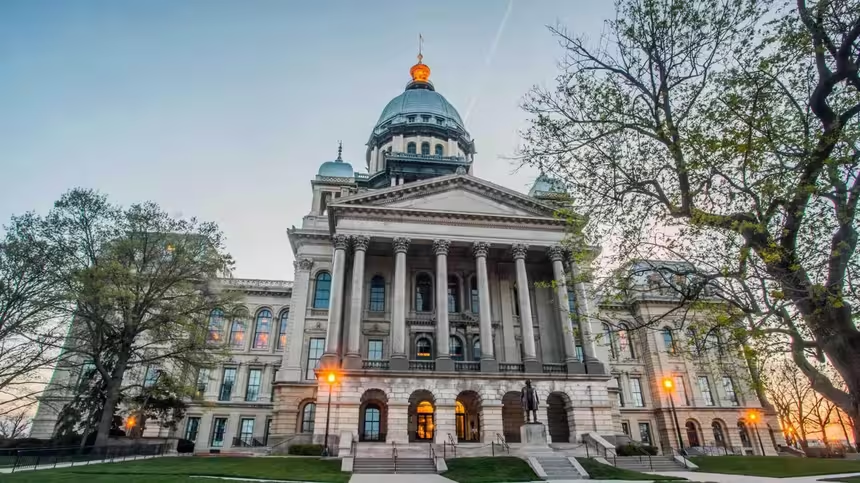
CapitolView
CapitolView is a weekly discussion of politics and government inside the Capitol, and around the state, with the Statehouse press corps. CapitolView is a production of WSIU Public Broadcasting.Providing Support for PBS.org
Learn Moreabout PBS online sponsorship[MUSIC] >> Welcome to Capital View on WSIU.
I'm Brian Sapp.
General Assembly is not in session this week.
But they did pass a flurry of bills out of committee last week.
Among the myriad of bills, they looked into funding and making some changes to Illinois's higher education programs.
We'll talk about that and the efforts of governor JB Pritzker and Chicago Mayor Brandon Johnson resisting some of the Trump administration policies are being used across the country by other communities who are looking to do the same thing.
Joining us to talk about these topics and more are John Jackson.
He's the visiting professor for the Paul Simon Public Policy Institute.
And Brendan Moore.
He's a reporter with Capitol News Illinois.
John and Brendan, welcome to the program.
Good to see you.
>> Glad to be here.
>> Good to be with you, Brian.
>> So we will start off with this past weekend, the Nose King's protest protest.
I'm sorry, this is the third one across the country to protest some of the changes and moves by the Trump administration.
Um, there were protests across the country here in Carbondale.
John and I, we saw the quite a number of protests here.
But John, let's start with you.
Can you tell us a little bit about these protests and some maybe context and what impact these could have?
>> Well, this is a remarkable phenomenon just in itself.
Uh, I drove up through the one in Carbondale and saw a big crowd.
Uh, it was estimated by the Southern Illinois in our paper that it was about 1500 here.
And of course, it was huge in the bigger cities.
Uh, invisible estimated that Chicago had, uh, 50,000.
And they also estimated that there were 300 or 3000 events, and between 8 and 9 million people turned out.
So it's become a thing in its own right.
But I want to give a larger context to it.
And the context is presidential power.
Uh, Donald Trump is clearly an easily the most powerful president in American history.
If Trump wants to start a war with Iran, he can do it.
And if he wants to go a month in a couple of days and then call it off and declare victory and go home, he can do that.
If he wants to go up to the Supreme Court and sit in on their oral argument, something that's never been done before.
Uh, and that, uh, he's doing now with respect to, uh, the birth birthright citizenship, Apparently trying to intimidate the court, I guess, is what he's up to.
But the Supreme Court doesn't need the intimidation.
They've been going with him on big, important things, most notably the presidential immunity decision.
Trump versus the US gave him the right to go out and do almost anything he wants to do.
Uh, but nevertheless, the Supreme Court has on occasion reined him in a bit, which they did with the tariffs in which they may do with this birthright citizenship.
The appellate courts have been a mixed bag, some for Trump, some against him.
District courts have had a lot of district judges going against Trump.
But the courts are still divided kind of outcome.
Uh, there's no question about the Congress because the Republican leadership.
Congress has abdicated all kinds of powers that they clearly have and clearly given up, as in tariffs or as in power to make war.
And that on war predates Trump.
But he's taken it perhaps to an extreme.
This all says that, uh, there is some resistance, uh, in the typical, uh, separation of powers and institutional sense, but the most important resistance is in public opinion and in grassroots democracy.
And that's what the no kings thing is all about, both public opinion and grassroots democracy.
But outside the Republican leadership, there has been a lot of Democratic leadership.
And Politico had a, uh, an article just this last Monday where they claim that Illinois was probably the most prominent state, giving opposition consistently to Trump.
Uh, and they gave credit to the governor and to the mayor of Chicago.
And it started with the Operation Midwife Blitz, which they pretty effectively fought with Ice.
And ultimately both the National Guard and Ice went home and went off and left Chicago, as they have, to some extent, other big cities.
They gave credit to the attorney generals, but the our attorney general, attorney generals in general on the Democratic side have filed, uh, opposition, uh, appeals or, uh, friends of the court or whatever they needed to do.
And so that's been an effective source and a really totally unprecedented source, uh, Has been coming from Pope Leo, who is an Illinois native and a South Side Chicago guy.
Mhm.
And I think people may have noticed what a steady critic of Trump and his policies.
Uh, he has been Palm Sunday week, uh, or Palm Sunday last Sunday.
Last week, he had a ringing declaration against the Iranian war as a war of choice, as a war that didn't have to be fought.
Uh, he rejected the idea that violence is a solution to any of these problems.
He's also consistently supported the immigrants and has weighed in again and again, criticizing Trump over the immigrants and over the treatment of poor and disadvantaged people in general.
Uh, so at the mass level and at some parts of the elite level, Political.
Political leadership, not exclusively because there have been some Republicans in Congress, but very few.
But in Congress and in state and local government, there are still some guardrails.
And so we're sorting out every day as it unfolds as to whether any of them will have much impact on Donald Trump's behavior.
>> Definitely.
I think we have to I think looking at, you know, the Congress and, you know, the and looking at if there you know, the Democrats are going to be able to put up enough of a fight, as we've seen with the shutdown, I think they're trying to use their tools there.
And then looking at the local level here.
Uh, Brendan, as you know, you're there in Springfield and you know, they are worrying about state issues and things like that.
There's still this move to kind of counteract some of the, um, movement by the National.
The federal government.
What were the what did you see there in Springfield with the.
No protests in in that area?
>> Pretty similar to what we saw around the country.
Obviously smaller than Chicago, smaller than Minneapolis.
But you still had over a thousand people that showed up in the capital city.
We had one of our reporters out there talking to people.
And, uh, I think they're they're really and John summed it up very well, but, uh, there, there is a, uh, a response to what many view as, as backsliding of democracy.
Uh, perhaps a rise of authoritarianism, uh, at the very least, kind of, uh, stretching the bounds of presidential power.
Um, you know, the breakdown of democratic norms.
And, and I think that, uh, as John said, uh, you know, the president, uh, perhaps the one thing that could constrain him is, is public opinion.
Um, he is not popular, uh, for, I mean, now a host of reasons the tariffs were not popular.
This war with Iran is not popular.
Uh, his policies on immigration are, are not popular.
Uh, at the very least, the heavy handed tactics that we saw here in Illinois, in the Chicago region with midway blitz.
Uh, and I think, uh, you know, invokes downstate, I think sometimes, I don't know, have a full appreciation of, of just how, um, how, how impactful that was in the Chicago area.
Just how, how, um, not, not just in the city, but in the suburbs.
Just how, how, uh, resented a lot of those tactics were and how unpopular they were.
And we've seen legislators here in the Capitol try to respond to, to some of that, uh, you know, last year they passed a measure that would grant a private right of action for citizens and folks who believe that their constitutional rights were violated by federal immigration agents.
Uh, that would create a 1500 foot barrier around courthouses, preventing arrests, state courthouses.
Um, and so, and that that's been challenged by the federal government, uh, as you would expect.
Uh, and then, uh, last week, uh, in, uh, house in the house, uh, executive committee, house Speaker Chris Welch, uh, advanced a bill that would essentially bar immigration, uh, federal immigration, uh, enforcement from, uh, building these, uh, ice detention centers in communities, you know, anywhere close to, you know, a school, a park, a homes and so.
And that'll probably if it passes and goes to the governor's desk, would probably get challenged too.
But it just shows that that that there is kind of this, uh, a movement to, to resist some of the, uh, excesses of, of the federal government, uh, in Trump 2.0 and, uh, you know, and as John mentioned, I mean, Illinois really kind of helped write the Trump resistance playbook, at least when it came to immigration.
Uh, you know, the governors talked about it a lot about, um, you know, one, uh, take out your phone, record everything, every interaction with Ice agents, uh, because that will help us in court and it has helped them in court.
Uh, you know, they've won a lot of cases because, you know, the judges looked at the evidence and said, you know, to the federal government, you're what you're telling me is not what I see in this video.
Uh, it just doesn't match the the reality on the ground.
And so you kind of see that multi-pronged approach of, of, you know, resistance in the streets.
Uh, you know, peaceful protest.
Uh, and then the legal avenue, uh, you know, the attorney general's been very involved in, in a lot of these cases as well.
Uh, I believe last year.
Uh, he was party to, I believe, about 52 lawsuits against the Trump administration.
Uh, and then we're starting to see some of this, uh, legislative response, uh, from, from, from state governments in blue states, uh, obviously, because, you know, we haven't seen a lot of pushback from, from, um, you know, Republicans that can control Congress, uh, and, and the, you know, and even the Supreme Court, uh, who has the Supreme Court has pushed back on the president a little bit, but not, not much.
So, uh, really, you know, you're seeing that a lot of the, a lot of the resistance is coming from the grassroots.
It's coming from state legislatures.
It's coming from from big blue cities.
Uh, you know, Mayor Johnson and, and others around the country.
So, uh, yeah, I think, I think we can't really overstate the significance of the no kings.
I think one thing that we should note, though, is that it's a much older crowd.
Uh, for the most part.
I mean, I think more young people are starting to come out, but, um, you know, I'll be interested to see, especially because that was a demographic, younger people kind of moved to the president in the last election.
Uh, you know, are they still with him or are they shifting back or do they show up in November?
Um, but, uh, but at the very least, though, I mean, it, it shows that they're, uh, the president is probably, uh, in some political trouble.
Um, you know, in November.
It's not looking good for his party.
I mean, they have a money advantage over over Democrats, but, uh, in terms of, of the movement on the ground, uh, it's looking like it's going to be a pretty good year for Democrats at the ballot box.
>> And I think we'll leave it there so we can move on to some other topics.
But I think as we start heading into summer and getting closer to those midterms, I think we might see.
I wonder if we'll see any changes in the Trump administration, but we'll have to see what happens there.
Moving on.
I want to stay with the legislature and talk with you a little bit.
Brandon or Brandon, sorry.
The plenty of bills passed out of committee last week.
One of the you wrote a story kind of wrapping up where we are with the with the bears, with so many things, it seems.
But I think that this is huge, a big monetary impact on the state.
And there's a bit more of a timeline here with Indiana kind of has their bill or their proposal out there, and we're waiting to see what Illinois does.
Can you kind of give us an update of where we are on this?
>> Yeah.
So legislators this week are on their spring break.
Uh, the House will be back next week and the Senate the week after, uh, they, They did not consider a bill.
The House didn't consider a bill that would basically allow for the bears, and really any large company willing to invest a certain amount to negotiate a payment in lieu of taxes with local taxing bodies.
This is that what the bears would call property tax certainty?
They want to know what their bill is going to be for the next 30 years or so.
If they do build a new dome stadium at the property they own in Arlington Heights, uh, there's been a lot of pushback among Democrats, especially Chicago Democrats.
Um, progressive Democrats, uh, who, who are concerned about, um, uh, obviously the bears leaving Soldier field and what happens to Chicago?
How is Chicago made whole?
Um, what does the city get?
Uh, but, but then also they're concerned about how this economic development tool would be deployed in other places because it's not just a bears bill.
I mean, this could, you know, you can, you know, have a company that wants to build something in Carbondale.
And they then would negotiate with the local taxing bodies.
This bill would it would be a weighted vote.
So the school boards would have an outsized influence.
And there's a lot of concern about do we really want to give, you know, a school board's representative, uh, as much, uh, that much power to make a big decision for, for a community that's kind of an impact for decades.
So there's a lot of stuff that has to be worked out.
Not to mention the infrastructure piece of it, which there's been more support for.
But, uh, the bears definition of infrastructure is a little bit more expansive than the states.
So the devil's in the details there.
Um, so, so, uh, I, I spoke last week with a couple of the, uh, the sponsors in the house.
So cam representative Cam Buckner from Chicago and he said that, uh, you know, the bears haven't given them a set deadline that, you know, there was some concern that the bears wouldn't wait till the end of the spring session.
Um, he doesn't think it'll take that long, but, uh, but then Kevin Warren earlier this week, uh, you know, it's the NFL owners meetings this week in Phoenix and he told NBC sports that, yeah, we haven't given the bears a set deadline.
Um, you know, and that, you know, we're hoping to have a decision though, in spring or early summer and which would basically put it right in line with the end of the spring legislative session May 31st.
So I would expect again, we'll know something in the next, you know, 4 to 6 weeks, uh, 4 to 8 weeks.
Um, you know, they have a lot of work to do to get this across the finish line.
Um, again, I think there's a lot of moving parts like the pilot bill probably doesn't move until there's some kind of agreement on, on, on Chicago.
You know, there were cranes at a story earlier this week about the Chicago Park District wants $630 million to renovate Soldier Field.
Perhaps that's a piece of that.
Uh, so so to be determined.
Um, yeah, I feel like we're talking about the bears every week, but it is a huge thing, obviously, with Indiana hanging out there too.
Uh, that that is still an option on the table.
Uh, but, uh, I think, uh, at least the fact that it's been kind of quiet the past few weeks after kind of the hysteria in late February, like, oh my gosh, the bears are going to move to Indiana after Indiana passed their bill.
Well, it's been kind of quiet the past few weeks, which I think is a good sign that that, you know, they're talking behind the scenes and that, you know, the bears at least reading between the lines, it seems like they want to be in Arlington Heights.
They want to get this done.
Um, in just a matter of how do you get 60 votes, uh, in the house especially, uh, and obviously 30 in the Senate.
Um, you know, that's a tricky thing, especially when you have so many Chicago legislators, they have enough collectively, especially under Speaker Chris Welch's unofficial rule of you need 60 Democrats for a vote to be called.
So, uh, that is the big number.
Um, and again, that's going to be a challenge.
But, uh, if the governor who is really backing this pilot concept, um, you know, really, really, you know, twist some arms and, and perhaps you get organized labor involved because again, these big mega projects would be huge for, for, for, for, for, you know, construction, um, you know, and so I think they can get it done.
Uh, but it remains to be seen.
Uh, it'll be a very fascinating thing to watch as, uh, they wind down their session in the next couple of months.
>> And I think we'll wrap it up.
There was hot and heavy, lots of lots of talk.
And especially I don't think, you know, Kevin Warren didn't really seem to do himself for the bears much when he put out that one sided statement.
And so things things have seemed to kind of cool down and looks like negotiations are happening.
So I think we'll just kind of wait for most of the bills and let the deal making happen.
We've got a little over six minutes.
Wanted to finish our last topic.
Talk about higher education.
Um, John flipped you, um, the house or the sorry, the General Assembly is looking at some funding mechanisms, increasing funding for higher ed.
And then also some talk about allowing community colleges to provide more four year bachelor's degrees.
I wanted to talk with you.
You've done a lot of study on this.
What can you kind of lay out where higher education is in the state of Illinois, what we should be looking at?
>> Well, the perennial questions are how to fund higher ed adequately and then how to distribute it across the institutions, the universities and the community colleges.
This new bill for higher education will really adopt and broad outline the K through 12 model that's already been in place for 4 or 5 years.
And that is how do you define what is an adequate base per pupil expenditure, and then how to distribute that base and ensure that everybody at least meets that adequate base definition.
And getting to that is an enormously complicated question, but let me just give you some history.
I came here in 1969 and at that time, which is a long time ago, but it is really pretty much true still today, uh, about 70% of our little above 70%, 72, 73% of what we were getting, uh, for our, uh, called the general fund money.
Uh, it was about 70 to 72% provided by the state.
And that left all other sources, most notably tuition and fees, to fill up the rest of that.
The last time I checked, it was around 30 that we were getting from the state.
And what's happened?
Well, it's often called the defunding of higher education, which certainly reached an extreme in Rauner when we got really clobbered and still trying to get over that.
But the answer for many years and probably mostly still answer on the distribution across institutions, was that the University of Illinois system got the first 50%.
We at Siu system got the second largest amount.
That probably reflected their research and our research base more than anything else.
Out.
Uh, political clout would be a part of that, too.
Mhm.
But little known is the whole idea of research institutions.
And there are only five total research one institutions University of Illinois, Champaign, University of Illinois, Chicago and Siu Carbondale are the only three publics.
We're joined by northwestern and the University of Chicago.
And our role is especially recognized because we have a med school, a law school, pharmacy, nursing, and U of I has comparable and much bigger research than all of it.
But that will help U of I and it'll help Siu both because that research mission is accounted for in the formula.
But don't count out the regionals.
The originals have a very important, very special commitment to educating.
Mostly not entirely, but they educate very heavily those students who are disadvantaged, those students who are first generation, uh, and that is also recognized.
The emphasis in this bill is on the equity to the unserved needs, and that will help us and the regionals.
So we all have some strong programs.
Uh, we have programs that we've been good at.
And this bill recognizes that by saying that we're interested in maintaining those strong programs and building on them.
And we're not really very interested right now in new programs.
Mhm.
Uh, the bill contains 1% increase, I think it was three last year.
So that's an outcome that, uh, universities and community colleges won't be happy with the community.
Colleges wanting four year degrees is also perennial.
Uh, they worked out as a result of last year's bill that didn't pass what I think is a very good compromise, and that is the compromise provides that it'll be a short list that each community college will get.
And that list has to be focused and especially focused on jobs and on what community colleges do.
Best of all, uh, those vocational courses.
>> And that's a, I think a theme just had some connection.
My wife's a teacher and I've had some connection with education at the secondary level, not post-secondary.
But yeah, those career type courses are seem to be popular.
A lot of talk here even at southern with, you know, those courses in addition.
So I guess we'll have to see what the legislature can get to through the rest of the session.
We've, as you said, we'll pick up next week after this break.
John and Brendan, thank you for joining us.
Good talking to you guys.
>> Glad to do it.
>> Talking Brian.
>> Thank you everybody for joining us this week on this week's edition of Capital View.
On behalf of John Jackson and Brendan Moore I'm Brian Sapp.
Have a great evening and we'll see you next week.
[MUSIC] [MUSIC]

- News and Public Affairs

Top journalists deliver compelling original analysis of the hour's headlines.

- News and Public Affairs

FRONTLINE is investigative journalism that questions, explains and changes our world.












Support for PBS provided by:
CapitolView is a local public television program presented by WSIU
CapitolView is a production of WSIU Public Broadcasting.