
How Trump is using presidential pardon power in new ways
Clip: 12/3/2025 | 6m 11sVideo has Closed Captions
How Trump is using presidential pardon power in new ways
President Trump announced he is pardoning Texas Democratic Rep. Henry Cuellar and his wife, who were indicted last year on bribery and money laundering charges. It’s the latest in a series of controversial pardons Trump has signed. White House Correspondent Liz Landers discussed more with Liz Oyer, who served as the Department of Justice pardon attorney in the Biden administration.
Problems playing video? | Closed Captioning Feedback
Problems playing video? | Closed Captioning Feedback
Major corporate funding for the PBS News Hour is provided by BDO, BNSF, Consumer Cellular, American Cruise Lines, and Raymond James. Funding for the PBS NewsHour Weekend is provided by...
How Trump is using presidential pardon power in new ways
Clip: 12/3/2025 | 6m 11sVideo has Closed Captions
President Trump announced he is pardoning Texas Democratic Rep. Henry Cuellar and his wife, who were indicted last year on bribery and money laundering charges. It’s the latest in a series of controversial pardons Trump has signed. White House Correspondent Liz Landers discussed more with Liz Oyer, who served as the Department of Justice pardon attorney in the Biden administration.
Problems playing video? | Closed Captioning Feedback
How to Watch PBS News Hour
PBS News Hour is available to stream on pbs.org and the free PBS App, available on iPhone, Apple TV, Android TV, Android smartphones, Amazon Fire TV, Amazon Fire Tablet, Roku, Samsung Smart TV, and Vizio.
Providing Support for PBS.org
Learn Moreabout PBS online sponsorshipGEOFF BENNETT: Today, President Trump announced he was pardoning Texas Democratic Congressman Henry Cuellar and his wife, who were indicted last year on bribery and money laundering charges.
They were alleged to have accepted roughly $600,000 in bribes and entities connected to Azerbaijan.
The president said Cuellar was targeted for criticizing President Biden's border policies.
As White House correspondent Liz Landers reports, it's the latest in a series of controversial pardons the president has signed.
LIZ LANDERS: To help explain some of these controversial pardons, we're joined by Liz Oyer.
She served as the Department of Justice's pardon attorney in the Biden administration.
Liz, thank you so much for joining "News Hour."
Let's start with this news about the Democratic congressman who was pardoned today, Henry Cuellar.
How does this fit into a larger pattern that we have seen from President Trump pardoning elected officials?
LIZ OYER, Former DOJ Pardon Attorney: Donald Trump has pardoned historic numbers of elected officials.
Typically, crimes involving public corruption are taken very seriously, and corrupt public officials are rarely considered for presidential pardons because of the betrayal of public trust that's involved in the underlying crimes.
In this case, Donald Trump is really sort of normalizing public corruption by liberally pardoning corrupt public officials who are charged with offenses that involve abusing their political offices to enrich themselves.
That's the case with this congressman.
Notably, this congressman had not yet stood trial for these charges.
So Trump is saying that this was an unfair prosecution in some way by the Biden administration.
If that is the case, we could expect that that would play out in front of a jury with an acquittal.
But rather than allowing that process to play out, Trump has intervened and granted him a presidential pardon.
LIZ LANDERS: Let's turn to this pardon of the former Honduran President Juan Orlando Hernandez.
He was convicted last year of drug trafficking.
And this comes also as the administration is battling what they say are narco-terrorists in Latin America.
Is there judicial consistency here?
LIZ OYER: It really shows that the pardons that Trump is granting are not principled.
They're out of sync with other parts of his stated political agenda.
It is very hard to reconcile the idea of pardoning a large-scale international drug trafficker with the administration's stated commitment to ending illegal drug trafficking into the United States.
The fact that we are literally blowing boats out of the water to stop drugs from coming into the United States is really just inconsistent with this decision to pardon the former president of Honduras.
LIZ LANDERS: There was another recent commutation of the private equity executive David Gentile.
He was found guilty of a white-collar crime.
I asked the White House press secretary, Karoline Leavitt, about that earlier this week.
Why did the president commute the sentence of David Gentile recently?
He was a private equity executive.
He served 12 days out of a seven-year sentence.
The prosecutor said he defrauded $1.6 billion with thousands of victims, including veterans, farmers, teachers.
KAROLINE LEAVITT, White House Press Secretary: The Biden Department of Justice claimed it was a Ponzi scheme.
This claim was profoundly undercut by the fact that GPB had explicitly told investors what would happen.
At trial, the government was unable to tie any supposedly fraudulent representations to Mr.
Gentile.
LIZ LANDERS: How many of these white-collar pardons or commutations has the president approved and why?
LIZ OYER: The majority of Trump's pardons to date, setting aside the January 6 pardons, have related to fraud or white-collar types of crimes.
And what's so staggering about the pardons is the amount of lost money that's involved in these cases.
Victims of these frauds that have now been pardoned are out over a billion dollars.
And Donald Trump has essentially wiped out the obligations of these folks who've received the pardons to pay back that money to their victims.
We have seen some very large fraudsters receive the benefit of pardons, and it is greatly beneficial to them financially because they then no longer have to pay back the debts that they owe to their victims.
LIZ LANDERS: Is there a way to rein in the power of the presidential pardon?
LIZ OYER: The Constitution gives the president very broad discretion to do whatever he wants ultimately with the pardon power.
He does not have to follow the recommendations of the Justice Department, and that has been a problem.
I will say that there are things that could greatly improve the transparency and accountability of the president for pardon decision-making that could be done without amending the Constitution.
One thing is more congressional oversight of the pardon process.
They could readily require that the president disclose his rationale for granting pardons, promptly disclose the decisions when they are made, and they could also legislate disclosure requirements for those involved in lobbying for pardons and doing legal representation of individuals seeking pardons.
LIZ LANDERS: What do Trump's pardons say about his broader views on justice?
LIZ OYER: Donald Trump seems to pardon people in whom he sees something of himself.
So the pardon of Juan Orlando Hernandez, the former president of Honduras, is an example of another world leader who was prosecuted for crimes involving the abuse of his office.
And Donald Trump can relate to and empathize with that person, and he got a pardon as a result.
He's pardoned many corrupt elected officials.
He's pardoned people who support him personally or politically sort of as a reward for their loyalty to him.
He also is using the pardon power in a way that's very destructive to the justice system more broadly.
He's pardoning people in many cases who have not yet begun to serve their sentence or, in some cases, as in the case of Representative Cuellar, has not even been tried before a jury.
And that has the effect of undermining cases that his own Justice Department is actively pursuing.
That is a very unusual way for a president to wield the pardon power.
LIZ LANDERS: Liz Oyer, thank you so much for joining "News Hour."
LIZ OYER: Thanks for having me.
Border Patrol's role in Trump's immigration crackdown
Video has Closed Captions
Clip: 12/3/2025 | 7m 39s | Border Patrol's expanding role in Trump's immigration crackdown (7m 39s)
A Brief But Spectacular take on connecting through reading
Video has Closed Captions
Clip: 12/3/2025 | 3m 16s | A Brief But Spectacular take on connecting through reading (3m 16s)
Hegseth's Signal chat put personnel at risk, watchdog finds
Video has Closed Captions
Clip: 12/3/2025 | 3m 10s | Hegseth's Signal chat put U.S. personnel at risk, Pentagon watchdog finds (3m 10s)

Johnson faces growing frustration from Republicans
Video has Closed Captions
Clip: 12/3/2025 | 5m 34s | Johnson faces growing frustration from Republicans as key issues expose rifts (5m 34s)

Lebanese farmers say ceasefire fails to ensure safety
Video has Closed Captions
Clip: 12/3/2025 | 7m 1s | Lebanese farmers rush to salvage harvest as ceasefire with Israel fails to ensure safety (7m 1s)
News Wrap: Israel receives body believed to be Gaza hostage
Video has Closed Captions
Clip: 12/3/2025 | 3m 50s | News Wrap: Israel receives remains believed to be one of last 2 Gaza hostages (3m 50s)
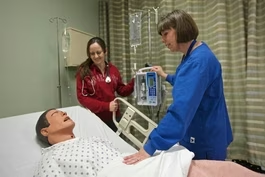
Student loan limits could reshape how U.S. trains nurses
Video has Closed Captions
Clip: 12/3/2025 | 7m 30s | Proposal to declassify nursing as 'professional' threatens ability to secure student loans (7m 30s)
Providing Support for PBS.org
Learn Moreabout PBS online sponsorship
- News and Public Affairs

FRONTLINE is investigative journalism that questions, explains and changes our world.

- News and Public Affairs

Amanpour and Company features conversations with leaders and decision makers.










Support for PBS provided by:
Major corporate funding for the PBS News Hour is provided by BDO, BNSF, Consumer Cellular, American Cruise Lines, and Raymond James. Funding for the PBS NewsHour Weekend is provided by...