
Pennsylvania Barn Rescue
Clip: 5/11/2026 | 4m 35sVideo has Closed Captions
Saving America’s rural heritage one board at a time. Meet Pennsylvania’s “barn saver.”
Saving America’s rural heritage one board at a time. Meet Pennsylvania’s “barn saver.”
Problems playing video? | Closed Captioning Feedback
Problems playing video? | Closed Captioning Feedback
America's Heartland is presented by your local public television station.
Funding for America’s Heartland is provided by US Soy, Sustainable Agriculture Research and Education, Rural Development Partners, and a Specialty Crop Grant from the California Department of Food and Agriculture.
Pennsylvania Barn Rescue
Clip: 5/11/2026 | 4m 35sVideo has Closed Captions
Saving America’s rural heritage one board at a time. Meet Pennsylvania’s “barn saver.”
Problems playing video? | Closed Captioning Feedback
How to Watch America's Heartland
America's Heartland is available to stream on pbs.org and the free PBS App, available on iPhone, Apple TV, Android TV, Android smartphones, Amazon Fire TV, Amazon Fire Tablet, Roku, Samsung Smart TV, LG TV, and Vizio.
Providing Support for PBS.org
Learn Moreabout PBS online sponsorship>> Let's take a little trip back in time.
Both to revisit one of our favorite stories and also meet a man whose future is tied to saving things from the past.
Travel through the Heartland and you're sure to come across imposing historic barns that dot America's rural landscape.
Age and the elements take their toll on structures like these, but one man in Pennsylvania decided that his skills could help preserve the past.
♪♪ >> It's just a great feeling to know that I'm saving a part of this history that so many people think is garbage.
I'm saving 80 to 95 percent of each building that would otherwise have been landfill or rotting away because people can't afford to maintain them.
>> John High has made it his mission to save as many old Pennsylvania barns as he can.
He calls his Lancaster County business, "The Barn Saver".
>> John's rescued more than 200 historic structures, either restoring them to their old luster or, in most cases, recycling the boards and beams into something new, like a house.
For High, saving barns or at least, parts of them, is a kind of penance >> Well, I was working for an excavating company and my boss would say, get rid of them because we are putting a development in.
That meant the house, the barn, everything was just bulldozed and sent to the landfill and I would look through these buildings before we were to start them and I'd just shake my head and cry.
>> After leaving his excavating job in the late 90's.
John discovered his woodworking skills could be used to save barns, doing virtually all of the work by hand.
>>It's a little bit of a delicate process.
But we actually draw a blueprint of every beam of the barn and then we put a tag on it, so that every beam has a tag on it, so they know how to put it back together at the other end.
>> This barn that High is working on is more than a century old.
Owner Greg Snell's grandparents bought it along with the family farm in 1940.
>> Well as we've been taking it down I've been thinking of all the times my mother was telling me she was in charge of being up in the hay mounds when she was a little girl, stomping the hat down when they threw it up and all.
>> Snell says the farm was sold in the 1970's after his grandparents died.
With the property being converted to a new development, Greg Snell asked the "barn saver" to salvage the pieces for posterity.
>> Well it's going to be converted into a home and it will have two lofts in the upper, um, where the hay mounds were and it will have a living area down below.
>> Brad Smith has been enjoying his converted barn for about two years.
He said he looked quite a while for just the right one to resurrect.
>> Above all I wanted to find one that was pretty pristine.
Most barns that you find that you take down have something wrong with them.
You know there's the age.
There's going to be something, some sort of problem.
Some are worse than others.
This was in really good shape.
>> Smith says there's a real charm in living in a home that's built this way.
>> The idea was to get the grand feel.
This is how it was set up originally.
The hay wagon would pull right in here and they would fill the barn with hay on either side.
>> Smith says it's a challenge to take an unheated, aging structure and turn it into a house, with modern conveniences.
Brad calls it the perfect marriage of old and new.
But John High worked his magic once again.
>> Some of the magic John makes with old barns has been immortalized in an illustrated children's book, written by High's author-wife, Linda.
>> Papa saves barns from bulldozers.
I there a lot to save, I ask.
Papa nods and I smile.
>> And that same satisfaction is something High feels every day about his chosen vocation.
>> It's very gratifying to know that I'm saving a piece of American history.
I feel sorry for people who go to work and hate their job.
I wake up in the morning I'm ready to work to save another piece of our history and just keep this thing rolling.
>> History is big in Pennsylvania.
In addition to centennial and bi-centennial farms, the Keystone state was home to the first Presidential mansion in the United States, some of the first newspapers in the new republic and the world's first oil well.
And while most folks associate Daniel Boone with Kentucky, The celebrated woodsman was born just outside Reading, Pennsylvania.
 New
NewVideo has Closed Captions
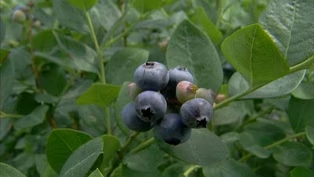
Harvest season in Florida is all about picking and packing your favorite blueberries. (5m 7s)
 New
NewVideo has Closed Captions
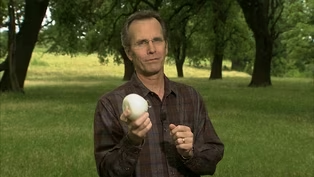
Learn about onions and how to prevent watery eyes while cutting them. (1m 40s)
 New
NewVideo has Closed Captions
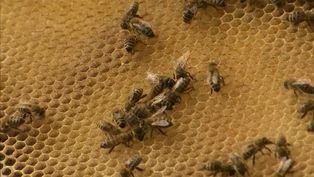
We’ll take you to Louisiana where scientists are working to solve the mystery of what’s killing bees (4m 59s)
 New
NewVideo has Closed Captions
It’s like a visit to Holland! Discover an Oregon farm growing acres and acres of bright tulips. (6m 20s)
Providing Support for PBS.org
Learn Moreabout PBS online sponsorship

- Food
Christopher Kimball’s Milk Street Television
Transform home cooking with the editors of Christopher Kimball’s Milk Street Magazine.









Support for PBS provided by:
America's Heartland is presented by your local public television station.
Funding for America’s Heartland is provided by US Soy, Sustainable Agriculture Research and Education, Rural Development Partners, and a Specialty Crop Grant from the California Department of Food and Agriculture.