
Florida Blueberry Harvest
Clip: 5/11/2026 | 5m 7sVideo has Closed Captions
Harvest season in Florida is all about picking and packing your favorite blueberries.
Harvest season in Florida is all about picking and packing your favorite blueberries.
Problems playing video? | Closed Captioning Feedback
Problems playing video? | Closed Captioning Feedback
America's Heartland is presented by your local public television station.
Funding for America’s Heartland is provided by US Soy, Sustainable Agriculture Research and Education, Rural Development Partners, and a Specialty Crop Grant from the California Department of Food and Agriculture.
Florida Blueberry Harvest
Clip: 5/11/2026 | 5m 7sVideo has Closed Captions
Harvest season in Florida is all about picking and packing your favorite blueberries.
Problems playing video? | Closed Captioning Feedback
How to Watch America's Heartland
America's Heartland is available to stream on pbs.org and the free PBS App, available on iPhone, Apple TV, Android TV, Android smartphones, Amazon Fire TV, Amazon Fire Tablet, Roku, Samsung Smart TV, LG TV, and Vizio.
Providing Support for PBS.org
Learn Moreabout PBS online sponsorshipWe're always glad we can share some very special stories with you.
Let's start in the Sunshine State.
Florida farmers produce a significant portion of the fruits and vegetables that make their way to your supermarket.
Everything from oranges and grapefruit to lettuce, tomatoes, even Brussels Sprouts.
And come spring, Florida farmers are harvesting some special produce, even as the snow flies up north.
It's all about a colorful crop of blueberries.
♪♪ >> In two days they'll be in New York and in three days they'll be on the store shelf somewhere.
>> The blueberries are on the move this morning at the William G Roe and Sons Packing House not far from Orlando.
And they'll keep moving through a short six week blueberry season in Florida where the Roe family will pack more than a million and a half pounds of these tiny bundles of dark-blue sweetness.
>> At this pace it is hard to tell who is keeping up with whom.
The computerized machines or the workers.
>> As soon as they packed they'll go into the cooler and be put in front of a 35,000 CFM fan.
It cools them down in about 45 minutes to room temperature and they're ready to go out the door.
>> If that customer out there ever gets their package of blueberries and they say, 'hey that feels little light', you can say, 'no no hold on now.
>> We're trying to get within three grams of the exact legal requirement for each one of these sized clam shells.
This machine can do up to 180 cups a minute.
We slow it down a little bit to keep it more accurate.
And they are tracked back to the grower by bar code and a little sticker on the carton.
So traceability right back to the field on the day it was harvested is very efficient.
>> Bill Roe is the Vice President of Operations for Roe and Sons.
He's the third generation to manage this operation.
William G. Roe started the business in 1927 packing citrus.
>> My grandfather originally came from upstate NY back in the early 20s.
Came down here and started picking fruit.
Got into the citrus business and eventually had a packing house.
>> It's safe to say growing blueberries was not on William G. Roe's original business plan.
But just like their grandfather, the present generation of Roes has had to innovate and explore new business opportunities.
Like blueberries.
>> So we went out, we bought a field.
We bought the equipment.
We converted our packing house over and boom, the blueberry industry just kind of blew up around us as we were growing up with it.
>> Now, five dozen growers from around the region and the Roes grow blueberries to be packaged under several different labels.
The Roes grow 18 acres themselves.
When you think blueberries, Florida isn't the first state that comes to mind.
But it turns out that the growing season here is perfectly timed.
>> The blueberry industry now is a year-round industry.
The northern hemisphere blueberry market starts in Florida.
And it's about six to eight week season.
So we're in a very narrow little patch when there really are no other blueberries in the world that are coming in.
♪♪ >> Another not-so-typical product sold by the Roes: tangerine juice.
Slightly sweeter than orange juice, the juice is sold under the "Noble" brand.
>> As with many farmers today, the Roes have a greater focus on environmental concerns.
In their case, bottling their juices in containers made from corn based plastics instead of petroleum.
>> Which means they're completely compostable.
Put them in an active compost pile.
In sixty days they are gone.
>> The Roe's are proud to carry on the legacy they inherited from their grandfather.
Several Roes serve in the management and daily operations of the business.
The latest is Bill's daughter, April.
She left her job as an Atlanta investment banker to join the team.
>> When I started from day one I knew that they trusted me and I trusted them.
And that takes a long time to develop working for another employer.
>> A family farming tradition getting sweeter with each generation.
>> You can call them "Blue" berries, but they are the "golden" child in the galaxy of Fruits and vegetables.
Blueberry consumption in the U.S.
has more than doubled in the past 15 years, thanks to the health benefits of this sweet and tasty fruit.
Blueberries are low in calories, but high in anti-oxidants, vitamins, minerals and dietary fiber.
And flavor aside, some folks still use the natural dye in blueberries to color textiles.
 New
NewVideo has Closed Captions
Learn about onions and how to prevent watery eyes while cutting them. (1m 40s)
 New
NewVideo has Closed Captions
We’ll take you to Louisiana where scientists are working to solve the mystery of what’s killing bees (4m 59s)
 New
NewVideo has Closed Captions
It’s like a visit to Holland! Discover an Oregon farm growing acres and acres of bright tulips. (6m 20s)
 New
NewVideo has Closed Captions
Saving America’s rural heritage one board at a time. Meet Pennsylvania’s “barn saver.” (4m 35s)
Providing Support for PBS.org
Learn Moreabout PBS online sponsorship
- Food
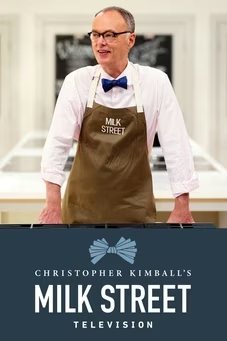
Christopher Kimball’s Milk Street Television
Transform home cooking with the editors of Christopher Kimball’s Milk Street Magazine.







Support for PBS provided by:
America's Heartland is presented by your local public television station.
Funding for America’s Heartland is provided by US Soy, Sustainable Agriculture Research and Education, Rural Development Partners, and a Specialty Crop Grant from the California Department of Food and Agriculture.