
Olivia Wilde on making “Tron: Legacy” with Jeff Bridges
Special | 13m 57sVideo has Closed Captions
Olivia Wilde on working with Jeff Bridges on “Tron: Legacy.”
On November 4, 2010, Olivia Wilde sat down with director Gail Levin for a conversation about working on “Tron: Legacy” with Jeff Bridges and how Bridges’ measured approach to acting makes him “a complete person.” Interview conducted for “Jeff Bridges: The Dude Abides” (2011).
Problems playing video? | Closed Captioning Feedback
Problems playing video? | Closed Captioning Feedback
Support for American Masters is provided by AARP, The Rosalind P. Walter Foundation, Thea Petschek Iervolino Foundation, Burton P. and Judith B. Resnick Foundation, The Philip and Janice Levin Foundation,...
Support provided by:

Olivia Wilde on making “Tron: Legacy” with Jeff Bridges
Special | 13m 57sVideo has Closed Captions
On November 4, 2010, Olivia Wilde sat down with director Gail Levin for a conversation about working on “Tron: Legacy” with Jeff Bridges and how Bridges’ measured approach to acting makes him “a complete person.” Interview conducted for “Jeff Bridges: The Dude Abides” (2011).
Problems playing video? | Closed Captioning Feedback
Where to Watch American Masters
American Masters is available to stream on pbs.org and the PBS app.
Buy Now
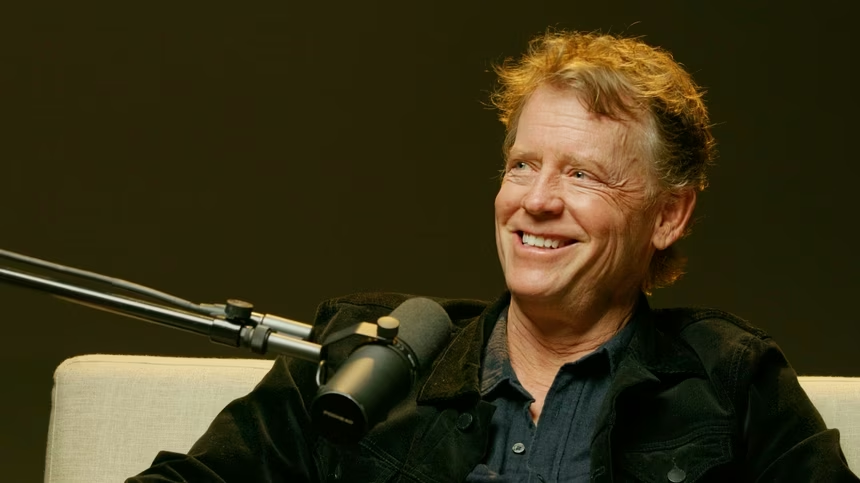
A front row seat to the creative process
How do today’s masters create their art? Each episode an artist reveals how they brought their creative work to life. Hear from artists across disciplines, like comedian Chris Fleming, actor Greg Kinnear, sports journalist Taylor Rooks, and more on our video podcast "American Masters: Creative Spark."Providing Support for PBS.org
Learn Moreabout PBS online sponsorshipMore from This Collection
Watch curated interviews from The American Masters Digital Archive. The full collection includes over 1,000 hours of never-before-seen, raw interviews: a treasure trove of the movers and shakers of American culture, including Maya Angelou, Patti Smith, Mel Brooks, Carol Burnett, Matthew Broderick, Carl Reiner, Joan Rivers, Dionne Warwick, Lee Grant, Sidney Lumet, Betty White and many others.
Brooke Shields' early career with Bob Hope and performing for the troops
Video has Closed Captions
Brooke Shields on her work with Bob Hope and performing for the troops. (13m 21s)
How Clive Davis became a titan of the music industry
Video has Closed Captions
Clive Davis on his journey in the music industry. (29m 7s)
Mike Wallace reflects on the 60 Minutes tobacco story controversy
Video has Closed Captions
Mike Wallace discusses the groundbreaking “60 Minutes” story on tobacco. (13m 45s)
John Goodman on "The Big Lebowski" and Jeff Bridges
Video has Closed Captions
Actor John Goodman talks about his work on the film, "The Big Lebowski." (12m)
Harvey Fierstein on gay representation on Broadway and its deep history
Video has Closed Captions
Harvey Fierstein talks to director Michael Kantor backstage during the production of "Hairspray." (13m 8s)

Video has Closed Captions
Ringo Starr describes his friendship with Mae West. (10m)
Mel Brooks' wild ride to his first Broadway show ever
Video has Closed Captions
Mel Brooks talks about the first Broadway show he ever saw—Cole Porter's "Anything Goes." (5m 44s)
John Kander and Fred Ebb on “Cabaret,” creativity and collaboration
Video has Closed Captions
Composer John Kander and lyricist Fred Ebb talk about how they have worked together. (5m 56s)
Isabella Rossellini compares her acting and modeling
Video has Closed Captions
Isabella Rossellini discusses her acting versus modeling career. (28m 24s)

Quincy Jones explains how he got started in music
Video has Closed Captions
Quincy Jones discusses his early career, friendships and how he defines himself. (15m)
Paul Mooney on his career and relationship with Richard Pryor
Video has Closed Captions
Paul Mooney reflects on the mechanics of stand-up and his role as Richard Pryor's best friend. (10m 39s)
How Phyllis Diller broke down the doors for female comics
Video has Closed Captions
Phyllis Diller reflects on how her comedy was a response to years of “take my wife” jokes. (11m 35s)
Providing Support for PBS.org
Learn Moreabout PBS online sponsorshipI've been an admirer of Jeff's my whole life.
I mean, Jeff's career is older than me (laughs).
But, you know, I feel now having worked with him and having become his friend that I've known him forever.
He has that effect on you, I think.
You know, I think that he just has really changed my perspective on a lot of things, including Hollywood and my career.
And so I feel very grateful that we had the chance to work together and I had the chance to really learn from him.
But having said that, I feel like I've been learning from him for years because just watching his work.
Watching Jeff behave on and off set is really a masterclass in just how to be a good human being and a good artist.
His perspective on his art is very unique in that he enjoys it immensely, takes it very seriously, but he doesn't let it oppress him.
There's nothing, you don't even wanna call it work when it comes to Jeff, because he really enjoys every moment.
And I remember we'd be shooting "Tron," you know, 17 hour days, and I would be saying, "Gosh, Jeff's really hanging in there, you know?"
You know, I kind of assume that he's this giant movie star and he's Jeff Bridges, and maybe he won't let them keep him for 18 hours on set, and maybe he won't be so polite about it.
But no, he was just so cool.
And in fact, we would share earphones and listen to Alan Watts lectures in our Tron suits on this immense glow in the dark set.
Jeff and I would be sitting there in the dark waiting for the next setup, endlessly waiting with one earbud in each listening to these lectures, and he'd look at me and be like, "Uh-huh, right, cool, huh?"
Like, yes.
And so, you know, I was learning from him as an actor and also as a person, because as we would rehearse together and then work together playing these characters who were like family who had in fact been in exile together for hundreds of years, and, you know, had a very, very intimate relationship and a very familial relationship.
I really wanted to establish a relationship with Jeff off set so that we could feel that familiarity.
And that's not hard to do with him.
You kind of instantly feel you can have that with him because he's so open and loving.
But one of the first things we connected on was Buddhism.
We started talking about spirituality and Buddhism, and I said, "Gosh, I'm so into it.
I'm so interested, but I don't know anything."
And he said, "Well, you gotta read Bernie Glassman."
So I think he gave me "Infinite Circle" and I read the book and I said, "Jeff, this is exactly what I've been looking for, because I'm an activist at heart.
I wanna change the world, but I'm so interested in Buddhism, but I don't understand how the two can go together.
How can I be okay with everything and accept the world, but also wanna change the world?"
And Bernie seemed to be laying that out, about how to be a know a social activist and a Buddhist at the same time.
And I was so inspired.
It was very important to Jeff that Bernie have some sort of influence over the script as it developed.
He wanted the Tron sequel to have a kind of mythical message to it, to have some kind of spirituality, some kind of larger story.
And he wanted Bernie to be the one to influence that.
And it made a lot of sense because this character that Jeff was playing is sort of like this, you know, I mean, he would, of course, explain it in a much more eloquent way and I'm sure he has.
But every character sort of fit into a kind of a Buddhist myth.
And for my character, it was very helpful because she's this completely compassionate being, this totally selfless kind of next step of evolution, Jeff's character's creation.
And he liked the idea that she was this entirely perfect Buddhist ideal.
So once he kind of got me onto that and I started understanding what that really meant, then we could, I mean, then the character really started coming together.
It was very helpful on set when we could kinda speak in these terms that I was learning from Bernie's work as I continued to read it.
And the cool thing was that it just made it all very accessible.
And from that point on, which was two months before we started shooting, then Jeff and I really connected over that.
And I got to keep learning from Jeff in terms of all of the, you know, his life experiences and the literature related to his study of Buddhism and just social activism and everything else that we had in common.
The interesting thing about "Tron" is that when the first one was made in 1982, Steven Lisberger, the director and writer, was really making something kind of experimental.
I'm almost shocked that Disney bankrolled this crazy experimental movie.
It's very ahead of itself in its philosophy and in the question that it's asking.
And the interesting thing about the sequel being made almost 30 years later is that, that is the appropriate amount of time to have passed in order for the philosophical question to be relevant again and for the technology to have evolved to a point where it's relevant again.
So the first film is asking the question, you know, what would happen if technology took over, if we became swallowed up by it, if it became our master?
The second film is saying, "Well, we know that's happened.
We're completely dependent on technology.
Now what?
Can we harness its power for good?
Can we retain what it means to be human?
And can we appreciate that?"
And so it really made sense that Jeff wanted to in involve Bernie.
But, you know, just that on its own, his deep appreciation for the message the film should have and his responsibility he felt towards the film and towards the audience was so unusual and really made the film a better piece.
And I think that, you know, without him, of course, the film is nothing.
It's a really interesting experience to be a part of, an evolved state of an earlier piece of art.
And to be able to do that with a person who was in the first incarnation of that piece of art.
That's really unusual to be able to ask Jeff and Steven Lisberger and Bruce Boxleitner who's also in our film, what was it like making the original, what did you feel about saying words like bit and program?
When that really wasn't a part of the daily vocabulary of computer users.
Nobody had personal, I mean, some people had personal computers, but it was obviously an unusual kind of story about programmers and very techy people.
Whereas the new film is about all of us who have now all become dependent.
There's a new wave of these kind of genre films that have really interesting actors in them and really interesting directors making them.
I think it started with Chris Nolan making "The Dark Knight," making it so brilliant when Batman didn't necessarily have to be so great before, and "Iron Man" really kind of took it to a new level with Robert Downey.
And "Tron" is the genre film, this sci-fi epic adventure that has someone as brilliant as Jeff Bridges in it.
And I think that makes it, it elevates it to another level.
It gives us a whole lot of cred, particularly with that Comic-Con audience that I think they are the most discerning of all audiences because they get a lot thrown at them and they can make or break a project.
In fact, Comic-Con is the reason for "Tron: Legacy" because when three years ago they brought test footage to Comic-Con to kind of feel out the response and see if people wanted a sequel.
They showed a three-minute test with Jeff in it, and people went insane and it went viral.
And that's the reason the studio green lit it, and that's the reason we got to make the movie.
So, you know, when there's that kind of demand for a story, it's such an honor to make it happen and to bring it back to them, to show it to them and thank them for it.
But they really appreciate that really great actors like Jeff are doing the movies that means so much to them, that are that genre that really gets them off, this kind of fantasy, amazing sci-fi world that they care so much about involving these brilliant veteran actors.
It's exciting for them and exciting for us.
It's really interesting and unique to Jeff that in the midst of this kind of epic tale that involves all this kind of technological babble, Jeff is able to behave just in a very natural way.
It's just a guy so that the audience feels as they do, I think, in all his films that they could be him, that he represents them, that there's this kind of real humanity to the performance that lets you relate.
And it's so much harder than it looks to do that within a kind of sci-fi green screen production.
To watch Jeff kind of do, I remember we were doing a dinner scene, and if it weren't on this giant soundstage, on this giant set in Tron suits with all this incredible 3D equipment around, it could be just the typical awkward family dinner in a play in any small story.
And that's how Jeff was playing it, and that's why it works.
But it was such a great lesson for me, and I think the other actors to watch how to behave naturally and how to be so unselfconscious even inside of this enormous structure where the acting feels like probably the least important thing because, "Oh my God, it's 3D and the suits light up and it's huge."
It's easy to forget that it is just a story about people and about humanity.
It's just interesting and kind of amazing to be a part of this new wave of technology.
And, again, to witness it being experienced by someone like Jeff who still just behaved as if he were on stage in the theater.
It's really incredible watching this mocap thing.
Just to take you through it really quickly.
What he had to do was, there was a body actor who played young Jeff's body, and then he wore what I call the Teletubby head, which is like a sock with sensors on it.
And he had to watch Jeff perform the scene, and then tried to mimic exactly what he did physically so that his body would reflect the way Jeff wanted it to behave as his character Clu.
Now, there's probably no more interesting and challenging actor to mimic than Jeff Bridges physically, because he's so unique in the way that he moves.
I mean, he smiles with his whole body, he frowns with his body, he laughs, he exclaims, everything is like happening everywhere.
And so this guy was a very athletic guy, I think some sort of professional football player, was exhausted after, you know, playing Jeff for a day because just the little movements that made up the character that Jeff was so brilliantly crafting were so intricate that it became, you know, it was totally exhausting and very difficult, but amazing.
And I just thought that watching that come together was really fascinating.
Something really struck me when I went to Jeff's 60th birthday party up in Montecito.
He was making his thank you speech, his birthday speech, and he said, "I feel very close to death right now."
And I kind of stopped and I thought, "What does he mean?
Is he ill?
I don't understand.
Why is he saying that?"
But he was saying it in the sense of, I feel so comfortable and happy with life that I feel very at peace with everything right now.
And that really had a huge effect on me, that he's just at peace.
And so that's why he's able to kind of live in the moment because he's not bogged down.
He doesn't weigh himself down with unnecessary, you know, bullshit.
And I think that's what you sense when you're around him, this kind of levity that comes from that and that openness that comes from that.
But it was also this amazing moment of seeing someone who has the career that we all would die for, but also a fully formed identity and a family.
And often I think actors think you have to sacrifice one thing for the other.
You can't have this, you know, long, successful, incredible, and beautiful and romantic marriage and children if you're gonna be this giant movie star.
It doesn't seem possible.
And, you know, Jeff obviously has that, and I think that part of that comes from his ability to separate work and life and his devotion to his art, his devotion to his family.
And I think that I'm sort of, I mean, my theory is that actors go from character to character to character.
And when you're really on a roll, you just never stop.
You're just always working and you jump from set to set and, you know, personality to personality.
And if you're not careful, you can become kind of an empty shell that you just fill with whatever the temporary identity is at the time that you are required to embody.
And if you're not careful and you don't nurture who you really want to become and what you believe in and who you really are, you can become just this shell with kind of remnants of past souls that you've taken on.
And I think that's why actors often become unhappy people.
They feel incomplete in some way, and Jeff doesn't feel that way because he seems to have really nurtured himself and continue to learn and be a student of so many different things and to continue to, you know, just develop as a person.
And that's another really important lesson that I learned from him.
And I remember on that night of his birthday watching him and just seeing it embodied, seeing this complete person, this whole person who is able to transform, but who is not just an empty shell.
And that really gave me a kind of optimistic perspective on my own career, on my dream, knowing that it is possible to have this kind of balance.
But I feel so lucky that I have a friend in Jeff that, you know, I can learn from.
And it's an extraordinary honor to have worked alongside him, but to be his friend is even more incredible.
(bright music)











Support for PBS provided by:
Support for American Masters is provided by AARP, The Rosalind P. Walter Foundation, Thea Petschek Iervolino Foundation, Burton P. and Judith B. Resnick Foundation, The Philip and Janice Levin Foundation,...