NJ Spotlight News
NJ Spotlight News: February 10, 2026
2/10/2026 | 26m 46sVideo has Closed Captions
Watch as the NJ Spotlight News team breaks down today’s top stories.
We bring you what’s relevant and important in New Jersey news and our insight. Watch as the NJ Spotlight News team breaks down today’s top stories.
Problems playing video? | Closed Captioning Feedback
Problems playing video? | Closed Captioning Feedback
NJ Spotlight News is a local public television program presented by THIRTEEN PBS
NJ Spotlight News
NJ Spotlight News: February 10, 2026
2/10/2026 | 26m 46sVideo has Closed Captions
We bring you what’s relevant and important in New Jersey news and our insight. Watch as the NJ Spotlight News team breaks down today’s top stories.
Problems playing video? | Closed Captioning Feedback
How to Watch NJ Spotlight News
NJ Spotlight News is available to stream on pbs.org and the free PBS App, available on iPhone, Apple TV, Android TV, Android smartphones, Amazon Fire TV, Amazon Fire Tablet, Roku, Samsung Smart TV, and Vizio.
Providing Support for PBS.org
Learn Moreabout PBS online sponsorship(upbeat music) - From NJ PBS Studios, this is NJ Spotlight News with Brianna Vannozzi.
- Hello and thanks for joining us tonight.
I'm Joanna Gagas in for Brianna Vannozzi.
A few stories we'll get into later in the broadcast.
The District 11 race is on.
We talk with Randolph Councilman Joe Hathaway, the Republican candidate vying to fill Governor Sherrill's vacant Congressional seat.
Plus, the latest from the courts on the Gateway Tunnel funding fight.
Will the project restart?
And later, what happened to the settlement funds meant to stop opioid deaths in the state?
We'll bring you the latest.
But first, the extreme cold that's blasted the state hasn't just been inconvenient, for some it's been deadly.
New Jersey's Department of Health has said that nearly 20 people have died from the biting cold.
Some of those individuals died in the winter storm that hit the state on January 23rd.
And those numbers were recorded before the latest deep freeze we felt this past week.
According to the state's 2-1-1 website, 19 of our 21 counties have issued code blue warnings, which make resources available like warming centers for those who need shelter.
Governor Mikey Sherrill has been urging residents to report any power outages to their utility company.
But some good news from the National Weather Service in Mount Holly that announced temperatures will get back to quote near normal levels this week with the potential for some above normal temps leading into next week.
We will welcome any warmer air New Jersey schools have been on edge for nearly a year, facing the loss of $1 billion.
The Trump administration's Department of Education announced last April that states must comply with its interpretation of DEI guidelines or lose their federal funding.
while New Jersey, under the previous Attorney General Matt Platkin, joined with 18 other states to file a lawsuit.
On Monday, New Jersey's acting Attorney General Jennifer Davenport announced they've reached an agreement with the federal government that she says prevents the illegal withholding of these funds.
The cuts would have been particularly harmful to students with disabilities and other special needs as well as students from low-income families and English language learners who rely on programs funded through federal support.
The state argued in the suit that it already complies with the Federal Civil Rights Act of 1964 and that there was "no lawful or practical way to comply with the Department's vague, contradictory, and unsupported interpretation of Title VI."
Earlier today, members of Congress held a hearing where they questioned officials from the U.S.
Department of Homeland Security over their immigration enforcement policies and recent actions.
Now, the hearing, held in the House Committee on Homeland Security, included two of New Jersey's representatives, Congresswomen LaMonica McIver and Nellie Poe.
Poe introduced a bill on Monday called the Plate Act that prohibits ICE agents from obscuring or removing their license plates.
Poe sent a letter to DHS Secretary Kristi Noem last week saying that federal immigration agents are breaking state laws by removing or swapping their license plates during operations, calling it a "blatant disregard for the rule of law."
Congresswoman Bonnie Watson-Coleman also introduced a bill this week, hers called the Fundamental Immigration Fairness Act, or FIFA, that prohibits DHS from arresting or detaining anyone going to or coming from an immigration hearing or a DHS office.
Watson-Coleman stated that "immigrants attempting to follow immigration laws should not be punished for their good faith efforts."
During today's hearing, McIver, who at one point was admonished for a lack of decorum, offered a scathing rebuke of recent DHS operations.
This is the despicable but predictable result of an agency that laughs at oversight, receives billions to deploy lethal force on our neighborhoods, and seems to believe that they are above the law and should be without accountability.
This administration believes it can act first, explain later, or hell, never explain at all.
Coming up, we'll talk with a Republican candidate running to fill Sheryl's vacant congressional seat and hoping to turn District 11 red.
That's next.
Major funding for NJ Spotlight News is provided in part by NJM Insurance Group, serving the insurance needs of residents and businesses for more than 100 years.
Annelia Mejia has secured the win as the Democratic candidate in the 11th Congressional District special election.
Her challenger, former Congressman Tom Malinowski, conceded the special primary race earlier today, announcing he'll support the progressive activist in the April general election to fill Governor Sherrill's vacant House seat.
It's a stunning result for the district where Malinowski was seen as a Democratic frontrunner.
The race still hasn't officially been called by the Associated Press, but Mejia's lead has been growing since last Thursday and as of midday still sat at about 900 votes with more than 90% of the votes counted.
But this race was impacted by a $2 million attack ad campaign against Malinowski by the pro-Israel group AIPAC that appears to have turned the tide.
Malinowski today criticized AIPAC's ads as "dishonest" as they attempted to paint him as a pro-ICE candidate because he refused to support unconditional aid for Israel.
also condemned the dark money campaign saying it's part of a broader threat to democracy.
Governor Mikey Sherrill today announced her support for Mejia, who will now go up against the only Republican in the race from the start, Randolph Councilman and former Mayor Joe Hathaway, who joins me right now.
Councilman, thanks so much for talking with us today.
Great to have you on the show.
Joanna, thanks so much for having me.
Appreciate it.
You call yourself a common sense workhorse.
Tell us why should the voters in the 11th congressional district vote for you.
Absolutely.
Well listen, when we started this campaign back in October, this campaign has been grounded in both my role as a mayor, but also my role in life as a young dad.
And I've seen so many young families and young people that are trying to get ahead here in New Jersey that grew up believing that if they worked hard if they made the most of themselves and of their God given ability that they could succeed in America and in New Jersey.
And if you fast forward to today that's that's just simply not the case.
That dream is out of touch for many many young families.
I'm running for this race because I believe we need a workhorse in Washington who is going to put the hard work ahead of the headlines and ahead of the political spin because at the end of the day we can make government work again for people.
We can make it work just like we do in Randolph just like we do at the local level.
Take that mindset down to Washington to help make life more affordable for people.
Well that's what this race is all about.
Let me ask you how would you do that.
What would be your key legislative priorities if the voters do send you to Washington.
Joanna one of the first things we want to do is eliminate taxes for first time home buyers.
Home ownership is critical for young people to get their start and to plant their roots in our communities.
And it's just right now something that's completely out of touch for a lot of folks.
And so if we can eliminate taxes on that home purchase for first time home buyers at the federal level but also work with our state and municipal partners as well.
Because remember property taxes in New Jersey are one of the biggest burdens for people as well.
If we can work together to reduce that burden that is going to set people up for success.
We also want to do things like address student loan interest rates for for college students to make sure those are capped at or below inflation so they're not paying for that long into their career.
And at the end of this young dad I know the importance of bringing a parent's perspective back to Washington.
We need to protect our kids in the community and online as well.
That's how we're going to make life affordable and better in New Jersey Councilman, there's no shortage of controversial issues driving the headlines right now, and one of them really did help to push your now opponent, Anililiya Mejia, forward.
And that's really the reaction here in New Jersey to recent ice activity nationally and here in the state.
I'm curious your thoughts your reaction to some of the recent ice activity we've seen and what would be your position in Washington.
Yeah listen I think one of the biggest things we're seeing specific to New Jersey is the disconnect now that's happened because of some of these sanctuary city laws that we deal with in the state where our local PD and our local law enforcement is unable to communicate or even understand what's going on with ice and with our federal agents to help keep everyday Americans safe.
Right.
I mean listen I absolutely think that there are things we can do with ice to both reform what's going on and operate more more effectively and a little more safely in our communities.
Absolutely.
But I think we need to come to the table across the aisle to remove some of these restrictions that are placed on our local police officers that keeps them from from keeping peaceful protests safe and allowing federal law enforcement to do their job.
Now my opponent is staunchly against supporting law enforcement across any level.
She's called to abolish ice or her former organization called to defund the police.
Those are steps that are only going to make Americans less safe and families in our district less safe every day.
If elected would you support legislation that's been proposed by Democratic lawmakers in Congress here in New Jersey that would require ice remove masks ensure that there are license plates on vehicles driven by ICE by immigration officers.
Would you support some of the body cameras worn.
We know that that's part of the conversation around DHS funding on Capitol Hill right now.
Would you support those measures.
Yeah listen again I'm running as a as a common sense local leader.
I get it right.
If we can do some of these things that that help bring people to the table and help make give the public trust and faith in our law enforcement and our government.
I'm all for that.
However I also want to see the ability for our local police to be to be able to work together and have the handcuffs taking taken off them and put back on our criminals.
So I'm willing to come to the table to to make things better to make our our our country safer to make sure we are still getting rid of the legal criminals who are here committing crimes.
But I hope that the other side is willing to come to the table to and enact some of these common sense things that will help our law enforcement community.
One of the other headlines driving the news cycle today is of course the gateway funding freeze.
It's playing out in the courts as we speak.
We know that the Trump administration is preparing an appeal even though a judge on Friday issued an unblocking of those funds.
What is your position on gateway funding.
Yeah look this is a great example.
I got to tell you from from day one I've talked about the fact that my job will be to represent the people of this district first before party before anything else.
It's about the people of this district.
And my position on Gateway Project has been very clear.
We need this project.
The president shouldn't be using this project as a pawn.
This is jobs.
This is a huge this is a huge commuter district.
Our residents need this project in more ways than one.
I hope the president and the Senate president come.
You know I'm sorry the minority leader come to the table and work this out.
Be adults in the room.
Figure this out and get the project moving forward.
We should not be playing politics with something as vital to our infrastructure as the Gateway Project.
Councilman have you sought the president's endorsement or would you accept it if he offered it.
We've been engaged with the White House and with many Republicans down in Washington.
We haven't had any specific conversations with with the White House about endorsements or anything like that.
So we will address that if and when it comes.
I'm happy to share we did get the majority whip Tom Emmers endorsement today.
Another common sense practical Republican because listen I think Republicans across the country now and folks in this district know that what we can't have is a representative who is going to make our families less safe our communities less affordable and our Jewish residents in particular more fearful based on her radical socialist agenda so we voters have a clear choice common sense practical leadership or anti-semitic socialism that's the choice at the end day I hope voters make the right choice on April 16th all right that's all the time we have Joe Hathaway a councilman former mayor in Randolph candidate for congressional district 11 thanks for taking time tonight.
Thanks to an appreciate it.
Well the 15 billion dollars in funding for the Gateway Tunnel project remains halted today and a federal judge is now giving the Trump administration until Thursday evening to restore funding enough time for the federal government to file an appeal.
That means as of today work remains paused at four sites and more than 1,000 workers have been laid off.
Now on top of that New Jersey's transit troubles persist with more overhead wire failures this week complicating commutes across the state.
Here with us to break down the latest is Colleen Wilson transportation reporter for the record and North Jersey dot com.
Colleen great to have you with us.
Let's start with Gateway first a temporary restraining order to unfreeze the funds then a day on that T.R.O.
What's happening.
What's the latest.
Yeah.
So it's kind of a hurry up and wait situation.
The judge gave them until Thursday to appeal to the Second Circuit.
And you know we'll see what happens after that.
I also just saw that in U.S.
the U.S.
Court of Federal Claims where the Gateway Development Commission is separately suing the Trump administration that they are also on an extended timeline.
They will it sounds like have oral arguments starting in March.
So they did not seek immediate relief in the same way that the states did.
Right.
Can you just help break down kind of the difference between these two lawsuits.
Yes.
So the U.S.
Court of Federal Claims is special a special court for signatories on a grant like in this case the Gateway Development Commission has the ability to sue and a breach of contract case like this one where they're saying the federal government isn't upholding its contract that it has with the GDC.
So this is the appropriate venue for them to sue and to try to enforce the contract.
New York and New Jersey the states of New York and New Jersey are not signatories on the agreement between the federal government and the Gateway Development Commission.
But they're still on the hook to help pay for a lot of the costs related to the 16 billion dollar tunnels program.
So they say that the U.S.
Court of Federal Claims is not an appropriate venue for them to sue or to be a party to a suit and try to collect and recoup money that they're investing separately.
So that's why they are in the U.S.
District Court and the Southern District of New York.
Yeah you just broke that down really well.
Let me just ask you when we talk about timelines how quickly could we see the project back up and running.
And conversely how long could the appeals process take out.
Just kind of walk us through the possibilities on the spectrum of a timeline here.
Sure.
Yeah it's really hard to say I think.
You know we've already seen Judge Vargas in the Southern District Act really quickly.
You know she had heard oral arguments on Friday at 1 o'clock and by about 7 p.m.
she had issued a decision in favor of New York and New Jersey.
So that goes to show just how quickly this sort of thing can go.
On the other hand a different judge in the circuit court could want to hear more if the government can display enough need for more time more documents more anything.
You know that process could really go out much further.
Colleen we saw this deadline approaching for a long time.
We heard lawmakers like Governor Sherrill and Governor Hope will talk about it.
We knew this work stoppage was going to come by February 6th.
Why wait then until just that same week to file these lawsuits.
Should they could they have brought them sooner and perhaps seen the project stay open.
That's a great question and something I've thought a lot about lately.
I think there's a couple of different ways to talk about that.
On the one hand what Tom Prendergast the CEO of the Gateway Development Commission told me when I asked him that very thing he said we have tried to work with the Trump administration.
We are trying to you know hold out and just pray basically for you know a better outcome and that we will all come to the table and resolve this.
On the other hand as far as you know why didn't they sue maybe three four months ago when this initially happened I mean perhaps they would have had the money by now but I think you know they had to prove to a court eventually that they worked with the Trump administration that they followed a very strict process for dealing with issues that the federal government could have whether they believe they're legitimate or not.
I think they wanted to show and demonstrate to the court we've tried.
We've done everything.
We have exhausted all options.
This is the very last you know venue for us to try to recoup and get this process going.
Yeah.
And some of those options were lines of credit.
I also wonder too if they will be able to recoup those funds.
That's a big risk there for the commission as well.
Yes.
Oh yes.
I mean they are already seeing a drastic increase in financing costs.
They they they estimated 17 million dollars in 2025 for its financing costs that that skyrocketed in 2026.
Those budget estimates to 30 million dollars.
So yes that is definitely a very big concern that will probably I think fall to the states of New York and New Jersey.
Perhaps that's something that will be you know discussed and litigated.
But that's among the reasons why New York and New Jersey are saying we need to sue separately.
We have our own damages.
We have our own harms that can't be litigated in another court.
Let me jump in there calling just because we're almost out of time and I want to ask you obviously commuters care about gateway.
But in the short term they care about their daily commutes.
What happened this week with NJ Transit and the Cantonary wires that seem to still become a problem.
That's right.
They're still relying on on decades old infrastructure frankly infrastructure that should have been replaced decades ago much of which is Amtrak.
So yes they had two incidents.
It sounded like yesterday where wires fell on the tracks.
In one case a piece of infrastructure failed which caused the wire to fall onto the tracks which is a similar story that we heard in December.
So certainly you know freezing temperatures are a contributing factor.
But I mean aging infrastructure that desperately needs replacement and prioritization and frankly like trying to understand why are those things failing.
How can we catch them and prevent them from happening.
That is a really important questions that we hope to have more answers for soon.
Yeah it seems to be an ongoing question.
Ongoing investigations into how you upgrade those and where does the money come from.
But Colleen Wilson transportation reporter for North Jersey dot com for your insight.
Appreciate it.
Thanks for having me.
There's a major controversy surrounding forty five million dollars that was paid to the state by companies who played a role in contributing to the state's opioid crisis.
Those funds were considered a big win for recovery advocates and former Attorney whose lawsuit secured the money, but their celebration quickly turned to outrage when they learned the state planned to divert the $45 million to four hospitals instead.
Well, new legislation to undo that move had a hearing in Trenton yesterday.
Our mental health writer, Bobby Breyer, was at the hearing and joins us now as part of our Under the Dome series.
Bobby, thanks for being here in the studio with us.
First, just tell us about this legislation that was introduced yesterday that had a hearing.
What would it do to this $45 million that I just said was diverted away from some of the harm reduction programs in the state?
That's right.
It's been interesting to follow this.
Really this current bill in its current form would ensure that the $45 million that was taken out of the opioid remediation, recovery and remediation fund was restored or put back into that fund.
Meanwhile it would also secure $45 million for those four hospitals.
But that money would come out of the state's general fund.
It's interesting.
Let's back that up a bit.
A lot of things that we just said there and it's bigger than I think people might understand.
The 45 million originally was supposed to do what?
Exactly.
So it's supposed to come out of that fund that would go towards things like Housing First initiatives, harm reduction programs, things that the Opioid Advisory Council advised the state to do.
So they take that money and use it in a way that helped people who were really impacted the most by this.
What advocates have said is when you take money out like this and what other state officials have said, when you take money out like this, it would go to hospital systems that while they may be doing addiction treatment services, it is a different type of help than what people would get on the front lines.
And it's really not what the money was intended to do.
Let's look at the hospital systems and that decision to move the money towards them.
Who made that decision and what explanation did they give for taking the 45 million and spreading it out to these four hospitals?
It's a great question because there was really no complete explanation that we got from this.
It still remains somewhat unclear.
We heard from some state officials that these four hospitals took the money as a way to kind of prevent some of these federal Medicaid cuts that they anticipated coming down the line.
I had also heard from state officials that the Murphy administration was involved in ensuring that this 45 million dollars went to these four hospitals.
State officials that I spoke to as well as advocates were hopeful that this reintroduction of this new bill would get momentum under the Sherrill administration.
So while it remained unclear of how this money came forward and was taken out, we do know that there is a hope now among advocates that the Sherrill administration would restore it.
But there is still a lot to be played here.
OK.
So recovery advocates have been really vocal since that plan was first outlined.
They staged die ins right at the statehouse.
Just can you talk us through what we've seen.
what the hearing was like and what it sounded like yesterday.
Sure.
You know that that die in happened in late June after this news came out that this forty five million dollars was diverted.
It's important here to note that this really came as a last minute almost 11th hour move by lawmakers without an introduction in front of other assembly makers and lawmakers.
And it was really one that came forward without the public knowing about it.
It kind of gets into that issues that many people have spoken about with transparency here in the state in the budgeting process.
You mean exactly.
Yeah.
And so when we have the lawmakers doing that there is a lot of folks that you know staged a demonstration for an extended period of time in the statehouse to show just how important this money was to them.
And then it also came a rare criticism from Attorney General Matthew Plattken saying that this money was not intended for these purposes.
It really came from these settlements as he had said the blood money that many families have had to endure from this opioid epidemic.
So a lot of pushback.
So you touched on this in your first answer.
You said the Vitalis bill Senator Joe Vitalis bill would return the 45 million to the harm reduction and other programs opioid recovery programs.
But he also wants to fund 45 million to the hospitals.
How do you do both.
That's right.
And that's a great question.
That's what we're going to see further on in these hearings.
I think right now it's kind of a way to at least from a lawmaker's perspective make everybody happy.
But at the same time there's these questions of how do you do this when you have a state budget that many people have scrutinized in recent years.
So that remains to be seen right now about how that's actually going to happen.
What we know right now from the hearing yesterday was first of all it was packed.
Second of all advocates have really been adamant that this $45 million belongs back in that fund.
When we know while these overdose numbers have come down in recent years, there's still communities that have been tremendously and disproportionately affected by it.
During testimony yesterday, many advocates spoke about black and Hispanic communities being disproportionately affected and why this money getting back into the fund is so important to make sure that grassroots organizations that help communities would be able to get that funding and those programs back in place.
You know communities of color are not rebounding in the same way that more white and affluent communities are as we see the opioid numbers drop.
We've seen criticism of harm reduction programs even from the Trump administration that earlier this year said they were cutting funding and then rescinded that but they said they would no longer be funding harm reduction.
Just very quickly, how does the data bear out the impact that harm reduction programs have?
The impact and the data is very clear with these harm reduction programs.
Time and time again they show that they reduce people dying of overdoses and really that is because of this peer support.
People on the ground who are with non-profits and grassroots organizations who may be in recovery themselves.
It's that thing that's not talked about a lot of times.
It's this level of trust that somebody who may be trying to recover and bounce back, trust the person that is giving them the information or the harm reduction kits that they need.
So while it is kind of a newer treatment that we've heard within the last 5 to 10 years, it's one that's proven to be extremely effective and one, of course, as you had mentioned, the federal government has pushed back on with a lot of treatment-first options, which really flies in the face of a lot of what harm reduction and evidence-based practices have said.
All right, Bobby Breyer, we have to leave it there, but thanks.
Great reporting.
Thanks, Joanna.
"Under the Dome" is made possible in part by the Corporation for Public Broadcasting, a private corporation funded by the American people.
And that's going to do it for us tonight.
I'm Joanna Gaggis.
For the entire team here at NJ Spotlight News, thanks for being with us.
We'll see you right back here tomorrow.
[music] New Jersey Education Association, making public schools great for every child.
And RWJBarnabas Health.
Let's be healthy together.
[MUSIC]
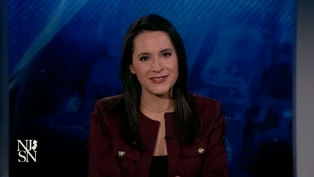
Rep. McIver says 'blood on hands' of Homeland Security chief
Video has Closed Captions
Clip: 2/10/2026 | 1m 51s | Two NJ colleagues introduce legislation designed to limit immigration agents' powers (1m 51s)
Providing Support for PBS.org
Learn Moreabout PBS online sponsorship
- News and Public Affairs

Top journalists deliver compelling original analysis of the hour's headlines.

- News and Public Affairs

FRONTLINE is investigative journalism that questions, explains and changes our world.











Support for PBS provided by:
NJ Spotlight News is a local public television program presented by THIRTEEN PBS