
July 3, 2026 - PBS News Hour full episode
7/3/2026 | 57m 46sVideo has Closed Captions
July 3, 2026 - PBS News Hour full episode
July 3, 2026 - PBS News Hour full episode
Problems playing video? | Closed Captioning Feedback
Problems playing video? | Closed Captioning Feedback
Major corporate funding for the PBS News Hour is provided by BDO, BNSF, Consumer Cellular, American Cruise Lines, and Raymond James. Funding for the PBS NewsHour Weekend is provided by...
July 3, 2026 - PBS News Hour full episode
7/3/2026 | 57m 46sVideo has Closed Captions
July 3, 2026 - PBS News Hour full episode
Problems playing video? | Closed Captioning Feedback
Where to Watch PBS News Hour
PBS News Hour is available to stream on pbs.org and the PBS app.
Providing Support for PBS.org
Learn Moreabout PBS online sponsorshipAMNA NAWAZ: Good evening.
I'm Amna Nawaz.
Geoff Bennett is away.
On the "NewsHour" tonight: Record-breaking heat bakes the Central and Eastern United States ahead of July 4 celebrations.
African soldiers lured by promises of high pay end up on the front lines of the war with Ukraine, facing almost certain death.
And one year since the deadly flood at Camp Mystic, two parents who lost their daughter remember her legacy and describe their push for better camp safety.
LARS HOLLIS, Father of Virginia Hollis: Keeping teachers, campers safe is a guiding light for us and why we're so involved in the protection of campers throughout the U.S.
(BREAK) AMNA NAWAZ: Welcome to the "News Hour."
Americans across the East Coast are preparing for one of the hottest Independence Days in recorded history.
A brutal heat wave is bringing dangerous temperatures to some 160 million from Mississippi to Maine.
Record-breaking triple-digit temperatures have disrupted travel, strained the energy grid, and forced some communities to change or cancel planned celebrations.
Yesterday, more than 100 people in Pennsylvania were treated for heat-related illnesses at an event tied to the 250th anniversary celebration.
In the capital, today's events on the National Mall were postponed for hours because of the extreme heat.
And, in New York City, where the heat index was expected to reach 110 degrees today, Mayor Zohran Mamdani urged residents to take precautions.
ZOHRAN MAMDANI (D), Mayor of New York City: What we ask New Yorkers to do is to be mindful of the danger that accompanies those temperatures.
That means make sure that you stay hydrated, make sure that you're putting on sunscreen, make sure that you're taking as many breaks as possible from being outside.
And, if you can, to stay indoors and to stay in air conditioning.
AMNA NAWAZ: Meanwhile, health authorities in Europe have now linked thousands of excess deaths to record heat.
To unpack it all, we're joined now by Jeff Goodell.
He's a contributing writer at "Rolling Stone" and the author of "The Heat Will Kill You First: Life and Death on a Scorched Planet."
Jeff, welcome back to the "News Hour."
Thanks for joining us.
JEFF GOODELL, Author: Thank you for having me.
AMNA NAWAZ: So there's heat advisories in effect in almost 30 states.
The National Weather Service said today's temperatures are extremely dangerous.
What are the risks here and who's most vulnerable?
JEFF GOODELL: Well, the risks are tremendous.
I mean, anyone who goes to the doctor knows the first thing they do is check your body temperature to see when things go wrong.
Our bodies are very sensitive to changes in heat, and it makes these kinds of outdoor events on weekends like this all the more dangerous.
I mean, these extreme -- being out in extreme heat puts a lot of strain on your heart.
So anyone with any kind of heart conditions, often, that means elderly people are most at risk.
Young children, especially before the age of 2 or so, have not fully developed an ability to sweat, so they're very vulnerable.
People who are on certain kinds of pharmaceutical drugs like antidepressants get in -- they mess with our body's ability to regulate temperature.
They're at risk.
And, finally, I really urge caution to any women who are pregnant or think they might be pregnant, because a lot of recent research has shown that the risk of miscarriage during extreme heat is much higher.
AMNA NAWAZ: So, Jeff, we're heading into this 250th anniversary weekend.
There's a lot of outside events planned, people getting together for barbecues and parades and so on.
We know there's a World Cup match scheduled to be outside in Philadelphia, which is seeing some record high temperatures too.
What do officials need to be thinking about leading into these events and what should individual people be doing to prepare?
JEFF GOODELL: Well, officials need to be covering the basics, which is access to water, access to shade, access to cooling centers, even better than shade, places, tents that are air conditioned, places where people can get out of the heat, and also, importantly, having medical personnel around who understand the risks of heat, because that is -- you would be surprised at how many of them really don't.
So that's really important.
And, personally, what's important is drinking water.
And I want to clarify the drinking water is important, not because the act of drinking water cools you off, but because if you're dehydrated, you can't sweat, and sweating is how our body cools you off.
So what's important is to keep hydrated, so that you can continue to sweat.
Wearing light-color clothing is really important, and making sure that you know that you have access to somewhere cool that you can get to, whether it's a building that's air conditioned or a cooling center or something, because heat builds up in your body, and it kind of becomes a runaway train.
And what you don't want to do is get too far down the tracks on that runaway train before you start cooling off.
And last thing I want to say, and if I can correct Mayor Mamdani in your intro, sunscreen is important to wear outdoors.
It protects us from U.V.
rays, but it doesn't do anything to protect you from heat.
AMNA NAWAZ: I want to ask a big picture question here, which is, we know what the data shows us about climate change and the increasing threats and the warming of the planet and them leading to more frequent, more intense heat waves.
But let's be specific about that so people really understand.
What is driving that warming?
What is driving that climate change?
What should we understand?
JEFF GOODELL: Well, it's very clear.
Science have -- has understood what's driving this warming for a half-a-century, and that is increasing levels of CO2 in the atmosphere, primarily from the burning of fossil fuels.
There was a study that came out yesterday from a very highly respected scientific group in the U.K.
that basically said that these kinds of extreme temperatures that we're seeing right now would be virtually impossible without the higher levels of CO2 in the atmosphere.
So what we're seeing is a manifestation of climate change.
What we're doing is living in the future that climate scientists have been warning us warning us about for 50 years.
AMNA NAWAZ: Jeff Goodell, contributing writer for "Rolling Stone," joining us tonight.
Jeff, thank you so much.
Good to speak with you.
JEFF GOODELL: Thank you for having me.
AMNA NAWAZ: We start the day's other headlines in Iran, where funeral ceremonies got under way for the country's late supreme leader the Ayatollah Ali Khamenei.
The cleric's almost-40-year reign was brought to an end in February when he was killed in U.S.
and Israeli airstrikes.
Iranian officials paid their respects today at Khamenei's flag-draped coffin in Tehran, along with dignitaries from Pakistan, Russia, and China, among others.
Banners of the late ruler were visible across Tehran, with some residents saying they feel the funeral sends a message to Iran's enemies.
AMIRHOSSEIN TAJBAKHSH, Tehran, Iran, Resident (through translator): Our sense of revenge will never be extinguished, but, at the very least, what we can do for our martyred leader who sacrificed himself for the nation is to hold his funeral ceremony with grandeur.
AMNA NAWAZ: Today's tributes are the first in a days-long series of ceremonies, which includes a public viewing of his casket tomorrow, and then a procession through Tehran on Monday, followed by his eventual burial in his hometown of Mashhad next week.
In Pakistan, at least 40 people were killed when an overcrowded bus plunged into a ravine earlier today.
Officials say the vehicle lost control as it traveled from Quetta to Peshawar and fell around 70 feet in Dhana Sar, a remote area known for its dangerous mountain roads.
At least eight others were injured, and what officials are calling one of the nation's deadliest road accidents in recent years.
A local government spokesperson says the bus was carrying additional passengers from another bus that had broken down.
A police investigation is under way.
In Venezuela, hundreds more people have been confirmed dead after last week's powerful twin earthquakes, even as the government defends its handling of the crisis.
Venezuelan authorities say more than 2,600 people died and more than 12,000 others were injured.
They did not say how many people remain missing, though one estimate says more than 38,000 are still unaccounted for.
It's been nine days since the quakes, and some Venezuelans say they have had to search for loved ones with their bare hands.
Acting President Delcy Rodriguez has defended the official response.
DELCY RODRIGUEZ, Acting President of Venezuela (through translator): We did not wait one, two, or three days.
We acted immediately.
After the earthquake, the Venezuelan state as a whole sprang into action immediately.
AMNA NAWAZ: Rodriguez has also accused what she called propaganda laboratories of politicizing the humanitarian crisis to criticize her government.
Her 180-day period as interim leader expired today, and there's been no official word on what happens next.
In today's World Cup action, Egypt won its first ever game in the knockout round after beating Australia in a hard-fought match that ended in penalty kicks.
In the meantime, Croatia is still reeling from a video replay that overturned what would have been a game-tying late goal in their loss yesterday to Portugal.
And, as expected, FIFA has confirmed the one-game red card suspension for American striker Folarin Balogun.
He will miss Monday's match against Belgium.
Parts of New York are on lockdown this evening for the expected wedding celebration of Taylor Swift and Travis Kelce at the city's iconic Madison Square Garden.
Guests were seen arriving for the event, which has been shrouded in secrecy.
It's believed that some 1,000 people are due to attend amid tight security.
Earlier, catering trucks had been spotted entering the venue, and even New York's police department is getting in the spirit, with a patrol chief shouting Swift lyrics at passersby.
MAN: I knew you were trouble.
I knew it.
This weather feels like a cruel summer.
Welcome to New York.
AMNA NAWAZ: The multiday celebration coincides with New York's July 4 celebrations, even as the city bakes in 100-degree heat.
The pop music icon and Kansas City Chief star have been dating since 2023 and announced their engagement last year.
Financial markets are closed for the July 4 holiday weekend, but a bit of American news overseas.
The National Archives in London says it discovered a vanishingly rare copy of the Declaration of Independence.
It's one of just 11 known copies of the Exeter Declarations named for Exeter, New Hampshire, where they were printed in July of 1776.
This document was captured from a ship that was then under the direction of the recently formed Continental Congress.
Experts at the National Archives say it tells a -- quote -- "untold story about American heroism at sea."
AMANDA BEVAN, Legal Records, National Archives: I think it shows what they were fighting for.
I think this is potentially the first one that's actually found in a situation where people are prepared to die for their country.
So, for them, I think it was something which was inspirational.
AMNA NAWAZ: The document was intended to spread the news that the 13 colonies had declared independence from Britain.
It was found by a volunteer reviewing the letters of an 18th century Royal Navy captain who had labeled it simply as another paper.
Still to come on the "News Hour": how climate change is endangering historic sites like Jamestown, Virginia; David Brooks and Jonathan Capehart weigh in on the week's political headlines; and Judy Woodruff on the people and ideas that have shaped the U.S.
The capital city of Kyiv observed a day of mourning today after a deadly barrage of Russian drones and missiles killed at least 30 people overnight Wednesday.
And on the front lines, there is no letup in the bloodletting.
By some estimates, Russia has taken 1.5 million casualties, including a half-a-million killed since the war began.
Now, as special corresponded Simon Ostrovsky reports, with Russia running out of recruits, it's bringing in mercenaries from far away.
And a warning: Some images in this story are disturbing.
MAN (through translator): What the (EXPLETIVE DELETED) you non-Russian piece of (EXPLETIVE DELETED)?
SIMON OSTROVSKY: This is the treatment awaiting African troops recruited to fight in Russia's war against Ukraine, beatings, electrocution, and worse.
SIMON OSTROVSKY: Lured to Russia with promises of employment, hefty sign-up bonuses and citizenship, and, instead, thrown to the front line as disposable manpower, deployed as human bait.
MAN (through translator): Look how many disposables.
They're even singing.
So happy.
Don't worry.
They will go on assault and they will be singing a different tune.
SIMON OSTROVSKY: Brutality and corruption go hand in hand in Russia's military.
Yet some of the estimated 4,000 African fighters now serving in the Russian army are the special target of abuse from their commanders and fellow soldiers, driven by racism and lawlessness within Moscow's army.
MAN (through translator): These are the (EXPLETIVE DELETED) comrades that have arrived?
(EXPLETIVE DELETED) What is your name?
FRANCIS NDUNG'U NDARUA, African Fighter: Francis.
MAN (through translator): (EXPLETIVE DELETED) you charcoal (EXPLETIVE DELETED).
You will be the can opener today.
SIMON OSTROVSKY: This is Francis Ndung'u Ndarua from Kenya.
That's an anti-tank mine strapped to his chest.
A soldier appears to be forcing him at gunpoint towards the front line on a suicide mission.
Since the video appeared on Russian social media, his family in Kenya say they have not heard from him, and his whereabouts are unknown.
It's a grim story, and not unique.
Since the start of the full-scale invasion in 2022, Ukrainian authorities estimate that Russia has recruited 27,000 foreign nationals from 130 countries, an international fighting force larger than some standing armies in Europe.
In an exclusive interview, Ukraine's Minister of Foreign Affairs Andriy Sybiha told the "News Hour" Russia has stepped up its recruitment from Africa and other countries to compensate for poor battlefield performance and mounting casualties.
ANDRIY SYBIHA, Ukrainian Foreign Minister: In case of deaths or disappearance, they are ideal soldiers.
Why?
Because no public resonance, because, if you lose your own soldier, Russian soldier, you must pay to the family $50,000.
SIMON OSTROVSKY: They value them less than their own people.
ANDRIY SYBIHA: They use them in their so-called meat assaults, unfortunately.
SIMON OSTROVSKY: What is a meat assault?
ANDRIY SYBIHA: So they use them on the most difficult directions on the battlefield.
So it means that their period of their life is very short.
SIMON OSTROVSKY: Ukraine is keen to get the message out that fighters from Africa and around the world who plan to join Russia's war against Ukraine will be used as cannon fodder and are likely to die or be captured.
But, at the same time, Russia is trying to recruit this year more fighters from abroad than it ever has before.
According to the Kyiv-based war crimes watchdog Truth Hounds, this year, Russia expects to recruit 18,500 foreign fighters, nearly a six-fold increase since the start of the war.
KENZA RHARMAOUI, Senior Researcher, Truth Hounds: So, the Russian are paying around $1,500 to $2,000?
SIMON OSTROVSKY: Per month or in total?
KENZA RHARMAOUI: Per month.
Per month, which is a quite great amount of money.
SIMON OSTROVSKY: Kenza Rharmaoui is one of the authors of the Truth Hounds report.
She says Russia's recruitment strategy is to target Africans in extreme poverty with few options at home.
KENZA RHARMAOUI: We're talking about people who are facing lack of opportunities, professional opportunities, economic opportunities.
SIMON OSTROVSKY: Did you get a sense of how dangerous it is for foreigners to serve in the Russian military?
KENZA RHARMAOUI: We have found cases of soldiers who were humiliated, beaten.
We have had some cases of people reporting being sent to suicide missions.
NARRATOR: Alabuga offers work.
SIMON OSTROVSKY: Not only men, but also women are in demand for Russia's war machine.
NARRATOR: And a stable income.
SIMON OSTROVSKY: An estimated 1,000 young women from across Africa have been recruited to work in one of Russia's largest drone factories.
NARRATOR: What types of jobs are available?
SIMON OSTROVSKY: The Alabuga Start program promises professional training and logistics, catering, and hospitality in its promotional videos.
On arrival, recruits sign an NDA and discover that, instead, they will be assembling suicide drones.
African governments have started to take notice of Russia's deceptive tactics.
Last year, Cameroon banned all men in uniform from traveling abroad without special permission in response to soldiers leaving their posts for better paid salaries in the Russian military.
WOMAN: The latest to be sucked in are 17 South Africans, trapped, scared, and desperate to come back home.
SIMON OSTROVSKY: Young South Africans have been drawn in too.
Lured by promises of bodyguard training, they ended up on the front line.
In Kenya, intelligence officials revealed that over 1,000 nationals had traveled to Russia to fight, prompting the foreign minister to visit Moscow to demand an end to recruitment drives.
It didn't come soon enough for some.
Last October, Peter Kamau's brother Gerald asked for a ride to the Nairobi Airport, saying he'd secured a job abroad to help feed his young family.
PETER KAMAU, Brother of Soldier Killed in Russian Military: On our way to the airport, he tells me that he headed to Russia.
And when I heard Russia, I trembled.
I shook.
SIMON OSTROVSKY: After arriving in St.
Petersburg, Gerald texted Peter that he'd be working as a cook in the military.
PETER KAMAU: It was only the casual greeting.
That was it.
I have never heard from him since then.
SIMON OSTROVSKY: That final message was back in November 2025.
Peter fears Gerald ended up at the front, like so many others.
MAN: Yes, welcome to the embassy.
WOMAN: Yes.
SIMON OSTROVSKY: To push back against Russia's influence in Africa, Ukraine's foreign minister told us his country is actively growing its diplomatic presence there.
So you're taking proactive steps to try to combat the recruitment of soldiers contracting to Russia?
ANDRIY SYBIHA: Of course, because, for us, it is a threat on the battlefield.
They're fighting against us on Russian side.
Really, for us, they are enemies.
Mercenaries from Africa should be one of the priorities in African Union to prevent, to stop this rush, illegal activities in Africa, because of the scale.
It is increasing.
SIMON OSTROVSKY: Kenza Rharmaoui believes an end to this type of recruitment is urgently needed.
Every new recruit is another life potentially lost.
The Russians are offering foreign fighters a chance to acquire Russian citizenship if they spend a year in the military.
What are their chances of surviving that year?
KENZA RHARMAOUI: From what we have heard, all the persons that we spoke to were fighting for less than two months, a month.
So we are talking about really short time on the field.
SIMON OSTROVSKY: So the chances are pretty high that you will die before you even get to the end of the year to get your citizenship?
KENZA RHARMAOUI: That you will die or that you will be captured, yes, most likely.
There is no possibility to just stop, end your contract, and go back home.
Once you're in this, you're in this.
I think this is also something that should be really well understood that this is something that you get into and there is no step back after.
SIMON OSTROVSKY: For the "PBS News Hour," I'm Simon Ostrovsky in Kyiv.
AMNA NAWAZ: This weekend marks one year since the catastrophic floods at Camp Mystic in Texas killed 28 people, the camp director, two teenage counselors, and 25 young girl campers, most of them just 8 years old.
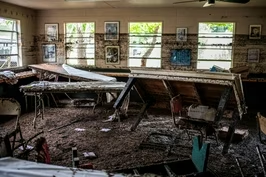
Torrential rains caused the Guadalupe River to suddenly surge on July 4, sending a deluge of water in just a matter of hours through the Texas Hill Country and, devastatingly, through the campgrounds where hundreds of girls slept.
In their final report, state investigators said the camp failed to respond adequately to storm warnings, evacuations were too slow, and there was poor emergency planning.
Just last week, Camp Mystic filed for bankruptcy.
Today, many parents are still pressing for stronger camp safety standards, even as they honor their daughter's memories.
That includes Lacey and Lars Hollis, who lost their 8-year-old daughter, Virginia, that day.
I spoke with them earlier this week.
Lacey and Lars, welcome back to the "News Hour."
Thank you for joining us.
LACEY HOLLIS, Mother of Virginia Hollis: Thank you for having us.
LARS HOLLIS, Father of Virginia Hollis: Thank you, Amna.
AMNA NAWAZ: Last year, when we spoke, you both generously shared with us stories about Virginia.
You told me about how she was a very talented composer and a pianist, a bright, happy child, and a wonderful big sister.
I just have to ask how you both are doing today.
What can you tell us?
LACEY HOLLIS: You know, today I think we're doing OK.
We still take it pretty much minute by minute, to be honest.
And, this week, this last month has been really difficult.
We were expecting it to be difficult, and it has been.
Summer in general, it's just difficult.
But we're happy to be here and still be speaking for Virginia and the girls, and it's very important to us, especially around July 4, to remember them.
LARS HOLLIS: Yes, it's a very difficult week.
It's been a rough month-and-a-half, I'd say.
I had the opportunity to go back to that area where we lost Virginia about a month-and-a-half ago, and I'd say it's very challenging.
We're obviously very focused on the recovery of Cile Steward, who's still missing.
And that, in addition to keeping teachers, campers safe, is a guiding light for us and why we're so involved in the protection of campers throughout the U.S.
LACEY HOLLIS: Yes, I think, in some ways, not just with the anniversary coming up, but the grief itself in some ways is getting kind of harder for us to carry, because we're having to face really the reality of her being gone.
And how do we start moving back towards some kind of regular life?
And just that heaviness has started to feel more real, which is really hard to face.
AMNA NAWAZ: What about Virginia's little sister, Siena?
How is she doing?
LACEY HOLLIS: You know, she -- we are just really, really proud of her.
She's amazing, in that she continues to kind of surprise me with how mature she's become through this.
She was the baby of our family.
She had a big sister who always helped her.
And it breaks your heart, because we are so proud of her.
She is helping us in ways we don't even know.
She's able to express sometimes her feelings, similar feelings that we have, better than we can even.
And it just blows you away, but it also breaks your heart, because these skills and strengths that she's showing, she should never -- she should never have to have those.
AMNA NAWAZ: And, Lars, I know since we last spoke, you have set up a foundation in Virginia's name to help other children.
On the Web site, it says: "Virginia taught us that a beautiful existence is made up of the dreams we chase, the talents we nurture, and the love we share.
We felt Virginia guiding us here."
Tell us more about the foundation and what you hope that it does.
LARS HOLLIS: Certainly.
We're so grateful for the support that we have already received from far and wide.
Virginia in eight years developed so many talents and had mentors beyond our immediate family that helped her achieve such great gifts.
And we wanted to pass that on to other children that -- and so we're -- we have established a found a 501(c)(3) in her legacy called Virginia's Song.
We have already been supporting our local community and passing on her gifts in the arts and athletics and agriculture, and we will continue to spread that love throughout the U.S.
LACEY HOLLIS: It kind of came to us because, really, in some ways, some of all that we have left of her is her song, these memories, these achievements, this these wonderful gifts, her little notes that she would write us, things -- stories and things.
And it kind of came to us because we were so grateful to have those, and all of a sudden wondered.
There must be so many children out there that have these beautiful gifts inside of them that they're never exposed, and really couldn't stand the thought of any child out there with a song or a golf swing or a -- anything hidden inside of them that they weren't able to share.
AMNA NAWAZ: You know, I have to ask you both.
As we have been reporting, the camp won't be operating this summer.
And I know you both were among the many families who were pushing for change and pushing for safety standards and fighting for accountability and channeling your pain into action to make sure another child doesn't endure what those children did.
It's not the right word, but is there a sense of relief for you or something else in some way that girls won't be at the camp this summer or maybe even ever again?
How do you look at that?
LACEY HOLLIS: I very much have a sense of relief that, this summer, the camp is staying closed.
I know we're continuing to grieve and deal with this trauma, and it was -- it felt very soon to even consider having children again in the same spot, knowing other people in that community are going through similar things.
And I think we have a -- very much a sense of relief that the legislation in Texas passed, and they're doing a wonderful job holding the line on that and getting camps on board.
LARS HOLLIS: It's an area that we feel passionate about and taking our grief and turning it into purpose.
A lot of the families, including our family, have gotten involved in the Safe Summers Foundation.
And it's really -- it's an organization that's trying to protect the 26 million summer campers that are in America.
And what we found through this journey has been the inconsistencies in commonsense regulations that come as expected in other childcare facilities in the U.S.
And so, just in the last several months of been in Austin, Jefferson City, Missouri, Washington, D.C.
We have passed laws in four states, and we're going to continue that march and just push for common sense bipartisan safety requirements that these summer camps should implement.
AMNA NAWAZ: And we have to underscore you're doing all of that as you continue to grieve Virginia.
And you've been so generous and so graceful in sharing that grief, which is so personal to each of you in your own way, with all of us, with the millions who've come to know you and Virginia because of this, and who think of you.
I mean, I drop my own children at camp, and my thoughts turn to you.
And I know that I'm not alone in that impetus.
But I have to ask, for people who know you now and who are following your story, what is it that you want them to know about how you've gotten through the last year and how you look at what's ahead?
LACEY HOLLIS: I think there's not just one way we've gotten through this last year.
I couldn't have ever imagined something like this happening that we would have gotten through.
We've gotten through it together.
From day one, I remember waking up and Lars looking into my eyes, holding my hand and saying: "We're going to get through this together.
Like, no matter what, we're going to be together.
Our family is going to survive this."
And I know that gave me just the hope and confidence that we could face it.
I'm not sure this is something you ever get through.
But, most days, gratitude really helps me.
This feeling that our daughter is still kind of living on and creating these meaningful connections with other people all across America, the world, I think it does help.
LARS HOLLIS: Just even in this week, the outpouring of messages and calls from friends and family and other Heaven's 27 families has been -- it's been remarkable.
And I think communication is a big part of getting through this journey, having -- besides just your friends and families, but also having the resources to work with professionals who've counseled other people that have been through similar loss.
That's been a major -- major benefit for us.
LACEY HOLLIS: But I will say, so many people try to encourage us by saying, you're so strong, or we're so proud of you, things like that.
And I don't -- being honest, I don't feel strong.
Every day is such a struggle.
And if we seem strong, I think it's because that's we don't have any other choice.
If we choose to wake up, we have to... LACEY HOLLIS: We have to be -- we have to Siena's parents and be there for each other.
But it's not strength so much as it's just necessity.
AMNA NAWAZ: I hope you know how many people out here are thinking about you, Lars, and you, Lacey, and Siena, and, of course, Virginia.
Lars and Lacey Hollis, we thank you so much for being with us today.
It's good to see you and speak with you.
LARS HOLLIS: Thank you.
LACEY HOLLIS: Thank you.
LARS HOLLIS: Thank you.
AMNA NAWAZ: As the country celebrates its 250th anniversary, a growing threat is putting some of America's most historic places at risk.
Rising seas and coastal erosion are reshaping the landscape where our history unfolded.
Special correspondent Ben Tracy with Climate Central takes us to Jamestown, Virginia, where archaeologists are racing to uncover America's past before it's washed away.
It's part of our ongoing series Tipping Point.
WOMAN: Well, and we know that it's shallow.
BEN TRACY: If you spend your days digging through the past... SEAN ROMO, Jamestown Rediscovery: I think it might be a gate.
BEN TRACY: ... Sean Romo says this is the place to do it.
SEAN ROMO: You can't put a shovel in the ground without finding something.
BEN TRACY: Romo is director of archaeology for Jamestown Rediscovery at the site of America's first permanent English settlement founded in 1607.
What took place here and why does this matter?
SEAN ROMO: Well, for American history, it's harder to have more of an impact than Jamestown.
This is the first place that, when English colonists come over here, they end up staying.
And without Jamestown, there is no modern United States.
BEN TRACY: This is where America's first representative assembly met, where Pocahontas married John Rolfe, and where the first enslaved Africans were forced onto these shores.
SEAN ROMO: And they are kept enslaved by the English colonists.
So in one place, here at Jamestown, we have our ideals of American democracy and our biggest mistake in slavery.
So this is a place where many different cultures interacted.
Many different cultures have a claim on the site, and the history is pretty complicated.
BEN TRACY: The ruins of the original fort were discovered in 1994.
SEAN ROMO: We can just open this up a little bit.
BEN TRACY: And archaeologists have unearthed five million artifacts that tell the stories of the people who lived here.
SEAN ROMO: This is a chain that was found at the bottom of one of Jamestown's early wells.
And you can actually hold it if you like.
BEN TRACY: So this is from how long ago?
SEAN ROMO: This is from the beginning of the 17th century.
BEN TRACY: Now they're using ground-penetrating radar to map out what still lies buried.
SEAN ROMO: Now, if it shows up, that will be really cool.
BEN TRACY: Because this has become triage, a race to save as much history as possible before it's lost.
When I think of archaeology, I think of a very slow, painstaking process.
You, however, don't have time on your side here.
SEAN ROMO: No.
We always have to be meticulous, but we do need to pick the pace up, because we are under severe threat from climate change.
And the real big one for us is flooding.
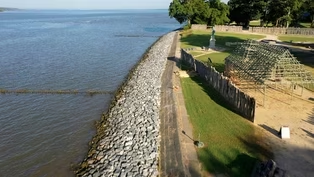
BEN TRACY: Jamestown is under siege from rising waters.
Sea levels here have risen 1.6 feet over the past century and could rise another three feet or more by 2075.
The James River is battering the shoreline on one side.
That swamp is really close.
SEAN ROMO: Yes, and it didn't used to be.
BEN TRACY: While an expanding swamp on the other regularly floods the excavation sites.
So what happens on a day where you get a lot of rain or it's high tide?
SEAN ROMO: On a day with a lot of rain or high tide, we're in the water.
BEN TRACY: And so when you talk about history being washed away, it's a literal thing.
SEAN ROMO: Oh, yes, that's not hyperbole.
It's actually happening right here.
BEN TRACY: And it's not just here.
Our burning of fossil fuels is rapidly warming the planet, causing ice sheets to melt and ocean water to expand as it heats up; 2.5 million Americans and many historic sites could be at risk of severe coastal flooding by 2050.
ROB YOUNG, Western Carolina University: If you want to argue about why or who's causing it, great, knock yourselves out, but sea level is hose rising.
We have been measuring it for more than 100 years.
BEN TRACY: Geologist Rob Young in his team at Western Carolina University are now assessing the risks to all 107 coastal national park sites for the National Park Service, including the Statue of Liberty, Fort Sumter, and Pearl Harbor.
ROB YOUNG: We have increased flooding of roads, parking lots, it impacts visitor access, all kinds of changes like that parks just haven't had to deal with before.
BEN TRACY: What are we most at risk of losing?
ROB YOUNG: The greatest vulnerability in the national park system without question are the barrier island parks in the Southeastern U.S.
BEN TRACY: The Atlantic continues to swallow homes along North Carolina's Outer Banks, which is why the historic Cape Hatteras Lighthouse was moved to quarter-mile inland back in 1999.
But it's one thing to move a lighthouse, another thing to move a Civil War fort.
ROB YOUNG: Yes, we're not going to move Fort Sumter.
So, no, it's not going to look like what it looks like now for your kids or for your grandkids.
Honestly, we can't protect them all.
And the trick for us as a society is to admit that and have a good national conversation about what we do about it and where our national priorities are.
But, unfortunately, I just don't see us having that conversation.
BEN TRACY: So, Sean Romo will continue to dig as long as he can, while Jamestown reinforces its defenses, hoping to buy more time.
Do you see a time where Jamestown Island is basically underwater?
SEAN ROMO: Sadly, yes.
If we do nothing right now, we're going to go from Jamestown Island to Jamestown Islands in the next 50 years.
So the time is now to act to protect this space and to make sure that future generations can still learn about and experience the place where American history was made.
BEN TRACY: For the "PBS News Hour," I'm Ben Tracy with Climate Central.
AMNA NAWAZ: It's been a busy week leading up to the nation's 250th anniversary, with major Supreme Court decisions and more primary upsets.
To discuss all this further, we turn now to the analysis of Brooks and Capehart.
That's "The Atlantic"'s David Brooks and Jonathan Capehart of MS NOW.
Great to see you both.
JONATHAN CAPEHART: Hi, Amna.
AMNA NAWAZ: Let's begin with this Supreme Court, closing out a term with some major decisions.
A quick recap for everyone following along.
Over the term, they handed the president some losses on signature issues like tariffs, birthright citizenship, mail-in ballots, that he couldn't fire a member of the Fed board.
But they also said he could fire members of independent agencies.
They upheld a state ban on trans women in sports.
They sided with him on immigration restrictions.
David, one common thread seems to be an expansion of executive authority given to President Trump.
Is that a good thing?
DAVID BROOKS: No, but I would say have to say, on the big authoritarian power grabs that Trump tried, whether it's the Federal Reserve, birthright citizenship, the tariffs, whether he could put National Guard troops in Chicago against the local officials' interests, the court stood up to Trump and slapped him back down.
And the court hates to take on a sitting president because they don't want to take on an elected official.
Remember, the Roberts courts upheld Obamacare because they just didn't want to upset what democracy had brought to us.
And so I'd say, on the big authoritarian power grabs, the Supreme Court did pretty good.
And it is -- this is grading on a very low curve, but it's the most effective branch of government we have right now.
And so on the Slaughter case, which was about the FTC and all those -- semi-independent agency... AMNA NAWAZ: The firing of the commissioner of the FTC, yes.
DAVID BROOKS: The firing of the commissioner.
It's not my preference.
I like the idea that starting mostly in the 1930s, Federal Reserve was obviously earlier, that we set up some agencies that are protected from raw politics.
DAVID BROOKS: And I think that was a good thing to do.
But a significant branch of legal thinkers have thought, no, they're -- the administration is elected by a president.
It should not be cushioned off from democracy.
I think that's the wrong decision, but it's a reasonable decision.
And so what the court did on this Slaughter case with the FTC and all the other independent agencies was not my preference, but reasonable.
And I'd have to say, on the big issues of preserving our democracy, the Supreme Court did OK this year.
AMNA NAWAZ: And the Slaughter case, we should also underscore, overturned a 100-year-old precedent as well.
AMNA NAWAZ: Jonathan, how did you look at this?
JONATHAN CAPEHART: Well, I don't know if the Supreme Court did OK by democracy.
I mean, David said you thought that the court didn't want to upset what democracy brought to us.
Democracy brought to us the Voting Rights Act of 1965.
And the Supreme Court just gutted it, decimated it.
And states around the country, particularly in the South, moved quickly, with the same speed, if not faster, than when the court took the first whack at it in Shelby v. Holder.
So I'm not as cheerful when it comes to the court in terms of standing -- yes, standing up to the president on the big authoritarian pieces.
But the VRA and Particularly Chief John Roberts really wanting to do something to, to his mind, correct it, predates President Trump.
But the other thing about the Supreme Court's term is that a lot of the decisions that they made, it would have been nice if Congress were functioning and had actually exercised its Article I branch powers to do some of these things.
I mean, it's great that the judiciary is functioning, but it'd be really nice if the legislative branch started acting like a coequal branch of government, instead of the staffing arm of the executive.
AMNA NAWAZ: Well, let's talk a little bit about what could happen in the legislative branch, some of those primary upsets we talked about earlier, because, in the past few weeks, we have seen anti-establishment wins for Democratic candidates in particular.
First to New York.
We saw the Democratic socialist candidate there, Darializa Avila Chevalier, unseat the five-term congressman Adriano Espaillat.
We also saw a former New York Comptroller Brad Lander unseat representative Dan Goldman.
Then, in Colorado, we saw Democratic socialist Melat Kiros oust a 30-year incumbent in Diana DeGette.
And we saw the state A.G., Phil Weiser, there, who ran to the left of Senator Michael Bennet, beat him in the gubernatorial primary there.
So, David, you see New York and Colorado.
Does two make a trend?
DAVID BROOKS: I think so.
I think this is a big -- the Colorado story is a bigger story than the New York story.
New York's my hometown.
I love it, but Brooklyn hipsters and Columbia University are not exactly normal America.
But Colorado is Colorado.
It's a semi-purplish state.
Michael Bennet was elected three times to the U.S.
Senate statewide, and he lost.
And then you had the Democratic Socialist candidate win.
And what you see, it's been - - it's been compared, I think, accurately, to when Dave Brat beat Eric Cantor in the Republican primary, and you saw a bunch of people said, these -- my party, screw them.
We're going to tear it all down.
And in that case, and I think, in this case, Democrats are -- they're just looking around through the most furious candidate because they're furious at what's happened.
And so they're doing that.
And I understand the fury.
My problem is, the DSA, the Democratic Socialists of America, should not be where you go.
The Democratic Socialist Party was started in the 1980s by Michael Harrington, a very wonderful guy, a serious intellectual, and he wanted the DSA to move us toward Denmark, a perfectly good political position.
Over the last five years, that party has been hijacked and taken over by an authoritarian wing, which supported Hamas in October 7, who supports Cuba, who supports China, who supports Maduro's Venezuela, who supports pretty much every left-wing authoritarian regime in the country.
So I understand wanting to register a protest against Washington.
But are the Democrats really going to take a position that we're going to become left-wing authoritarians, just as the Republicans become right-wing authoritarians?
And the final thing to be said is, the Democratic Party became great not by fighting the right, but by fighting the left.
It was Hubert Humphrey in 1946 who pushed the communists out of the Democratic Farmer -- the DFL, the Democratic Farmer Labor Party.
It was George Meany who pushed the communists out of the labor movement, basically.
And they defined who they were by pushing against the right, but also by pushing against the left.
And we're going to see if the Democratic mainstream has the guts, the conviction, or even the clarity of thought to push against what's happening.
And we will see.
AMNA NAWAZ: Jonathan.
JONATHAN CAPEHART: I'm going to get -- outrage - - I'm not going to I'm not going to fall into the Democratic trap of, oh, my God, the Democratic socialists are taking over the country when we're talking about, one, wins in deep blue seats in congressional districts, two, when we're talking about what really to me is the big trend here is that the establishment, the incumbents are being thrown out.
And folks are angry.
They're angry because of affordability.
They're angry because the president is robbing the nation blind.
They're angry because it doesn't seem like it any of these elected officials are doing anything to hold the president accountable for what's happened.
I mean, Diana DeGette is no conservative.
She was a progressive.
Congressman Dan Goldman, not big capital-P progressive, but he was left of center.
Brad Lander, who -- another person who beat Dan Goldman, he's no socialist.
He's basically like a mainstream Democrat in New York City.
And so, to my mind, I think we need to pay attention to what voters are saying.
If they're choosing the Democratic Socialist candidate, then Democrats need to pay attention to, well, why did they choose the DSA candidate and not someone who's a little closer to the center?
Could it be that their message on the economy, their message on what they're going to do is resonating?
And, quite honestly Mayor Mamdani, who has put his weight behind a lot of these candidates, the thing he has going for him is, New York City is doing fine.
A lot of people predicted that, oh, you put you elect a Socialist, and then the city will go to pot.
And instead, it's -- I'm not going to say it's the opposite, but the dire predictions haven't proven true.
And so I think it there's still time to look at other races to see whether the DSA is actually a thing, and a thing in the way that the Tea Party had become for Republicans in the way-back.
AMNA NAWAZ: Lots more races ahead.
We will talk about it some more, but I'm not sure if you heard or not, in the meantime.
America's turning 250 tomorrow.
AMNA NAWAZ: We have been talking about it a little bit.
When we step back to see how Americans are looking at their own country right now, we have some insights from our latest PBS News/NPR/Marist poll.
It found 65 percent of people say that they're proud to be American; 83 percent say the country has moved away from its founding principles and ideals.
And at the same time, some 53 percent of Americans say the country's best days are still ahead of us.
So, David, do you see more reason to be concerned then or more reason to be hopeful?
DAVID BROOKS: I'm hopeful.
We go through this.
We go through periods every few decades where people just want to burn everything down.
And it was brutal to live through those periods, but we get through them.
And we get through them because we're a nation of awesome vitality.
We have the vitality to change and to fix things, and we have done it again and again in the 1770s, 1830s, 1890s, the 1960s.
So we're going to do it again.
And I have tremendous love for the country, but also tremendous compassion for the country, for the evils we have done, for those who've suffered from those evils, and you got to have love for your country and compassion for the country at the same time.
AMNA NAWAZ: Jonathan, last word to you on this, I should say your birthday weekend.
Belated happy birthday to you.
JONATHAN CAPEHART: Well, thank you very much.
I consider myself to be part of the 65 percent who are proud of their country.
It's times like these when I feel most patriotic, because this is when I get to say, you know what, this country's mine.
This country is mine too.
My ancestors were brought here in chains, and they helped build this country and to help to make it a great power.
My ancestors, meaning Black community, writ large, marched in the streets demanding that this country live up to its ideals in the 1950s and the 1960s, which made it possible for me to sit here right now.
There's backtracking.
There's regression.
But I am optimistic because this is America.
How could I not be optimistic when the history that allowed me to be here is going to be the history that is going to keep us going forward?
AMNA NAWAZ: Jonathan Capehart, David Brooks, thank you so much.
JONATHAN CAPEHART: Thanks, Amna.
AMNA NAWAZ: Happy fourth.
JONATHAN CAPEHART: And to you.
AMNA NAWAZ: Well, this week, PBS News launched "In Pursuit of Happiness," a six-episode podcast series hosted by Judy Woodruff exploring the people, the culture, and the ideas that have shaped America.
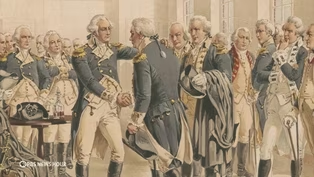
In this clip from the very first episode, presidential historian Lindsay Chervinsky takes a fresh look at President George Washington and why he believed surrounding himself with competing viewpoints made him a stronger leader.
LINDSAY CHERVINSKY, Presidential Historian: Bravery was never the problem.
Early on, he made decisions.
So, for example, Fort Necessity, this was after the initial conflict with French and Native allies.
He built a fort as a defensive mechanism, and it was very poorly situated.
He took none of the knowledge from Native allies at this point in his life.
And many of his troops said that this was a poor place to build the fort, and he didn't listen.
He was too stubborn and too proud to listen to that advice.
Later on, he learned from that.
And so he both learned how to better position his forces, but also who to listen to.
JUDY WOODRUFF: And whatever lessons he learned or didn't learn in the years when he was wearing a uniform, of course, carried on to his time as president.
We have a question.
And we can't cover his entire presidency.
We're not even going to try.
But I do want to listen to one viewer who had a question about his Cabinet.
WILLIAM HEDRICK, Alamogordo, New Mexico: Hi.
I'm William Hedrick.
I'm from Alamogordo, New Mexico.
As a military commander and as the chief executive, why did he allow so much unresolved conflict within his inner core, both within the revolution and once he was president, and specifically between Hamilton and Jefferson?
LINDSAY CHERVINSKY: I love this question, because it actually was central to his leadership.
So, because Washington didn't have a lot of the training, didn't have a lot of schooling, he intentionally surrounded himself with people who had a lot more knowledge, a lot more experience than he did, but also were different from one another.
He wanted to have a lot of different perspectives, and he started this practice during the revolution, where he would call a council of war and he would pose a series of questions.
He almost never went into a meeting with his mind made up.
So you would pose these questions, and then he would allow his officers to debate, and that was by design, because he wanted them to poke holes in each other's arguments.
He wanted them to flesh out the weaknesses of the other position, because it allowed him to try and get as much information and to have as many different ideas presented to him as possible.
JUDY WOODRUFF: And he and Hamilton, of course, were close and remained close until Hamilton's... LINDSAY CHERVINSKY: They did.
But the thing is, is, when Jefferson and Hamilton were disagreeing with each other, Washington sided with Jefferson almost 50 percent of the time.
So the idea that Washington was controlled by Hamilton is total Jefferson propaganda.
And, instead, he was often trying to triangulate to find a middle ground between the two, a more moderate position.
But you -- if you look at the Cabinet records, you can almost -- it's almost as though he's counting, because one day he's with Hamilton and the next day he's with Jefferson, and then the next day he's with Hamilton, and the next day he's with Jefferson.
He was meticulous about trying to find that middle ground, and I do actually think it made him a better president.
JUDY WOODRUFF: Why did he care so much about the middle ground?
What was that all about?
LINDSAY CHERVINSKY: Well, he was trying to be a president for all Americans, and they represented two distinct poles, two distinct visions of what the country could be, but they were also among the more radical perspectives of those two positions.
And so, by finding a middle ground, I think he believed he was best serving the nation.
AMNA NAWAZ: And you can watch "In Pursuit of Happiness" on our YouTube page or listen wherever you get your podcasts.
Meanwhile, this weekend, PBS News presents "Bruce Springsteen: Finding America in Song."
Geoff Bennett speaks with the musician about the country's musical history and his new Center for American Music in New Jersey, as America marks this milestone anniversary.
Here's a preview.
GEOFF BENNETT: An American music icon reflects on the role songs play in America's story as the nation marks its 250th anniversary.
BRUCE SPRINGSTEEN, Musician: I'm in the hearts and minds business.
You change people kind of one at a time, and I believe that culture has impact.
GEOFF BENNETT: "Bruce Springsteen: Finding America in Song," a PBS News special.
AMNA NAWAZ: And be sure to check your local listings or watch on our YouTube page.
This weekend on "Horizons," William Brangham explores some unsung heroes of American invention and innovation.
And on "Compass Points," an examination of America's foreign policy legacy as the nation turns 250.
You can watch both "Horizons" and "Compass Points" on our YouTube channel, wherever you get your podcasts, and on your local PBS station.
Check your local listings.
And that is the "News Hour" for tonight.
I'm Amna Nawaz.
On behalf of the entire "News Hour" team, thank you for joining us.
Have a wonderful, safe Fourth of July.
 New
NewBrooks and Capehart on Supreme Court standing up to Trump
Video has Closed Captions
Brooks and Capehart on whether the Supreme Court has stood up to Trump (10m 56s)
 New
NewGeorge Washington’s belief in the power of differing views
Video has Closed Captions
Why George Washington believed in the strength of differing viewpoints (3m 51s)
 New
NewHow climate change endangers historic sites like Jamestown
Video has Closed Captions
How climate change and rising seas endanger historic sites like Jamestown, Virginia (5m 49s)
 New
NewNews Wrap: Iran begins funeral ceremonies for Khamenei
Video has Closed Captions
News Wrap: Iran begins funeral ceremonies for late Supreme Leader Khamenei (5m 34s)
 New
NewParents push for safety a year after fatal Camp Mystic flood
Video has Closed Captions
One year since deadly flood at Camp Mystic, parents push for better safety standards (11m 40s)
 New
NewRecord heat engulfs parts of the U.S. ahead of July 4th
Video has Closed Captions
The growing dangers of record heat waves like the one engulfing July 4th celebrations (5m 38s)
 New
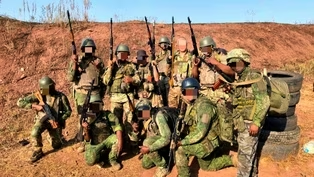
NewRussia lures African soldiers to deadly front in Ukraine
Video has Closed Captions
Lured by Russia, African soldiers end up on deadly front lines of Ukraine war (8m 21s)
Providing Support for PBS.org
Learn Moreabout PBS online sponsorship New Episode
- News and Public Affairs

Today's top journalists discuss Washington's current political events and public affairs.
 New Episode
- News and Public Affairs

FRONTLINE is investigative journalism that questions, explains and changes our world.
 New Episode
 New Episode
 New Episode
 New Episode
 New Episode


 New Episode
 New Episode
 New Episode
Support for PBS provided by:
Major corporate funding for the PBS News Hour is provided by BDO, BNSF, Consumer Cellular, American Cruise Lines, and Raymond James. Funding for the PBS NewsHour Weekend is provided by...