
January 10, 2026 - PBS News Weekend full episode
1/10/2026 | 26m 44sVideo has Closed Captions
January 10, 2026 - PBS News Weekend full episode
January 10, 2026 - PBS News Weekend full episode
Problems playing video? | Closed Captioning Feedback
Problems playing video? | Closed Captioning Feedback
Major corporate funding for the PBS News Hour is provided by BDO, BNSF, Consumer Cellular, American Cruise Lines, and Raymond James. Funding for the PBS NewsHour Weekend is provided by...
Support provided by:

January 10, 2026 - PBS News Weekend full episode
1/10/2026 | 26m 44sVideo has Closed Captions
January 10, 2026 - PBS News Weekend full episode
Problems playing video? | Closed Captioning Feedback
How to Watch PBS News Hour
PBS News Hour is available to stream on pbs.org and the free PBS App, available on iPhone, Apple TV, Android TV, Android smartphones, Amazon Fire TV, Amazon Fire Tablet, Roku, Samsung Smart TV, and Vizio.
Providing Support for PBS.org
Learn Moreabout PBS online sponsorshipJOHN YANG: Tonight on PBS News Weekend, ICE# shootings spark protest around the country## as the Trump administration deploys more Border# Patrol agents to Minneapolis.
Then, why critics## say Myanmar's first election since a military# coup five years ago are a sham.
And a new book## offers a glimpse into one of the most secretive# and controversial companies in Silicon Valley.
MAN: It enables lots of companies to# make better use of the information## they collect.
Most of the work it does# is pretty benign.
Some of it is quite## laudable.
But then there's other stuff that# gives a lot of people cause for concern.
(BREAK) JOHN YANG:## Good evening.
I'm John Yang.
This week's series# of shootings by federal agents enforcing President## Trump's crackdown on illegal immigration# has sparked a weekend of protests.
There## were rallies and demonstrations across the# country.
They were organized after a woman## was fatally shot by an Immigration and Customs# Enforcement agent in Minneapolis on Wednesday and## a Customs and Border Protection agent wounded# two people the next day in Portland, Oregon.
In Minneapolis, crowds gathered in the city where# an ICE officer shot and killed 37 year-old- Renee## Nicole Good and demanded that ICE leave.
Voices of# anger and outrage were heard across the country.
STEVEN EUBANKS, Protester: Killing# people in the streets intimidation## tactics is horrifying and we can't# allow it.
We have to stand up.
WOMAN: We want ICE off the streets.
JOHN YANG: From Durham, North Carolina, to# rainy Washington, D.C.
and Philadelphia,## demonstrators in hundreds of cities and towns# took to the streets in a mass protest dubbed## the ICE out for Good Weekend of Action.
Some# protesters say ICE is overstepping its legal## power and jeopardizing public safety.
For others,# the threat to democracy is just as urgent.
KELLY MIKEL WILLIAMS, Candidate for U.S.# Congress: We will win when we come together,## because it's not about them, it's about us.# Trump must go now.
ICE must go for good.
JOHN YANG: More protests are scheduled for# tomorrow.
Lisa Gilbert is the co-president of## Public Citizen, a progressive advocacy group# that helped organize today's protests.
Lisa,## what are you hearing from around the# country about turnout and whether or## not there have been any problems or troubles?
LISA GILBERT, Co-President, Public Citizen:# Well, turnout has been amazing.
We're holding## 1,000 plus events, peaceful, lawful vigils# around the country in this astounding moment## where people are reacting to an atrocity.# It was organized in only 48 hours and so the## massive numbers we're seeing the number of people# turning out telling their neighbors to turn out## all of it just demonstrates the real magnitude# of the outrage that I think people are.
JOHN YANG: Were you surprised# that it came together so quickly?
LISA GILBERT: I think this issue really# impacts us all.
No one in America should## walk the street fearful of masked agents should# be worrying that their businesses could be## ransacked or facing intimidation and violence# or even death just for being a good neighbor## I think many people see themselves in this# incident have been truly horrified at the## escalating violence that they've seen from ICE# and CBP and this moment sparked a people are## reacting to an abuse of power that they've# been watching for many weeks and months.
JOHN YANG: what was the goal for# today what do you hope to accomplish?
LISA GILBERT: The goal for today is to have# a community led non-violent lawful reaction## to the horrors that we've been seeing the# deadly violence the terror wielded by ICE## the abuse of power from Trump none of# it is acceptable.
So we want to honor## and humanize the lives that have been taken# by ICE.
We want to demand accountability and## transparency and immediate investigation# into the killing of Renee Good and just## really expose the systematic pattern of violence# which, you know, it does not just include Renee.
It includes 30 plus lives that have been lost in# ICE detention just in 2025.
So calling attention,## calling for accountability, these are our goals.
JOHN YANG: The Trump administration has# already said that they're going to send in,## deploy more a bigger federal presence# into Minneapolis.
What do you say to that?
LISA GILBERT: I think it is exactly the# wrong reaction.
People are calling for this## nonessential, unnecessary, militarized# force to leave.
The reaction has been## clear.
And what more troops will spark is more# intensity.
And what we want to do is deescalate,## focus on accountability for# the harms that have already## been perpetrated and move forward.
This# is exactly the wrong direction to go.
JOHN YANG: Both Minneapolis Mayor Jacob Frye# and Minnesota Governor Tim Walz warned against## doing anything that could sort of be served, be# used as a pretext for sending in more federal## agents.
What do you say to that?
Was that a# concern when you were organizing these events?
LISA GILBERT: Well, our events are First# Amendment rights protests.
So long as they## are nonviolent and peaceful, which they have been# and which was the goal and undergirded all of## our organizing.
We were not concerned that what# were doing could spark reaction of this nature.
However, we know the Trump administration is# seeking any excuse to put further troops into## the nation to militarize at higher levels.# We've even been fearful, as many know,## of the Insurrection Act being invoked at any# spurious pretext.
So we are of course always## worried about what the Trump administration# will do.
They have clear authoritarian goals.
But I think what we can control is# how peaceful and clear our actions## are.
And they're needed in this moment of# violence.
We need to stand up together.
JOHN YANG: And do you think the# momentum will keep up tomorrow?
LISA GILBERT: I do, absolutely.
I think we've# only seen growth throughout the day.
Yesterday## there were 500 events.
By the night there were# 800, by the morning there were a thousand,## and so on and so forth.
People are# really outraged and it's showing up## everywhere across the country and# we expect it to continue building.
JOHN YANG: Lisa Gilbert, co-president# of Public Citizen, thank you very much.
LISA GILBERT: Thank you.
JOHN YANG: And tonight's other headlines.
Tensions# are escalating in Iran as protests near a second## week.
Today, Iran's attorney general warned# that protesters could face the death penalty.## President Trump has warned of retribution if# peaceful protesters are met with violence.
Despite efforts to clamp down on dissent,# demonstrations have grown fueled by anger## with the hard line ruling regime and the# worsening economy.
Human rights watchers## say at least 72 people have been killed and more# than 2,000 detained since the protests began.
The U.S.
military confirmed this evening that# it conducted several large scale strikes against## ISIS in Syria in retaliation for an ambush# on American forces last month.
U.S.
Central## Command said several airstrikes were launched# throughout Syria as part of Operation Hawkeye## Strike.
It's an effort to target Islamic# terrorism and prevent future attacks.
Last## month's attack killed two U.S.
troops and# a civilian translator working in Palmyra.
President Trump has moved to tighten U.S.
control# over revenue from the sale of Venezuelan oil.
An## executive order aims to prevent legal claims# on the funds by putting the money beyond the## reach of the courts.
The administration# says the purpose is to ensure economic## and political stability in Venezuela and to# curb illegal immigration.
It says the money## will be the property of Venezuela but# will be held in U.S.
treasury accounts.
Mr.
Trump signed the order after meeting# with more than a dozen oil executives at## the White House in an effort to raise $100 billion# investments to fix Venezuela's oil infrastructure.
And rescuers in the Philippines# say there's hope of finding more## survivors in a massive avalanche of garbage.
Disaster response teams say they're sending## special equipment to the scene after detecting# signs of life.
Four people were killed and dozens## went missing on Thursday after a mountain# of garbage suddenly collapsed.
Rescuers## have been racing the clock to find survivors.# So far, 12 injured workers have been rescued.
Still to come on PBS News Weekend,# with voting underway in Myanmar,## what's at stake as the country's civil war# rages on.
And a peek behind the curtain of## one of Silicon Valley's most secretive# and common controversial companies.
(BREAK) JOHN YANG: This weekend in Myanmar,# which is also known as Burma,## the second phase of national elections is# underway.
It's the first election since## the ruling military regime seized power five# years ago.
But with major opposition parties## barred from participating, leaders jailed, and# an ongoing civil war keeping many from voting,## the process is widely criticized as a sham.# Special correspondent Kira Kay has our story.
KIRA KAY (voice-over): The newsroom of the# Democratic Voice of Burma, DVB is on countdown,## their 2:00 p.m.
broadcast about to go live.# Today's news is the bombing of a hospital## by the Burmese military who took control# of the country in a coup five years ago.
Although the junta says they were striking# rebels, they are fighting, DVB's reporters## confirm that 34 civilians were killed, including# a pregnant woman and a three month old baby.
AYE CHAN NAING, Democratic Voice of# Burma: You see all these bombing in## Gaza or bombing in Ukraine almost# every day on the TV and similar## things happening in Burma every day.
We're# seeing two or three airstrikes every day.
KIRA KAY (voice-over): Aye Chan Naing, DVB's# founder, relies on a network of journalists who## risk their lives daily to get footage out of the# country.
The newsroom sits in northern Thailand.
KIRA KAY: And this is all across the country?
KIRA KAY (voice-over): It had been founded in# exile in 1992 and now finds itself there again## after the coup.
Life in Myanmar today is a# far cry from its so called decade of hope,## which began in 2010 when the long repressed## country first tentatively opened# to the world and tried democracy.
That's when Nobel Prize winning opposition leader# Aung San Suu Kyi was released from house arrest,## allowed to run for parliament and eventually# became the country's de facto leader.
The## United States engaged, funding democracy efforts# and encouraging investment.
Newsrooms opened.
AYE CHAN NAING: We were quite excited to be able# to move back to Burma.
We were able to travel## around the country.
We can do stories from# anywhere.
Young people are really enjoying## the freedom, mobile phone, internet, it's# affordable to almost everybody and lots## of foreign companies are coming in.
So it's# a pretty promising future for the country.
KIRA KAY (voice-over): But the military never# fully let go.
The constitution guaranteed them## 25 percent of the seats in Parliament, giving them# an effective veto over true reform.
And the army's## genocide of the minority Rohingya people, which# happened under Aung San Suu Kyi's leadership,## was a black stain on her reputation.
She walked a# fragile line with the military from the beginning.
AUNG SAN SUU KYI: If you have read the present# constitution, you will understand that without## the backing of the military.
We can never say# that we are really on the road to democracy.
KIRA KAY (voice-over): Then on February 1, 2021,## following another humiliating loss at# the polls and claiming election fraud,## the military ended the democracy experiment.# Newly elected parliamentarians, including## these three from Aung San Suu Kyi's party,# were about to be sworn in for the new term.
THIDA NYEIN, Mandalay Regional Parliament# (through translator): They detained U.S.## regional representatives elect# at 2:00 a.m.
i.. Some of the male representatives were taken# away with hoods over their heads.
Civil## servants and students launched a nonviolent# protestant.
But then the junta cracked down.
THIDA WIN, Myanmar National Parliament# (through translator): We had to launch## our resistance together.
Students and# ot.. public.
None of us wanted to do armed# resistance.
But we had no other choice.
YIN MIN HLAING, Myanmar National# Parliament (through translator):## I took a leading role in organizing# units of the People's Defense Fo.. held basic military trainings on the border in# coordination with people from my constituency.
KIRA KAY (voice-over): Five years later,# Myanmar is in the grips of a brutal civil## war that an increasingly desperate junta has# not been able to win despite help from abroad.
TOM ANDREWS, Special Rapporteur for# Myanmar: We've been tracing the use## of sophisticated weapons of war to attack# civilians.
Where is the junta getting these## weapons?
Who's supplying them?
Well,# Russia number one, China number two.
KIRA KAY (voice-over): Tom Andrews# is a former U.S.
congressman and## current Special Rapporteur for# Myanmar to the United Nations.
TOM ANDREWS: The international# community has been not only## not providing the requisite# levels of humanitarian aid,## but have been unwilling to provide the pressures# necessary to back this military junta off.
KIRA KAY (voice-over): Western sanctions# on jet fuel and Myanmar's banking systems## have been partial and uncoordinated.# The Trump administration dropped some## American sanctions on allies of# the ruling generals this summer.
KIRA KAY: Aung San Suu Kyi.
Where# has she been?
Has anyone seen her?
TOM ANDREWS: No, we just don't know# what her condition is.
We don't know## where she is.
We've heard reports of# her being moved to harsher conditions,## but it's very difficult to get information.
KIRA KAY (voice-over): While fighting# rages in the country.
Across the border## in neighboring Thailand, a pro-democracy movement# is flourishing comprised of one selected leaders.
NAY PHONE LATT, National Unity Government: I will# try my best to take down this military junta.
KIRA KAY (voice-over): The NewsHour first met# Nay Phone Latt 10 years ago as he registered## to be a first time candidate with his father in# tow.
We next met him in hiding in 2022 as helped## establish a pro-democracy national cabinet.# He admits he's tired, but no less determined.
NAY PHONE LATT: The young generation and# Generation Z, they are fighting against## military junta forces in the battlefield.
Compared# with them, you know, my situation is not so bad.
KIRA KAY (voice-over): Those young forces# have gained territory from junta control and## local administrations are taking over with# guidance from the pro-democracy leadership.
NAY PHONE LATT: In some control area, we have# to give the public service to the people,## especially education and also the hair care# system.
And also there are so many public## service things.
So we are trying to give# that kind of public service to the people.
KIRA KAY (voice-over): The women# parliamentarians are also actively## coordinating aid and services for the# communities in most desperate need.
WOMAN: Now we are collecting taxes# and rely on that money for public## services.
My ministry is the Ministry# of Electricity and Energy.
We oversee## road construction and can also provide# electricity to hundreds of villages.
But now, despite having lost control# of significant parts of the country,## Myanmar's military government has decided this# is the time to hold a new nationwide election.
TOM ANDREWS: The junta knows how much they# would lose in a free and fair election.
So## they're doing everything possible to go# through this ruse, this charade of an## election.
We're going to make sure that the actual# political parties that would overwhelmingly win,## that they're all outlawed.
We'll make sure that# freedom of speech is outlawed and hope that## the international community is going to ignore# everything and accept this so called election.
KIRA KAY (voice-over): Inside Myanmar,## brave Burmese activists are urging a boycott# openly on public str.. their lives.
There have already been more# than 300 arrests under a new so called## election interference law with violators# facing the potential of the death penalty.
YIN MIN HLAING (through translator): I# feel abandoned and have much less faith## in democracy.
The world doesn't need to do a# lot of things to help Myanmar.
First recognize## our truly elected leadership, put pressure on for# the release of our leaders, help prevent jet fuel## and arms by sanctioning and other methods,# and strongly reject these sham elections.
TOM ANDREWS: You have champions on the front# lines of the very values that are supposed## to be about what Americans are all about.
It's# also in our national security interests.
This## is a very strategically important part of the# world, the natural resources that are there.
The United States and other countries# really have an opportunity here to stand## for principle but also sees strategic interest.
KIRA KAY (voice-over): Myanmar's military# government says it will announce final results## after a third round of voting at the end of# January.
Voter turnout so far has been low.## For PBS News Weekend, I'm Kira Kay# along Thailand's border with Myanmar.
JOHN YANG: On January 26, the Trump# administration will end temporary## protected status for about 4,000 Burmese# refugees in the United States, saying it's## now safe for them to return.
Advocates for# these refugees say most of them are human## rights defenders who would be targeted by the# military regime if they were forced to go back.
Multimillion dollar Palantir Technologies# is one of the most secretive and powerful## companies in Silicon Valley.
It develops# software that can quickly analyze massive## amounts of data.
It's used by government# agencies, the military and major corporations.## A new book, "The Philosopher in the Valley: Alex# Karp, Palantir and the Rise of the Surveillance"## gives readers a glimpse inside this controversial# tech firm and its outspoken and colorful CEO.
Ali Rogin spoke with the author, New York Times# Magazine contributing writer Michael Steinberger.
ALI ROGIN: Michael, thank you so much# for joining us.
Let's start with the## most essential question.
Who is# Alex Karp and what is Palantir?
MICHAEL STEINBERGER, Author, "The Philosophy in# the Valley": Alex Karp is the CEO and co-founder## of Palantir.
And Palantir is a technology firm# that specializes in data analytics.
It makes## software that enables organizations to make# faster, more efficient use of their own data.## It's important to clear up some of the things# that Palantir doesn't do.
It doesn't collect## data.
It doesn't store data, and it doesn't# sell data.
It just enables organizations,## and these are typically large organizations,# to make better use of their own data.
ALI ROGIN: Depending on who you talk# to, Palantir is an amazing tool for## data collection and efficiency, or it's very# dangerous technology that has potential for## great abuse.
Why is it that this company arouses## such strong feelings on both sides?
MICHAEL STEINBERGER: Because both of those## things are true.
It enables lots of companies# to make big better use of the information## they collect.
It makes their businesses more# efficient, their operations more efficient.
But Palantir also works, for instance, with the# CIA and a number of other clandestine services.## Its technology is being used now by ICE to help# facilitate deportations here in the United States.## So it's used by a wide range of organizations.# Most of the work it does is pretty benign.
Some of## it is quite laudable.
But then there's other stuff# that gives a lot of people cause for concern.
ALI ROGIN: Much of the book is a case study# on who Alex Karp is.
And you write about the## fact that he is not a tech guy by training,# by background, but he does seem to embody## the dominant Silicon Valley ethos right now# with a lot of these companies making these## very powerful technologies with little to no# oversight, with great potential for misuse.
But what they say is if we don't make# them, these tools are going to fall## into the hands of the bad guys.
How do you# think about that as it relates to Alex Karp?
MICHAEL STEINBERGER: Well, that# has always been Karp's pitch.
He## has emphasized for over 20 years now that# Palantir takes great care to guard privacy,## is very concerned about protecting civil# liberties.
Basically, the idea has always## been that its software can enable law enforcement# to find the bad guys without pulling millions of## innocent people into their dragnet and so his# pitch essentially has always been, trust me.
But, you know, the reality is that Palantir# doesn't police the use of its own technology.## It is up to the client to decide how rigorously,# for instance, they wish to enforce the privacy## controls that the software is equipped# with.
And the concern has always been that## technology this powerful can lend itself to# abuse.
And there have been instances of abuse.
And there are obviously a lot of concerns at# the present moment about how it's being used,## for instance, by the U.S.
government,# by different government agencies.
ALI ROGIN: I want to press on# that.
You write in the book about## how Karp has defended his work with ICE.
Palantir# has had contracts with ICE for a number of years,## and, of course, ICE is coming under greater# scrutiny these days due to some of its actions.
How would you think Karp would explain Palantir's# work with ICE if he were asked about it today?
MICHAEL STEINBERGER: Well, he has defended# Palantir's work with ice.
You know, his view## on immigration has evolved.
During the first# Trump presidency, when Palantir software was## being used by ICE, he did not agree with Donald# Trump's views on immigration.
He's now singing## a very different tune during the second Trump# presidency.
He believes that the 2024 election,## among other things, signaled that basically# Americans wanted to keep the demographics of## the country the same way, and that essentially# empowered Trump to pursue this crackdown.
And you know, Karp has made very clear# that Palantir is happy to work with ICE to## implement that policy.
I have not spoken to him# about what happened in Minneapolis, for instance,## but he has kind of brushed aside the# concerns that people have expressed,## even people internally at Palantir, about# the work the company is doing with ice.
ALI ROGIN: And your book paints a really detailed# and intimate picture of who he is as a person,## his eccentricities.
And one of the things I wanted## to ask you about is the fact that his# alma mater, which you share with him,## Haverford College, will not invite him to# speak.
Why is he so obsessed with that?
MICHAEL STEINBERGER: Well, I# think with a lot of these guys,## there's always something in their lives,# something.
Someone not acknowledging## their success, someone not giving# them what they think they're due.
And for much of the time that I was reporting# the book, this was kind of a jokey thing.
I mean,## he would kind of joke about it, but# you knew that he was being serious.## He was very irritated that Haverford# wasn't inviting him to speak on campus## at commencement or on any other occasion,# despite the success he's had leading Palantir.
But it turned more serious after October# 7, after the October 7 massacre in Israel,## when protests erupted on college campuses across# the United States, including at Haverford.
And## he was very angry about what was happening# on the Haverford campus to the point that## he said to me that he would never give# a dime to the school.
So what's kind of## a joking through line through much of the# book turns quite serious towards the end.
ALI ROGIN: Michael Steinberger, the new# book is "The Philosopher in the Valley":## Thank you so much for joining us.
MICHAEL STEINBERGER: Thank you for having me.
JOHN YANG:## And that is PBS News Weekend f.. I'm John Yang.
For all of my colleagues,# thanks for joining us.
See you tomorrow.
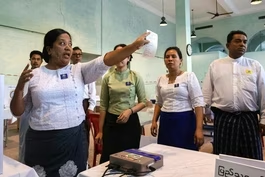
Critics call 1st Myanmar election since military coup a sham
Video has Closed Captions
Critics call Myanmar’s first elections since military coup a sham as civil war rages on (9m 29s)
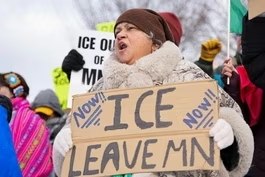
ICE shootings spark outrage, protests across the country
Video has Closed Captions
ICE shootings spark outrage, protests across the country demanding accountability (5m 45s)

New book looks inside controversial tech firm Palantir
Video has Closed Captions
New book offers glimpse inside world of controversial tech firm Palantir and its CEO (6m 14s)
Providing Support for PBS.org
Learn Moreabout PBS online sponsorship
- News and Public Affairs

FRONTLINE is investigative journalism that questions, explains and changes our world.

- News and Public Affairs

Amanpour and Company features conversations with leaders and decision makers.












Support for PBS provided by:
Major corporate funding for the PBS News Hour is provided by BDO, BNSF, Consumer Cellular, American Cruise Lines, and Raymond James. Funding for the PBS NewsHour Weekend is provided by...