
December 3, 2025 - PBS News Hour full episode
12/3/2025 | 57m 46sVideo has Closed Captions
December 3, 2025 - PBS News Hour full episode
Wednesday on the News Hour, the Pentagon's watchdog finds Pete Hegseth's infamous Signal chat put U.S. personnel at risk. As immigration crackdowns begin in new cities, we explore the expanded role Border Patrol agents are playing, far beyond the U.S.-Mexico border. Plus, Congress returns to Washington as Republicans confront issues that expose rifts within the party, including the Epstein files.
Problems playing video? | Closed Captioning Feedback
Problems playing video? | Closed Captioning Feedback
Major corporate funding for the PBS News Hour is provided by BDO, BNSF, Consumer Cellular, American Cruise Lines, and Raymond James. Funding for the PBS NewsHour Weekend is provided by...
December 3, 2025 - PBS News Hour full episode
12/3/2025 | 57m 46sVideo has Closed Captions
Wednesday on the News Hour, the Pentagon's watchdog finds Pete Hegseth's infamous Signal chat put U.S. personnel at risk. As immigration crackdowns begin in new cities, we explore the expanded role Border Patrol agents are playing, far beyond the U.S.-Mexico border. Plus, Congress returns to Washington as Republicans confront issues that expose rifts within the party, including the Epstein files.
Problems playing video? | Closed Captioning Feedback
How to Watch PBS News Hour
PBS News Hour is available to stream on pbs.org and the free PBS App, available on iPhone, Apple TV, Android TV, Android smartphones, Amazon Fire TV, Amazon Fire Tablet, Roku, Samsung Smart TV, and Vizio.
Providing Support for PBS.org
Learn Moreabout PBS online sponsorshipGEOFF BENNETT: Good evening.
I'm Geoff Bennett.
Amna Nawaz is away.
On the "NewsHour" tonight: The Pentagon's watchdog finds Defense Secretary Pete Hegseth's now infamous Signal chat put U.S.
personnel at risk.
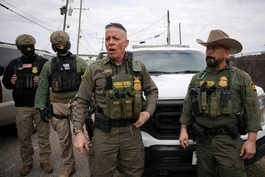
As immigration enforcement crackdowns begin in new cities, we explore the expanded role Border Patrol agents are playing far beyond the U.S.-Mexico border.
Congress returns to Washington, as Republicans confront a host of issues that are exposing rifts within the party, including the expected release of the Epstein files.
And near the Israel-Lebanon border, farmers are caught in a conflict, despite a cease-fire between Israel's military and Hezbollah.
MOHAMMED ALLAWI, Farmer (through translator): We don't know what will become of us.
We live from this land.
Our lives have been destroyed.
(BREAK) GEOFF BENNETT: Welcome to the "News Hour."
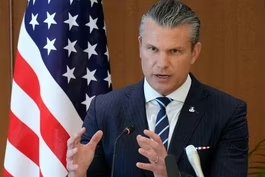
A Pentagon watchdog report has found that Defense Secretary Pete Hegseth put U.S.
service members at risk when he used the Signal messaging app to discuss a military strike in Yemen earlier this year.
His use of Signal came to light when a journalist was accidentally added to a chat that gave sensitive real-time updates about a strike against Houthi militants.
Nick Schifrin is here to walk us through what we know.
So, Nick, what did the Pentagon watchdog find?
NICK SCHIFRIN: So this is an investigation by the Department of Defense's inspector general mandated by Congress.
It took him months.
And according to a person who has read this document, the inspector general found that the messages that the secretary transmitted were -- quote -- "secret/no foreign."
The definition of that classification level is that unauthorized disclosure could reasonably be expected to cause serious damage to national security and it can't be shared with foreigners.
And the inspector general went on to say, if those messages had been intercepted, it would have endangered U.S.
service members and the mission.
And the reason the inspector general has concluded this is that Hegseth was, as you just said, narrating or really previewing upcoming strikes into Yemen against Houthi rebel leaders on a Signal chat, where "Atlantic" editor in chief and "Washington Week" moderator Jeffrey Goldberg had been accidentally added.
And the detail was extraordinary, times, the types of weapons, exactly who was going to be flying toward Yemen, exactly when.
And they concluded -- quote -- "We are currently clean on OPSEC," short for operational security.
A former senior military official told me this, Geoff, today.
And this was just echoed by the Senate Armed Services Committee top Democrat, Jack Reed, that if a lower-level service member provided that level of information before the launches of manned aircraft with pilots inside those cockpits, that service member would have been court-martialed and discharged.
GEOFF BENNETT: How is the Pentagon responding to all of this?
NICK SCHIFRIN: The Pentagon points to other results inside the inspector general's findings, including these.
The secretary can declassify anything as he sees fit.
And that suggests that Secretary Hegseth's defense is that what he was writing, he was declassifying essentially as he wrote it.
The inspector general also said the secretary provided a small handful of Signal messages to the I.G., but not others.
Hegseth declined an interview with the inspector general and he informed the inspector general that he considers this investigation completely partisan.
And chief Pentagon spokesman Sean Parnell provided this statement -- quote -- "The inspector general review is a total exoneration of Secretary Hegseth and proves what we knew all along.
No classified information was shared.
This matter is resolved and the case is closed."
By the way, the inspector general also concluded, Geoff, that Hegseth violated policy by using his personal device for these Signal chats, rather than a government phone.
GEOFF BENNETT: All right, Nick Schifrin, our thanks to you, as always.
NICK SCHIFRIN: Thank you.
GEOFF BENNETT: The day's other headlines begin in the Middle East.
For the second day in a row, Israel has received remains believed to be those of one of the last two hostages still held in Gaza.
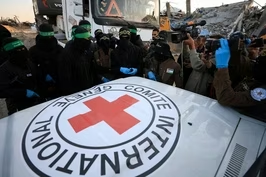
Palestinian militants transferred a white body bag to the Red Cross seen here in footage captured by our producer in Gaza, Shams Odeh.
Israel says it will conduct forensic testing after remains handed over yesterday did not match either hostage.
All this comes as Israel says it would soon open a critical border crossing with Egypt that's been closed since may of 2024.
Israel's military says it will allow Palestinians to leave Gaza via the Rafah Crossing, but Egypt says, citing the terms of the cease-fire, that movement must go both ways.
Israel says it won't allow Palestinians to reenter Gaza until all hostage remains are returned.
Here at home, President Trump has proposed rolling back fuel efficiency standards set by the Biden administration in a push to make it easier for automakers to sell gas-powered vehicles.
DONALD TRUMP, President of the United States: We're bringing back the car industry that was stolen from us because we have people that didn't know what they were doing sitting at this desk.
GEOFF BENNETT: In the Oval Office, President Trump touted the move alongside auto executives and Republican lawmakers, saying it would make cars more affordable.
The new standards would reduce fuel economy from the Biden standard of 50 miles per gas to an average of 34.5 miles per gallon by the year 2031.
The Biden era rules were intended to promote the production of electric vehicles.
Transportation remains the largest source of greenhouse gas emissions in the U.S.
A dozen former FDA commissioners say they're deeply concerned about proposed changes that would create a far stricter process for vaccine approvals.
They penned an article in "The New England Journal of Medicine."
It comes as a federal vaccine advisory panel is also expected to change a longstanding guidelines on immunizing newborns against the liver infection hepatitis B. The CDC's Advisory Committee on Immunizations, which has been overhauled by Health Secretary Robert F. Kennedy Jr.
meets tomorrow for a two-day meeting, where they will make their recommendations formal.
Federal health recommendations currently suggest babies get the hep B shot within 24 hours of birth.
The American Academy of Pediatrics says it will still urge a dose at birth, no matter the panel's findings.
On Wall Street, stocks ended up for the second straight day and are once again approaching record levels.
The Dow Jones industrial average added more than 400 points, while the Nasdaq gained 40 points.
The S&P 500 pulled within a half-percent of its all-time high.
And it's become a bit of an annual holiday tradition, Spotify Wrapped.
The streaming platform released its year-end summary of popular artists and trends today.
The most played artist in the world was superstar Bad Bunny.
It's his fourth time racking up the most streams.
And he dethrones Taylor Swift, who held the top spot two years in a row, although we should point out for Taylor Swift fans she still ranked first in the U.S.
The top song globally was "Die With a Smile," the Lady Gaga and Bruno Mars collaboration, and "The Joe Rogan Experience" was the platform's top podcast for a sixth consecutive year.
Still to come on the "News Hour": an Education Department proposal to declassify nursing as a professional degree threatens students' abilities to get loans; President Trump issues another controversial pardon, this time for a Democrat -- how he's using the power in new ways.
The Department of Homeland Security confirms it started a sweeping immigration crackdown in New Orleans today.
There are also multiple reports that the Trump administration has started an immigration enforcement operation in the Minneapolis-Saint Paul region.
That's after the president repeatedly disparaged the Somali community in that area, which is the largest in the country.
Our White House correspondent, Liz Landers, is with us.
And, Liz, I understand you have more information about how the president's immigration crackdown is being carried out.
LIZ LANDERS: Geoff, the "News Hour" can confirm that Border Patrol, not Immigration and Customs Enforcement, is primarily running the New Orleans operation.
The Trump administration has used that strategy to crack down on immigration in several other cities this year.
And, today, the face of these operations, senior Border Patrol Agent Greg Bovino, was spotted in a Home Depot parking lot in a suburb of the city.
Scenes in New Orleans this week, a business warning federal immigration agents to stay out, while a Methodist Church praises the contributions of immigrants.
The Big Easy is now the latest major city to become part of the Trump administration's immigration crackdown.
The Department of Homeland Security announcing today the start of an operation dubbed Catahoula Crunch that will target -- quote -- "criminal illegal aliens that have been released from jail," a stated effort that's moved across the country this year.
In Charlotte, North Carolina, last month, Border Patrol agents were seen smashing a car window, chasing people in parking lots, and conducting arrests on the side of the road as part of what it called Operation Charlotte's Web.
The Department of Homeland Security says at least 425 people were arrested in that operation, though the total number of people arrested with prior criminal records is not clear.
The crackdown there sparked protests and condemnation from the state's Democratic governor, Josh Stein.
GOV.
JOSH STEIN (D-NC): This is not making us safer.
It's stoking fear and dividing our community.
GREGORY BOVINO, El Centro Sector U.S.
Border Patrol Chief: It seems like he chooses illegal aliens over American citizens in his own state.
LIZ LANDERS: The man behind these scenes, senior Border Patrol Officer Greg Bovino, who has become one of the faces of the administration's massive immigration enforcement operations.
He's vocal about defending his controversial work on TV.
GREGORY BOVINO: Too many times, we're finding that some very, very disreputable individuals are seeking work in people's homes, in their gardens, and otherwise.
We don't want those people in society.
LIZ LANDERS: And on social media.
GREGORY BOVINO: This is our (EXPLETIVE DELETED) country.
LIZ LANDERS: Where he regularly posts Hollywood-style videos like these.
HAMED ALEAZIZ, The New York Times: ICE is in charge of interior enforcement, so... LIZ LANDERS: Hamed Aleaziz covers immigration for The New York Times.
He says this kind of interior immigration enforcement is normally carried out by Immigration and Customs Enforcement, or ICE, officers, not the Border Patrol.
HAMED ALEAZIZ: Border Patrol typically and historically in the modern era has mostly worked at the border.
I mean, they are in charge of stopping people who cross between ports of entries, people who are crossing illegally into the country.
That has been their mandate.
And what we're seeing now is a change with that mandate, of course.
LIZ LANDERS: Bovino joined Customs and Border Protection in 1996, where he worked in the El Centro Sector of California's southern border.
MAN: Reports of a surge in raids of undocumented residents have been circulating on social media.
LIZ LANDERS: In the waning days of the Biden administration earlier this year, Bovino led a sweeping immigration operation in California's Kern County, which is about 300 miles from the border, and home to a community of Latino farmworkers.
Border Patrol says the operation resulted in 78 arrests.
HAMED ALEAZIZ: It almost seemed like a model, a first step in Bovino's efforts to take immigration enforcement across the country.
WOMAN: You need to identify yourselves.
LIZ LANDERS: Those methods were seen again in Los Angeles over the summer, with Bovino tapped to lead the way.
HAMED ALEAZIZ: If you recall, in June, ICE did an operation in downtown Los Angeles, and there were protesters who showed up.
And there was all kinds of protests after this operation.
President Trump sent in the National Guard.
And during that time, they -- the Department of Homeland Security had extra people from across the agency come with resources to help with operations, with security, all of that.
And Bovino and El Centro Sector that he runs in California were part of that.
And ever since then, he was empowered by the administration.
LIZ LANDERS: That came after the White House increased pressure on DHS to reach its goal of 3,000 immigration arrests per day.
How is it more efficient for the administration to use Border Patrol agents instead of ICE agents to conduct some of these operations and raids?
HAMED ALEAZIZ: If you have more agents on the ground, more resources on the ground aside from ICE doing arrests, you're naturally going to boost the number of people being arrested.
An arrest is oftentimes the beginning of the process of a deportation.
LIZ LANDERS: After the immigration crackdown in L.A., agents were sued for racial profiling.
A lower court ruled against the Border Patrol, but the Trump administration appealed to the Supreme Court and won, with Justice Brett Kavanaugh ruling ethnicity can be a relevant factor in immigration stops.
In Chicago, Bovino's tactics have also been the subject of another contentious lawsuit.
Protesters and news outlets sued the federal government over excessive use of force during immigration operations in the Midwestern city.
In one instance, Bovino himself appears to launch a gas canister into a crowd, which he said was in response to a protester throwing a rock at his head.
Federal Judge Sara Ellis later determined Bovino lied about the rock and issued a preliminary injunction limiting federal agents' ability to use force, which was temporarily blocked by an appeals court.
Bovino told CBS Chicago that his agents only respond to protesters when necessary.
GREGORY BOVINO: And the use of force that I have seen has been exemplary, and, by exemplary, I would say the least amount of force necessary to accomplish the mission.
LIZ LANDERS: How much decision-making and leeway does Bovino have when it comes to the Border Patrol?
HAMED ALEAZIZ: I think it's -- the leeway and the decision-making that he has, I think, is seen in the operations that he's conducting.
And in every location, there are similar stories of targeting Home Depots, targeting car washes.
These are -- the types of arrests that are happening are all apparently as part of a model that him and his agents have that they believe is successful in getting more arrests.
So I think he is not somebody that's been limited in any way in conducting immigration enforcement.
LIZ LANDERS: How Bovino uses that leeway in New Orleans is yet to be seen.
For the "PBS News Hour," I'm Liz Landers.
GEOFF BENNETT: Congress is facing a long holiday to-do list, from budgets and health care to foreign affairs, all while Republican leaders contend with growing frustration and even open rebellion within their ranks.
Lisa Desjardins has more.
GROUP: Five, four, three, two, one.
REP.
MIKE JOHNSON (R-LA): There you go.
(CHEERING) LISA DESJARDINS: The season of light is under way outside the Capitol, but there are shadows and restlessness inside, especially for House Republicans and their speaker, Mike Johnson.
He has key defenders.
REP.
RALPH NORMAN (R-SC): Look, Mike's job is like nailing Jell-O to a wall.
He's done a good job.
REP.
MIKE FLOOD (R-NE): If you look at what our goals were when this Congress started, we have achieved almost all of the ones that were initially set out.
LISA DESJARDINS: But on social media, anger and worse, like from New York Republican Elise Stefanik, who this week called Johnson a liar.
Another congresswoman, Marjorie Taylor Greene, backed her up, writing that: "The speaker breaks his promises."
Greene recently announced her resignation, among her concerns, that, during the government shutdown, as Johnson held daily news conferences, he kept the full House out of session for nearly two months, and he blocked popular bills, like the one releasing the Epstein files.
Republican Thomas Massie of Kentucky co-sponsored that.
REP.
THOMAS MASSIE (R-KY): He's been basically just doing whatever President Trump wants to do.
So I would say President Trump's been in control of the House.
LISA DESJARDINS: Johnson points to the numbers.
REP.
MIKE JOHNSON: When you have a razor-thin majority, which we have, this is not like the old days.
In the old days, they had 30-, 40-seat majorities, and so four leaders could go in a back room, create the agenda, and foist it upon everybody and say, this is what you're doing.
LISA DESJARDINS: But other Republicans say that is exactly what's happened.
They are increasingly going around Johnson.
REP.
THOMAS MASSIE: Well, I have been here 13 years, and I have never tried to use a discharge petition, but it became apparent to me that that was a legitimate tool and that it could succeed.
LISA DESJARDINS: Buried in the House rules, discharge motions allow a majority of House members to sign a petition and force a House floor vote on a bill.
Just a handful have ever succeeded.
But in just the last two years, five discharge petitions have made the 218-signature threshold.
This week, Representative Anna Paulina Luna announced she will attempt a discharge petition on another popular and blocked bill, one to ban stock trading by members of Congress.
Not everyone is comfortable with this.
REP.
MIKE FLOOD: I'm a former speaker of the Nebraska legislature.
I know what it's like to run a legislative body.
And that's not how it should work.
LISA DESJARDINS: But, increasingly, more Republicans say this is the way to get Johnson and Trump's attention.
REP.
DON BACON (R-NE): If the White House took our input, I think they have been in a strong position.
This is a way for us to put in our input.
LISA DESJARDINS: Now, the dynamics for House Republicans aren't just palace intrigue.
They will determine if and how the House addresses those Affordable Care Act subsidies, due to expire for millions at the end of this month.
GEOFF BENNETT: And, Lisa, you have been talking with House Republicans this past week about Speaker Johnson.
How serious are their concerns?
LISA DESJARDINS: This is a real test.
We have seen Speaker Johnson navigate, seemingly even against the odds, some of the policy concerns, get through very large bills this year, but this is his biggest political test.
I was amazed in the past week, over the holiday week, how many of my Republican sources, rank and file, and senior Republicans were texting me about their discontent, even raising possible ouster -- no one's really going that far, but it's in the air right now -- of Speaker Johnson.
So this is a real test.
Today, I caught up with him, and he told me exclusively sort of how he's reacting to these public and private calls from discontent.
REP.
MIKE JOHNSON: A lot of people disagree with us staying home during the shutdown.
But we won the shutdown because of that.
And in a midterm cycle, you have very small margins, and people have their emotions and all that.
But you can always find a few people who are disgruntled about things.
LISA DESJARDINS: And that's true, but the key for Republicans especially, if you're Republican speaker in this century, you got to make sure that doesn't grow.
Now, what does this matter?
It doesn't just affect him and his leadership, but it also affects big issues.
I mentioned health care, also Ukraine, Russia and, of course, what Republicans present going into a critical election year next year.
GEOFF BENNETT: And we heard the speaker mention the slim GOP margins.
Republicans picked up a win last night in that closely watched special election in Tennessee.
Tell us about it.
LISA DESJARDINS: What an interesting race.
There's something for each party in this race, but in the end the winner of this race, Matt Van Epps, who is a veteran, former Army helicopter pilot, was able to win by nine points.
That sure sounds like a lot doesn't it?
No, this is a deep red district where the former congressman, a Republican, won by 22 points.
It's pretty easy math.
That's a 13-point slide for Republicans in red Trump territory.
Trump in fact himself came in and tried to help with this race.
So did Speaker Johnson.
They were able to win it.
But this is something that, when I talked to my Democratic sources last night, they said they were ecstatic about being within nine points.
And it really expands the group of potentially vulnerable Republicans.
There are more than 30 who in the last midterm election lost their race by 13 points or fewer.
So we will see what it means.
It's a special election.
It's not the same as a midterm, but Democrats like the enthusiasm they saw from their voters last night.
GEOFF BENNETT: Lisa Desjardins, our thanks to you, as always.
LISA DESJARDINS: You're welcome.
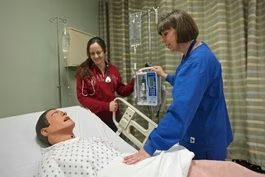
GEOFF BENNETT: New limits on federal student loans could dramatically reshape how the U.S.
trains nurses and doctors.
Under the so-called One Big Beautiful Bill Act passed earlier this year, future medical students would be capped at borrowing $50,000 per year, no more than $200,000 total.
The law also gives the Department of Education broad authority to decide which graduate degrees count as professional and therefore qualify for higher loan limits.
The Trump administration is now proposing a far stricter cap, $20,500 a year for students pursuing graduate degrees in nursing, public health or social work, fields the department says no longer meet the definition of professional programs.
Other disciplines, including education, accounting and architecture, would also lose their professional designations.
We're joined now by Jennifer Mensik Kennedy, president of the American Nurses Association.
Thanks for being with us.
JENNIFER MENSIK KENNEDY, President, American Nurses Association: Thank you for having me.
GEOFF BENNETT: So what's your principal concern about how these new federal loan caps would affect future nursing students and, beyond that, the delivery of medical care in the U.S.?
JENNIFER MENSIK KENNEDY: It's going to have devastating effects.
We know the average cost of attendance for nursing graduate students is over $30,000 a year.
And the fact that some individuals might say, well, maybe nursing school shouldn't cost that much, that's fine, but we shouldn't limit the definition of what's considered a professional, because these have -- these policy implications have real-world negative impacts.
It's like a Trojan horse.
We define it once in one area without nursing.
What's next?
There's a lot of downhill consequences that could happen in so many other things besides just this.
And this is on the heels of the Big Beautiful Bill taking out all of the Title 8 funding.
So all the federal funding for nursing education was removed, now this.
We're going to see increased wait times for primary care visits.
We're going to see people not having access to health care in the United States.
GEOFF BENNETT: The administration says that nearly all nursing students fall under the proposed caps and therefore would see no impact.
I would imagine you see it differently.
JENNIFER MENSIK KENNEDY: No, absolutely.
So, about 20 percent of nurses have a graduate degree.
And when we think about majority and percentage, maybe that seems like it's a small amount.
But when you think there's over five million registered nurses, 20 percent is a million individuals.
And when we're looking at a time when there is a primary care shortage, we have lack of access in rural communities, we need to make sure we help support individuals who are going back to school to be able to become nurse practitioners, certified registered nurse anesthesiologists, certified nurse midwives and CNSes.
So this is a really important time for our country, because nursing is absolutely indispensable to our health care system.
GEOFF BENNETT: Our team spoke this morning with Preston Cooper, who focuses on higher education policy at the American Enterprise Institute.
And he has a different view.
He says the current structure contributes to rising tuition.
Take a listen.
PRESTON COOPER, Senior Fellow, American Enterprise Institute: The loan limits which are being applied to nursing programs are going to protect aspiring nurses from borrowing excessive debts.
And they are going to protect nurses from schools which are charging just way too much relative to the value they are offering.
This is going to lower student loan burdens for aspiring nurses.
And so it's just very odd to me that professional associations which claim to represent nurses seem to want to bury aspiring nurses in more student debt.
GEOFF BENNETT: How do you respond to that?
JENNIFER MENSIK KENNEDY: Well, that's an unfortunate perspective, because research does show that this won't have an impact on reducing the cost of nursing education.
What's going to happen are, individuals are going to go and seek private loans.
Oftentimes, those are more maybe more predatory or have higher interest rates, and they don't qualify, for instance, for public service loan forgiveness.
So if you have federal loan and you work in a rural or underserved community, you can work off that time or work off your loan through PSLF.
You can't do that with a private loan.
So it's not going to stop people from taking out loans.
They're just going to get loans that are actually going to be a more negative impact via the private process.
GEOFF BENNETT: What would a better policy solution look like, in your view?
JENNIFER MENSIK KENNEDY: A better policy solution, of course, would be to include the definition of professional include nursing, advanced practice nurses back in that definition, particularly in a time when we have a shortage of R.N.s and a shortage of advanced practice registered nurses.
This is also for faculty, right?
So nurses who go on to get doctoral degrees to go back and teach nurses.
We had over 80,000 qualified applicants for nursing school turned away last year because mostly we don't have enough nurses to teach in nursing programs.
So I would want the Department of Education to go back and include nursing in that professional definition and make sure that Title 8 funding gets re-put into the budget, because both of those have such a negative impact that it's just going to be very much more compounded.
GEOFF BENNETT: Do you from your vantage point have an idea as to why the Trump administration is delisting these areas of pursuit as no longer professional?
JENNIFER MENSIK KENNEDY: You know, it's a really good question.
And I'm going to say that, with -- you have a first year of administration.
You have many new people and a lot of departments.
The Trump administration has been very supportive of advanced practice registered nurses.
Particularly, we saw that in the first time -- in his first administration during COVID.
And so this seems very counter to that time.
So we think this is really more of a misunderstanding.
We did send a letter in October, 57 total nursing organizations, asking to make sure that nursing was included.
So we're hoping that they go back and review this and add nursing before the comment period opens.
GEOFF BENNETT: And what's the risk that students, especially those from low-income backgrounds, will be pushed toward private high-interest lenders if they can't get a loan from the federal government?
JENNIFER MENSIK KENNEDY: No, absolutely.
So, the majority of nurses in this country are white.
And what we see is, the majority, 56 to 58 percent of our population, is not white.
And so we really want those from other ethnic backgrounds, minorities to come into nursing school, because we're going to see better patient care when we have nurses and advanced practice nurses who reflect the communities that they serve.
We're going to see people very much question the ability to go back to school.
And so it's another limitation on individuals who want to become nurses who don't have the access, who don't have the economic means to have parents or have other incomes to be able to pay for their education out of pocket.
So this is going to severely limit even further those ethnic minority groups who maybe want to aspire to be a nurse and just had their opportunity taken away from them.
GEOFF BENNETT: Jennifer Mensik Kennedy, president of the American Nurses Association, thanks for joining us.
JENNIFER MENSIK KENNEDY: Thank you.
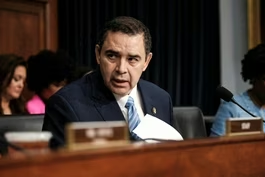
GEOFF BENNETT: Today, President Trump announced he was pardoning Texas Democratic Congressman Henry Cuellar and his wife, who were indicted last year on bribery and money laundering charges.
They were alleged to have accepted roughly $600,000 in bribes and entities connected to Azerbaijan.
The president said Cuellar was targeted for criticizing President Biden's border policies.
As White House correspondent Liz Landers reports, it's the latest in a series of controversial pardons the president has signed.
LIZ LANDERS: To help explain some of these controversial pardons, we're joined by Liz Oyer.
She served as the Department of Justice's pardon attorney in the Biden administration.
Liz, thank you so much for joining "News Hour."
Let's start with this news about the Democratic congressman who was pardoned today, Henry Cuellar.
How does this fit into a larger pattern that we have seen from President Trump pardoning elected officials?
LIZ OYER, Former DOJ Pardon Attorney: Donald Trump has pardoned historic numbers of elected officials.
Typically, crimes involving public corruption are taken very seriously, and corrupt public officials are rarely considered for presidential pardons because of the betrayal of public trust that's involved in the underlying crimes.
In this case, Donald Trump is really sort of normalizing public corruption by liberally pardoning corrupt public officials who are charged with offenses that involve abusing their political offices to enrich themselves.
That's the case with this congressman.
Notably, this congressman had not yet stood trial for these charges.
So Trump is saying that this was an unfair prosecution in some way by the Biden administration.
If that is the case, we could expect that that would play out in front of a jury with an acquittal.
But rather than allowing that process to play out, Trump has intervened and granted him a presidential pardon.
LIZ LANDERS: Let's turn to this pardon of the former Honduran President Juan Orlando Hernandez.
He was convicted last year of drug trafficking.
And this comes also as the administration is battling what they say are narco-terrorists in Latin America.
Is there judicial consistency here?
LIZ OYER: It really shows that the pardons that Trump is granting are not principled.
They're out of sync with other parts of his stated political agenda.
It is very hard to reconcile the idea of pardoning a large-scale international drug trafficker with the administration's stated commitment to ending illegal drug trafficking into the United States.
The fact that we are literally blowing boats out of the water to stop drugs from coming into the United States is really just inconsistent with this decision to pardon the former president of Honduras.
LIZ LANDERS: There was another recent commutation of the private equity executive David Gentile.
He was found guilty of a white-collar crime.
I asked the White House press secretary, Karoline Leavitt, about that earlier this week.
Why did the president commute the sentence of David Gentile recently?
He was a private equity executive.
He served 12 days out of a seven-year sentence.
The prosecutor said he defrauded $1.6 billion with thousands of victims, including veterans, farmers, teachers.
KAROLINE LEAVITT, White House Press Secretary: The Biden Department of Justice claimed it was a Ponzi scheme.
This claim was profoundly undercut by the fact that GPB had explicitly told investors what would happen.
At trial, the government was unable to tie any supposedly fraudulent representations to Mr.
Gentile.
LIZ LANDERS: How many of these white-collar pardons or commutations has the president approved and why?
LIZ OYER: The majority of Trump's pardons to date, setting aside the January 6 pardons, have related to fraud or white-collar types of crimes.
And what's so staggering about the pardons is the amount of lost money that's involved in these cases.
Victims of these frauds that have now been pardoned are out over a billion dollars.
And Donald Trump has essentially wiped out the obligations of these folks who've received the pardons to pay back that money to their victims.
We have seen some very large fraudsters receive the benefit of pardons, and it is greatly beneficial to them financially because they then no longer have to pay back the debts that they owe to their victims.
LIZ LANDERS: Is there a way to rein in the power of the presidential pardon?
LIZ OYER: The Constitution gives the president very broad discretion to do whatever he wants ultimately with the pardon power.
He does not have to follow the recommendations of the Justice Department, and that has been a problem.
I will say that there are things that could greatly improve the transparency and accountability of the president for pardon decision-making that could be done without amending the Constitution.
One thing is more congressional oversight of the pardon process.
They could readily require that the president disclose his rationale for granting pardons, promptly disclose the decisions when they are made, and they could also legislate disclosure requirements for those involved in lobbying for pardons and doing legal representation of individuals seeking pardons.
LIZ LANDERS: What do Trump's pardons say about his broader views on justice?
LIZ OYER: Donald Trump seems to pardon people in whom he sees something of himself.
So the pardon of Juan Orlando Hernandez, the former president of Honduras, is an example of another world leader who was prosecuted for crimes involving the abuse of his office.
And Donald Trump can relate to and empathize with that person, and he got a pardon as a result.
He's pardoned many corrupt elected officials.
He's pardoned people who support him personally or politically sort of as a reward for their loyalty to him.
He also is using the pardon power in a way that's very destructive to the justice system more broadly.
He's pardoning people in many cases who have not yet begun to serve their sentence or, in some cases, as in the case of Representative Cuellar, has not even been tried before a jury.
And that has the effect of undermining cases that his own Justice Department is actively pursuing.
That is a very unusual way for a president to wield the pardon power.
LIZ LANDERS: Liz Oyer, thank you so much for joining "News Hour."
LIZ OYER: Thanks for having me.
GEOFF BENNETT: The prime minister of Lebanon said today the nation was far from normalizing relations with its southern neighbor, Israel.
One year ago, Lebanon and Israel signed a cease-fire that was supposed to end a war between the militant group Hezbollah and Israel, a war that left more than 4,000 Lebanese and more than 100 Israelis dead.
But with near daily Israeli attacks still taking place, life for civilians in Lebanon's south remains dangerous.
Special correspondent Simona Foltyn reports from that tense border.
SIMONA FOLTYN: It's olive harvest season in Southern Lebanon, but after two years of war between Israel and Hezbollah, it's slim pickings from Mohammed Allawi.
MOHAMMED ALLAWI, Farmer (through translator): For two years, we have neglected this land.
There are few olives.
We didn't farm it.
We didn't even put fertilizer.
The people have abandoned their land.
They're not willing to come here.
We only come here when accompanied by the Lebanese army.
SIMONA FOLTYN: Under the protection of the Lebanese army, farmers have a week to complete their harvest.
Coming here alone is dangerous, despite a U.S.
brokered cease-fire signed last year.
In line with the deal, the Lebanese army replaced Hezbollah as the dominant security force in Lebanon's south.
But Israel has continued to carry out air raids and ground operations and still occupies Lebanese land.
Captain Elias Barich is in charge here.
Can you explain where we are at the moment?
CAPT.
ELIAS BARICH, Lebanese Armed Forces (through translator): We are now in the village of Maroun El Ras on the Southern Lebanese border that looks out on occupied Palestine.
This is the main area where you will find olive trees and it extends up to the village.
SIMONA FOLTYN: We are just a few hundred yards from the border.
The Israeli settlement of Avivim lies beyond the rubble of Lebanese homes.
On this side, the land lies fallow, in contrast to the lush green across the border fence.
During Israel's ground incursion earlier this year, countless olive trees were uprooted.
In a statement to the "News Hour," the IDF denied responsibility.
Now Lebanese farmers are trying to salvage what's left.
What would happen if you were not present here during this harvest?
What are some of the risks the farmers are facing?
CAPT.
ELIAS BARICH (through translator): The farmers are facing difficult challenges in this area because the enemy, Israel, is based close to their lands and sometimes carries out surveillance operations, provocations and even opens fire to terrorize civilians and prevent them from reaching their land.
Our presence here is to give them a sense of security and to protect their right to work their lands safely.
SIMONA FOLTYN: The Lebanese army has also come under attack.
Last year, during the height of the war, one of Captain Barich's men was killed when an Israeli tank fired at a clearly marked army base, an incident the IDF claimed to have no knowledge of.
CAPT.
ELIAS BARICH (through translator): The work in the border region is not easy.
The geography is difficult and the security is volatile because the enemy, Israel, is always trying to send threatening messages and ignite tensions in the area.
SIMONA FOLTYN: The captain has only around 170 troops for a sector that spans 10,000 acres of hilly terrain.
His men must secure five border villages and dozens of miles of roads.
U.N.
peacekeepers, called UNIFIL, are here to support them.
LT.
COL.
CIARAN HIGGINS, UNIFIL Irish Battalion: From what I have observed, they're well-equipped, the individuals that I have gone on, but the size of patrols that I have been on are small patrols.
They're one to two vehicle.
SIMONA FOLTYN: Do you think that the farmers would not tend to their land if LAF and UNIFIL were not present?
LT.
COL.
CIARAN HIGGINS: They absolutely would not come down here.
SIMONA FOLTYN: Why?
LT.
COL.
CIARAN HIGGINS: It wouldn't -- they feel, anyway, it wouldn't be safe enough for them.
There's been a large number of civilian excavators targeted by drones, usually actually small quadcopters that drop grenades on them.
So I think there would be the fear there from the civilians that that might happen to them.
SIMONA FOLTYN: Responding to these allegations, the IDF said it operates with utmost precaution to minimize civilian harm.
But the fact remains that more than 100 civilians have been killed in Israeli strikes during the cease-fire, according to the U.N.
Farmers like Mohammed need to come here daily to work the land, not just when the Lebanese army and the U.N.
are able to provide an escort.
MOHAMMED ALLAWI (through translator): We are not just living on olive trees.
We also grow tobacco and wheat.
We have to come here all the time to work.
SIMONA FOLTYN: You are a farmer.
If you cannot come to your fields, if you can't tend to your olive trees, what are your options?
MOHAMMED ALLAWI (through translator): We don't know anything else.
I mean, most people here survive on farming.
SIMONA FOLTYN: "And if there is no farming," I ask?
The painful realization that life as it was before the war may never return.
MOHAMMED ALLAWI (through translator): We don't know what will become of us.
We live from this land.
Our lives have been destroyed.
SIMONA FOLTYN: It's afternoon and the window of the army's protection is closing.
We leave the fields ahead for the village center along abandoned roads, past more abandoned fields.
And this is what's left of Mohammed's village, Maroun El Ras, just layers upon layers of destruction.
He shows us where he used to live with his wife and five children.
MOHAMMED ALLAWI (through translator): The IDF booby-trapped and detonated all the houses here.
They used this field for the tanks.
They set up a perimeter here and they detonated all the homes.
SIMONA FOLTYN: Mohammed's family fled during the heaviest fighting, and he's unsure if Hezbollah used his house to launch attacks.
There are, however, traces of the IDF.
In the rubble, we find a spent Israeli rocket alongside fragments of civilian life.
Mohammed doesn't feel safe to live here.
MOHAMMED ALLAWI (through translator): They won't allow any of the border villages that face them to be inhabited.
SIMONA FOLTYN: More than a year after the cease-fire, Lebanon's border villages remain a no-man's land, where life has been rendered all but impossible.
For the "PBS News Hour," I'm Simona Foltyn in Maroun El Ras on Lebanon's border with Israel.
GEOFF BENNETT: The "News Hour" reached out to the Israeli military with detailed questions about their activities in Southern Lebanon.
They issued a statement which read, in part: "Since the cease-fire came into effect, the IDF has identified Hezbollah's efforts to rebuild its military infrastructure, including in Southern Lebanon," and that "the IDF continues to act in a targeted manner against Hezbollah's reconstruction attempts."
We will be back shortly, but, first, take a moment to hear from your local PBS station.
It's a chance to offer your support, which helps to keep programs like the "News Hour" on the air.
For those of you staying with us, as we mentioned, today is the day when Spotify tells its subscribers which artists they listened to the most this year.
And for most, vocals reign supreme, but there's a growing genre focused on instrumental music.
William Brangham profiles one of the bands at the forefront of this movement.
Here's a second look.
WILLIAM BRANGHAM: This Texas trio, with their airy and dreamy sound, are one of the most unlikely musical sensations.
Guitarist Mark Speer, bassist Laura Lee Ochoa and drummer Donald DJ Johnson are the band known as Khruangbin.
Even though their shows sell out globally like they did here in Vermont this summer, even they can't quite put a label on this moody genre they've called carved out.
MARK SPEER, Khruangbin: People still ask me, like, hey, so, oh, you're in a man.
What genre do you play?
I don't know.
WILLIAM BRANGHAM: Whatever it's called, it has taken Krungman to great heights.
They've had hit collaborations with fellow Texan Leon Bridges and another with Sir Paul McCartney, those trademark black wigs that Mark and Laura wear.
They were initially put on as a lark before their first ever show, but they now offer an easy mask of anonymity.
Their records have earned them critical acclaim for their undefinable brew of rock, funk and psychedelia.
But even 15 years on, the band members say the process of crafting that sound is still evolving.
MARK SPEER: Earlier in our career, yes, we had a very specific way of making songs, but I feel like that's shifted over the years.
And I couldn't tell you exactly how we do it anymore because every time we go into it's different.
LAURA LEE OCHOA, Khruangbin: Yeah, they're just like puzzle pieces.
Almost like arranging furniture in a room.
You like, you don't know where anything's gonna go and then you find one thing that works and you're like, this is where this table's going to go.
MARK SPEER: And then you paint and it's like, oh crap.
Now I have to rethink the whole.
DONALD JOHNSON, Khruangbin: I mean we have a saying.
The song will tell you what it wants.
MARK SPEER: Yes.
And that's absolutely true.
But it almost takes a minute for the song to be like, put this drink down.
Oh no.
Yeah.
WILLIAM BRANGHAM: Do you really think I know we're talking metaphorically here, but do you really think of it as another organic entity that you guys are interacting with?
LAURA LEE OCHOA: The song?
WILLIAM BRANGHAM: Yeah.
LAURA LEE OCHOA: Oh yeah.
MARK SPEER: Yeah, Big time.
LAURA LEE OCHOA: Oh yeah.
MARK SPEER: When you're in love with someone, like really in love with someone, that's what this is.
When the song is there, it's not just three of us, you know, it's the whole thing.
WILLIAM BRANGHAM: Khruangbin's success has ushered in a wave of other bands seeking to capitalize on this style.
Like Glass Beams, Arc Du Soleil and Yuuf, each offering their own take on this moody guitar driven genre.
Though Khruangbin is known for their musicality, there's also that pretty unusual name.
It's a Thai word that sort of means airplane.
And it is a tough one for even diehard fans to pronounce.
WOMAN: I was calling it like Kronga B Carabin.
MAN: Kurring bing.
MAN: Carbin.
Krabin.
MAN: Carbin.
Karabin.
WOMAN: Crabin.
MAN: I went on Google so many times for the pronounce WOMAN: Khruangbin.
MAN: Karagbin.
MAN: I think I'm saying it right.
Karangabing.
Is that right?
Karangabin.
WILLIAM BRANGHAM: What's the name of this band again?
WOMAN: Khruangbin.
WILLIAM BRANGHAM: You got it.
Given your guys success, did you ever think maybe we should name our band a more pronounceable word?
MARK SPEER: Well, we can't change it now.
LAURA LEE OCHOA: We wanted the website domain to not be taken.
MARK SPEER: Yeah.
WILLIAM BRANGHAM: What was the genesis of it?
LAURA LEE OCHOA: Part of it.
type in the first four letters of Our band name.
You're going to get us and Khrushchev.
LAURA LEE OCHOA: Yeah, that's it.
MARK SPEER: And he hasn't put out a record in years, so we're good.
WILLIAM BRANGHAM: Bombed.
WILLIAM BRANGHAM: Even though they do occasionally layer vocals into their songs, almost always sung together, Khruangbin's essential sound is a trio of instrumentalists.
WILLIAM BRANGHAM: Do you think that there's something distinct about listening to just instrumental music that resonates with people differently than music that is more filled with identifiable lyrics and words and sounds?
LAURA LEE OCHOA: It's like the international language.
I mean, I think there's that part of it.
DONALD JOHNSON: That's something that we discovered early on when we were traveling throughout different countries that spoke different languages that we didn't speak.
We could just get on stage and play.
And it still works.
LAURA LEE OCHOA: I think it's also when there's not the human touchstone of a voice, I think it's slightly more challenging, but I think it's a challenge that people enjoy.
They have to get over that initial hump of being like, okay, I don't speak this language.
I don't know anyone at this party.
It makes you have to, like, intentionally listen and connect, and I think that can be really moving.
WILLIAM BRANGHAM: Sometimes, though, their fans can't help but sing along, even if the words aren't there.
DONALD JOHNSON: This beautiful moment that we had once in Columbus, Ohio, early on, were playing Derncalle, and the entire room started singing Mark's guitar melody.
WILLIAM BRANGHAM: Wow.
DONALD JOHNSON: Didn't have words.
It was just da, da at the top of their lungs.
MARK SPEER: They were going off too.
DONALD JOHNSON: It was amazing.
No words, just people singing along with the melody.
And that's all you needed.
WILLIAM BRANGHAM: For those other fans wanting to sing along with Khruangbin, the band's fall tour is wrapping up soon.
For the "PBS News Hour," I'm William Brangham.
GEOFF BENNETT: At the Men's Central Jail in downtown Los Angeles, a new children's library inside the visitors center is giving kids a place to read and learn during the often long waits to see their loved ones.
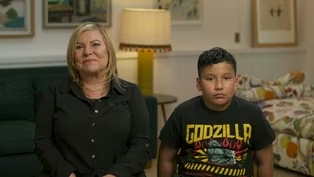
Tonight, a grandmother and her 10-year-old grandson share their Brief But Spectacular takes on connecting through reading.
FRANCISCO PRECIADO, 10 Years Old: My name is Francisco.
I'm 10 years old.
And I am in fourth grade.
QUESTION: Francisco, tell me who you're sitting next to.
FRANCISCO PRECIADO: My grandma.
QUESTION: What's your favorite thing about your grandmother?
FRANCISCO PRECIADO: My favorite thing, she always stay there for me.
LINDA VILLEGAS, Grandmother: Francisco's father is in Men's Central Jail in L.A.
He's been there almost three years.
Francisco basically lived in a little town in Mexico by Guadalajara.
I brought him here back in July because he wanted to be with his dad.
He misses his dad a lot.
So I put him in school.
The language barrier has been hard on him, but he's trying.
To get into the Men's Central Jail, you have to be on the phone 12:00 midnight Thursday.
You have two minutes to try to get an appointment, and if you don't get the appointment, that's it.
I wish he could see him more often, but he only sees him like every two, three weeks.
We get there by 10:30 or so, and we go put money in his books, and then they tell you to sit down and wait.
When I walked in there one day, I saw this little library, beautiful, and I was like, wow, that's really nice, but I didn't know that the kids were allowed to take books.
QUESTION: Do you have to wait a lot in the jail?
FRANCISCO PRECIADO: Yes, like two or three hours.
Every time we go, we take some new books.
QUESTION: Find your favorite dinosaur there as fast as you can.
FRANCISCO PRECIADO: Here.
QUESTION: OK, you found it pretty fast.
LINDA VILLEGAS: We take advantage because of the fact that he's still having a hard time reading.
I read with him and I translate it to him.
QUESTION: What's the hardest part about the visit?
LINDA VILLEGAS: Seeing your son there.
My grandson and my son just hold the glass with their hands.
My son tries to put a face like it doesn't bother him, but I know it does.
QUESTION: What's something that makes you feel proud about Francisco?
LINDA VILLEGAS: The way he is, the smile that he has when he comes out of school, saying, I did this, I did that, and I love you.
He always tells me, I love you.
I'm proud of you, papa.
I love you.
My name is Linda.
FRANCISCO PRECIADO: My name is Francisco.
LINDA VILLEGAS: This is our Brief But Spectacular take... FRANCISCO PRECIADO: ... on reading with my grandma.
GEOFF BENNETT: And you can watch more Brief But Spectacular videos online at PBS.org/NewsHour/Brief.
Also online, we explore who will qualify to get those so-called Trump Accounts after the Dell family pledged more than $6 billion for the investment accounts for children that were authorized in the Republican spending bill passed earlier this year.
That's at PBS.org/NewsHour.
And that is the "News Hour" for tonight.
I'm Geoff Bennett.
For all of us here at the "PBS News Hour," thanks for spending part of your evening with us.
Border Patrol's role in Trump's immigration crackdown
Video has Closed Captions
Clip: 12/3/2025 | 7m 39s | Border Patrol's expanding role in Trump's immigration crackdown (7m 39s)
A Brief But Spectacular take on connecting through reading
Video has Closed Captions
Clip: 12/3/2025 | 3m 16s | A Brief But Spectacular take on connecting through reading (3m 16s)
Hegseth's Signal chat put personnel at risk, watchdog finds
Video has Closed Captions
Clip: 12/3/2025 | 3m 10s | Hegseth's Signal chat put U.S. personnel at risk, Pentagon watchdog finds (3m 10s)
How Trump is using presidential pardon power in new ways
Video has Closed Captions
Clip: 12/3/2025 | 6m 11s | How Trump is using presidential pardon power in new ways (6m 11s)

Johnson faces growing frustration from Republicans
Video has Closed Captions
Clip: 12/3/2025 | 5m 34s | Johnson faces growing frustration from Republicans as key issues expose rifts (5m 34s)

Lebanese farmers say ceasefire fails to ensure safety
Video has Closed Captions
Clip: 12/3/2025 | 7m 1s | Lebanese farmers rush to salvage harvest as ceasefire with Israel fails to ensure safety (7m 1s)
News Wrap: Israel receives body believed to be Gaza hostage
Video has Closed Captions
Clip: 12/3/2025 | 3m 50s | News Wrap: Israel receives remains believed to be one of last 2 Gaza hostages (3m 50s)
Student loan limits could reshape how U.S. trains nurses
Video has Closed Captions
Clip: 12/3/2025 | 7m 30s | Proposal to declassify nursing as 'professional' threatens ability to secure student loans (7m 30s)
Providing Support for PBS.org
Learn Moreabout PBS online sponsorship
- News and Public Affairs

FRONTLINE is investigative journalism that questions, explains and changes our world.

- News and Public Affairs

Amanpour and Company features conversations with leaders and decision makers.











Support for PBS provided by:
Major corporate funding for the PBS News Hour is provided by BDO, BNSF, Consumer Cellular, American Cruise Lines, and Raymond James. Funding for the PBS NewsHour Weekend is provided by...