
Capitol View | December 4, 2025
12/4/2025 | 26m 46sVideo has Closed Captions
Jeff Williams host this week’s top stories with analysis from John Jackson and Dan Petrella.
Jeff Williams host this week’s top stories with analysis from John Jackson of the Paul Simon Public Policy Institute at SIUC and Dan Petrella from the Chicago Tribune.
Problems playing video? | Closed Captioning Feedback
Problems playing video? | Closed Captioning Feedback
CapitolView is a local public television program presented by WSIU
CapitolView is a production of WSIU Public Broadcasting.
Capitol View | December 4, 2025
12/4/2025 | 26m 46sVideo has Closed Captions
Jeff Williams host this week’s top stories with analysis from John Jackson of the Paul Simon Public Policy Institute at SIUC and Dan Petrella from the Chicago Tribune.
Problems playing video? | Closed Captioning Feedback
How to Watch CapitolView
CapitolView is available to stream on pbs.org and the free PBS App, available on iPhone, Apple TV, Android TV, Android smartphones, Amazon Fire TV, Amazon Fire Tablet, Roku, Samsung Smart TV, and Vizio.
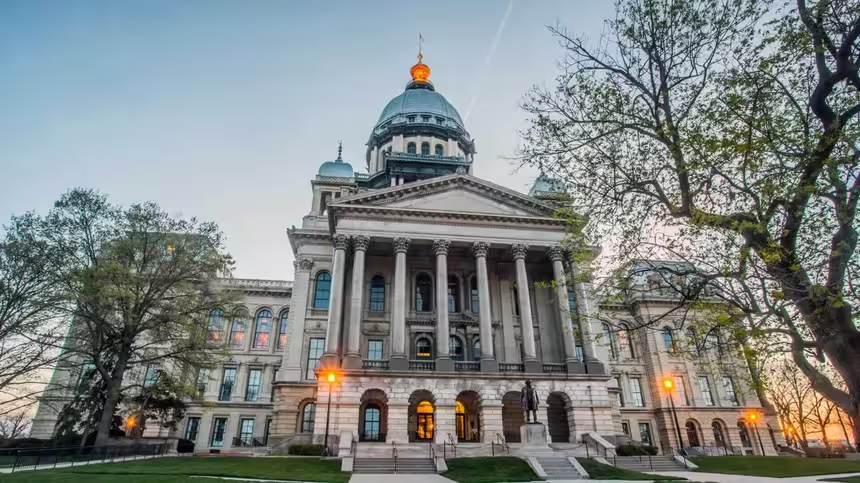
CapitolView
CapitolView is a weekly discussion of politics and government inside the Capitol, and around the state, with the Statehouse press corps. CapitolView is a production of WSIU Public Broadcasting.Providing Support for PBS.org
Learn Moreabout PBS online sponsorship[MUSIC] >> Welcome to Capitol View on WSIU.
I'm Jeff Williams sitting in this week as we take a look at what's making news around the state in Illinois politics, the US immigration enforcement and detainment effort in Chicago will soon mark its third full month of operation, and a new report indicates the dosage cuts and other federal funding cutbacks will have a significant impact on Illinois's economy, especially in health care and education.
We'll take a closer look at those stories, and likely some others this week on Capitol View.
And to help guide our discussion this week, our John Jackson visiting Professor with the Paul Simon Public Policy Institute and Dan Petrella, political writer with the Chicago Tribune.
Gentlemen, welcome back to the program.
>> Glad to be here.
>> Thanks for having me.
>> Well, as we tape this show today, it's roughly, I think, day 86 of ICE's operation Midway Blitz, the immigration enforcement and detention effort in Ice.
In some ways has become kind of part of the daily news cycle and daily life, especially in Chicago.
Dan, you reported on one of the more recent developments, I believe, when Congresswoman Lauren Underwood actually was allowed to visit the Broadview Processing Center.
What what did she experience?
>> Yes, this was the week leading up to Thanksgiving.
She was allowed inside the first member of Congress to be permitted access in several years.
And, uh, probably not coincidentally, when she was able to tour the facility, there were, uh, no one being held there or processed there and hardly any workers present there.
So they brought her in at a time.
They said they were upgrading their security security cameras.
And so the last, um, uh, detainees had been had been processed the previous evening.
And, um, you know, there were only a few security guards and then the, the, um, federal officials who were giving her the tour that were present there.
So, um, she didn't really get a good look at the actual day to day operations of the facility.
Um, but she did see, you know, um, functioning showers and a few toilets and things, but not really, um, facilities that were adequate to, uh, keep people overnight, which is how the facility has been used for several months, but not how it was ever designed to be used by ICE's own guidelines.
It's not supposed to hold people for more than 12 hours.
Um, the Tribune and others have documented how that that policy has been repeatedly, uh, bent, um, people staying there for days at a time, sometimes, you know, upwards of a of 100 people or so, I believe, being held there.
So, um, the, the processing at the facility has, has, uh, slowed down dramatically as the, uh, you know, very militarized enforcement actions here in the Chicago area have really quieted down over the last couple of weeks.
That's a you know, one of the very interesting changes is that they've really shifted their attention elsewhere.
You know, Gregory Bovino, the the bombastic Border Patrol commander, who is sort of leading the, um, these enforcement efforts, uh, that were, I would say, designed to, to gain a lot of attention and, um, sort of the shock and awe, uh, tactic has moved on.
He was in North Carolina previously.
Um, and so now it's sort of, uh, figuring out what is going to happen in the aftermath and whether, uh, that sort of show of force is going to return in the spring, which has been, um, you know, predicted by, by some, um, also sort of just trying to, to figure out what all happened while they were here, still piecing together a lot of that.
Uh, one of my colleagues just reported yesterday that out of nearly 1900 people who were detained during the first half of the operation.
Uh, most had no criminal records, which goes against the sort of targeting of the worst, of the worst, as the Trump administration has been saying they're doing.
Um, and another interesting development in federal court yesterday is the, uh, lawsuit that had, um, really tried to restrain the tactics that that Ice and particularly Border Patrol were using in some of these enforcement efforts, tear gas and less lethal munitions, things like rubber bullets and pepper balls and things like that, had really tried to clamp down on that, um, the Chicago Headline Club and others who who filed that lawsuit moved to dismiss it as it was moving to appellate court here in Chicago.
Um, they're saying that, you know, basically the main part of the operation has ended, but it's also sort of, uh, seems in response to a conservative three judge panel of the Seventh Circuit appeals court that maybe indicated they were going to overturn the lower court ruling that really restrained how Border Patrol could use those, uh, more aggressive enforcement tactics.
>> Yeah.
As you mentioned this, we're coming up on, on, on three months and we've talked about this before in other other shows.
Has this had a noticeable impact on, on on folks lives, especially within the in the city of Chicago, or is this just become kind of routine over the last 90 days?
>> You know, it really has there was a lot of fear, especially around schools at drop off times and things like that.
There were incidents of people, you know, parents being taken into custody in those situations.
There's been reporting that, um, attendance was down at some Chicago public schools during the enforcement actions, out of fear.
You know, there's been lots of anecdotal reports of, uh, you know, normally vibrant immigrant communities like Little Village in Chicago, uh, being much quieter than usual as a result of some of these enforcement tactics.
Um, and, you know, just, uh, seeing seeing these instances where there were armed Border Patrol agents marching down the the streets in, in the, um, you know, touristy, uh, you know, commercial centers of Chicago posing for photos around the bean and things like that.
I think that that really, um, you know, drew a lot of a lot of ire from a lot of folks.
And, um, you know, there are folks who who oppose these efforts who have really praised, uh, you know, everyday Chicagoans who stepped up and, and bought their whistles and, and tried to protect their neighbors who maybe are in the country without authorization.
Or as we've seen, many US citizens have also been been swept up in these in these efforts.
So, um, it really has, uh, it did.
So a lot of fear, um, and confusion among folks all across, not just the city, because it was across the suburbs, even into some of the far out suburbs as well.
So, um, I think everybody's a little bit on edge to see, uh, you know, if they do return at some point and then to try and figure out what happens with the folks who were, um, who were swept up in these Actions.
>> Yeah.
And I guess you referenced one one district, um, challenge.
And the legal jockeying continues in the federal courts.
Dan, if I'm correct, the US Supreme Court still hasn't made a decision or ruling on the constitutionality of deploying, uh, Illinois National Guard troops or guard troops in this situation.
>> We're still we're still awaiting a ruling from the from the Supreme Court there.
Um, and it's been, uh, several weeks now and sort of, uh, you know, maybe moot for the time being since the, uh, the out-of-state guard troops, um, who were sent here, I believe, have have returned home.
But obviously there's still, um, you know, guard troops here in, in Illinois that could be federalized and deployed.
So, um, it'll be interesting to see how the how the court rules in that and something we're, uh, I think expecting soon, but it'll, you know, they take they take their time and don't always, uh, operate on the, the schedule that we assume or hope that they'll take action in these situations.
>> Yeah.
And I'm not not necessarily directly related, but I think if I'm correct here, the Seventh Circuit Court of Appeals in Chicago, as we're taping this today, are hearing oral arguments later today over whether I think approximately 400 or so detainees should be released to electronic monitoring.
So we'll continue to watch and see what, uh, what continues to develop on that front.
I want to shift gears just a little bit.
A recent report by the Illinois Economic Policy Institute suggests that the dosage that's the Department on Government Efficiency cuts and some other federal funding decisions related to executive orders and whatnot will potentially have a pretty huge economic impact on Illinois, I think, to the tune of of nearly $10 billion a year.
It specifically highlights impacts on on Medicare and public health infrastructure and and education.
Uh, John, what what do you make of, of, of this, uh, Economic Policy Institute, uh, kind of initial analysis of the economic impact of some of these cuts.
>> Jeff, I think this indicates that it had its intended consequences.
This is what they had planned to do.
Go back to January through March, when Elon Musk was riding high and making cabinet meetings and all kinds of appearances.
It was clear that he was put there to do massive cuts in federal jobs and programs, and it was openly targeted to hit the blue states and to hit the Democrats the hardest.
Uh, President Trump, for example, once called these Democratic programs, unquote, and those programs were eliminating the Department of Education, uh, the Affordable Care Act, subsidies, the Snap program, subsidies to electric vehicles, alternative energy sources using wind and solar, and having it subsidize all that, for example.
But what they forgot to consider was that in hitting blue states and blue cities, they overlooked the fact that in a very blue state like Illinois, there are an awful lot of red counties and red territory where there are lots and lots of Republicans.
And many of these Republicans are working class people and people who have lower incomes and who depend on things like snap, for example.
Uh, the uncertainty and cutbacks in Snap, uh, have led to much increased emphasis on food banks in this part of the state.
For example, uh, and what you wound up doing was cutting programs that support an awful lot of Trump supporters.
Uh, there were 44 million or 44 million on snap.
And so that hit that possibility.
Uh, I'm sorry, that's on ACA and on snap there were 22 million.
And so you're hitting people that are really dependent on these programs.
And the first Republican really to make a national stink about this was Marjorie Taylor Greene, which was an incredible turnabout for her because she was cover girl for the MAGA movement, and now she's totally condemned to outer darkness and is completely on the outs and has announced he's not going to run again.
So what the Republicans are now discovering is that they're really political consequences that could hurt them and the base very seriously.
And that was reinforced by the election results just two weeks ago, which put the Republican and Trump administration on notice that there are some political consequences that are perhaps the unintended Intended consequences, but it certainly got a lot of Republican congressional people concerned about the midterms.
>> Yeah, well, the old adage that Congress has the power of the purse.
John, do you anticipate that some of these decisions could potentially be revisited in the in the new year?
They're still trying to work out the the FY 26 budget.
>> Well, the most immediate effect is they're trying the Republicans are trying very, very hard to come up with a replacement for Obamacare, the ACA.
And they've been trying to do this since Trump's first term.
And when he came in, he promised immediate relief on that front.
And they haven't been able to produce one yet.
A plan has eluded them constantly and still seems to do so.
Uh, we've still got budget fights to go over this, and in fact, we've got a January deadline when this continuing resolution plays out and has to be addressed one more time.
>> Um, sure.
Um, something that that that just came out up, I believe, yesterday.
This week, I wanted to toss this in.
Um, the governor signed a bill that will, I guess, I think, essentially allow the state to set up its own vaccine protocols.
It's kind of coming out of, uh, some federal federal policy changes at that level.
Do we have an idea, either John or Dan?
What what that may help to do, at least in one small area of health care?
>> Yeah, sure.
So this is a result of some of the politicization.
Who I have a hard time with that word of the, uh, the centers for Disease Control and the and the, um, the FDA and their vaccine, uh, protocols, uh, under, uh, Health and Human Services Secretary Robert F Kennedy Jr.
Um, the Pritzker administration feels that some of the decisions that are being made at the federal level on vaccine policy are no longer based in science and no longer reliable.
So they are moving through the Illinois Department of Public Health to, uh, be able to make their own vaccine recommendations, uh, relying on their own, uh, experts, uh, their own, you know, doctors and scientists who would review the data and the, um, information and then make recommendations and, uh, state regulated insurance plans, which is a smaller segment of all health insurance plans.
But those that are regulated by the state would be, uh, required to cover the vaccines that are recommended by the state.
>> Uh, um, another area, the governor and the Illinois Board of Higher Education recently highlighted, uh, enrollment gains in the state's public universities.
I believe enrollment around 190,000 students, highest in the past ten years or so, and comes off of another high enrollment year last year.
Here.
John, you were a long time administrator here at Siu.
What?
What does this enrollment data mean for the state university system?
Especially at a time when some of the state's public university campuses are having difficulties maintaining enrollment?
>> Well, I think it is a good news item, and I think it indicates that statewide, things have turned around and I B.he has endorsed that idea.
Let me give you a little historic background we've had in this state since the turn of the century and since Blagojevich, a real problem in funding higher education and in keeping our students here in Illinois, rather than letting them go to other states, which they've been doing.
Uh, we had, uh, a basic disinvestment, as it's called in higher education.
And when the budget crunches came along, higher education and the social work areas, uh, were the ones that were most vulnerable politically.
And we all took the hardest hit.
This was particularly the case in the Rauner years, when we lost a major part of our base budget, which we still have not been able to recoup all of.
And it impacted the students very significantly in things like support for scholarships, especially the math program.
It also means that we came to rely heavily on tuition rather than on the income from the state.
When I first started watching this, we were getting 74% of our budget from the state, and now we're down to low 30s.
The last time I noted, and that meant that we got more and more invested in tuition, which is now providing something way higher up in the 60s and 70s, uh, in terms of our total budget.
And again, the round of years aggravated all of that.
When Pritzker came in, he really tried to put a stop and at least turn this around.
Uh, Iowa, Indiana, all kinds of states, uh, have been poaching on our enrollment.
Chicago Tribune ran a story about three years ago about Alabama, where the the northern state that provided the most students for the University of Alabama was Illinois.
And that was mostly from those, uh, good suburban high schools where even Alabama was having, uh, great success in getting our students down there.
So Pritzker took this on.
He's helped significantly on the increase in the Map grants, and he's helped on the base budget in higher education.
And so Siu and the other state universities have tried to make their own contributions, and we've put a heavy emphasis on recruitment in the last 3 or 4 years here, as you well know, Jeff.
And I think it indicates a good news item that all this effort is beginning to pay off.
>> Mhm.
One of the really interesting things to watch, you know, as we talk about federal policies too, is how, you know, the threats from the Trump administration to federal higher education funding is going to affect the universities and what they have to do with tuition.
And then also, um, the the immigration policies and the student visas and things like that.
And, um, you know, the universities I know rely on those foreign students who pay full freight tuition to help with with some of that bottom line.
And if fewer foreign students are enrolling at places like Siu or University of Illinois, it's going to be really interesting to see what impact that has on both enrollment and on their on their budgets.
>> And I'm sorry.
>> Good point.
>> Talking about budgets, um, the Legislative session resumes for spring in about a month or so.
In in January.
Um, Dan, what any early indication, what we may see, along with the usual stuff, anything that we may be seeing coming up in in January.
>> Yeah.
You know, it's it's an election year.
So I think especially in the first few months before the March 17th primaries, we're going to see a pretty light, quiet agenda.
Um, they typically don't like to tackle anything too controversial, uh, before voters go to the polls in the primaries.
I think this is going to be another session where, uh, you know, the budget is really the the big question.
It's going to be another tight year.
Um, in an election year, we're I don't think going to see, uh, Democrats pushing for big changes to tax policy or anything like that.
There's been some, um, you know, rumblings from the city of Chicago and from progressive lawmakers about needing to look for some more, uh, progressive revenue solutions both at the city and state level.
We heard, uh, the governor tell an alderman on a live microphone a couple of weeks ago that he still thinks the state needs a graduated rate income tax.
But then he later said, well, that's not my priority for for the spring.
So one dynamic to watch is whether, uh, you know, lawmakers who do want to do that, push ahead with that, regardless of whether, um, you know, the governor is, is, uh, giving it his full throated endorsement like he did back in in 2019 and 2020.
Um, you know, I think it was, um, a little bit of a surprise that they were able to get a deal on the mass transit bill back in the veto session.
So that takes one big, uh, big item off the agenda for the spring.
Um, and I think that, you know, obviously, these questions of the Chicago Bears and their stadium and what's going to happen with that are going to linger forever until some sort of resolution is is reached there.
But I would predict we'll see.
Um, you know, some smaller, smaller bore kind of items come up.
But, uh, I don't think there's going to be any big, uh, major, major changes, uh, you know, especially the big sweeping tax changes or anything like that.
I think they'll do just enough to, uh, to balance the budget for the next year and then go home in June and start campaigning for for the November elections.
>> Well, you mentioned that the, the elections, uh, obviously the primary is, is is just around the corner and there are many local and statewide races going on, and we've got about five minutes or so left.
But the primary for Dick Durbin's open Senate seat to me is pretty wild.
What other 22 candidates, 14 Democrats, eight Republicans that have filed petitions, is the nomination for both of these parties in this race really that wide open?
>> No.
Not really.
They they have lots of applicants right now, but only a few serious players.
And those are in the Democratic primary.
And that race is about to heat up right after the first of the year and really has already started heating up.
And of course, the emphasis on Democrats, because the Democrats are highly likely to continue to control Senator Durbin seat.
The major contenders are Lieutenant Governor Stratton, Congresswoman Robin Kelly and Congressman Raja Krishnamoorthi.
And Raja Krishnamoorthi.
I think is the way to say that Governor Pritzker quickly endorsed his lieutenant governor.
And that makes sense.
You have a running mate that you're proud of her first term, and, uh, he's a considerable advantage for the lieutenant governor.
Uh, but I think it's safe to say that Raja has made the most noise and has gotten the most coverage and has shown the most strength by considerable magnitude so far.
And we're, of course, on the other end of the state from Chicago, but we've seen an enormous amount here from him.
Uh, he came down here 2 or 3 times.
I heard him speak at the Siu law school in the spring.
Uh, he's emphasizing his downstate ties, which the others don't have, because he was, uh, raised in almost born in, but raised in Peoria.
So he likes to emphasize his downstate roots and more importantly, every TV station we have, which are one in Illinois and one in, uh, Paducah, Kentucky, and one in Cape Girardeau, Missouri, are all carrying a lot of flights of his ads.
He's got out a new ad now, which I think is the fifth Flyte of different ads, and they're all very slick and very well done.
Uh, and I think that reflects the fact that, uh, when the reports were filed, he had $23 million on the last report that I saw in the bank, and the other two had really abysmal numbers on the amount of money that is being, uh, given to them so far.
And that's going to be a gap that's going to be very hard to make up.
Uh, so it's it's going to be a knock down drag out still.
But I'd have to say, uh, that the congressman has made by far the best, uh, campaign and the best, uh, impact and gotten his name out there better than anyone so far.
And he actually uses the incredibly complex name that he's got.
He brags about how many letters it has in it, and he uses that to his advantage.
>> Dan, how's the field playing out from your end of the state?
>> Well, yeah, it's similarly up here in the much more expensive Chicago TV market.
It's hard to turn on on the TV and not see especially, you know, during a sporting event or late night TV or things like that and not see a an ad where he's telling us to just call him Raja.
Um, kind of nodding as John said to his, uh, you know, for us native English speakers, difficult to pronounce, uh, last name, uh, but, you know, the fundraising, uh, really does speak for itself.
You know, uh, he's been stockpiling money in his congressional campaign fund for for years.
He's one of the most prodigious fundraisers in Congress.
Um, Lieutenant Governor Stratton has tried to use that against him by taking this know corporate PAC pledge.
Uh, but the big question on her side is, you know, whether, uh, the governor is going to come in with money, uh, not through the official campaign fundraising account, but through one of the superPACs that have been set up on her behalf, or perhaps through the Democratic Lieutenant Governors Association or some, uh, way where he can sort of funnel some unlimited money behind her campaign and just how much she's willing to do that when he's also going to be on the ballot next year, and has already put $25.5 million into his own re-election campaign for a third term.
>> Let me just quickly add how much he's focused on running against Donald Trump, too.
He's been really hard hitting.
And in that vein, he's on board with the governor's approach to what to do about Donald Trump.
>> Yeah, John, I'll let you have the last word.
We are once again out of time.
John Jackson, the Public Policy Institute, Dan Petrella, Chicago Tribune, gentlemen, thank you for joining us.
>> Glad to be here.
>> Thanks.
>> And thank you for tuning in for this week's edition of Capitol View.
I'm Jeff Williams.
Have a good week.
[MUSIC] [MUSIC]

- News and Public Affairs

Top journalists deliver compelling original analysis of the hour's headlines.

- News and Public Affairs

FRONTLINE is investigative journalism that questions, explains and changes our world.












Support for PBS provided by:
CapitolView is a local public television program presented by WSIU
CapitolView is a production of WSIU Public Broadcasting.