
Capitol View - August 7, 2025
8/12/2025 | 26m 46sVideo has Closed Captions
Jeff Williams host this week’s top stories with analysis from Hannah Meisel and Jeremy Gorner.
Jeff Williams host this week’s top stories with analysis from Hannah Meisel of Capitol News Illinois and Jeremy Garner from the Chicago Tribune.
Problems playing video? | Closed Captioning Feedback
Problems playing video? | Closed Captioning Feedback
CapitolView is a local public television program presented by WSIU
CapitolView is a production of WSIU Public Broadcasting.
Capitol View - August 7, 2025
8/12/2025 | 26m 46sVideo has Closed Captions
Jeff Williams host this week’s top stories with analysis from Hannah Meisel of Capitol News Illinois and Jeremy Garner from the Chicago Tribune.
Problems playing video? | Closed Captioning Feedback
How to Watch CapitolView
CapitolView is available to stream on pbs.org and the free PBS App, available on iPhone, Apple TV, Android TV, Android smartphones, Amazon Fire TV, Amazon Fire Tablet, Roku, Samsung Smart TV, and Vizio.
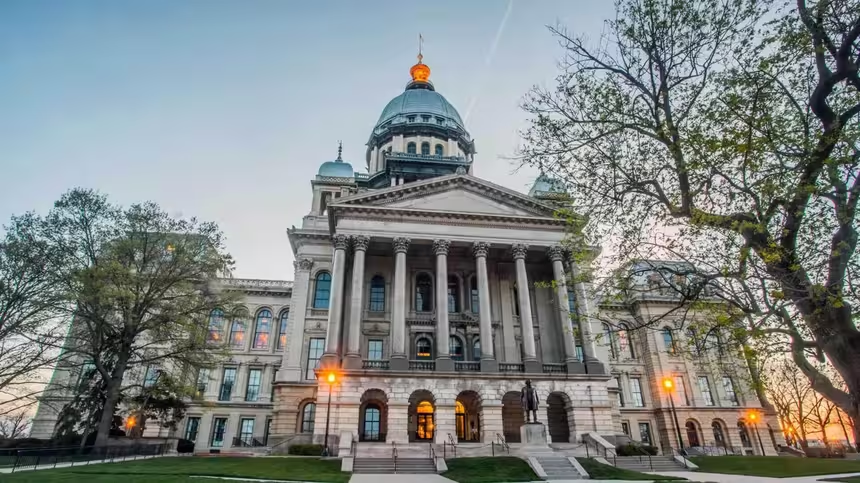
CapitolView
CapitolView is a weekly discussion of politics and government inside the Capitol, and around the state, with the Statehouse press corps. CapitolView is a production of WSIU Public Broadcasting.Providing Support for PBS.org
Learn Moreabout PBS online sponsorship>> Welcome to Capital View on Siu.
I'm Jeff Williams sitting in this week as we take a look at what's making news around the state in Illinois politics.
It's been another eventful week as more than two dozen Texas House Democrats are in Illinois in an effort to delay their state from redrawing congressional district lines.
We'll take a closer look at that story and more headlines from around the state to help guide our discussion.
This week, our Hannah Maisel, statehouse and Chicago reporter for Capitol News Illinois.
And Jeremy Gardner, Illinois state government reporter for the Chicago Tribune.
Hannah and Jeremy, welcome back to the program.
>> Thanks for having us.
>> Glad to be here.
>> All right.
>> Well, despite some threats of being arrested, that group of Texas lawmakers remains in Illinois in an effort to prevent a vote in their state on a Republican drawn congressional map.
that could help President Trump hold on to power in the US House in the upcoming midterms.
Jeremy, I know you've been following the story.
Bring us up to speed.
>> Yes.
So basically, um, Texas Democratic lawmakers came to Illinois, came to the Chicago area on Sunday, um, ahead of what was supposed to be a special session, vote on a new map, um, that would redraw the congressional districts in Texas.
Um, Texas Republicans who have the, um, who, um, who are constitute the majority of, um, the state legislature there, um, were poised to redraw, um, five seats, which were Democratic seats to try to, um, make them safe for Republican territory if if they had candidates running for those seats for Congress.
Um, and this was, you know, this is obviously, um, you know, a ploy, uh, for President Trump, uh, to, uh, get, you know, one of his key, um, Republican governor allies, Greg Abbott, to try to lead this charge and redrawing the map because, you know, many have said many observers have said that come 2026, the US House, um, could be on the, you know, on the verge of flipping, um, several Republican seats.
That's obviously top of mind for President Trump.
So, um, in order to avoid that, Texas Democrats who are, uh, comprised the majority in the Texas House, uh, so it's an 88 to 62 advantage, by the way, in the Texas house, it's, um, 88 Republicans to 62 Democrats.
Um, and you there basically were more than 50 Democrats who left Texas, uh, you know, and basically preventing a quorum from, you know, preventing the House from convening for this session.
They went to, uh, New York, Boston, uh, New York State, Boston and Chicago, uh, to essentially seek refuge.
You know, these are blue parts of the country.
Obviously, Illinois is a bastion for Democratic politics in this country.
And, um, and of course, Governor Pritzker, the you know, their leader, uh, has welcomed them with open arms.
So basically, they're the Texas Democrats are here to prevent this special session from happening.
Um, and, um, you know, basically trying to raise awareness of the issue, saying that, uh, this special session was called under false pretenses.
Uh, it was really meant to help the victims of the mass flooding.
Um, you know, that Rock, Texas, um, you know, there, you know, um, that, uh, caused, um, you know, many deaths and, um, a lot of untold damage in the state and, uh, you know, so that's basically what the session was supposed to be called for.
But of course, uh, Democrats have seen that Republicans have other plans for this.
So what we're where we're at now is, um, Democrats have been threatened with arrest, um, with civil warrants, um, through the Texas House, um, to try to basically coax them to, uh, Republicans trying to coax them to get back into session to vote on this, um, to vote on this redistricting effort and other matters.
Um, but Illinois Attorney General Kwame Raoul, Governor Pritzker and other legal experts say that, um, there's no legal standing for Texas law enforcement to come to Illinois and compel these people to come back or arrest them.
So, um, so basically that's, uh, so it looks like Texas Republican officials in Texas are still trying to find, I'm sure, creative ways to, um, try to make that happen.
But, um, so far, Texas Democrats are just kind of holding court in the Chicago area, just trying to raise awareness, awareness as much as they can about what their counterparts in the, um, the Republicans in the Texas legislature are doing and um, and they're trying to their goal really is to get this special session canceled, um, to get Governor Abbott to cancel this special session so that, um, this vote on the redistricting effort does not occur.
>> Jeremy, how realistically, if you've talked to any of them, how long do you think that they can they can hold out and stay in Illinois?
They're a part time legislature.
And the governor obviously there could call another special session and whenever he wanted to.
>> Right.
I mean, I spoke with one lawmaker who, um, you know, I guess like Friday was going to be another when Republicans were going to take another stab at convening.
But, um, I believe August 20th, August 19th or 20th is, um, you know, this supposed deadline where, um, something was supposed to happen, um, you know, in the legislature for this to, you know, for this redistricting effort to proceed.
Um, and they're going to be here as long as it takes, I was told.
You know, so it could be until the 20th.
At least it could be longer.
We don't know.
Um, you know, they could be, uh, you know, in, in the Texas Democrats could face fines.
I believe it's $500 a day, but they're, you know, they they've gotten a lot of outside support to cover those fines if necessary.
Um, so really, um, while time is of the essence, at the same time, they don't appear to be in any rush to get back, because the key here is to prevent a quorum from taking place for, um, a, you know, for this, you know, map to become law.
>> Um, you know, the governor, on more than one occasion over the last few days has, has said, well, maybe Illinois should look at redrawing it's map and is this maybe some saber rattling?
I mean, the Democrats already hold what is it, a 14 to 3 majority in terms of congressional districts in in the state.
What?
I mean, what is the expected to take place?
Or how might this play out in Illinois if the governor decides to move forward with redistricting effort here?
>> Well, I think it should be noted that Governor Pritzker in recent days has, um, uh, you know, has taken criticism from detractors, including Republicans, um, who've basically branded him a hypocrite, saying, hey, you're welcoming this group of lawmakers from Texas who, um, are against gerrymandering.
But, you know, that is exactly what you do in your state.
That's what, um, Pritzker's, uh, political opponents have been saying.
Um, I asked Pritzker, um, Sunday night when the Texas Democrats arrived, you know, about, um, the Illinois Senate, Republican leaders comments about this support from the governor being hypocritical, uh, because of the gerrymandered maps in Illinois.
And Governor Pritzker basically said, look, you know, our map is constitutionally sound.
Um, you know what?
What?
And then.
And then he said that, you know what Republicans should not be allowed to do is change the rules.
Um, you know, you know, midway through the decade, because typically these maps, um, are decided on by state legislatures at the beginning of each decade when the census numbers are in.
Um, so it's every ten years.
Um, and obviously, Governor Pritzker saying this is a clear effort by Donald Trump to try to change the rules in the beginning, in the middle of a decade, um, for, uh, his for a political advantage.
And, and at the same time, but at the same time, Governor Pritzker has basically acknowledged that if if they need to if, you know, it's it would be very difficult in Illinois to carve out another Democratic seat, um, like you said, um, it's a 14 to 3 advantage that Democrats have over Republicans.
But Governor Pritzker has not ruled it out.
The talking point he's had over the last few days is everything is on the table, so we'll see what happens.
>> This storyline has taken up a lot of oxygen, especially over this last news cycle.
In fact, I think the governor was was on the Late Show, uh, Tuesday evening.
What is your sense in terms of redistricting and what is there, you know, is is there, uh, a feel or a need or an urgency to, to to work on this map much earlier than when Illinois normally would.
>> Right.
I mean, like Jeremy said, it would be difficult to squeeze out another, um, Democratic district from, uh, our current map, which is already quite gerrymandered.
But, you know, of course, the governor does want to leave all options on the table.
Um, you know, we've seen him over the last several years, raise his national political profile.
And, you know, I think that getting, uh, dragged or drafted into this, uh, fight along with other blue state governors, uh, kind of fits into what he's, uh, trying to do, which is be a leader in the National Democratic Party.
And, um, you know, I think Democrats are maybe not explaining this, uh, well enough to a national audience.
Um, because, you know, it's very easy for Republicans and, uh, even independents, even Democrats who see our own districts in Illinois and say, like, this is this is a ridiculous thing.
You are hypocritical.
I think they're not probably explaining well enough that this is, um, a mid, uh, decade kind of thing initiated by Donald Trump, uh, who want, you know, he can probably see the writing on the wall, uh, of, of, you know, it's, uh, typical for, um, midterm elections to not go the way of a presidential, uh, you know, the president's party.
Uh, that, of course, happened in 2018, in a huge way that we had the blue wave election.
And I think, he and other Republican strategists are worried about that.
Um, you know, I think the governor, like, uh, like Jeremy said, he wants to keep all options on the table.
And he said, I want to read a quote, uh, that he on Tuesday.
He said, there are no rules anymore, apparently.
And so we're going to have to play by a set of rules that are being set out in front of us, which, frankly, none of us believes is the right way to operate.
And he said, you know, it is possible to redistrict.
It's not something I want to do.
It's not something that any of us want to have to do.
But, um, you know, if he is getting pressure and other, um, blue state governors are getting pressure, basically they've said like, the gloves are off.
Uh, if they're going to, uh, if Texas Republicans are going to cheat, um, then we will have to respond in kind because, uh, you know, one of the things that on Sunday, um, as the Texas Democratic, uh, caucus was coming into, uh, Illinois, um, it was at that press conference also, and their, uh, leader, uh, Gene Wu said, basically we this is a national fight.
It's not just it extends beyond our own state lines, because if other red states see Texas doing this, what's to stop them from doing the same thing?
Um, you know, there are really no rules about, um, redistricting in the middle of a decade.
Um, it's just that we've never been in these political waters before.
And so, um, you know, if they try a novel approach, then the worry is that other Republican states would do the same.
Um, so, you know, I it's it reminds me, though, of when, uh, President Barack Obama came to, um, Springfield in 2016 and he gave this, uh, you know, it was toward obviously the end of his eight year term.
And he gave this speech to the General Assembly, of course, where he once served.
And he did touch on redistricting.
He said, you know, Congress is broken basically because of the way that districts are drawn up.
You know, it encourages polarization in the, you know, 20 tens Republicans nationwide had this project red map that they deployed in a bunch of different states, and it was very effective.
And it was also like very underground.
You know, most people probably are not even aware that every decade we have redistricting after a census.
Um, but he said, you know, we should do these, uh, nonpartisan, bipartisan commissions to draw lines.
But he also said this needs to be done across the nation, not just in a select few states, which it is done in some states already.
Uh, and in Illinois, we technically have a process for such a thing.
But, um, as we've seen over the decades, it's not really worked out in the way that maybe it was imagined to, um, but, you know, him saying that it should be done everywhere, you know, signals that he.
He's not a Pollyanna about it.
He understands, uh, you know, the realities of politics.
And that, uh, a lot of times in this, it's a, it's a zero sum game.
Um, and so if.
You know, you you don't want to bring a, you know, knife to a gunfight, basically.
>> And.
And the subject of, of, of a nonpartisan redistricting committee could be the topic of.
An entire series of of of capital views.
We're in that kind of fun time in an election cycle when candidates and potential candidates are all doing their maneuvering.
This week, we have had one question essentially answered that's Republican Congressman Darin LaHood decided he will seek re-election to his 16th district seat.
Is this a big surprise to either of you, considering that he was pretty top line candidate in terms of potentially a Republican challenger for Dick Durbin's U.S. Senate seat, as well as being mentioned in passing as a potential Candidate in the gubernatorial race.
>> No, it's not a surprise to me.
I mean, um, uh, Darren LaHood has been in Congress.
Gosh, will it be eight years?
I remember, uh, when I was an intern in Springfield, he was still in the state Senate, but, you know, pretty quickly rose to Congress.
And I think that, um, he's no fool.
He's already gotten to know Congress.
He's, uh, finally, you know, uh, at a point where he is, um, you know, he's rate rising in seniority.
Um, he, uh, you know, based on the amount of people that I've seen him bring to Illinois in the last several years.
You know, he's made, um, powerful alliances.
I don't think he wants to give up his seat in Congress to run for, um, a Senate seat that he's.
He probably would not win.
Uh, just based on the, you know, strong Democratic stronghold that is Illinois.
Um, so, no, it's not a surprise, But, um, you know, I think that it does say a lot about just how shallow the Republican bench is in Illinois.
Illinois Republicans have, you know, been in the wilderness for quite some time.
And, um, you know, uh, there's there's been other names floated.
Um, former Illinois Republican, uh, party chair, uh, Don Tracy has been flirting with, uh, run for either governor or Senate.
I think, uh, he told one of her colleagues this week that he would lean more toward Senate, but, you know, he's, um, I would say more of a strategist than a candidate.
He's not, um, the most rousing person, uh, you know, there's really there's there's people who are very good candidates.
Uh, they speak well.
There's something about them that voters connect to.
And then there's strategists.
And I would say that he is, uh, not maybe, uh, cut out to be, uh, a candidate for especially for an office quite that high profile.
Um, but, you know, there's, like I said, not a lot of other names.
Now for governor.
Um, you know, there's been quite a few people who have already thrown their hat into the race, not necessarily very well known.
There's still going to be some other names that will be officially announced in the coming months.
Um, but, you know, we are coming up in an election cycle because this week, uh, people start passing petitions to get on the ballot for the March 2026 primary.
And we are again in an election cycle.
I'm so sorry to inform everyone.
>> That's okay.
We're I'll say you're you're with you're with family with with this show.
Uh, I think most everyone will be would be interested or is interested in in in the minutia of Illinois, of Illinois politics.
Uh, and you mentioned you mentioned Don Tracy and potentially dipping his toes in those.
Since the era of of of of Thompson and Edgar and maybe even Ryan.
Either one of you how what has been the significant change, do you think, in the Republican Party in Illinois and their ability to to seek especially constitutional offices?
>> Well, you know, we've seen this shift.
It used to be, you know, the basically the rule, it was such a rule that it was, you know, turned into a, um, you know, a very well known saying that all politics is local, but that's just not true anymore.
Um, the nationalization of politics, uh, while Illinois was able to fend it off for longer than a lot of other states, uh, just based on the size of Illinois, um, how active our legislature is.
And, you know, just the fact that, uh, a lot of our, um, we've had a lot of leaders in both parties who have been very high profile, um, we've been able to we were able to fend off that nationalization, but that's just not true anymore.
Um, you know, the the stakes of politics, um, have been raised, especially over the last ten years, uh, since Donald Trump came, you know, came down that golden escalator and, um, you know, kind of changed politics forever in the United States.
And, you know, I think Republicans have, uh, taken a huge hit.
Um, you know, we if you remember back when Bruce Rauner was running for well, he was governor already, he refused to ever answer a question about Donald Trump.
He was trying to kind of hold on to his libertarian but socially moderate identity.
But it just it didn't work because, uh, the effects of Donald Trump and his movement were just too powerful.
And, um, you know, since then, um, and it's the same in the Democratic Party, but not to, uh, in different ways.
But, you know, you're measured by how much you're with Donald Trump to, you know, be considered a Republican.
Um, and, you know, there's been lots of Republicans, um, especially in, you know, former GOP strongholds like DuPage County, uh, which has turned, you know, completely blue.
It's, uh, almost every representative, uh, in, uh, all levels of government, uh, are democratic.
And, uh, for the first time ever, several years ago, um, the DuPage County Board, um, was won by Democrats and is controlled by a Democratic, um, chairwoman.
So it is, you know, the the face of Republican Party in Illinois, um, has just changed, and it's made the party a lot less appealing for those, um, you know, voters that the party used to count on very, very strongly in, especially in the suburbs.
>> Do you have any observations from from your perspective and having covered the party?
>> Yeah.
So I mean, one of the things too, that I think is that's important to touch on is the role of money in these elections.
Uh, Republicans do not have the donor base that they used to.
They used to rely on, um, you know, wealthy donors, uh, to bankroll their campaigns.
Um, in the era of Governor Thompson, in the era of Governor Edgar, the era of Governor Ryan.
Um, you don't see that anymore.
I mean, they had, uh, you know, especially since JB Pritzker has come along a billionaire.
It's hard to compete with Governor Pritzker's money.
Uh, we saw in the last election cycle in, um.
Well, in the last governor's race in 2022, uh, you know, you had Ken Griffin, uh, you know, another billionaire hedge fund manager.
Uh, you know, he came up with a slate of candidates, uh, spent $50 million to try to get Richard Irvin elected.
Um, or an upwards of that.
And he finished in, I believe, third place, fourth place he did in the primary.
And I think that kind of goes to Hannah's.
That kind of goes to Hannah's point is that, you know, many of these Republicans, these Republicans who I just mentioned were kind of on the more moderate side where, you know, in primary elections, um, you know, that's where you see a lot of the extremes come along.
So that's why you saw Darren Bailey, uh, emerge victorious in there.
You know, some somebody that people get excited people in the Republican base, the new Trump era Republicans kind of get excited about.
But a lot of it does come down to money.
I mean, you had Ken Griffin kind of pull out of the race.
Um, that really hurt Republicans, um, down ballot and, you know, down, up and down the ballot.
Um, and then you have, uh, Richard Uihlein, another key Republican donor.
Um, he has also he invested a lot in the 2022 election.
And he's not a player, you know.
Really?
Right now in, um, helping, uh, Republicans in Illinois get elected.
So Republicans have a big problem.
They're outmatched funding wise.
Um, and, uh, and yeah, so at the same time, you know, you don't really see a lot of these big names.
You know, on the Republican side, people who some Republicans can get excited about really making much of a name for, for themselves, partly for that reason.
Um, and then, you know, the other thing with, you know, you know, Hannah was talking about and you were talking about, uh, Darren LaHood.
I mean, I remember during the Republican National Convention last year, you know, one of the things that I was trying to tease out of, uh, the Republican delegation is who do you think would be a good candidate for governor?
And, you know, everybody loves Darren.
Republicans love Darren LaHood.
They feel like he, you know, governor or Senate or any race.
They feel that he is somebody who can appeal to Republicans.
He could probably appeal to, you know, to maybe moderate conservative Democrats.
Um, and, you know, like, like Hannah said, you know, he's a veteran in Congress.
He's got some respected, respectable standing in Congress.
And of course, he's got the Trump backing, which would, um, even though this is Illinois, it would still help him with Republicans in general.
Um, you know, Richard Porter was another name, you know, where he's really lesser known, but is more does more a lot of behind the scenes.
Um, in the, in the state's Republican operation, um, you know, a lawyer who is in, um, George H.W.
Bush's administration.
Um, but he's pulled out.
Um, so, yeah, I mean, it's going to be and then Don Tracy, who, you know, was not an elected official.
He's a strategist.
He was trying to promote the Illinois GOP.
Um, and, uh, yeah.
So, you know, it's really going to be interesting to see the field of candidates, you know, in the coming months.
I'm sure there's probably going to be a lot of them.
But as far as, um, you know, you know, the Illinois Republican Party, you know, the overarching problem without, you know, just being unmatched in addition to that, um, you know, they don't control any of the constitutional offices, right?
Um, in 2022, they lost by such a lopsided victory.
And it seems and they have a lopsided disadvantage in the Illinois General Assembly.
It's so they're really up against a lot.
So it's going to see what they come up with.
Um, you know, in the next coming months as petitions are circulating and who's, you know, entering, um, any of these races on the Republican side?
>> Jeremy, I'm going to let you have the last word, as we often do on this show, we run out of time before we run out of things to talk about.
Hannah Maisel, Capitol News, Illinois Jeremy Gorner, Chicago Tribune thank you both for joining us this week.
>> Thank you.
>> Thank you.
>> And and you at home.
Thank you for joining us for CapitolView I'm Jeff Williams.
Have a good week.

- News and Public Affairs

Top journalists deliver compelling original analysis of the hour's headlines.

- News and Public Affairs

FRONTLINE is investigative journalism that questions, explains and changes our world.












Support for PBS provided by:
CapitolView is a local public television program presented by WSIU
CapitolView is a production of WSIU Public Broadcasting.