
Washington Week with The Atlantic full episode, 10/2/26
10/2/2026 | 26m 45sVideo has Closed Captions
Full Washington Week with the Atlantic broadcast from October 2, 2026.
Full Washington Week with the Atlantic broadcast from October 2, 2026.
Problems playing video? | Closed Captioning Feedback
Problems playing video? | Closed Captioning Feedback
Major funding for “Washington Week with The Atlantic” is provided by Consumer Cellular, Otsuka, Kaiser Permanente, the Yuen Foundation, and the Corporation for Public Broadcasting.
Washington Week with The Atlantic full episode, 10/2/26
10/2/2026 | 26m 45sVideo has Closed Captions
Full Washington Week with the Atlantic broadcast from October 2, 2026.
Problems playing video? | Closed Captioning Feedback
Where to Watch Washington Week with The Atlantic
Washington Week with The Atlantic is available to stream on pbs.org and the PBS app.
Buy Now
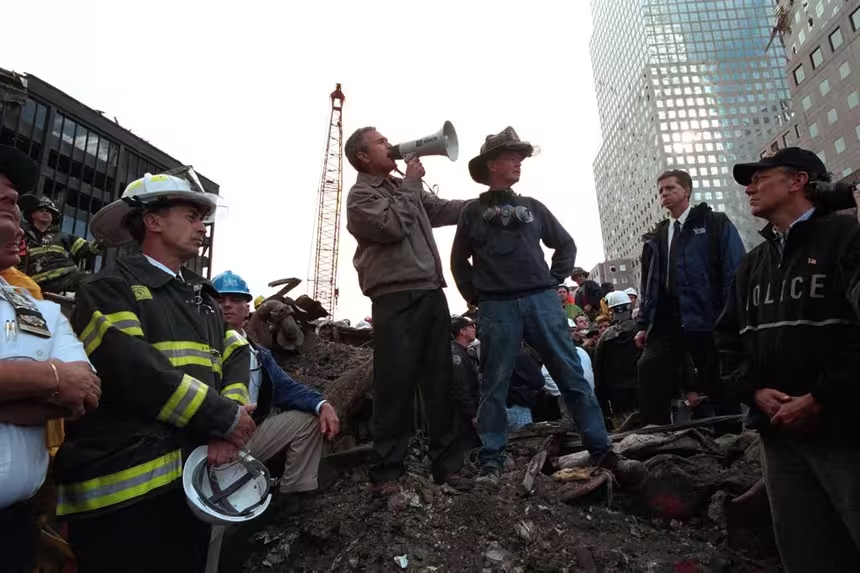
10 big stories Washington Week covered
Washington Week came on the air February 23, 1967. In the 50 years that followed, we covered a lot of history-making events. Read up on 10 of the biggest stories Washington Week covered in its first 50 years.Providing Support for PBS.org
Learn Moreabout PBS online sponsorshipJeffrey Goldberg: President Trump has made a curious request of Republican voters, one that many of his party's candidates don't like very much.
Donald Trump, U.S.
President: I'm asking you to pretend that I'm on the ballot.
Jeffrey Goldberg: With a month to go before midterm elections and 73 percent of the country saying we're heading in the wrong direction, his words -- Donald Trump: Pretend please that I'm on the ballot.
Jeffrey Goldberg: -- may lead to a Democratic Party-controlled Congress, next.
Good evening and welcome to Washington Week.
One thing we know about Donald Trump, and he would not deny this, is that it's all about him, always.
He's the main character, and he doesn't like it when he's not.
Any other Republican president facing miserable approval ratings would tell members of Congress, do whatever it is you have to do to win.
For Trump, the price of not holding onto Congress is enormous.
But he doesn't see this, or he doesn't particularly care.
It's just not part of his makeup.
This main character syndrome also explains why six years after losing the presidency to Joe Biden, he's still obsessing about election conspiracies, and it explains why he wants to remake Washington, remake it physically, according to his whims and tastes, even going so far as to try to put his name on a martyred president's memorial.
I'll discuss President Trump and his many preoccupations tonight with my guests.
Steve Inskeep hosts Morning Edition at NPR.
Zolan Kanno-Youngs is a White House correspondent at The New York Times.
Janae Kingsbury is a staff writer at The Atlantic.
And Michelle Price is a White House reporter at the Associated Press.
Thank you all for being here.
We have a lot to cover.
Zolan, let me start with you.
It's four weeks now, about, from the midterms.
Conventional wisdom says that we're possibly looking at a blue wave.
Is the conventional wisdom right?
Zolan Kanno-Youngs, White House Correspondent, The New York Times: You're right that that's the conventional wisdom, right, that history says that the incumbent party is going to face challenges.
But we've got some added layers on that history, right?
The campaign promise that the president ran on, driving down cost of living the economy, he has not made good on that campaign promise.
Polling shows that there is economic frustration widely throughout the country, including within his own base.
You add on to that the war in Iran has not been four to five weeks, right?
We're still in it as well, and we have seen the cost continue to fuel that economic frustration.
Jeffrey Goldberg: It's been four to five weeks, but seven times.
Zolan Kanno-Youngs: There you go, right.
Jeffrey Goldberg: Right.
Zolan Kanno-Youngs: And look, it's a political quagmire right now, and that's another campaign promise.
No more of these forever prolonged wars, right.
Michelle Price, White House Reporter, Associated Press: No more wars, period.
Zolan Kanno-Youngs: No more wars, period, and we have seen that.
So, they are not in a good place.
Republicans are not in a good place.
The White House is not in a good place.
And in response to that challenge, you are seeing the president not say, distance yourself from me, do what you got to do, but rather, pretend I am on the ballot.
Jeffrey Goldberg: That's what I wanted to get to.
I mean, you saw President Trump in the opening of the show demanding that Republican members of Congress tie their fate to his.
That's been a good deal for Republicans for much of the Trump era.
It doesn't sound like a good deal now.
And so I -- like a thought experiment for you, Steve, like, would any other unpopular president have made this demand on his party.
I mean, all presidents are egomaniacs, let's stipulate.
Steve Inskeep, Host, NPR: Okay.
Jeffrey Goldberg: But would any other president have done that?
Steve Inskeep: No, and I think of a different example.
George W. Bush in 2006 was happy almost to campaign not at all when he was very unpopular and facing a midterm election in a similar circumstance to now.
Although I should note it didn't work for George W. Bush.
His party lost both houses of Congress, and there's a case to be made that, you know, Trump is Trump, and even if he did try to duck or invite people to distance themselves from him, it would not work because Republicans in Congress have done whatever he told them to do on issue after issue for a couple of years.
And you alluded to the broad trends, the way that people feel that prices are up and so forth.
That is true.
I think, as I get ready to travel out and talk to people, as I've been preparing for that, I get a sense that for a lot of people, there are also issues that are personal to them, that bother them and they think about.
My colleague on NPR, Stephen Fowler, was reporting this morning about one of the effects of Supreme Court rulings on gerrymandering and Republicans gerrymandering to try to improve their chances in the House.
This has offended black voters in the South, and a lot of them have been more motivated, and a lot of them have been turning up in greater numbers in elections the past couple of years.
There are a lot of Americans who were affected when the administration cut billions of dollars worth of grants to different places across the country.
There are a lot of people who had opinions about the administration's move against universities.
Of course, these moves also had support, but there are a lot of people who have a personal reason to be energized in this election.
Jeffrey Goldberg: Michelle, you're -- I was going to say that you're reporting from inside the White House, but we should note that you are a part of an organization that has been banned by the White House, and you're obviously back in to some degree.
But nevertheless, you're still reporting on what's going on inside the White House.
And I want to talk about this press crisis in a moment.
But are the people who are advising the president telling him the truth about what's going to happen if current trends prevail come the midterms?
Michelle Price: There's -- we're seeing some bits of truth trickle through.
You know, he's not going to places that are swing districts.
He's going to places that it's going to help Republicans.
It's deeply red areas right now.
It's the do no harm tour.
But the president still insists that his poll numbers are actually great, that the poll numbers that everyone else are seeing are fake.
There is a little bit of denialism, and we also have just seen with this administration on all sorts of issues, things are not taken to the president that are bad news sometimes, or they're kind of soft-pedaled.
They're not given to him right away.
So, there still seems to be a major disconnect with him for the stakes of this.
We also just see him sometimes talk about this like he's actually not that concerned if Republicans lose.
He's saying, vote as if I'm on the ballot, but he'll say, you know, Republicans, like, what are you doing?
What are -- this is not actually personal for him.
Zolan Kanno-Youngs: Yes.
When he gets pressed on sort of the prospects for Republicans, his answer almost differentiates the party from him.
It's almost as if his answers imply that his agenda and his policies have not had an impact on the country.
Jeffrey Goldberg: But -- Michelle Price: He'll shrug when he hears about the prospect of Democrats possibly taking over and say, well, I can take it.
Jeffrey Goldberg: But that makes no sense -- Michelle Price: Yes.
Jeffrey Goldberg: -- from a political standpoint.
I mean, I -- Steve Inskeep: From a passing legislation standpoint it makes no sense, but, politically, it could be better for him to have a full-on -- Michelle Price: And there really is not a legislative agenda.
Steve Inskeep: Yes.
Jeffrey Goldberg: No, but my point is only that Democrats in control of the House and the Senate would mean presumably endless investigation, endless subpoenas, endless probing.
Obviously, Congress controls the purse strings, et cetera, et cetera, et cetera.
It doesn't make any sense, according to the laws of political physics that we understand.
That's all I'm saying.
Steve Inskeep: No.
Jeffrey Goldberg: Small point.
Michelle Price: It's true, but this is a president who also, in 2024, remember he went through four court cases.
He has found that he feels like he becomes tougher.
He seems to work best when he has an opponent, an enemy.
The fundraising goes up.
That's not actually as politically devastating for anybody else as it is not as devastating for this president.
Jeffrey Goldberg: Janae, one of the interesting things about the presidency right now is that given the number of problems that he's facing, everything from diesel and gas prices to, you know, the jobs numbers, which we didn't even talk about, which are weak, he spends an extraordinary amount of time- thinking about how to rebuild, physically rebuild Washington more in his own image.
You're our beat reporter, one of our beat reporters on this subject.
Talk about how important you would rate these projects, the arch, the ballroom, the Kennedy Center.
Talk about how important he seems to treat those things even in these periods of political crisis.
Janae Kingsbury, Staff Writer, The Atlantic: Sure.
Well, you know, he only has a little over two years left in office.
I think his number one priority is the White House ballroom for its proximity, but also for what he cites as national security reasons.
Jeffrey Goldberg: Right.
Janae Kingsbury: And then we have the arch, which has yet to break ground, but it is speed -- it is fast-tracking through a lot of the red tape that normally kind of helps preserve this process for how projects are built.
Jeffrey Goldberg: How long should it take if he were treating it according to the way these things are usually done?
Janae Kingsbury: Yes.
I mean, it can take years for, we're talking about monuments and memorials that are well-documented in terms of how the process should go.
It involves both Congressional approval and federal historic preservation processes and federal body reviews.
Jeffrey Goldberg: I'm going to ask you to do something that it's not really fair but I want you to predict - - she can handle it.
She can handle it.
Steve Inskeep: It's just live.
Jeffrey Goldberg: It's just live T.V.
Look, nobody's going to remember that you said the following, whatever you said, unless they do.
What are the chances that this 250-foot arch that will separate the Lincoln Memorial from Arlington National Cemetery, what are the chances that it actually gets built by the time he leaves office?
Janae Kingsbury: Okay.
Well, all right, cast your bets.
I would say, I mean, the way -- the recent developments with the arch, which is that an advisory council decided that the entire historic preservation consultation process could just be completely disregarded is a huge path that he just cleared.
And so now he only needs one more approval, which he's likely to get in November from the National Capital Planning Commission, and that means they can immediately start breaking ground.
And as a fact, there's already been some activity in Memorial Circle.
It looks like there's cameras, and they're doing some testing of the soil.
So, I think that's become one of his big priorities, and it seems very likely.
Jeffrey Goldberg: Right.
Zolan Kanno-Youngs: His announcement that he would equip that arch with drones and ammo, to me, obviously, the headline was sensational, and we -- it caught all of our attention.
But it also told me that they have an intention to use that national security argument, which they have found success with in the courts when it comes to the ballroom.
Jeffrey Goldberg: Right.
You mentioned that the military application of the ballroom, some, I guess, bunkers beneath the ballroom, that expedites this.
And so what -- I guess I'm just feeling like we're having a like kind of almost Alice in Wonderland conversation.
Is the president of the United States going to build a 250-foot marble arch for snipers and as an ammo dump right across -- Steve Inskeep: And a drone base.
Jeffrey Goldberg: And a drone base.
That sounds, as we note, a little bit curious, a little bit unusual.
But then it might actually expedite the process is what you're saying.
The Pentagon might say, oh, we actually do need it, or Pete Hegseth might say, we do need it.
Janae Kingsbury: Yes, I mean, to your point, I think, you know, the moderate success that he saw with the ballroom might have influenced his decision to turn the arch into a military complex.
Although he is saying that the military strongly made this request.
What's interesting is that the White House told me that nothing will change about the actual design for the arch, so we're not talking about fencing or any additional security, and this is still meant to be a public monument.
So, there are tourists and there are new concerns that -- security concerns -- Jeffrey Goldberg: Look, I'm no military logistics expert, but it just seems to me that if the -- one of the first rules of Army security is don't tell people where all the ammo is.
And if you build that as an ammunition stockpile, and you don't have a fence around it because you want tourists - - all I'm saying is it's not making sense.
Could you -- Steve Inskeep: The snipers will defend it.
Jeffrey Goldberg: The snipers will defend it.
Janae Kingsbury: That is an option.
Jeffrey Goldberg: Yes.
The -- in terms of the priorities, how do you rank these building projects in terms of his overall political, ideological legacy priorities?
Zolan Kanno-Youngs: I agree that he -- he talks about the ballroom all the time, right?
And he focuses on it all the time.
Jeffrey Goldberg: I mean, you guys as White House correspondents hear it every day.
Zolan Kanno-Youngs: Yes.
Michelle Price: Yes.
Jeffrey Goldberg: He brings it up all the time.
Michelle Price: He's been inviting people to tour the site.
He invited President Xi to go to it, even though it's -- Zolan Kanno-Youngs: Did it at the state dinner.
Michelle Price: Even though it's a military complex, he has gotten to tour it.
The Hispanic celebration this week he invited the attendees.
He said Hispanics -- what did he say about they might not survive a fall, or they would survive a fall?
Jeffrey Goldberg: Oh, he said Hispanics would -- Michelle Price: Would survive a fall -- Jeffrey Goldberg: -- survive the fall into the pit.
Michelle Price: -- at the construction site, yes.
It's become a regular feature of events at the White House.
Jeffrey Goldberg: Right.
Zolan Kanno-Youngs: I think the Kennedy Center, though, is emblematic of a bit of a different theme right now.
And the ballroom, I think he's had some moderate success.
He sees all these things as part of his legacy.
The Kennedy Center, he has faced some losses recently.
And that court decision where he could not put his brand, his name on the Kennedy Center, that is something that we didn't see that kind of loss where an institution is pushing back on his expansion of his power in his first year in office.
Jeffrey Goldberg:Right.
So, Janae, you had some new reporting on the Kennedy Center today.
Tell us about what you found.
Janae Kingsbury: Right.
So, you know, even though the Kennedy Center is largely dark, there's no arts, there's no artists or staff, really.
The remaining staff have been ordered to work from home during this temporary closure period.
But yet the Kennedy Center's still planning to put on the Kennedy Center Honors, which is their flagship kind of marquee event that they host every year, and it's one of their biggest fundraising drivers.
But this time it'll be at Capital One Arena.
Jeffrey Goldberg: Which is Washington's hockey and basketball arena.
And that'll be the first time in the history of the Kennedy Center Honors that it's not at the -- is it that the Kennedy Center -- and you've been in and out of the Kennedy Center, is it that the Kennedy Center is actually physically unsafe to use, or is that an excuse that they're making to remake it in his own image?
Janae Kingsbury: Well, officials are saying that the building is unsafe and they've closed it temporarily for the next week.
Like on a rolling basis, they're going to keep evaluating whether the center needs to remain closed.
And -- but they've done a number of assessments.
The legal fight that's playing out, there's been so many reports and assessments up uploaded to show that there's extensive damage.
Water intrusion is something that's led to a lot of corrosion to the steel and the structure.
Soffit panels are in really bad shape.
And last month, there was a storm that rolled in that led to a section of the ceiling collapsing within the grand foyer.
Jeffrey Goldberg: What are the chances that the president is going to say, maybe we should just knock it down and do it all over again?
Janae Kingsbury: Well, you know, for a long time that seemed to be kind of a scenario that was farfetched and among the Kennedy Center doomers who were describing this -- Jeffrey Goldberg: Not a term that we ever thought we'd hear in Washington.
Janae Kingsbury: Right.
But -- Steve Inskeep: A.I.
doomers, Kennedy Center.
Jeffrey Goldberg: Yes.
Janae Kingsbury: But it's been -- the rhetoric has been escalating dramatically in the past few weeks where, you know, we've seen this photo of him holding or appearing to look at a presentation that says, Kennedy Center Demolished -- Zolan Kanno-Youngs: On Air Force One, right.
Janae Kingsbury: -- on Air Force One, as well as he's -- I think even his posts on Truth Social have taken a really dark turn, an alarmist turn.
He talks about, you know, someone could die and that someone almost died when the ceiling collapsed last month.
And he's now saying that, you know, if the Kennedy Center won't allow his name back on the institution, then it won't raise the money that it needs to completely restore the building to the way it need to be.
Jeffrey Goldberg: Just noting before we pivot that the Kennedy Center is named after a president already, and that is the -- meant to be the living memorial to a president who was assassinated in service of his country.
Just noting that.
Zolan Kanno-Youngs: And by the way, all this focus on the Kennedy Center ballroom, remember the topic at the top of the show, it's not addressing that economic concern.
Michelle Price: Right.
Jeffrey Goldberg: No, that's what I mean when I say this -- Zolan Kanno-Youngs: There is a split screen here.
Jeffrey Goldberg: What I say is that this might be the most important thing to him.
Zolan Kanno-Youngs: Right.
Michelle Price: Yes.
Jeffrey Goldberg: I want to pivot to something else that is also important to him, which is the re-litigating the 2020 election, which he of course lost, but which he says he won.
We saw something very odd in Congress this week a hearing in which the former prosecutor, Jack Smith, was testifying and Senator Eric Schmitt tried to trap Smith but managed to trap himself.
Why don't we just watch this for a minute?
Sen.
Eric Schmitt (R-MO): What would you say if I had a series of text messages from your team that said you were in Atlanta at a Warrior Hawks game on February 3rd, 2024, the day after Willis and Wade announced their affair?
You -- I don't think you know that we have this stuff.
So, I'll give you a second to process it so you don't, you know, perjure yourself.
Jack Smith, Former Special Counsel: I recall going to a University of Maryland basketball game where Caitlin Clark was playing right around that time.
Sen.
Amy Klobuchar (D-MN): Could it then be that University of Iowa is the Hawkeyes?
Could that be it?
That might be the confusion over the names of the team, but perhaps you should have looked at it more carefully.
Jeffrey Goldberg: I just want to remind all of you that we're the country that won World War II.
Apart from just being embarrassing for Senator Schmitt it's revealing insight into what preoccupies many Republicans in the legislative branch even today.
Is that fair to say that they -- the question that I have is he doing that because Trump wants him to do it, or is it because it's more widespread as an organic concern within the party?
Michelle Price: Well, what we see often in hearings, whether it's somebody who's, who works for the administration who's testifying or it's the members themselves, it is all a performance, it is all a show.
They know that the president likes to watch C-SPAN.
He likes to watch the hearings.
There is kind of an audience of one going on here.
And, you know, I don't know how much Eric Schmitt personally -- he may personally care about getting Jack Smith, but it is very clear that this is a thing that President Trump cares a lot about.
And if you are a Republican member of Congress, you kind of live and die politically based on your standing with the president in most cases right now.
And showing that you're taking all these steps to kind of further his causes, the things that are important to him, that's how you remain in good standing.
Steve Inskeep: There's another part of that exchange that was remarkable to me, and that is that Senator Schmitt, having had this misapprehension about where Smith was, says, and you're a dirt bag, used the word dirt bag.
And Senator Klobuchar effectively asked him to take that back.
He said, no, I stand by that.
And so his facts have been exposed as not facts, but it's like, I'm calling the name.
I'm going to go with the name.
And that I wouldn't say that's just him.
That is our politics right now.
It's can you land the name?
Can you stick the landing on the name?
Jeffrey Goldberg: Right.
Steve Inskeep: And he went there, and that's, that was the product of that exchange.
Jeffrey Goldberg: Right.
Zolan, you wrote recently about the president as he gets more agitated about losses that may be piling up, that he's turning his attention to the media more than ever.
And you write that, you know, he stripped funding from public television and radio, the Pentagon fired the editor and publisher of Stars and Stripes, et cetera, and he's thrown whole networks and news organizations out of the White- or is trying to throw them out of the White House.
Post-election, would a Democratic Congress be effective at protecting press rights, or is he going to double down on this rolling assault?
Zolan Kanno-Youngs: Well, I think the current litigation that we're seeing both with the Associated Press as well as this case involving MS NOW, CNN and Politico is going to matter a good amount, not just for entry onto White House grounds, but just how much power the president has over what's called the White House Pool, which I take every opportunity I can to inform people really matters, right, in terms of tracking where the president goes and having independent journalists put questions to him that are actually critical and seeking of the truth.
Will Congress be able to actually shield the press?
I don't know.
But what we do see already is a trend where when the president's power is being questioned in the lead up to that ban, lost in the Supreme Court on mail ballots, right, Kennedy Center loss as well.
So, as he continues to face pushback, you see him try to assert power over one of his more favorite foes, right, the media.
Jeffrey Goldberg: Yes.
Michelle, you're a direct -- you're directly involved in this.
How has your life as a journalist been changed by this, or has it?
Michelle Price: I mean, we still do our jobs.
We will always still do our jobs.
We still cover this administration.
We cover it a little differently sometimes if we can't be in the room, but we would never stop covering the most powerful person arguably on the planet because of this.
You know, this is a matter of free speech.
Our court case is ongoing, and people can read the filings, but we feel it's very important.
And to Zolan's point, it's not just about who's asking the questions, and they're being tough questions, but it's called a protective pool.
It is also so that there is independent record of the president, his movements, especially in those worst case scenarios.
This is a president who had -- who's had multiple attempts on his life.
When he was at -- on that stage at Butler, there is no protective pool.
There was no pool of reporters going with him to the hospital.
There are conspiracy theories that kind of sprout up because people did not see where he went.
There's no film footage.
So, it serves a broader purpose for the American public and just for the continuity of the office.
It's important.
Steve Inskeep: Can I just add something about the effect of this?
I don't feel that any of this has prevented any of the coverage that the president would not like.
The media are still doing their jobs.
As a reporter, I've often felt when someone refused to talk to me, I sometimes ended up with a better story because it forced me to work harder and go to other sources and find other information.
I'm still reading Associated Press dispatches that I learn from.
I'm still seeing good reporting on CNN and other news outlets.
I'm on my way over here and reading The New York Times and learning a story that says that the president personally ordered $20 million in ads to be spent on himself, government funding for ads.
We knew about the ads, but did not know his personal involvement.
And I'm continuing to learn those things.
Jeffrey Goldberg: Well, if you keep watching us, you'll continue to learn things every week.
But we're going to have to leave it there for now, I'm sorry to say.
But I want to thank our guests for joining me, and thank you at home for watching us.
For more on the controversy surrounding this year's Kennedy Center Honors, please read Janae's latest article at theatlantic.com.
I'm Jeffrey Goldberg.
Good night from Washington.
 New
NewAs setbacks mount, Trump turns his anger toward the media
Video has Closed Captions
As setbacks mount, Trump turns his anger toward the media (6m 19s)
 New
NewTrump makes himself main character of GOP midterm campaign
Video has Closed Captions
Trump makes himself main character of GOP midterm campaign (16m 30s)
Providing Support for PBS.org
Learn Moreabout PBS online sponsorship New Episode
- News and Public Affairs

Top journalists deliver compelling original analysis of the hour's headlines.
 New Episode
- News and Public Affairs

FRONTLINE is investigative journalism that questions, explains and changes our world.
 New Episode
 New Episode
 New Episode
 New Episode
 New Episode
 New Episode

 New Episode
 New Episode
Support for PBS provided by:
Major funding for “Washington Week with The Atlantic” is provided by Consumer Cellular, Otsuka, Kaiser Permanente, the Yuen Foundation, and the Corporation for Public Broadcasting.