
September 25, 2026
9/25/2026 | 55m 47sVideo has Closed Captions
Mohammed bin Abdulrahman Al Thani; Mark Rutte; Alon Shaya
Qatari PM Mohammed bin Abdulrahman Al Thani discusses U.S.-Iran diplomacy and Qatar's efforts over Gaza. NATO Secretary General Mark Rutte discusses the war in Ukraine and a growing strain on European security, while President Trump invites Vladimir Putin to the G20 Summit in Miami. Chef Alon Shaya’s cookbook, Memories of a Good Meal, explores how food can preserve history and stories of survival.
Problems playing video? | Closed Captioning Feedback
Problems playing video? | Closed Captioning Feedback
September 25, 2026
9/25/2026 | 55m 47sVideo has Closed Captions
Qatari PM Mohammed bin Abdulrahman Al Thani discusses U.S.-Iran diplomacy and Qatar's efforts over Gaza. NATO Secretary General Mark Rutte discusses the war in Ukraine and a growing strain on European security, while President Trump invites Vladimir Putin to the G20 Summit in Miami. Chef Alon Shaya’s cookbook, Memories of a Good Meal, explores how food can preserve history and stories of survival.
Problems playing video? | Closed Captioning Feedback
Where to Watch Amanpour and Company
Amanpour and Company is available to stream on pbs.org and the PBS app.
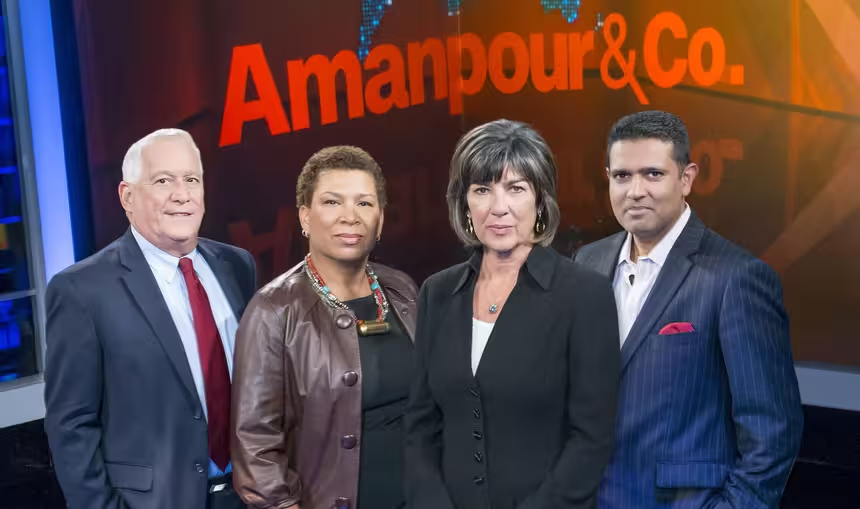
Watch Amanpour and Company on PBS
PBS and WNET, in collaboration with CNN, launched Amanpour and Company in September 2018. The series features wide-ranging, in-depth conversations with global thought leaders and cultural influencers on issues impacting the world each day, from politics, business, technology and arts, to science and sports.Providing Support for PBS.org
Learn Moreabout PBS online sponsorship[ Music ] >> Hello everyone and welcome to Amanpour and Company.
Here's what's coming up.
>> If the security doesn't include everybody in the region, it means that the security is incomplete.
>> As the war with Iran grinds on, will diplomacy ever work?
I sit down with Qatar's Prime Minister Sheikh Mohammed Bin Abdulrahman Al Thani on mediating between Washington and Tehran.
Then... >> We've invited President Putin to the G20.
>> Russia's finances and Russia's production are what must be stopped if Putin is to be stopped.
After a week of clashing visions at the UN General Assembly, where do the United States and Europe go from here?
NATO Secretary General Mark Rutte joins me.
Also ahead.
- It hit me so hard that in the darkest of times that food can really bring people together in a way that nothing else can.
- Memories of a good meal.
The award-winning chef, Alon Shaya, speaks to Walter Isaacson about how food can keep history alive.
(upbeat music) - Amanpour and Company is made possible by the Anderson Family Endowment, Jim Atwood and Leslie Williams; Candice King Weir; the Sylvia A. and Simon B. Poyta Programming Endowment to Fight Antisemitism; the Straus Family Foundation; the Peter G. Peterson and Joan Ganz Cooney Fund; Charles Rosenblum; Monique Schoen Warshaw; Koo and Patricia Yuen, committed to bridging cultural differences in our communities.
Barbara Hope Zuckerberg.
And by contributions to your PBS station from viewers like you.
Thank you.
- Welcome to the program everyone.
I'm Christiane Amanpour in New York at the United Nations.
President Trump came here this week with a stark message for the world about American power.
In what amounted to a declaration and a rejection of the very concept on which the UN was founded, he threatened to "annihilate Iran" and defended a worldview where, as he put it, "to the victor belong the spoils."
The next day, Iran's president, Massoud Pezeshkian, addressed the UN.
He showed pictures of the schoolchildren killed by American airstrikes on Minarb, and he vowed that Iran "cannot be made to surrender."
The United States president described us as terrorists.
We have been the victims of terrorism.
But behind the scenes in New York, diplomacy is also underway.
Top US and Iranian officials have held their first talks since the June ceasefire unravelled, and they were mediated by Qatar.
And Doha is also at the center of efforts, of course, over Gaza, from the Board of Peace to questions about past funding of Hamas.
I asked Qatar's Prime Minister Sheikh Mohammed Bin Abdulrahman Al Thani all about all of this in an exclusive interview.
Prime Minister, welcome back to the program.
Thank you.
You are mediating between U.S.
and Iranian sides.
Can you tell us the most you can tell us about where we are in terms of potentially an agreement?
Well, thank you very much for having me.
First of all, Christiane, look, we've been in the past few weeks trying our best.
Actually, since the MOU has been, I won't say collapsed, but fallen short, trying our best to bring back diplomacy into track.
Yesterday, we had the indirect talks between the two parties, and I believe there were some positive progress in these talks.
We believe that we have sensed that from both parties that they want to see some positive progress.
We have also noticed that in the exchange that we had yesterday.
Of course, we cannot say much about it right now.
And in these kind of situations, normally, it's better to stay away from the public eyes until it gets mature.
But we are really hopeful that diplomacy can prevail at the end and we can find a solution.
Can I ask you, because it seems now that that strait of Hormuz and the U.S.
blockade is really putting the pressure on Iran.
Who would you say is under the most pressure right now?
Well, I think the entire world is under pressure, including Iran.
Now if we are just going to weigh the pressure, who's like have the pressure more, the whole region is under the same pressure as Iran by the way.
The blockade is yes imposed on Iran but also there's a blockade that imposed on us as Gulf countries.
My country especially, we cannot get ships out, it's very difficult, very challenging.
You have seen that the strait has been insecure and this is unacceptable.
The strait has been always an international waterway and this is becoming like a global problem.
The world needs to come together to address this issue because currently it's an issue that's being used in this war which is unacceptable but for us in order to protect our people and to protect the future generation we should put an end for this manipulation and this blackmailing of the waterways.
Okay, so you're talking presumably about Iranian blackmailing of the waterways.
Well, there is in general anyone who is using the waterways to block countries and to block the freedom of navigation.
This is considered unacceptable.
This is considered trying too strong arming.
And we refuse any blockade or any blackmailing by any country or any party.
I mean, the obvious question is, what options do you have?
How do you end this other than around a table, right?
So do you think-- because the Iranians seem to want a future in which they are at any security negotiation for the whole region, that they can't be put to that side and work arounds.
Do you think that that is going to happen?
How do you see it happening?
Well, I think if there has been a right moment for this, it is the right moment.
We need to make sure that we do not represent any concern for the Iranians nor the Iranians represent a concern for us.
We are neighbors.
This is a destiny.
We've been maintaining a good relationship with them for decades now.
And I think that when we see all this chaos today happening in the region, the region is calling for a security arrangement that ensures that every country in that region is feeling safe and secure.
And this is the right of the Iranian people, the right of the Qataris, the Saudis, the Emiratis and everyone in that region.
So we've talked about Iran and the blackmail and this and that.
What about the United States?
They started this war.
I don't know what you all said to your allies in the Trump administration when you knew that this was going to happen.
But even at the UN, President Trump essentially said, "The spoils of the world go to those who've won it."
In other words, you know, "To the victor go the spoils."
He has sort of talked up American military victories in the world.
And he also threatened that if there was no deal, there would be annihilation of Iran.
How do you read all that?
Because it's very bellicose.
Look, Christiane, the war, I mean, Qatar position has been very clear from the beginning.
We didn't want this to happen.
We didn't want this to start in the first place.
We were doing everything we can.
And we have walked every avenue between the U.S.
and Iran in order to find a diplomatic solution between them.
Now the war has happened and basically we've been calling that the only way forward will be around an agreement.
There will never be a military victory.
It's never it's not about like the U.S.
is big power.
Iran has their own power and has their own capabilities.
It's not about who's more powerful than the other because at the end of the day the ones who are losing are the people of those countries.
And today actually we've seen that this war impact is not only on the region it's on the global economy.
So that's why any kind of escalation will have a consequences that the region cannot bear, the world cannot bear and we prefer that diplomacy is the only way forward for this.
Mr.
Prime Minister, your particular state has taken a massive hit, whether it's the Al Udeid Air Base that the United States uses.
We understand through reporting that it was much worse hit than was told by your government or the United States, that it'll take years to rebuild that.
We know from your own official figures that your LNG and your exports have taken a massive hit.
Now, you're a very rich country, but how worrying is that?
Because your whole posture and that of the other GCCs has been based on being prosperity, stability, you know, continuation, and being able to work all these different forces in your region.
All of that's gone up in smoke for the last six months.
Well first of all you know look I mean what we've been affected significantly by this war and this is something that Qatar didn't hide or didn't decline.
Whatever being reported actually by the government is the reality and we have been very clear from the beginning and actually very accurate with everything and every damage that's been created in the country, whether it's in if it's an allocated airbase or it's in the LNG and I'm sure that you have seen all the reporting about what damage has been created on our LNG facilities and transparency for us was a key.
It's important for us, for our people, it's important for our partners and our friends to understand what kind of damage has this war created for us.
Now, the whole model of the Gulf countries is built on prosperity and forward-looking, opening partnerships, connectivity hub, and this will remain our model.
Yes, we have security challenges in the region, but we are strongly believing in diplomacy.
We believe that diplomacy will prevail if we want to have, you know, to continue to have a prosperous region and prosper Iran, hopefully, in the future.
>> The whole sort of defensive structure that you were counting on from the United States seems to have gone up in smoke, that you still got attacked, even though you host all those bases, even though you give so much money to the United States.
You guys gave a plane to the United States to the president.
And what did you get in return?
Saudi Arabia, one of the big investors in the United States, can't even get President Trump to help when the Houthis are making threats to Saudi Arabia.
What's in it for you anymore?
- Look, our defense arrangement that we have in our country is based on our own, building our own capacity and our own capability.
And that has been always the doctrine for the state of Qatar to make sure that we have a military that is able and capable to defend the country and our armed forces has demonstrated their capabilities throughout that war.
It doesn't mean that our partnership with the U.S.
is not valuable for us.
It is one of the most or even it is the most valuable defense partnership that we have.
What is happening right now is an outstanding circumstances that all of us we are looking at it we are thinking about how can we improve and can have a stronger partnership in the future that can making sure that this bond is solidified.
Let me move on to the other massive issue and that's the Israel-Palestine issue.
So there's been talks and conferences here about what to do and the Board of Peace met about Gaza.
Is there any progress on on of a notable fashion on whether it's humanitarian aid whether it's setting up a state I know that takes a while but you know international stabilization force or the Palestinian sort of security force to take over from Hamas where is where is that right now?
well I think that since the signing of the Sharm el-Sheikh agreement we have seen that Israel every time is not fulfilling their commitment and their part of the commitment of the agreement and it's very simply it's for one person gain and for the gain of the Prime Minister and his far-right government that's That's the whole thing.
Like when every aspect of that MOU is asked, you know, Israel is asked to implement, they just deny it and they just move on in the opposite direction.
They occupy now more than 70% of the strip instead of withdrawing.
They are continuing the killing while this agreement called the ceasefire and the targeting of the population over there.
The humanitarian aid was supposed to go at least with minimum average of 600 trucks every day, and the average number of trucks that goes every day over there is 150.
And we have a long list of violations that, unfortunately, Netanyahu's government are committing.
And basically, we have seen that he is the biggest obstacle right now in progressing this peace plan, while everyone among the mediators is trying to work very hard to make sure that this agreement upholds.
So they would say that actually the big issue is the fact that Hamas is still armed and hasn't started disarming.
And on that, our colleague Ronan Bergman published last week that Netanyahu was repeatedly warned starting in 2019 that Qatari money was flowing to Hamas' military wing, not just humanitarian channels.
This reportedly came from Shin Bet, military intelligence, Egyptian officials, finds that the money funded roughly half of Hamas' entire military wing budget.
>> This is Netanyahu's claim or whose claim is this?
>> No, no, this is the independent, investigative work of very good Israeli journalists.
>> Then let me break down for you the fact and the reality.
And we've been very clear on this.
There has no single penny that has flown into Gaza without the full coordination and consent by the United Nations and the Israeli government.
And they are the ones and it was across governments, not only Netanyahu.
It was Netanyahu and other governments as well.
So there is no single penny that's been leaked by Qatar or Qatar has funded intentionally or unintentionally the military wing of Hamas.
Our money was very simply broken out into three categories.
Number one is buying the gas from the Israelis to supply to the power plants in Gaza.
The other part is funding a list of families under the poverty line with $100 per family, and this list is approved by the Israelis every time, and they go and collect the money from the bank according to a mechanism that's been agreed upon between us, the Israelis, and the United Nations.
And the third part of this aid was going as salaries for the government employees, civil employees, in the government in Gaza, and approved list of those employees by the Israeli security, I'm sorry, Shin Bet or Mossad or whatever security agencies is responsible for this.
Those are the ones who are approving that.
Beside this, there is nothing going outside this category from our funding that's been requested many times by the Israeli government and across governments and not initiated by us.
So today, with all the respect for those journalists who are putting out reports, I don't know these reports written by whom, about Qatari money, you know, funding Hamas military wing.
This is a baseless accusations that Qatar never accepts and will never accept doing something like this.
We've been calling systematically many times for the Israelis counterpart who were coming to ask for these hubs that these hubs are temporary by Qatar and let us agree on a long-term solution for the situation in Gaza and every time we've been pushing for that the response was from the Israeli party that we have an election cycle let's wait after this and that has been the conversation that we had since this financing has started all the way until September 2023, just a month before October 7, when the Israeli officers were in Doha pushing for another round of funding.
So you've just mentioned the Israelis and these upcoming elections.
They've turned you and your reputation into sort of like a kind of a proxy fight.
Figures like Naftali Bennett pushing to designate Qatar as an enemy state.
You of course were mediators between Hamas and Israel during the war when Netanyahu was accused of sabotaging deals.
You've denied any involvement in so-called Qatargate, which was a political scandal centered on allegations that top Netanyahu aides accepted financial backing from Qatar to promote Qatar's image and strategic interests within Israel.
Have you seen any evidence firsthand that Netanyahu's deliberately undermined or slow-walked ceasefires for political survival?
Well, first of all, this accusation and what they are calling Qatargate and Qatar is bribing or infiltrating the Israeli government, this is absurd.
I mean, this would be the worst investment Qatar have ever done, if this is the case.
We've been struck by Netanyahu's government.
Netanyahu has sabotaged many attempts for us in the ceasefire before and in the releasing of the hostages.
And we have seen that he's been undermining our efforts every step we were moving forward.
With the other person, Naftali Bennett, who is accusing now Qatar and talking about it.
One of the governments that he was a prime minister in was a government that was requesting and praising actually what Qatar was doing for Gaza at that time.
So now trying to pick a fight among themselves for election reason and just for their political and personal gain and using Qatar as the scapegoat for this, this is totally unacceptable.
Qatar has been unfortunately maybe at the center of the campaign of anyone who wants to see chaos in the region, who wants to see an escalation in the region for one simple reason because they have seen that Qatar has been the only country that in every conflict and every chaos he is trying to create is the country who is trying to pursue to put down this conflict and clean up this chaos.
On that note, Prime Minister, thank you very much for joining us.
Thank you.
Thank you very much for having me.
President Trump used this U.N.
summit week to extend an invitation to Vladimir Putin, saying the Russian president would be welcome at this year's G20 summit in Miami.
This comes as European leaders raise red flags about the international order coming under intense pressure, mostly from Russia.
France's Emmanuel Macron in his last speech to the assembly warned against a return to "the law of the jungle" and Canada's Mark Carney called this a "once in a century" moment urging again for "middle powers to band together".
And on Ukraine, President Zelensky said he still hopes Trump can help bring the war to an end and quickly.
The Ukrainians did not choose this war.
We choose not to die, not to lose our country, our families, not to lose our independence, our freedom.
But ending that war remains an ambitious goal.
And with the European security order under growing strain, I spoke to NATO Secretary-General Mark Rutte.
Secretary General Mark Rutte, welcome back to the program.
Good to be back.
There's a lot of talk right now about what is Russia's relative strength in all of this.
So a new report from Danish intelligence say it could launch a limited military attack against a NATO country in the coming months.
As you know, the Polish prime minister said it could send drones or missiles within months.
One of your NATO deputy commanders says that he's becoming Putin increasingly cavalier, dangerous and risk accepting.
What do you say to that?
How much concern is there about him really testing the boundaries?
We have plenty prepared for this.
NATO is a defensive alliance and my message to anyone in NATO territory is first of all stay calm because we know Putin is not on the right track now when it comes to Ukraine.
Russia is losing over 43,000 men a month seriously wounded or dead in Ukraine.
So he's not in a good place and what he tries to do of course is to play us apart and we should not step into the trap.
The second message is carry on because Europeans are spending so much more on defence.
We have to rapidly do more of that.
Make sure we are not only stronger today but also stronger tomorrow.
And finally we have to make sure that we keep Ukraine full in focus and the support for Ukraine going.
OK, so let me ask you about another perspective that the Estonian Foreign Minister who is obviously the Baltics, front-line states, maybe the first most vulnerable.
He says that they have good intelligence, they can see deep into Russia, and he doesn't see any build-up on their border.
And he says that we don't believe that there's going to be any imminent physical attack.
And he said, even if there is, we're going to fight.
And Putin, with all his scare tactics, can't intimidate our people.
So I wonder if sometimes it's a bit confusing because we as observers hear, you know, worrying and alarm bells from those who I read out and then the different kind of commentary from other countries.
Yeah, but also when you look at the Danish report, basically it's not saying that they predict Russian invasion tomorrow or the day after.
And I would agree with the Estonian foreign minister.
At the same time we cannot be naive because Putin is rapidly building up its armed forces, he is investing heavily in defence, the whole industrial base is turning out for the war effort and basically supporting the war effort.
But we are better, we are stronger, we are ahead and what we have to do, and that's why I'm saying, hey, stay calm and carry on and support Ukraine, we have to make sure that we stay ahead of the Russians.
That's what we are doing as a defensive alliance, absolutely clear on our aims and that is to protect the one billion people living in NATO territory.
Just a quickie because it was admitted by NATO, I think by certainly by Germany just this morning to us by the EU President von der Leyen, you all remember the Leipzig drone attack and I was told by von der Leyen that actually involved Russian operatives on the territory of Germany to do that and you and previous SG's have said not one inch that if there's Russian aggression on an inch of our territory we'll fight back does that not fall into the one-inch category to have Russians on in this case German territory and attacking that vulnerable site well that site this is not an incursion in neutral territory but it is still very serious it is a hybrid attack at least in a hybrid attack they tried to organize they failed the Germans have been very clear in saying it was the Russians but when it comes to hybrids and when it comes to cyber we have everything in place we need we know what to do the problem is we cannot always be public about it it will not always be tit-for-tat because sometimes our reactions will be symmetric that means that you will clearly see this happens and this is how NATO reacts and countries react sometimes it is what we call asymmetric that means that at a time of our own choosing our own manner we will react to what is happening.
The Russians you know know this.
They know that we are stronger also in this domain but also here it is again calm and carry on because we have trained and prepared for this we have got it.
But you know they actually did something against European and other Allied leaders they sent a drone onto a train station right when actual leaders were leaving Ukraine supporters of Ukraine so yes hybrid but also real and that's why I'm saying we cannot be naive about the Russians so they are willing to in a situation where Putin is increasingly under pressure where he is losing over 40,000 of his own men each month in Ukraine now that are seriously wounded he is trying to play his part to they should not step into the trap because what he would love us to do is to talk the whole day about Russia, talk the whole day about these hybrid threats, then start to forget about Ukraine, stop supporting Ukraine and what we need to do is more support for Ukraine.
And what I am very happy with when you look at the Poles for example, the Polish Foreign Minister Radek Sikorski being very clear that the reaction of Poland to more hybrid attacks will be more support for Ukraine and not less support for Ukraine.
This is what I'm hearing all over NATO charity.
By the way, more support for Ukraine in return for hybrid threats is the best reaction we can give to the Russians.
Right here at the podium just yesterday, President Zelensky basically appealed for more of the weapons that you're talking about.
Defensive weapons essentially, anti-ballistic missiles.
And we know that they're running out.
Everybody's saying that they're running out because of the war in Iran and because of how much you've spent in Ukraine, etc.
And we also kind of know that Russia is actually really ramping up its defense or its military, you know, posture and making weapons and ballistic missiles and increasing the power of drones at a very fast pace.
It's really adapted and it's almost doing better now in that regard than Ukraine, which had the advantage with the drones and the different kind of weapons.
The Ukrainians are fast catching up, for example when it comes to jet-powered drones.
And what we're seeing when it comes to Ukraine on the front line, we thought only a year ago that when it comes to this vital part of Donetsk, these fortified cities, that the Russians might be able in the not-too-distant future to really move against them.
At the moment our assessment is this will take much and much longer so the Ukrainians are really successful on the front line.
Ukrainians are also successful in striking deep inside Russia.
It's true that the Russians are constantly pummelling and attacking key industrial infrastructure and innocent civilians and residential areas.
And that is why it is so important that we keep the flow of interceptors which are able to take out those missiles as much as possible.
Do you have them?
I mean, can you assure the Ukrainian people, let's say, that they can look forward to another day when they can have most of these missiles intercepted?
The opposite is true now.
Most of them are getting through.
The good and bad news?
The good news is that the production of these interceptors is also, thanks to President Trump here in the United States, is ramped up day in, day out.
It always takes time before you have them off the production line.
And in the meantime, and this is not the bad news, but this is the more nuanced news, we will do as much as we can to supply Ukraine with what they need.
Not only when it comes to Patriot systems, but also other air defence systems which are built in Europe.
So I would love for it to be, in terms of size, more than it is at the moment.
We are a bit limited, but a lot is coming now off the production lines in the near future.
I think that President Zelensky, what he said, that he thinks this winter will be critical and essentially make or break.
And you said, you know, correctly you say, that Putin is losing tens of thousands of men per month.
But does he know it?
You know, it seems that the CIA leader went to Russia to tell him the truth about what's going on on the battlefield and to say, "Don't test NATO because we are actually committed to Article 5."
But is anybody in his circle telling him the truth about the losses?
Well, when you lose now 1.2 million in the four and a half years of this fight, of your own people, probably somebody will have told him in his own system.
I hope he has organized it like that.
But also you will get societal reactions coming from this.
The point is this, that where Russia is weaker than NATO, they have a leader which is willing to sacrifice one of his own, 1.2 million of his own people, in this completely crazy, unprovoked war of aggression against Ukraine.
And this is why my message to the Europeans is, keep on supporting Ukraine, but also make sure that we continue to become stronger and stronger, so that we are not only ahead of the Russians now, but also indeed in three or five years.
Do you think in that case that the best form of defence against Russia is not necessarily all the sanctions and the isolation, but really beefing up the military power of the Ukrainians?
We have to do everything at the same time.
So the sanctions are important, this European Union working on that together with its partners.
It's of course crucial to develop the defence industrial base in the West.
This is happening now here in the United States, quadrupling the output of the big industrial companies but also in Europe.
It's also investing more in defence generally, that's the money, making sure that this big irritant in the US that the Europeans and the Canadians were not spending the same as the US.
We are now solving this thanks to President Trump and thanks to the Europeans and Canadians ramping up the defence spending.
We have to, it is end, end, end.
We don't have the luxury to say there is one route or another and in the meantime what we are seeing is that the Ukrainians are successful in deep strike, are successful on the front line but exactly this issue of the pummeling of their cities, of their critical infrastructure, whatever we can do and it will not be perfect in the near future, but whatever we can do, we have to do.
And will you be at the G20?
Because as you know, the United States, Trump has invited Putin to the G20 in Miami.
They want to bring Putin in and read him the riot act.
Or not.
Or maybe bring him in and show him, as we've heard, that the value of doing business with the United States is greater than the value of being isolated and waging war.
It didn't work out so well when President Trump and Putin met in Alaska.
It appeared that Putin got away with his views.
What do you hope for another meeting between Putin, Trump, the European leaders, the other allies who go to this G20?
Well, I would not agree with you about Alaska.
I think what the American president did from day one coming into office is working on Ukraine, bringing it to an end.
An end where the Russians will not try to attack Ukraine again, where Ukraine can move forward as a sovereign, independent nation.
The thing is this, that Putin in the end will most likely be more impressed by the American president at the moment than by the Europeans.
The Europeans have to be involved, they are involved, but the American president is key here.
So the Anchorage meeting in Alaska, I applauded the fact that... Even though it doesn't pressure Putin, President Trump's activities towards Putin are based on a sort of a businessman, you know, sort of traditional transaction.
I don't think that's a fair... So how does he do it then?
I don't think that's a fair... Because we see in public that that is what's going on.
I suppose as a negotiating tactic you could say it's good or not depending on the on the results.
What should the US president as the most powerful person say to end this war?
I'm not sure that it is a fair assessment of what happened in Anchorage.
I think the president really tried to bring this to the next stage and it is only the American side which is able to really bring this war when it comes to the peace negotiations and for the both two of them to sit down for peace negotiations it's only American side which can be decisive here of course with full European back up so any conversation between Putin and Trump I welcome I must say what what Steve Whitcoff and Gerard Kushner and Mark Ruby are doing in the domain of diplomacy is absolute absolutely crucial again wherever possible backed up by the Europeans that's happening because in the end you can only solve a conflict like this in the end by a peace deal and it has to be a peace deal where Ukraine can move forward in full sovereignty, majesty and being a country which is able to defend itself and for the Russians to understand that they can never try this again.
When you look around and obviously the war on Iran is complicated matters a lot including using up all the weapons that are needed in Ukraine.
What is the biggest challenge over the next let's say let's say three months?
Well again for the Europeans for me it means keep on working what you're doing that is spending so much more ramping up your defense industry making sure we are not only strong today but also strong tomorrow understanding that Putin is not in a good place that he tries to divide us that he will never be successful at doing that but also sickling and clearing to the Russians, hey this is a defensive alliance but if you try something against us we stand ready to defend ourselves.
And when it comes to the Strait of Hormuz of course I know the American president and the whole system here in the United States is trying to open the Strait again to bring this war to an end but I'm still absolutely believing that it is important that the nuclear capability of Iran is severely degraded that the ballistic missile capability of Iran is severely degraded because this was a threat not only to Israel in the Middle East but also to Europe.
What about a former NATO commander before you became Secretary General who's now the president of Czech Republic Petr Pavel He told me a few months ago that he thought Putin, because the whole defence industrial system there is geared to this war, that he almost doesn't have a way out, that he has to keep kind of doubling down and doubling down and that he might actually try to provoke NATO in a way that some kind of incursion to then show to the world that actually NATO is not going to stand up and it's not going to be united and and push him back.
Well I can assure you that when it comes to the United States the White House, the Pentagon and the State Department, all the allies in Europe and Canada that if something like that happens we are ready we will defend ourselves and more importantly Putin knows this and this is why he will not try it I believe not even a small thing in the hybrid domain we might see more and there again we have all the response options we need but to be sure that we can do this not only today but also prevent this from in the future we have to continue and what we are doing at the moment and that is ramping up spending and the production and support in Ukraine that's exactly what we are doing we will not let ourselves played apart or divided we will not step into that trap and that is what I'm getting also here in New York from all my colleagues in NATO.
Mark we have to stay the course this is exactly the right approach.
All right Secretary General thank you very much.
Thank you very much.
Food can be a powerful vessel for memory, preserving stories that might otherwise be lost.
Chef Alon Shaya's new cookbook, Memories of a Good Meal, tells the stories of Jewish Holocaust survivors, Navajo Code talkers and Japanese Americans held in internment camps during World War II.
Shaya pairs their experiences with recipes that evoke memories of family and identity.
The James Beard Award-winning chef joins Walter Isaacson now to discuss how recipes can preserve history and stories of survival.
Thank you, Christiane and Alon Shaya.
Welcome to the show.
Thank you so much for having me.
You have this wonderful, beautifully designed and printed new cookbook called Memories of a Good Meal, and it comes out of the Rescued Recipes Initiative.
So let's start by explaining what the Rescued Recipes Initiative is.
Yeah, I started the Rescued Recipes Initiative in partnership with the United States Holocaust Memorial Museum and my late dear friend Stephen Fenves.
And it really started with me coming across Stephen Fenves' family's cookbook that was rescued from his home while he was being sent to Auschwitz.
I saw the recipes, I wanted to cook some of the recipes for him, and they were all in Hungarian.
He began translating them into English for me, and I started cooking him his mother's recipes for the first time in 80 years.
We became fast friends, and fast forward, we've raised close to a million dollars by taking his recipes and taking him around the country to cook.
You know, there was a cut triangle of red cloth at the beginning of the book that really just brought it all home to me.
It was actually part of a Nazi flag.
Explain where that was and who had it.
I came across that at the Yad Vashem Holocaust Museum in Jerusalem.
It was part of their kind of culinary artifacts from the Holocaust.
And it was a torn cloth signed by women in the Ravensbrook concentration camp.
As they were starving to death, they came together in these dark barracks and kind of fantasized about meals and shared stories of their family's favorite meals, their children's favorite soup, the significance of the tablecloth and Shabbat candles on the table.
And it hit me so hard that in the darkest of times, that food can really bring people together in a way that nothing else can.
And I wanted to really learn more about those times.
And that's eventually what led to the Rescued Recipes Initiative and then to writing this book.
I know you were told about these recipes, most of them.
You had to listen to people describing them and you had to recreate them yourself.
Sometimes you found a recipe.
How did you go about recreating these recipes?
And were some of them very hard?
Yeah, some of them were more literal.
Others were really just part of the storytelling.
We, you know, there's the chapter of the partisans who were living in the Polish forest through the winter, and pretty much all they ate were potatoes.
And so that chapter is all recipes with potatoes in different ways.
And we wanted to kind of have the recipes be an extension of these survivors' stories so that as people are cooking them and gathering around the kitchen or the table that the recipe really brings up parts of their stories.
So one of the recipes from this Polish partisan chapter is a smashed potato with a vodka sauce.
And, you know, potatoes and vodka were a big part of their lives as they were derailing the German war machine and, you know, bombing trains and armaments throughout small villages in Poland.
And so the recipe isn't one that they actually made, but the act of smashing the potato, the vodka cream sauce that goes along with it, it really helps to bring what they were going through together and becomes an extension of that storytelling.
What was it like to watch someone taste a dish you had reconstructed from their memories?
And were there moments when you knew you got it right or you knew you got it wrong?
Yeah, Stephen Fenves, who we write about in one of the chapters and was the catalyst for the Rescued Recipes Initiative, he grew up in this pretty wealthy household.
They had a family cook, her name was Marish.
She was the one that rescued the cookbook.
And as a child, Stephen would walk into the kitchen and he would, you know, reach up on the counter and try to grab little bites of food when their parents were entertaining for their friends.
And he had these memories of Marish kind of slapping his wrist and saying, "No, these are for the adults.
Get out of the kitchen, I'm busy."
And one of the recipes are these little potato doughnuts, savory potato doughnuts with lamb.
And when he came to our first Rescued Recipes event in DC, I was waiting at the front door for him with this tray of potato circles stuffed with lamb and sour cream.
And I said, "Steven, I'm not going to slap your wrist.
You can have as many of these as you want."
And it was one of those moments where his eyes really lit up and I saw the power of how this dish that he remembers from such a young age, that was one of his mother's recipes kind of coming back to him full circle.
And it was just one of the most impactful moments throughout this entire experience for me, especially as a chef who works to bring food and make that connection and make somebody feel something from what they're eating.
That was a very special moment.
The book is beautifully rendered, great high-quality art paper, photographs of the wonderful recipes.
To what extent is it supposed to be the type of cookbook you'd have on your kitchen table and you'd try to make the recipes, or to what extent is it something larger than that?
I think it can be both.
I think that the idea is that these recipes are, everything is available at a grocery store.
You can actually make these recipes and follow along with them.
But it's also a history book and I think that history and food are two things that if you're, if you want to remember what happened during the war, if you want to share these lessons from these survivors, it's a way to do that while gathering with other people.
And that to me is what I think makes this book really special.
It isn't just a cookbook, it's also a way to get your history lesson in and to teach those lessons to other people.
Well, you smuggle in a dollop of history and a dash of morality amid the recipes, which makes it feel like a worthy endeavor.
And you do it sometimes not just with Holocaust survivors, but as the book goes on, you're taking Japanese who are in internment camps during World War II.
- Yeah.
- The Navajo code calls.
When did you decide you were gonna add to the group of people who had to have their recipes recovered?
- Yeah, well, I wanted this book not just to be about the Holocaust.
I wanted it to be about World War II and to show the breadth of what this war was.
And so we got a chance to cook alongside a Navajo code talker on the Navajo reservation.
We went to Manzanar in California and met with survivors of the internment camps there where Japanese Americans were taken and held prisoner.
And I worked with June Hirsch, who was an incredible co-author with me on this book.
And she really had a lot of experience with interviewing survivors and researching stories.
So we went along and found really, I think, what made, you know, the World War II such a wide conflict, such a wide war, and affected everybody in the world.
And we wanted all of those stories to share.
We could only fit 10 stories into this book, but each one of them, I think, brings another angle into how wide and far spread this war really was.
- And when you'd spread it out, go into others, where did you find the recipes say, what surprised you about the recipes say for the Navajo Code Breakers?
Well you know the blue corn mush that we made for John Kinsel who was one of the Navajo Code Talkers is a very classic Navajo dish where they would take blue corn and millet and kind of make like a polenta or a porridge out of it and and they would burn juniper branches and add the ashes to the porridge to you know add minerals and vitamins to it.
And so John Kinsel who served in Guadalcanal had this moment where there were these large coconut crabs and these crabs would kind of climb the coconut trees and crack coconuts with their claws.
That's how powerful they were.
But they would also lacerate the soldiers as they were sleeping in the foxholes.
So one of the recipes in his chapter is this very classic blue corn mush, but it's topped with crab meat that is then braised in coconut milk.
And so that recipe really in one dish tells the story of how John used his skills of being able to work the land and understand how to cook wild animals and help save his company through doing that.
Ice cream comes up several times in the book.
American forces figured out how to make it by using the freezing temperatures and high altitude planes.
I think another point, the Navy group figures out how to do operating ice cream barge in the South Pacific.
What does that tell us about the power of food to boost morale?
Yeah, they would attach these canisters of milk and sugar to the airplane wings and put little propellers on them and as they would fly, you know, 30,000 feet in the air, the propellers would spin and the milk and sugar would freeze into ice cream and as soldiers from the Navy were rescued in Guadalcanal and throughout the Pacific Theater, they would, the first thing that they would get as they came onto these ships after being rescued was a bowl of ice cream.
And it really, it really did help boost their morale.
And it really, I think, helped to show people that one bite of food can turn something very horrible into something a little bit more tolerable.
And that's why we included an ice cream recipe in the book and told the story of what the Navy did in the Pacific theater.
Why is this book particularly relevant now?
Why did you decide to do it?
Is it had something to do with the immigration issues we're facing?
Well, yes.
And also, you know, now is really our last chance to get first-person narratives from survivors.
A lot of the people that we interviewed for this book were well into their 90s.
And John Kinsel was 106 years old when we got a chance to spend the day with him.
And he passed 23 days later.
And so we really don't have a lot of time left to hear these stories directly from survivors.
I think that it's so important that everybody goes out and tries to meet survivors and understand their lessons.
There are so many parallels to what we're going through in the world now, whether it's immigration or just divisiveness.
And these lessons, I hope, can teach us and our younger generations what values are important and how we should show up to the polls, how we should show up to teach our friends and teach our communities so that we don't enter these these horrible times again.
We should learn from what happened and I think today people are getting their news in such horrible ways, you know, the way the algorithms are feeding you what you want to hear or what you might have clicked on and so much of it is false and this book is really heartfelt stories from people what they went through and and that can't be argued with.
You came to New Orleans as an Israeli immigrant you opened a wonderful restaurant Saba on Magazine Street which I think is just a few blocks from where you're sitting now how is your experience being accepted into the community of New Orleans and being an immigrant in New Orleans and being an Israeli how did that help inform this?
Well I think that we are all going through these really hard times where people are trying to pull us apart they're trying to create conflict and what I do through cooking food and at our restaurants is to really show that there's humanity behind all of this and if you get sucked into the politics of it all or what decisions governments are making whether it's in America or in Israel.
You can really be torn apart and you will not understand that within these communities whether it's in America or in Israel there are beautiful people that are living their lives and eating together and sharing meals together and through cooking I really try to bring that to the forefront and and break bread with everybody creates a creates a atmosphere of conversation where you can agree you can disagree but at least you're sitting down together and I think that that's such an important piece of all of this.
If you were to continue this project, do more about Recovered Recipes, would you try to do the Palestinians at some point?
Absolutely.
I mean, I think that the Palestinians are a beautiful people and they've been ravaged by their government decisions.
And I think that what this book is really all about is to kind of strip away the politics, strip away the divisiveness, and to show that at our core, we all want to be together.
We all want everyone to be safe.
We want people to be well-fed and healthy.
And that, I think, is what the power-- I think that is the power of food.
It can do that.
One of the things you do in your restaurant, one of the things we do in New Orleans, is have a diversity of cultures.
Diversity is under attack today.
But to me, it's a way of having creativity, having the food you have at Saba, as well as the food that young Duke Chase has at Dukie Chases.
It's all a mix of different cultures.
Tell me about how seeing food helps you appreciate the diversity, particularly in a place like New Orleans.
Sure.
You know, food is a window into people's lives, into people's history, whether it's dark history in New Orleans through the slave trade and how African and Haitian and Caribbean cuisine came into New Orleans to create dishes like gumbo and jambalaya.
What food does is it creates this medium where we can gather around it and we can talk about those things.
But we can also learn about people and we can learn about their family traditions.
What makes, what makes their dining room table delicious and vibrant.
And that's everything that I think this book represents.
It's about how do you see past this dark, this darkness into something that is more humane.
And how do you learn these lessons and how do you learn this history and then be able to teach it to other people through the act of eating and sharing meals.
When you eat and share a meal, you retain so much memory, more so than just watching a movie or reading an article.
Food enters your body.
It becomes a part of who you are.
The smells, the textures, the sounds of eating, all of that helps to really build memory in a way that can then be shared.
And that to me is just one of the most important things that we can do.
- Alon Shaya, thank you for joining us.
Appreciate it.
- Thank you.
Thank you so much.
- And that's it for our program tonight.
If you ever want to know what's coming out on the show every night, sign up for our newsletter at pbs.org/amanpour.
Thank you for watching and goodbye from our week at the United Nations Summit in New York.
♪♪ Amanpour and Company is made possible by the Anderson Family Endowment; Jim Atwood and Leslie Williams; Candice King Weir; the Sylvia A. and Simon B. Poyta Programming Endowment to Fight Antisemitism; the Strauss Family Foundation; the Peter G. Peterson and Joan Ganz Cooney Fund; Charles Rosenblum; Monique Schoen-Warshaw; Koo and Patricia Yuen; committed to bridging cultural differences in our communities; Barbara Hope Zuckerberg; and by contributions to your PBS station from viewers like you.
Thank you.
[music] You're watching PBS.
[music]
 New
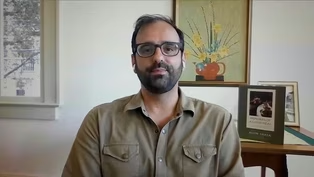
NewIsraeli-American Chef Shares New Book of Rescued Recipes from WWII
Video has Closed Captions
Chef and author Alon Shaya discusses his new book, "Memories of a Good Meal" (17m 58s)
Providing Support for PBS.org
Learn Moreabout PBS online sponsorship New Episode
- News and Public Affairs

Top journalists deliver compelling original analysis of the hour's headlines.

- News and Public Affairs

Today's top journalists discuss Washington's current political events and public affairs.




 Recently Added
 New Episode


 New Episode
 New Episode
Support for PBS provided by: