
Inside “Good Grief,” Sara Bareilles’ New Album and Documentary
Clip: 9/22/2026 | 17m 24sVideo has Closed Captions
Sara Bareilles and Josh Alexander discuss her album "Goof Grief" and the doc about how it was made.
Musician Sara Bareilles has had a difficult few years. Behind the glamour of her successful music career, she has been dealing with loss. Her new album “Good Grief,” and a documentary about its making, speak to the will to overcome. The album is out now and the doc, “Sara Bareilles: Good Grief,” is available to watch on Kinema. Bareilles and her director, Josh Alexander, speak about the journey.
Problems playing video? | Closed Captioning Feedback
Problems playing video? | Closed Captioning Feedback
Inside “Good Grief,” Sara Bareilles’ New Album and Documentary
Clip: 9/22/2026 | 17m 24sVideo has Closed Captions
Musician Sara Bareilles has had a difficult few years. Behind the glamour of her successful music career, she has been dealing with loss. Her new album “Good Grief,” and a documentary about its making, speak to the will to overcome. The album is out now and the doc, “Sara Bareilles: Good Grief,” is available to watch on Kinema. Bareilles and her director, Josh Alexander, speak about the journey.
Problems playing video? | Closed Captioning Feedback
Where to Watch Amanpour and Company
Amanpour and Company is available to stream on pbs.org and the PBS app.
Watch Amanpour and Company on PBS
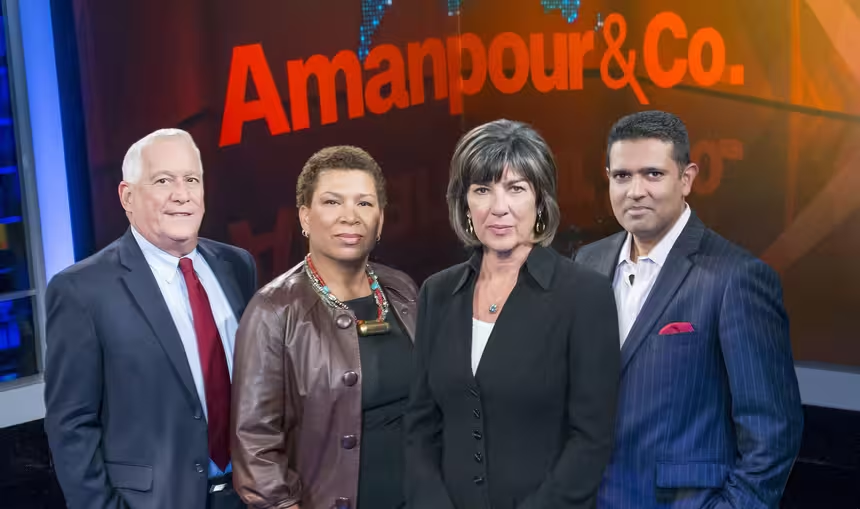
PBS and WNET, in collaboration with CNN, launched Amanpour and Company in September 2018. The series features wide-ranging, in-depth conversations with global thought leaders and cultural influencers on issues impacting the world each day, from politics, business, technology and arts, to science and sports.Providing Support for PBS.org
Learn Moreabout PBS online sponsorshipSara Bareilles, Josh Alexander, thank you both for joining us.
The name of the album and the documentary, "Good Grief," is a really fascinating look into the songwriting process.
Sara, I wanna start with you.
This is the first album that you're making in what, seven, eight years, maybe more?
- Yeah.
- There's a lot of grief that we're talking about and working through and some of the lyrics and also just how you're working.
What was behind it?
- A lot of loss and a lot of big transformative life experiences.
I think starting with the pandemic in 2020 and then shortly followed by the death of a very dear close friend, followed by the death of another very dear close friend, followed by the demise of democracy.
Yeah.
I mean, there's so much to grieve, so many things to grieve.
It didn't feel exactly like a choice to create this record with this thematic structure.
However, that is how it worked out.
And I think it's just, it was a very organic unfolding of, you know, my processing as a writer is to sort of take these things that I don't know how to metabolize and try to purposefully put them somewhere.
And so this collection of songs started to gather in 2020 and then it was completed in 2025 and we started recording and invited Josh in to kind of bear witness to the experimentation around capturing this very raw, very tender material that you're right is pretty heavy stuff.
It's about loss and transition and change and what we let go of and a little bit of a free fall.
I think why I couldn't write was because I wasn't ready to be honest.
My best friend, he was diagnosed with stage four lung cancer at the end of 2019.
I love feeling.
My grief is just like cracked open right now.
And I think that's what music does.
It's like moving it around and you don't even know it's happening.
♪ So Sara, this really kind of, from almost the first scene, we are thrushed into this idea that this is a group of people who know each other, care about each other, haven't seen each other in quite some time, right?
And you just jump right in to some heavy conversations.
There were these kind of almost fly-on-the-wall sort of moments where I don't know where the microphones were, I didn't know where the cameras were, but they were really picking up a lot of just intimate conversation and lots of tears.
Yeah, and lots of laughter.
I do want to remind people that I think one of the great mysteries of grief is how much joy is also embedded in processing grief, especially with other people.
Yeah, I invited some very beloved, trusted collaborators and a lot of artists.
I've had a lot of artists reach out to me after seeing the film and just saying how nice it is to get a chance to touch in on what it can be like in the studio.
It isn't always like this, I should say, but when you have a kind of shorthand with your co-pilots and, you know, there is a kind of mysticism around the making of music.
There is something kind of unknowable and unforeseen that transpires or can transpire and you sort of go in with the hope that you're going to discover something alongside each So there's, it's very thrilling and very vulnerable because you know that you're stepping into the unknown.
And I knew that this material, which was dealing with, you know, so much loss, a fertility struggle, death of friends, you know, just really hard material, I knew that it would have to be in really capable, caring hands.
And that's what you get to see in this beautiful film, is just these unbelievable artists who know when to make a joke or wrap their arms around you or light a stick of Palo Santo and not say a single word.
It's a really moving experience to grieve in community and to really experience the transmutation of the emotion because of that community.
Josh, what was it like for your crew and yourself and your team that was in the room where it was happening?
And I wonder, you know, I mean, did you, did your crew end up talking about things in their own lives or bond in a different way than maybe a different type of documentary that you've worked on where everybody kind of clocks in and clocks out?
The whole thing felt like Summer Camp in the most remarkable way.
And one of the things that Sara and I had talked about before we started shooting was she had really talked me through her intentionality of who she was bringing that week.
So my producing partner Daniel and I knew that we needed to bring people that would show up in the same way.
And if there's one lesson for me that's such a huge takeaway from this film and from Sara's bravery and from this music, it's that, and Sara talks about as well, it's that grief needs to be witnessed.
It's not something that can be metabolized alone.
And so who you ask to witness your grief and then how you show up when you're witnessing someone else's grief is the key to the whole thing.
And so my crew, all of us were on the exact same ride that they were on.
And another thing, Sara and I decided that the crew and the band, we'd all eat lunch together every day, so that we all felt like we were there doing one project together.
It wasn't like there was a separate film crew filming this piece of art unfolding.
And so those were just some of the things that we tried to do in the setting and in creating the film.
And in creating of the container that I think allowed all of us to be experiencing the same thing.
And these scenes would happen and we would take a 10-minute break and the crew would end off in a corner talking about loss and grief and struggling to have children and all of these different things.
So we were on the same ride.
Maybe that stayed on the G. Maybe the chorus pedals.
So tell me your story, tell me now.
When you watch all this footage, and you remember your friendship with Sara before the film and after, what did you learn from this that kind of leapt out at you, either about the process, about her?
You know, one of the things that bowled me over that week is, and you see this in the film, you almost see no phones.
Yeah, that's right.
You know, everyone is just present.
And, you know, there's a thing that you do a lot in a sound mix on a movie where you'll turn off all the labs of everyone that's not speaking.
So you just hear you get the cleanest dialogue and the person that's speaking.
And so me and my sound mixer in the edit, we were doing that.
And I realized something was missing.
And I went back and returned on everyone's labs.
And then you heard all this active listening.
People weren't just there.
They were, you heard them breathing, you heard them making sounds and etc.
And you could feel what it means to show up.
And so that's really what that whole week felt like.
And also just the beauty in speaking the truth.
I mean, Sara talks a lot about this that recently, you know, Sara has been saying that she just wants to speak the truth.
And I think you see that in this film, there's a lot of falsity out there that we're all in aggravating all the time now.
So to see the bravery of people saying what they feel in the moment and also that, you know, that on the other side of feeling into and speaking the truth around loss and grief, we think that it's going to be suffering on the other side of that.
But actually, there's joy, there's release, there's a softening of the heart, there's connection.
So I think we all want and are hungry for a permission structure to feel this stuff and to speak it.
So then when you're invited into a container that allows you to, it's the opposite of feeling bad.
It's just joyful.
Sarah, I guess maybe a similar question for you.
Early in the film, you mentioned that you're a control freak.
And here's a project where there's going to be lots of stuff that you don't control.
And I guess watching now the finished product, what did you learn about yourself on where, you know, maybe you'd heard something about how you are, but then seeing it on camera, was it any different?
That's a great question.
Um, I think the thing I am a control freak about is the truth telling.
Because what I have learned, especially from experiencing grief and really working to like process and understand what was happening is that so much of our lives are based around this illusion of control.
And that we are really ultimately at the seat of it all.
We are all in a free fall that we have no control over.
We do not have control over our lives or our, you know, what happens to us or the people we love to a terrifying degree.
So the idea that I'm trying to like make something, anything, seems so young to me.
Even a year later, I'm like, you can't, there's so much that's out of our control.
But the thing that I feel really committed to and really dogged about is I expect people to tell me the truth.
I'm thinking about my working relationships and my personal relationships.
I expect people to tell me the truth and I really work hard to tell them the truth, even when it's uncomfortable.
I really want to live in a space that has as much clarity and understanding as is possible.
Josh, this does not feel, when you're watching it, like something that the record label put out as a part of the promotional tour.
Is that conscious in what you were trying to do?
How did you make sure that -- >> Thank you for saying that.
And it was fully, fully conscious.
You know, I think that there -- I think we've all gotten used to these certain kind of benchmark genres now that happen in a lot of docs.
There's a lot of slob bio docs.
Some of them are beautiful.
But a lot of them are hitting a lot of these kind of cliches and these expectations.
And the whole intention of this was to try to -- and it's not new to me.
It's borrowing from a beautiful, long tradition of Verite music documentaries, whether it's Scorsese's The Last Waltz, the Aretha Franklin doc that came out a couple years ago, Amazing Grace.
I mean, there's beautiful films.
Don't look back, the Dylan doc.
So how do you show up and let the story unfold of its own volition, with its own velocity and its own unwinding and unfolding?
And so that was always the intention.
And also to give an opportunity for people who don't get this joyful experience of what it's actually like to be in a music studio, in a recording studio, to have that experience.
As you're hearing Sara play a song for the first time for that band that she's never played out loud for them before.
And then as she then starts to record it and they start to overdub different instruments onto it, you know, all that stuff was just so delicious.
It's so alive and generative.
So this felt like the right way to tell that story.
Sara, kind of a dumb question, but one that I'm always fascinated by, and I've asked Lenny Kravitz this and Jake McCauley this, but like, where do you get your songs from?
I mean, where does it come from?
It's such a good question, and I think every artist has such a different answer, and my answer is sort of all of the above.
On this particular record, I had experiences that I'm referring to as like transmissions, which is not usual for me.
I'm a little bit more of like a craftsman, like I sit down, usually the music comes first, and then I'm crafting a lyric.
And it oftentimes starts with a theme or an idea or there's some phrase that feels like the nucleus of an idea that I can parse apart into something that's more of a full meal.
But there were several songs on this record that were what I'm referring to as transmissions.
Like, there's a song called "Just a Kid" about my friend Chad Joseph, who passed away in 2020.
And I was walking home from the grocery store, and I had two hands full of bags of groceries, and I had to put down my grocery bags and sing into my phone because I could feel this song arriving.
And I got home, and I put the groceries away, and I wrote the song.
And it was, that's very unusual for me, but it happened a few different times on this record.
And I have to feel that there's something about, you know, people talk about the veil being thin.
I think that when you start really excavating the relationship between this life and whatever comes next, I think that veil is very thin all the time.
And I think this music is really porous and it's really full of the lives of my friends that are no longer with us and other stories.
You know, I wrote one song, a song called "Home" inspired by a conversation between Stephen Colbert and Anderson Cooper and on Anderson's incredible podcast, "All There Is."
But yeah, it was just like the stories that we tell about our lives are just so important.
And so I felt like they wanted to belong together on a record.
♪ I stared across the great divide ♪ You're having pop-up shows in different cities, you're on a concert tour, but it's almost like a collective release of whether it's grief or joy, and it's all happening and they're using your music and they're talking about it online.
There's people coming back saying, "It was such a good cry."
[LAUGHTER] It's like, "What?
What does that mean?"
You know what I think is really remarkable is that I think it's ritual.
It's turned into these kind of organic grief rituals that, and there is dancing and there is jumping up and down actually very intentionally.
This show is built to sort of take you through the album and then there's good grief and then there's good release.
It's like wanting to encompass the vastness of the experience.
Grief holds so much.
But I'm finding people are not on their phones, they're not recording the shows, or they'll record for very short amounts of time, very intentionally.
And that has been remarkable.
It's not a request.
It's not something we're asking people to do.
They're just sitting and experiencing something in real time with a tremendous amount of presence, which has been so surprising to me.
I got this incredible question from this hospice worker who came, and he said, "I had a patient ask me, 'What is the opposite of grief?'"
And he's like, "I'd like to know your answer."
And I thought for a minute, and I sort of caught myself.
I'm like, "I think my impulsive answer is to say joy, but I can feel in my mouth that's not the right answer.
It's not because there is so much joy in grief."
And I asked him, "What is your answer to that question?"
And he said, "The opposite of grief is forgetfulness."
I had to think about that for a minute.
And he's like, "Because grief is remembering."
And it just, it moved me so much.
And I think that people are really coming to this show and to this music and to this film because there is something they want to remember about themselves, about people they loved, who they've lost, or pets, or experiences.
You know, I just think it's a really rich, it's a really rich experience.
Director Josh Alexander and musician Sara Bareilles, thank you so much.
Thanks, me too.
Thank you so much.
>> Thanks for this conversation.
 New Episode
- News and Public Affairs

Top journalists deliver compelling original analysis of the hour's headlines.

- News and Public Affairs

FRONTLINE is investigative journalism that questions, explains and changes our world.
 New Episode
 New Episode
 New Episode
 New Episode
 New Episode
 New Episode

 New Episode
 New Episode
Support for PBS provided by: