
InFocus 508 - Building a Business 3
12/11/2025 | 26m 46sVideo has Closed Captions
This episode explores what it takes to build a thriving successful business in Illinois.
This episode explores what it takes to build a thriving successful business in Illinois.
Problems playing video? | Closed Captioning Feedback
Problems playing video? | Closed Captioning Feedback
InFocus is a local public television program presented by WSIU
Support provided by:

InFocus 508 - Building a Business 3
12/11/2025 | 26m 46sVideo has Closed Captions
This episode explores what it takes to build a thriving successful business in Illinois.
Problems playing video? | Closed Captioning Feedback
How to Watch InFocus
InFocus is available to stream on pbs.org and the free PBS App, available on iPhone, Apple TV, Android TV, Android smartphones, Amazon Fire TV, Amazon Fire Tablet, Roku, Samsung Smart TV, and Vizio.
InFocus
Join our award-winning team of reporters as we explore the major issues effecting the region and beyond, and meet the people and organizations hoping to make an impact. The series is produced in partnership with Julie Staley of the Staley Family Foundation and sponsored locally.Providing Support for PBS.org
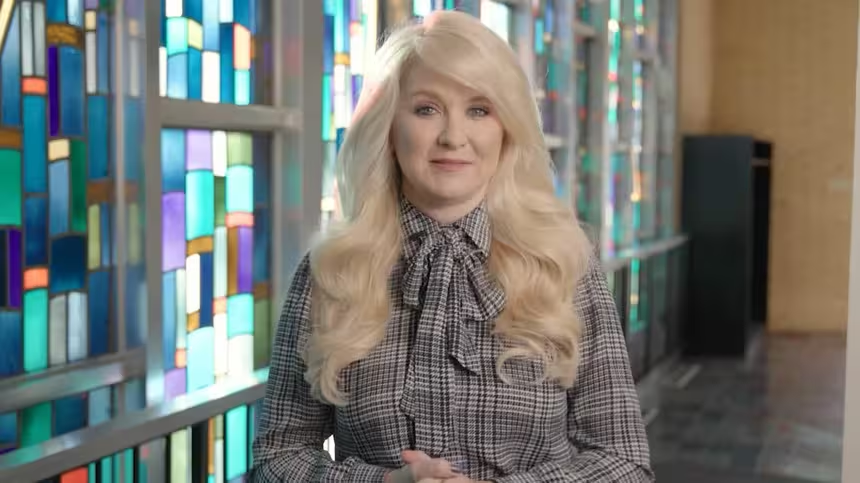
Learn Moreabout PBS online sponsorship[MUSIC] >> Welcome to InFocus on Siu, I'm Brian Sapp.
In this episode, we're talking about building a business in Illinois.
Having a product or service that brings in customers is definitely a key to success.
But businesses can't make that happen without skilled employees.
We're traveling to Springfield to look at just one relationship between business and education, all to find and educate a workforce to meet the demands of the job market.
>> So Shay Builders is a full service general contractor based out of Springfield, Illinois.
Uh, we've been in business for 125 years.
At this present time, we operate mainly from I-70 to I-80 in the state of Illinois and then coast to coast.
I like to say so from Quincy all the way over to Danville.
We specialize in things like healthcare, building K through 12 construction.
>> Josh Ray is the director of People operations with O'Shea builders.
In addition to meeting the human resources needs of the company, he works to help people build their careers.
But he wants to find the right employees to meet the company's needs.
>> The ideal team player is someone who's humble, hungry and smart.
These are things that we think about are not necessarily things you can learn, but it's kind of who these people are.
So we really look for personalities and, uh, folks that exhibit those things in the way they do whatever they're doing, whether it's uh, gosh, maybe it's taking out the garbage or it's leading a $100 million construction project.
>> But that's been a challenge.
According to Matt O'Shea.
He does client outreach and brand partnerships for the company.
In his role, he's seen a growing need in finding the right employees.
>> One of the biggest things I see is we have this huge gap between people getting ready to retire and young, uh, kids, young adult coming into the trades, and we're missing this middle, this middle ground here.
And we find a lot of these younger guys are starting to really take traction, and they're starting to grow, and they're filling that void more and more.
But that's what we're finding the most is whenever we're looking for people, here's our problem is we are missing a huge generation of people that are in the field and know how to do it.
>> Josh Collins and his staff at Lincoln Land Community College were evaluating their programs to find out how well they were meeting the students needs and the needs of the employers, like O'Shea builders.
>> We actually do that through various means.
One is a program advisory committee.
All of our career and technical education programs have to have a program advisory committee, and that's just simply employers coming out once or twice a year and telling us if we're meeting their needs.
>> It was an opportunity that O'Shea was eager to take part in.
>> They reached out to local to leaders in the local construction companies, and they put together an advisory group and asked those folks, what do you really need in a program?
If we were going to put a program up, start one from scratch in the construction industry?
What would those what would that program have?
What would what would be the courses?
What would be the homework assignments?
Who would teach in those courses?
>> The advisory committees are made up of businesses who might be looking for similar employees.
As president and CEO of Springfield Sangamon Growth Alliance, Ryan Mccrady works to attract and keep businesses working in the community.
While tax and other incentives play a role in attracting businesses, they also need a talent pool to make a long term investment.
>> And so when a business makes an investment, either in a new facility or expanding their current facility, they're looking at a 20 to 40 year return.
So they have to look at what talent exists today and what's the production system to produce talent into the future.
And that's where the workforce development system becomes so important.
Like with Oakland Community College.
That's a factor we always bring into play to show a business that we're kicking out workers right now, but we have this really good community college that works closely with employers and that will continue to supply you talent.
>> And that's why he believes businesses are willing to create these relationships with companies that might be their competitors.
>> You see all the different contractors involved.
It's easy to think, well, they're all competing for the same talent, but what they know is if they grow the size of the pie, or if they increase the density of talent and show that there is career opportunities here in the community, more people come in.
They actually have to get a fewer percentage of the actual people to be able to do the staff that they need.
And that's led to this cooperation.
And the results are really what has led to it because it's working here.
>> Mccrady says this partnership is seeing success beyond construction and manufacturing.
>> The health care industry was always important.
The pandemic helped highlight that, but it also helped show the holes that were existing.
And so the ability to be able to train up and build that health care industry here is really important, both for the new workers but also the upskilling.
So maybe you're a CNA and you want to become an LPN or an RN with a bachelor's degree.
Having all those programs in your community, like I said before, creates that long term pipeline of talent.
>> Collins says these changes have helped them improve the education and training they were providing to their students.
>> Our end goal is essentially to develop a good workforce to our our employers.
Now, to do that, we've got to start at the very beginning, where we start engaging our employers and ask them the simple question of what do you need out of a student coming out of a program like Diesel Technologies or Construction or any of our healthcare programs?
Uh, what do you need for that student coming out?
Because ultimately, uh, if we're developing students and we're building students skills to what the employers are going to need, then the student is going to be able to maximize their abilities, their opportunities, and ultimately their, you know, pay and salary going forward.
>> To find out how this relationship is helping the students learn.
We visited their construction management, diesel technologies and healthcare training programs.
>> So at any one point on Monday through Thursday, 8 a.m.
to 920, there's 112 to 118 students rolling through the space.
And before we were in a bunch of little smaller labs, we needed one large lab we could call home and grow in.
And so Lincoln Land put the investment in to repurpose this space that had been sitting for about 15 years and develop a real nice, state of the art, professional looking construction lab and classrooms.
>> Chris Edmonds is the director of the Construction Technologies Program for Lincoln Land.
On the day we talked with Chris, students in the commercial electrical class were in the lab.
>> So for 16 weeks they've been learning about electrical theory.
They've been learning about both residential and commercial electric electricity.
And so from the first year standpoint, they're kind of trying it out to see if they like it as a career.
But if they're going to go into those management classes, they're looking at, hey, this is another trade I'm going to have to learn to work with, to schedule with.
Um, this may be a subcontractor subcontractor on one of my large jobs that I have to work together to make sure the electrical systems go in that building correctly.
>> And Edmonton, the staff at Lincoln Land worked with area high schools to let students know they were developing this new program.
And once they had those relationships built with the schools, they developed their business relationships.
>> Um, and then after that, we started working with our partners, um, here in Springfield, like, um, O'Shea, builders, L Pruitt, Henson, Robinson Companies, Anderson Electric, Babb Electric, um, and really focusing on their needs and what they needed in entry level position employees, whether it be people in the field, in the trades, or people in the office or pseudo office.
>> The program focuses on labor, materials and processes.
During the first year, students learn about the labor and materials part and how they go together, like electricity or carpentry.
In the program, they seen an impact from the internships that they require students to complete, which happens during their second year.
And that's in order to receive their associate's degree in construction management.
The relationship with the school is something that has already helped O'Shea find new talent.
>> There's a young woman named Alexis Bowman who has done fantastic.
She came up to us this past summer in her internship, and she's been a rock star.
And then she's continued to work, uh, a few hours a week.
During the semester.
>> We had a chance to talk with Alexis Bowman.
She's one of the students.
In the second year of the program, she found her desire to build after working with her dad on construction jobs, building decks, and working on her grandmother's house after learning basics in her first year, she's found this year has given her the skills to manage projects that she's going to be see when she works at O'Shea.
>> The second year is all the management side.
So all of the scheduling, learning how to do rfis, submittals, everything like that within the managing of the project for.
>> Lincoln Land has organized a curriculum to make sure that it's authentic and not just sitting behind a desk.
>> This year's a lot more like hands on on the computer side.
So understanding, like all of the technology, everything that they use within the field, even, um, which is crazy to me that all the field guys are using iPads instead of just regular blueprint blueprints.
So learning how to use all of that is what we're doing a lot.
>> Edmunds explains that the second year is meant to help students learn how to organize the labor and materials that they've practiced on during their first year.
>> So after they learn how buildings are put together, then they look at how they manage and and successfully complete those projects working with labor, working with materials, working with those processes.
Um, so some of the classes they would take, they would take a construction estimating class A, construction documents and legal aspects.
They actually have an internship their last semester here, where they're out with a construction company, 16 weeks, a minimum of 20 hours a week.
Um, putting what they learn in the classroom to work out in the real world.
>> In addition to working with the college to align standards with professional needs, Frye from O'Shea, teaches classes as well.
A theme for his classes are that he covers soft skills.
Frye explains the class and what he gets to learn about the students.
>> Um, but I also I get to meet them too.
And as a hiring manager for O'Shea builders, I get to find some of the some of the best and the brightest and get a get a chance to meet them firsthand outside of maybe an interview room, which can be it can be scary for some people.
>> Having current professionals teach their classes gives Alexis the chance to gain insights that she can put into use right away for her work in the field.
>> So Brad is actually my mentor and my boss at O'Shea.
So he taught our class.
And Courtney is really high up in, um, l Pruitt.
Um, our OSHA 30 class is another guy that works at OSHA, so they all understand what's going on on the job.
So I think that helps a lot with them teaching us, um, what we're doing right now.
Um, they're teaching us what they actually know and what they're using every day.
>> And Alexis is just one example of the success Lincoln Island has seen since implementing these new programs.
>> The first cohort, um, is in their second year, but many of them are already being recruited by companies.
In fact, that really started their freshman year.
And sometimes it even starts before they get here, uh, where companies will will look for high school students, uh, to sponsor and send to to our program and then offer, you know, a work agreement.
>> We've got to see our students go work, um, with those employers.
They're not just like a one day job shadow.
They're either, you know, working with them for 16 weeks or they're going out there for a week just really getting to learn what they do.
And and that's the biggest thing is these students are learning what that day in, day out looks like.
>> Alexis says these experiences have built her capabilities to get the work done once she completes her degree.
>> I think I am prepared, I think this internship did help me and this program definitely helped me within, like even the hands on.
I understand what the trade guys are doing in the job and also these, um, I guess what are they called?
These management classes definitely help you because whatever we're doing in class, that's what I'm doing on the job right now.
>> Moving across campus, we find the Workforce Career Centers, which houses the new Diesel Technologies programs.
Collins explains this was an opportunity to take a program and build it to meet the needs of area employers.
>> Even before, um, we start a program, you know, if we should start a program.
Uh, what does that look like?
Is there an actual need?
Are we going to build a program where employers are going to hire those students?
Uh, so, like the diesel Technologies program, uh, what we ended up doing was we ended up calling 20 of our largest employers, and we ran through a total needs assessment with them.
What is your average need on a yearly basis?
What's your projected over the next three, five, ten years, uh, before even determining whether whether to start a program to make sure that we would be able, uh, to to make sure those students have job opportunities within our area coming out.
>> This planning can take time, but the returns have created a program that benefits not just employers but provides opportunities for students.
>> So this diesel program is in year three.
It's a it's a cohort style program.
Uh, so the students start in the fall semester.
Uh, the first one's graduated last spring.
Um, and then the freshman classes in its its first semester year, so it's relatively new.
Everything in here was rehabbed, uh, that about three years ago.
When you're doing it the right way, there's a lot of engagement.
So the employers have been extremely engaged.
Most of the equipment in this room is somehow donated, whether it's, you know, a big tractor, a truck or some of the training aids.
The industry has been extremely generous because we're helping meet a tremendous need that they have.
>> The program has been so successful.
Lincoln Land has more students than they have spots.
Dug Harbor is one of those students in the second cohort.
He's currently working at a home improvement store, but he's taking these classes because he's always enjoyed working on equipment and getting his hands dirty.
>> I am currently in hydraulics, uh, where me and my partner, Allen, we're taking apart a hydrostatic brakes and motor.
Uh, the we're currently just getting understanding of what it all does.
And once we take it apart, get to, you know, knowing all the parts and how they work.
We'll eventually be moving on to the equipment to better, you know, understand why and how it works.
>> Doug is in the lab Monday through Thursday, two days a week.
He says they're working on hydraulics, and the other two days they're working on getting their hands onto the motors.
The courses are broken into eight week segments, with some work spanning the whole 16 week semester, but it's all part of what he hopes to work on when he graduates.
>> Uh, learning diagnosis on electrical and and hydraulics.
That is the biggest one right now.
Uh, for our English project, I had to interview somebody in the field.
So that was the biggest key point he made was if you can understand how to do that, you'll be a really you'll be one of the better employees, because not a lot of people get the knowledge that you're learning from Lincoln Land to understand how to diagnose this stuff.
>> As you heard, Doug includes his work in English right along with his lab work.
That's no fluke.
In their research, Lincoln Land has found from employers that communication skills go hand in hand with the work on the machinery.
>> What reports are you actually going to be writing?
What things do you need to do on the communications class, which is an interpersonal communications classes?
What kind of communication is this student going to be doing once they're actually working?
Technician.
And so our, um, English and communication professor actually went out to our employers, uh, went out to the shop to see firsthand what the students would be doing when they were in the workplace and how they would be communicating and then contextualizing the coursework to match the dean.
>> Even though he has experience in the workforce.
Doug appreciates the combination of hands on lab work with time in class.
>> I knew how to, you know, take apart stuff.
You know everybody.
You just.
That's just all hands on.
But all the class knowledge that I've gained by just sitting there and kind of, you know, taking notes, looking over slides, like understanding what all goes into it has definitely drived the motivation to be here more than anything.
>> Doug believes the collaboration has led to strengthening the program for more students success.
>> I've actually been enjoying it a lot.
You're obviously engines.
You can't go wrong.
You get all you're doing is just taking it down, understanding what it's doing and putting it back together.
Everybody can do that, but it's the hydraulics that I've been enjoying a lot.
>> I did my first schooling in biology, and I've always had a love, and I feel like a calling towards science.
Uh, more so healthcare.
>> Courtney and Dylan works as a healthcare tech.
She wants to take the next step and become a clinical medical assistant.
She's following that dream with the CMA program at Lincoln Land Community College.
>> The CMA program is comprehensive, so it teaches you about having hands on experience clinically as well as administratively.
So with that, I figured it was the first best step to immerse myself in healthcare while being here.
>> Clinical medical assistants are the people who call you back when you visit your doctor's office.
They take your height, weight, blood pressure, and other medical details before being seen by your provider.
Caitlin Crane teaches the class.
She says most students are new to the healthcare field.
>> Most students are looking for gainful employment, and they're looking to do that through a short term healthcare training program.
>> Classes meet twice a week in the evenings, giving students a flexibility to attend.
The class provides 144 hours of classroom instruction with practical practice.
After that, the students spend 160 hours in an externship with the program.
>> So tonight we have our clinical medical assistant, uh, students who are learning venipuncture or how to draw blood.
Um, the purpose of our program is to provide a short term healthcare training program to get students into the workforce.
>> As is the case with the other programs we've highlighted.
The classes cover hands on skills practice, but they've also found a need for work beyond the books and the lab.
>> So each year we meet with our partner healthcare facilities in a program advisory committee, and in that advisory committee, they really recommended that students spend more time on these soft skills prior to going to their externship, which is clinicals, and prior to stepping into their roles as a medical assistant.
>> Or teacher, does a great job at, I guess, bridging the lectures from whiteboard to real life.
So it's a lot of how do you act in the workplace and then share, share a testimonial of how she would act in a workplace scenario, and then it would be a lot of, okay, so there are these terminologies that you need to know and understand.
>> And and even though she spent time in a healthcare setting and appreciates the chance to practice these soft skills.
>> What it means to be a hard worker, what it means to be a good listener, what it means to be professional, what it means to carry yourself a certain way.
What it means to follow something through, what it means to be punctual.
And because these things were so stressed upon.
It's entrenched in all of our heads as students now.
So it's almost like if you're in the workplace, you're going to hear Caitlin's voice in the back of your head telling you, hey, be professional.
Be an active and assertive listener.
Be compassionate.
Be sympathetic.
Show up on time.
>> After completing their classroom hours and their clinical hours, students are eligible to sit for the Certified Clinical Medical Assistant exam.
>> It's a nationally recognized certification exam that all of our employers in the area recognize and validate value.
Um, they also gain employment, usually during their externship or shortly thereafter they are offered a position in healthcare.
>> Completing this program is part of Corrigan's plan to one day be a doctor practicing neurology.
>> It's my first stepping stone towards that goal, and I don't think I would have changed the decision to start here because you learn so much in such a short space of time, but you also are able to be in the clinics, be in the hospitals doing the things that you're learning about.
Seeing it come to life.
And then I figure the next step when you decide to do medicine, it's it should be easier.
>> While Lincoln Land has found success with students like Cordie and Alexis and Doug, they found that potential students may not know about possible careers.
That's why they've began hosting a career fair connecting students and businesses.
>> So this past year we had over 100 employers on campus.
We basically shut down for parking lots.
Um, employers brought big equipment.
Um, so we had sprayers, you know, bulldozers, tractors, trailers, um, and we focused on the trades.
We focused on healthcare and agriculture.
Uh, and so we we kind of brought the employers and then the schools brought the students.
So we had over 1300 high school students coming out, meeting with over 100 employers, and learning about all the various types of careers and training programs that can get them into those careers.
>> Edmund says this outreach in their work refining the programs are attracting more students.
>> We knew we would have growth, but we've seen an extreme rate of growth to this point.
Um, I have students wanting to sign up for classes next fall already.
Um, and I'm already taking that list because we don't start registering registering students till March.
>> Even with the positive responses and outcomes Lincoln Land is working to stay current with workforce needs in the community.
>> We're expanding our radiography program based upon employer need.
They need more, um, radiography technicians.
Um, and we've got a program so we can help build that out for them.
We've got a shortage in surgical technicians.
Um, so we're trying to expand that program again, uh, based upon employer need, um, in feedback because we don't want to we don't want to grow a program when employers aren't hiring those folks, because then our students don't have necessarily a place to go.
So so we try to be very careful and be in lockstep with, with the supply and demand of students and in jobs.
>> When it comes to attracting and keeping businesses.
Mccrady says the program is helping that by creating long term incentives for employees to stay in the community.
>> But they continued to get upskilled here in the community so that what that also helps us to do, it helps us retain talent here, and people don't feel like they have to move somewhere else to advance in the industry.
And so you can make a lifetime career here, continue to advance your career, continue to make more money, improve your quality of life, and improve the quality of life of all the people you take care of in your family.
>> Matt O'Shea at his company says they've seen how these partnerships are creating a stronger community.
>> The one thing I do like most about Lincoln Land is it's mostly local students and their kids that grew up in the Springfield area, or adults that grew up in the Springfield area.
They've stayed in the Springfield area, and they want to improve the Springfield area.
And like Josh said, we're 125 years old this year.
Uh, without Springfield, we wouldn't be here.
And so to see these other young people, um, have the passion to join a trade in the central Illinois area and then stay here.
Uh, it makes you feel even better.
>> Doug and Alexis echo the sentiments of Kordian that their work in the programs they're in will provide a strong foundation to pursue their future plans.
>> I want to be the guy that everybody goes to and be like, hey, I can't figure this out.
I know you're really good at it.
Can you teach me how to figure this out?
That's the goal.
And you think you're going to get that here?
Yes, I do believe so.
This will get me at least on the path to it.
You're not going to.
You know, they can't force enough knowledge in the two year course that you have.
They can't force enough knowledge into you right off the bat.
So it's just going to be getting as much as you can while you're here, then getting into your field and then just learning as much as you can from the job that you're going to be going to.
>> I'm hopefully going to be a field engineer or a project engineer at Austin Builders.
>> How exciting is that?
>> It's really exciting.
I'm really excited.
I think this internship has really opened my eyes on how awesome construction is.
>> Mccrady says the attitudes of these students are found throughout the workforce in the companies that he works with.
>> So workforce availability and the talent that exists in the community is the number one and most important thing when we're looking to retain and attract business.
And those training institutions are an important part of that.
And the Midwestern work ethic is a real thing.
It's alive and well here in our community.
It's alive across the Midwest.
And although we take it for granted, businesses from around the country and around the world actually see it here as a physical item, and we should be very proud of that.
>> Thank you for joining us for this episode of Building a Business.
If you'd like to see previous episodes highlighting growing and thriving businesses in Central and Southern Illinois, visit the InFocus page on our website.
Org.
I'm Brian Sapp, thanks for watching.
[MUSIC]

- News and Public Affairs

Top journalists deliver compelling original analysis of the hour's headlines.

- News and Public Affairs

FRONTLINE is investigative journalism that questions, explains and changes our world.











Support for PBS provided by:
InFocus is a local public television program presented by WSIU