
Who will emerge as the GOP's 2028 nominee?
Clip: 10/16/2026 | 16m 18sVideo has Closed Captions
Who will emerge as the GOP's 2028 nominee?
From Marco Rubio to JD Vance, the panel discusses who might be the next Republican presidential nominee and the challenges they may face in the primaries and general election in 2028.
Problems playing video? | Closed Captioning Feedback
Problems playing video? | Closed Captioning Feedback
Major funding for “Washington Week with The Atlantic” is provided by Consumer Cellular, Otsuka, Kaiser Permanente, the Yuen Foundation, and the Corporation for Public Broadcasting.
Who will emerge as the GOP's 2028 nominee?
Clip: 10/16/2026 | 16m 18sVideo has Closed Captions
From Marco Rubio to JD Vance, the panel discusses who might be the next Republican presidential nominee and the challenges they may face in the primaries and general election in 2028.
Problems playing video? | Closed Captioning Feedback
Where to Watch Washington Week with The Atlantic
Washington Week with The Atlantic is available to stream on pbs.org and the PBS app.
Buy Now
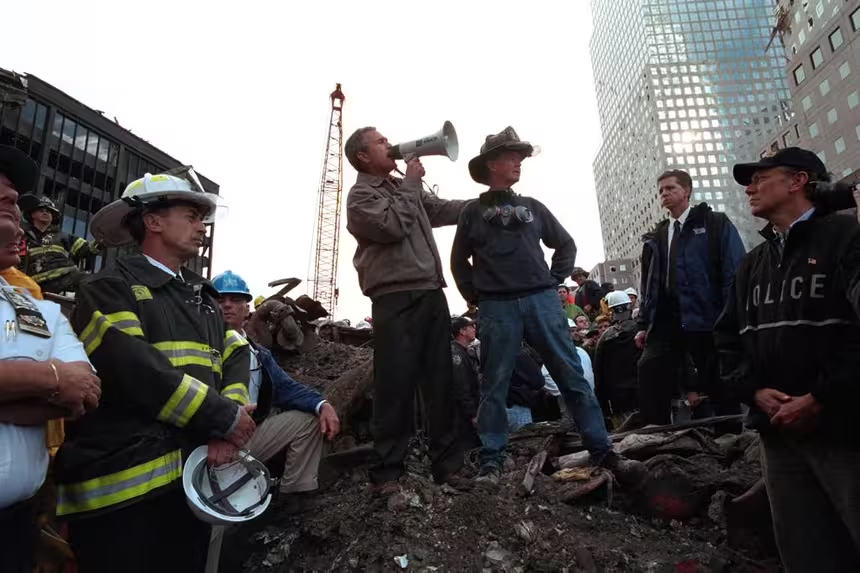
10 big stories Washington Week covered
Washington Week came on the air February 23, 1967. In the 50 years that followed, we covered a lot of history-making events. Read up on 10 of the biggest stories Washington Week covered in its first 50 years.Providing Support for PBS.org
Learn Moreabout PBS online sponsorshipJeffrey Goldberg: This leads me to a 2028 question in a kind of way.
We've talked about -- I mean, the conventional wisdom is that J.D.
Vance and Marco Rubio would be the two obvious contenders, leading contenders for the Republican nomination.
Not clear that Donald Trump believes anyone should follow him, but J.D.
Vance, I guess, is the technically anointed one.
But in talking about the shift in Texas Republican politics away from what we now would call the muscular or over-muscular interventionism of the Bush years, you know, the Republican primary voter, especially after Iran, especially seeing where the prices are now, it sounds like a little bit of an uphill battle for Marco Rubio to get to get the nomination.
Mark Leibovich, Staff Writer, The Atlantic: I mean, you get the feeling -- I mean, you hear Rubio and Vance in all these discussions, you get the feeling we're all going to look like rather obsolete in two years.
I mean, if you think about -- it feels like I have a real feeling that someone who is not one of those two will emerge.
I mean, if we were having this conversation -- Jeffrey Goldberg: Who?
Mark Leibovich: I'm going to say -- Evan Smith, Managing Director for Events, The Atlantic: Someone else.
Mark Leibovich: Yes, you know, last night -- Jeffrey Goldberg: I thought I could trap him into -- Mark Leibovich: Evan mentioned Ted Cruz last night.
Jeffrey Goldberg: Ted Cruz.
Mark Leibovich: No, actually, Ashley mentioned Ted Cruz.
Anyway, that's a name -- Jeffrey Goldberg: Cruz '28, yes.
Mark Leibovich: But, listen, if we were having this conversation in 2014, we'd have been talking about Jeb Bush and Chris Christie and Rubio, the first iteration.
And looking back, we would be sort of laughing at ourselves.
Vivian Salama, Staff Writer, The Atlantic: Yes.
Jeffrey Goldberg: Right.
Vivian Salama: The other thing is that Vance, like on paper, is very MAGA.
I mean, he's more MAGA than Donald Trump on paper.
Mark Leibovich: Is that going to be a good thing?
Vivian Salama: But the party is Donald Trump right now.
Jeffrey Goldberg: Yes.
And the other thing -- Vivian Salama: And he's made sure of it.
Jeffrey Goldberg: -- and Ashley knows this better than anyone, the difference between J.D.
Vance and Donald Trump is that, and people might not believe this who haven't been directly exposed to Donald Trump, but Donald Trump has his real charms.
I mean, we've been directly in the Oval Office, as he's trying to convince us that he -- a chandelier would look great hanging over the desk.
Ashley Parker, Staff Writer, The Atlantic: And that he won in 2020.
Jeffrey Goldberg: And that he won in 2020.
Ashley Parker: Yes.
Jeffrey Goldberg: But J.D.
Vance does not -- I'm going to try to find a way to say this -- does not have a personality that one associates with political popularity.
Ashley Parker: Hold on.
Yes.
Jeffrey Goldberg: And Marco Rubio does to a much greater degree.
And Donald Trump like -- and what people who don't vote for Donald Trump don't understand is that he's tremendously charming and charismatic when he wants to be.
Ashley Parker: Yes, exactly.
I mean, J.D.
Vance is not the political athlete that even Marco Rubio is, and certainly not that Donald Trump is.
And also we've seen that Trumpism, the behavior, everything about him is not transferable.
I would just point you to Marco Rubio in 2016, where in the last gasps of his campaign, tried to do a poor man's Donald Trump, and it didn't work for him.
Jeffrey Goldberg: Right.
Either you're born an insult comic or you're not.
You can't just train yourself in the last -- yes.
Let's talk about what happens after the midterms and what Trump's last two years in office might look like.
Evan, talk about that a little bit.
I mean, an ordinary figure in the last two years of eight years total, you know, is a lame duck, he might not have Congress with him at all, and those people sort of fade from view.
Donald Trump is not the sort of person who would allow himself to fade from view.
So, what - - I'm not asking for policy predictions, but what could the relationship between a Democratic Congress and a lame duck Republican president, who is Donald Trump, look like?
Evan Smith: Well, as a practical matter, if they win the House, Democrats win the House, or if they win both, then the Trump agenda could be slowed to the point of being dead in the water for the next two years.
The president has shown a willingness and enthusiasm for ignoring Congress the first two years.
He's been able to get stuff done without Congress being involved.
Congress has been unwilling to assert itself.
Surely, he would find ways to do that.
But, to me, the four most important words of the post-midterm period are going to be Art of the Deal.
This is a guy who temperamentally likes to cut deals.
Remember that press conference with Mamdani a couple of weeks ago where he was looking at Mamdani like a boy looks at his junior high school girlfriend, right, with those puppy dog eyes?
Trump understands that there are people he has to make peace with, do business with in the way that he -- going back to the New York Trump.
That is the guy who we're going to see potentially for the next two years if Congress flips.
Ashley Parker: But I also think -- you know, we were talking about how the guardrails from Trump's first term are gone to a second term.
I think to -- I mean, this may surprise people, but to the extent that there are still guardrails in the first two years of his second term, those will be gone potentially in the final two years.
And the thing Donald Trump fears more than anything is sort of obsolescence, irrelevance.
Jeffrey Goldberg: Irrelevance.
Evan Smith: Right.
Ashley Parker: And so if he feels it's slipping away for whatever reason, because his party is having a primary that he's not a part of, because Congress is investigating him and he doesn't have control, whatever it is, he will become ever more desperate to get the attention back on him.
Jeffrey Goldberg: So, you're saying he might go onto social media and tweet crazy things?
Ashley Parker: Well, sure, certainly that.
But -- Mark Leibovich: He would never.
Jeffrey Goldberg: I mean, theoretically.
Mark Leibovich: Theoretically.
Jeffrey Goldberg: I mean, yes.
I mean, but you're - - what you're saying is an intensification of the practices that we've seen already?
Ashley Parker: An intensification of the practices the people, who don't like his behavior already loathe, yes.
Jeffrey Goldberg: Right.
Vivian Salama: And there's also going to be a wave of sort of less qualified people coming into office, as we see usually in the first -- after the first two years, you see turnover.
Jeffrey Goldberg: Right.
Vivian Salama: And the fear is that also there are less qualified people that will step into the ranks and also be guiding and informing his decisions that way, and that's also going to be problematic.
Jeffrey Goldberg: Vivian, I want to come to you to talk about what the next two years might look like on a global -- from a global perspective.
But let's just talk about -- I don't want to scant the issue of what could happen next month during the election.
Obviously, elections are all local and distributed, but we've gotten many signs that when Trump doesn't like the outcome of an election, he says so and also tries to manipulate the systems to get the outcome he wants.
How worried should we be that -- let's just say there's two or three key Senate races that are very close that will decide control of the Senate, how worried should the country be of different kinds of shenanigans?
Vivian Salama: I mean, there's definitely the potential for different kinds of shenanigans.
I mean, depending on what happens in the midterm elections, obviously, that could hurt Congress' ability to do much.
Let's say in the case of Ukraine, for example, you know, if it is a -- if Democrats hold both chambers of Congress, for example, they could pass appropriations.
I mean, a lot of Republicans would agree to that too.
They could pass appropriations only for Ukraine, for example, and find ways to get weapons and other things to Ukraine.
But the White House has also become very skilled at circumventing sort of those normal processes.
And so that is definitely a possibility, and especially with Stephen Miller, who has basically mastered the art of circumventing the roadblocks.
Jeffrey Goldberg: Right.
Vivian Salama: I think that that is definitely something that we're going to see a lot.
Jeffrey Goldberg: Evan, how worried are people in Texas about what -- I don't want to say it's inevitable that it will be a close election, but there's a really good chance that you'll have a very close race here.
Evan Smith: I'd say very worried.
Remember that the Republican candidate, who may be on the losing end of a close election, maybe, is the attorney general who believes himself to have purview over election interference and shenanigans.
And, you know, Texas has been a place where allegations have been made, repeatedly disproven, about non-citizens voting.
Tarrant County, which is one of the largest counties in the country, that's where Fort Worth is, just cut the number of polling places in advance of Election Day summarily to reduce access to voting.
They say, no, there's plenty of polling places, but the citizens of that community are not happy about this.
Jeffrey Goldberg: Well, what are -- I mean, what are the chances that you wake up the morning after Election Day and we don't know who controls the Senate, and we don't know the results here, we don't know the results in Maine, we don't know -- I mean, it's not insignificant.
Evan Smith: I'll go back 26 years to when I was standing on Congress Avenue when George W. Bush and Al Gore were locked in an election that did not end on election night.
We have experience at this right here in Texas.
But, look, I think it's entirely possible.
I think it's entirely possible.
Jeffrey Goldberg: Mark, what are the chances that we actually are heading into a crisis, and we're being all a little bit too blithe about it, which is to say, the crisis would be if we don't even know by the time a new Congress is supposed to be seated, who's in charge?
Mark Leibovich: Yes.
I mean, that's the real threat here.
I mean, and there are states, like Texas, where -- I mean, by the way, it's likely we won't know who controls the Senate even if there are no shenanigans or protests or anything because just the nature of, you know, Alaska time differences, slow counting and so forth.
Evan Smith: Ranked choice.
Mark Leibovich: Ranked choice, I mean, where there's going to be -- you know, that could take a while.
Evan Smith: Right.
Mark Leibovich: But I would say there is part of me that thinks that, you know, it's important to be vigilant but it -- probably at this point, you know, probably things will go fairly smoothly, but at the same time, you know, January 6th kind of changed all the calculations there.
Ashley Parker: But there's also -- I would add there's the actual crisis of, you know, the people around the president, as we, my colleagues, at The Atlantic reported trying to get him to declare martial law, right?
Like there's the crisis of real shenanigans, and shenanigans is not a strong enough word.
But then there is the crisis of confidence in Trump -- Jeffrey Goldberg: It's a good word, though.
Ashley Parker: Yes, it's a nice word.
Jeffrey Goldberg: Yes.
Ashley Parker: But -- and then there's the crisis of confidence and trust in institutions, which have already been eroded when you have a president who doesn't accept the results of a free and fair election in 2020.
And, you know, talking to Democrats, they're terrified.
Are ICE officials going to show up at the polls?
You know, we don't know what's going to happen.
But to just point out, even just the talk of ICE officials showing up at the polls coupled with the arrests and some of the killings that is happening with ICE officials can have a chilling effect of a legal citizen who has brown skin saying, you know what, it's not worth it for me, right?
I'm not going to take time off of my job to show up and maybe get hassled by ICE and get shot in a parking lot when I'm a citizen.
Jeffrey Goldberg: Right.
Vivian Salama: And Ashley just mentioned eroding agencies.
That's also true for the agencies right now that monitor and combat foreign interference in our elections, where they have been really watered down to bare bones.
And that is something that officials are very concerned about as well.
Jeffrey Goldberg: The FBI is not that interested in what Russia does in America, at least compared to the way it used to be interested in what Russia does in America.
Vivian Salama: Well, they believe it's a hoax, actually.
It's actually even worse than that, where they believe it's a hoax.
And so they think that that is a narrative meant to undermine Donald Trump.
Jeffrey Goldberg: Right.
Vivian, I want to talk -- in the last few minutes that we have, I want to talk about the way the world could shake out.
I alluded at the top of the show to the idea that we're already in World War III, we just don't recognize it as such.
And the reason I say that is you have a war in Ukraine.
Russia's invaded Ukraine.
Russia's using North Korean troops and Iranian missiles to suppress a NATO-backed western country.
America has been supplying and been the main source of intelligence and weaponry, at least until now, more or less.
But we're in this moment when our allies, America's allies, don't necessarily believe that America will come to their rescue.
South Korea, I'm thinking of Japan, Lithuania, the rest of the Baltic states, Poland -- Vivian Salama: Canada.
Jeffrey Goldberg: Well, our notorious enemy, Canada.
But Canada -- the only threat to Canada is the United States.
The threat to Arab countries in the Gulf is Iran.
The threat to South Korea is North Korea, obviously China and Taiwan.
So, the question is, if the president -- going back to this theme that the president's views are actually kind of stable in a way, he is a quasi-isolationist, the next two years can be very, very strange and very, very frightening because America's adversaries might be able to guess that Donald Trump is not going to come to the rescue of our traditional friends.
Vivian Salama: There's an increasing belief, especially across Europe, but elsewhere in the world as well, Japan, you mentioned South Korea, that the president will not come to their rescue, as you say.
I mean, a perfect example -- Jeffrey Goldberg: Even when there's a treaty.
Vivian Salama: Even when there's a treaty.
And a perfect example of it was about two months ago, the U.S.
was preparing to do their annual joint military exercises with South Korea, and President Trump, out of nowhere, just put the kibosh on it, said, we're not going to do them anymore, because he didn't want to offend North Korean leader, Kim Jong-un, with whom he has a deep, long-standing romance.
So, you know, they completely pulled back on it.
Jeffrey Goldberg: They blow hot and cold, though, to be fair.
Vivian Salama: But, yes, this is true.
This is true.
And so -- but this was shocking to the South Koreans, but also to allies across the region who saw that as signaling to North Korea like it's open season at this point.
Jeffrey Goldberg: Right.
Vivian Salama: And this is something that is deeply concerning across the world.
Jeffrey Goldberg: Mark, I mean, we always talk about the question of loyalty in the context of the Trump presidency.
Is there any loyalty at all to the principles that Democrats and Republicans have previously adhered to when it comes to the organization of the world, the post-World War II liberal international order?
Is there any sign there, or did that die with Lindsey Graham maybe?
Mark Leibovich: It's certainly dubious at this point.
I mean, certainly the NATO countries, you know, and Canada obviously and Ukraine, I mean, they have learned, I think, this lesson, not just over the last year, I mean, certainly, I mean, probably towards the end of the first administration, and certainly now.
I mean, I think they have, in some ways, learned how to stand on their own two feet in ways that I think has emboldened them in some degree.
And, you know, maybe is healthy in the long run, but certainly not for the purposes of the United States and their alliances.
Jeffrey Goldberg: Right.
Ashley, maybe next to last question to you on this question, Canada came up in a joking manner, but it's not a joke, neither is Greenland.
The things that he thinks about, he always thinks about, right?
It never -- I always think of it as kind of a Lazy Susan, where the issue's just the brain is a Lazy Susan and it just comes around.
So, talk about a president under duress, under investigation by a Congress.
We've kind of hit this point, but I think it's worth underscoring.
Ashley Parker: Yes.
I mean, again what he is so focused on now, even under duress, is the ballroom, is physical, tangible monuments to himself.
And I say that to answer the Canada and Greenland question because he is a quasi-isolationist, except he is very focused on physical, tangible expansion, particularly in the Western Hemisphere.
He sort of truly believes Canada should be a 51st state.
When Greenland pointed out, you get all the advantages, he's like but it's not the same.
I want to own it.
Jeffrey Goldberg: Right.
Ashley Parker: And we may see that going forward.
Jeffrey Goldberg: Right.
Well, we're going to find out if Canada remains independent, and we're going to find out who the next senator from Texas is, I think we're going to find out soon.
We're going to have to leave it there.
I want to thank our panelists for joining me, and thank you at home for watching.
And a special thank you to Austin PBS for hosting us.
I'm Jeffrey Goldberg.
Good night from Austin, Texas.
 New
NewIs a blue wave coming, and how will Trump react?
Video has Closed Captions
Is a blue wave coming – and how will Trump react? (22m 46s)
Providing Support for PBS.org
Learn Moreabout PBS online sponsorship New Episode
- News and Public Affairs

Top journalists deliver compelling original analysis of the hour's headlines.
 New Episode
- News and Public Affairs

FRONTLINE is investigative journalism that questions, explains and changes our world.
 New Episode
 New Episode
 New Episode
 New Episode


 New Episode
 New Episode

 New Episode
Support for PBS provided by:
Major funding for “Washington Week with The Atlantic” is provided by Consumer Cellular, Otsuka, Kaiser Permanente, the Yuen Foundation, and the Corporation for Public Broadcasting.