
Capitol View | September 3, 2026
9/3/2026 | 26m 46sVideo has Closed Captions
Jeff Williams host this week’s top stories with analysis from Brenden Moore and Jason Piscia.
Jeff Williams host this week’s top stories with analysis from Brenden Moore of Capitol News Illinois and Jason Piscia of the University of Illinois, Springfield.
Problems playing video? | Closed Captioning Feedback
Problems playing video? | Closed Captioning Feedback
CapitolView is a local public television program presented by WSIU
CapitolView is a production of WSIU Public Broadcasting.
Capitol View | September 3, 2026
9/3/2026 | 26m 46sVideo has Closed Captions
Jeff Williams host this week’s top stories with analysis from Brenden Moore of Capitol News Illinois and Jason Piscia of the University of Illinois, Springfield.
Problems playing video? | Closed Captioning Feedback
Where to Watch CapitolView
CapitolView is available to stream on pbs.org and the PBS app.
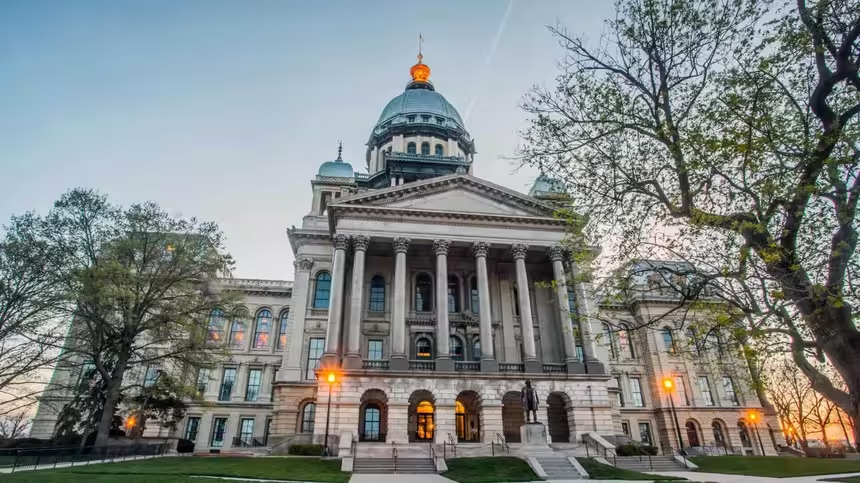
CapitolView
CapitolView is a weekly discussion of politics and government inside the Capitol, and around the state, with the Statehouse press corps. CapitolView is a production of WSIU Public Broadcasting.Providing Support for PBS.org
Learn Moreabout PBS online sponsorship[MUSIC] >> Welcome to capital view on WSIU.
I'm Jeff Williams sitting in this week as we take a look at what's making news around the state in Illinois politics.
Well, ethics and ethics reform in the Illinois House continues to draw some attention.
And the fall election campaign season is officially underway.
We'll take a closer look at those stories, and likely some more this week on Capitol View.
And to help lead the discussion, our Brenda Moore, state House reporter for Capitol News Illinois, and Jason Pecha, director of the Public Affairs Reporting Program at the University of Illinois, Springfield.
Gentlemen, welcome back to the program.
>> Good to be here.
Good to be with you, Jeff.
>> All right.
Ethics seems to always be a topic, at least simmering in the background.
I think this summer, maybe for lack of other things going on at the Capitol.
It's kind of taken a center stage.
I'm not exactly sure how to get in to jump into this conversation about the legislative inspector general, but a little bit of that, a little bit of, of background on, on, on this story.
Um, there's been a lot of, of ongoing discussions about events of harassment and allegations as such and calls for, for reform.
Earlier, we had the resignation of Democrat Harry Benson after sexual harassment allegations and a and a subsequent legislative inspector general's report that surfaced most recently right before the State Fair.
There was a very public allegation made by a former staffer of another Democratic state lawmaker, Amy Breel of, of, of Ottawa.
Um while Representative Breel and the Democratic Caucus, for the most part, I think are strongly denying those allegations, citing in part a legislative inspector general's report that essentially found those allegations as unfounded.
And also, I think, chalking it up to some electioneering on the part of of Brazil's Republican challenger.
At the same time now, recently we've had a leader in the House, I believe, of the Democratic Women's Caucus that is calling for legislative Inspector General Michael Mccuskey to resign over how he has been conducting those investigations.
There's a probably a lot to unpack there.
Brendan, do you want to start?
What is the controversy surrounding the legislative in general?
That's that's really kind of drawn him into the crosshairs in the past several weeks of this summertime period.
>> Yeah.
>> So Mike McCluskey has been the LIG since 2023.
He's a retired judge.
He's generally well liked by by folks across the board.
Kind of a jovial guy.
Loves to talk.
But, uh, some of, uh, some of that has got him in a little bit of trouble, uh, in recent months as, uh, these investigations have really put him in the spotlight.
Uh, so basically one of the, uh, one of the complainants, uh, one of the, the folks that was, uh, uh, sexually harassed by representative X rep Harry Benton, uh, basically, uh, accused him that his basically said that his report had a lot of inaccuracies in it.
Uh, and then she actually wrote a, a letter to the four legislative leaders basically saying that, uh, he violated, uh, her, her, um, violated her, uh, confidence and, uh, made inappropriate comments and, uh, basically broke some standard investigative norms, uh, during his investigation.
And, uh, basically said that, uh.
it was a problem because, uh, if, you know, people don't feel they can go to the LIG uh, and that they're, that they're, uh, that, basically that their anonymity is going to be respected.
Uh, that, that then, you know, nobody's going to feel confident, uh, to go file a report if they need to.
Uh, so, uh, that was reported in the Tribune last week.
And, uh, and then after that came out, uh, state Representative Mary Beth Canty, uh, came out with a statement basically calling on McCluskey to either resign or for the Legislative Ethics Commission to remove him from his position.
So basically how this works is, uh, you know, McCluskey gets appointed by the full legislature for a five year term.
It's not up until June 30th, 2028, but he can be removed for cause by the Legislative Ethics Commission, which is this eight member, uh, bicameral, bipartisan, uh, commission, uh, that kind of, uh, oversees the LIG.
They oversee a lot of these, uh, ethics issues.
Uh, in the capital.
Uh, and, uh, and for cause, uh, isn't really isn't really defined in the statute.
They kind of give the LEC some leeway to determine that.
Um, it has to be a vote of at least five members.
Uh, and the LAC is kind of a secretive body.
They don't meet in public.
Uh, they don't put out a meeting schedule.
So we don't necessarily know if they're going to take it up.
Um, I did ask all the four legislative leaders for comment on, on the, uh, the Tribune report and on the, uh, the letter that was outlined in that.
And basically they all, to some degree or another, uh, punted it off to the LEC saying that it's in their hands.
Uh, although it was highly suggestive that, that there, there were a lot of concerns, by the way.
Um, you know, McCluskey has, uh, handled how he handled the Benton investigation and how he may have handled other investigations, and that may be a concern for, say, Representative Briel, who, um, you know, basically has has dismissed the allegations against her basically saying that the, that the complaint was unfounded by the LIG.
Well, if the LIGS credibility is in question, well that that, you know, basically, you know, could throw, uh, some credence to some of those allegations, even if they were unfounded.
>> Yeah, yeah.
In the also part of the backdrop of this, I guess probably after the, the, the, the fallout with representative former Representative Benton, um, Speaker Welch created this private 11 member, um, I guess, working group to look at at ethics and potential ethics reform.
Um, other than I think we've heard some grumblings from, uh, one of the members that was appointed or not appointed that was kind of concerned about how this all kind of came together.
Do we do we know much about this particular body and what it's going to do?
>> No, not not really.
I mean, so so these working groups are are private.
They, they they don't meet in public.
It's not like a committee that meets, uh, in the house where it's public before and the media before, you know, any, any, anybody can go and watch it.
Uh, this is an internal, uh, you know, among, uh, House Democratic members.
Uh, it started with 11.
The speaker named 11 people to that, to that, uh, working group.
At least three have declined to participate for various reasons.
Um, and there may be a fourth that isn't participating too.
I haven't confirmed that.
So, uh, 7 or 8 members on this, on this working group.
And and I know they've met at least once.
But again, we don't know necessarily what what they have been talking about, uh, or how much progress they've made, although the goal seems to be to get something teed up for veto session where they can, they can take on some of these ethics concerns, uh, these workplace culture concerns, uh, that, that, that have arisen.
Um, you know, it because while there are legislators that are concerned about how the LIG has, has acted and how, um, you know, he maybe is enforcing some of the, uh, the laws and regulations, uh, that are kind of in already in his purview.
Uh, there's a general agreement that, uh, that there needs to be more done from a legislative perspective, uh, to give some teeth, uh, to, to, uh, maybe more teeth to the LIG as an as an office.
Uh, and also, uh, some internal house Democratic, um, uh, I guess, uh, HR, uh, reforms to make sure that, uh, folks that work for the house or work in some of the district offices feel like they're protected and that they can actually go to somebody, uh, if, if there's something that goes wrong in one of those offices.
>> Yeah.
Yeah.
Uh, Jason, you've you've been an observer in Springfield, both as a, as a reporter and editor and, and now kind of on the other side as a, as a, as, as a teacher.
Ethics has been a subject kind of either not front and center, kind of on the, on the, on the burner for, for, for many years, especially in the House, especially after Speaker Madigan's ordeal.
Um, is this enough, do you think to kind of push something along and get something done?
Or are we hearing more lip service?
Do you think?
>> I, I don't like to make predictions about what the legislature is going to do.
But, you know, I think in this case, it'll probably follow the the usual process of what happens.
Something bad happens ethically.
People are outraged by it.
There are calls for people to step down.
Sometimes that happens, sometimes that doesn't.
And then maybe someone in the legislature will get together and put together a bill that responds to that specific thing.
They may push it through maybe before an election or, you know, to to help save face.
Uh, and, you know, it'll address a small loophole that might be somewhere.
Uh, and then, you know, everything dies down for a while.
The public seems to be satiated and that everything's going to be okay.
And then again, there'll be another round of this in the future where something else bad will happen, and then there'll be outrage, and then something will will be introduced to get passed.
Uh, it's a, it's a, I'd say a vicious cycle here in Springfield.
Um, there, you know, there's been some big elements that have been approved, like the legislative inspector General, creating that office and doing some of the things that they do.
But, um, again, it's a piecemeal approach and it seems they, they'll, they'll take a small bucket of water to put out a big fire and then, uh, you know, wait for the fire to rekindle in some other form.
>> Yeah.
Yeah.
Um, shifting gears just a little bit.
The, um, Springfield State Fair, obviously, uh, occurred during state fairs going on right now.
That's usually the unofficial start of the, of the campaign.
The on the election season, if we take a look at the top of the ticket, at least if we look at who's coming, who's making their trips down here, um, the governor's race is, is, is in full swing.
This is kind of, I guess, a rematch, if you will.
Um, either one of you, as you've kind of looked and watched their campaigns and what they're saying this time, how would you compare this, this gubernatorial race to the, to the, to the last one and what they're out there, you know, stressing to voters this time around.
>> Yeah, I think especially on the Republican side, Darren Bailey, uh, you know, maybe learned his lesson four years ago and he dissed Chicago in his initial, uh, campaign and sort of that soured the city on him.
Uh, he's trying to make amends with all that is his, uh, tour around the state, uh, in the last week or so, which I'll give a shout out to my former student and Brendan's coworker, Ben Zielinski, who put, uh, you know, did some miles this past week.
Uh, following the two candidates around on their, on their tours.
Uh, but Darren Bailey, uh, was, uh, he was in downstate Illinois and, and kind of told them, you know, this is probably going to be one of the last times you're going to see me before the election.
I need to go and focus on Chicago.
Uh, and, you know, get, uh, get myself, uh, in good graces with them.
Just, you know, the Pritzker campaign has has gone all in on television ads lately.
And, um, and what we're seeing on the main TV ad that I, that I see from him is the, uh, everything Bailey said four years ago, uh, or comments that he made about, uh, you know, hot button issues like gun control and abortion and LGBTQ education, those issues that really kind of divide the world, uh, and galvanize the Republican base in some way, but also turn off a large amount of voters this time around.
Bailey's trying not to talk about those things and is focusing on affordability and other kitchen table issues.
Uh, but Pritzker won't let, uh, the electorate remember or won't let them forget the things Bailey said four years ago about those things, to try to paint Bailey as being too extreme, uh, to be governor.
>> Yeah.
The, the, the, the tours were both kind of rally the troops kind of tours.
They were they were very much they weren't really persuasion tours.
They were more.
We're going to go to our base and we're going to.
We're going to try to fire people up.
As Jason mentioned, Darren Bailey was downstate.
He was really encouraging his supporters, his core supporters downstate, his base to turn out basically, as Jason said, you're not going to see much of me the next few months.
I have to go to Chicago because I have to convince voters up there to give me a chance.
But that is only possible if we do better up there.
But we also need every single vote we can get down here.
Uh, so that was kind of his message last week.
Uh, the problem, uh, has been, and this is a difference from four years ago is that, uh, Bailey has no money.
Uh, last time he at least had some, some, uh, a few million bucks, uh, in the bank from from, uh, Mega-donor Richard Uihlein, uh, who also backed him through an outside superPAC last time.
Um, Uihlein did make a donation this week, but it was for $6,900.
Uh, it's far different from the 12 million he gave to Bailey last time, and 42 million he gave to the outside PAC.
So so the so.
So he's had a problem, uh, getting the message out to those Chicago voters who, uh, you know, he's trying to convince, uh, because he just doesn't have the money to do it.
Whereas Pritzker does have unlimited resources can kind of run that ad campaign.
Um, you know, I hopped on the campaign tour a few times last week to, uh, and, uh, it was, uh, it was hard not to notice how, uh, Pritzker has a very national message.
Um, it's very anti Trump, as you would expect.
Um, you know, I saw him in East Peoria over the weekend.
Uh, he had about a 20 minute, uh, speech, uh, kind of rallying folks in a, in a union hall.
And again, he, you know, was mostly friendly audiences.
He went to, uh, saw some union folks and, uh, went to college campuses, went to a lot of Democratic friendly audiences downstate, but he only mentioned Darren Bailey's name for the first time, like 13 minutes into that 20 minute speech.
It was mostly about about Trump.
And you couldn't help but notice the visuals to a lot of like, less like JB for governor signs and a lot of like American flags and a lot of like, um, you know, very much, uh, it felt like a national campaign or like, like, you know, priming for a national campaign.
Obviously, we know all the chatter about possible presidential campaign in 2028.
Um, you know, he says he's focused on Darren Bailey, but, uh, it's pretty clear, uh, based on just, uh, some of the messaging and the fact that, you know, it's very trump forward and, and you don't really hear a lot about Darren Bailey until the back end when he, when he's speaking that, um, you know, it's a, it's a very, it's a very national campaign.
Uh, and, uh, in the, you know, this, it's kind of a reflection that this rate, they don't view this race as particularly, um, close or competitive.
And they don't really view Darren Bailey as as much of a threat, uh, to knock him off of a third term.
>> Yeah, yeah.
Um, Mail-In voting starting to get underway.
In fact, I just received my letter at home this past week for that.
Uh, has the confusion surrounding around the president's executive order on new restrictions on mail in balloting, has that cleared any or is it still kind of a big question mark as Illinois and other states are getting ready to do all of all of that that is entailed in mail, in voting?
>> It seems like there isn't much confusion, at least among regular people.
Like you mentioned, you got your letter.
I got my letter this week as well from my county clerk here in Sangamon saying, you know, I'm a mail in ballot person myself.
And, uh, they said, you know, it'll be mailed out on September 24th, which is the first day for, for mail in voting ballots that can be submitted.
Um, I think, you know, I may be wrong, but I think most people will look toward their local officials, uh, for updates about how the election works and aren't necessarily looking to Washington, D.C.. Um, and that's really at the heart of the, of the Supreme Court case.
And the conflict here is that, um, you know, the executive order that the president put out, you know, requires that the federal government put together these lists of citizens who are U.S.
residents and over 18, um, and directing the Postal Service not to mail out ballots to people who aren't on those lists.
Um, and then the states have come back, you know, the, the Constitution says the elections are a function of the state and the federal government should be, shouldn't be getting involved.
Um, you know, I think, you know, part of Trump's, uh, you know, modus operandi is, uh, to sort of infuse confusion into, uh, into conversations to, to get people feeling one way or the other.
Um, so, uh, yeah, I think at this point people are listening to their, their local election authorities and, uh, at least in Illinois, you know, the clerks that, uh, the news media have been talking to seem to say that, uh, everything's going to run as normal.
>> Mhm.
>> Brendan, anything on your front?
>> Yeah.
I mean, Jason, Jason covered it pretty well.
I mean, I think there is there is there is a lot of confusion, though, to be clear.
I mean, uh, a federal judge did block the Trump administration from, uh, the Postal Service from, from going through with implementing the executive order.
Uh, obviously there's a case ongoing.
Uh, the attorney General, Kwame Raoul, joined in a lawsuit on this last week.
Um, and we'll see if that gets resolved before Election Day.
But, um, I think, uh, as Jason said, I think a lot of people are taking their, uh, taking the lead of, of local election officials on this.
Um, I do think there will be an emphasis this year, especially on, uh, getting ballots in before Election Day.
Um, you know, Illinois allows them to be collected if they're postmarked by Election Day up to two weeks after.
But, um, again, there's, uh, given some of the federal, uh, some of these executive orders and some of the, um, you know, there's a lot of uncertainty right now, so, uh, it'll be something to keep an eye on, especially as, uh, I mean, early voting and mail ballots go out, uh, I believe September 24th here in Illinois.
Yeah.
>> Um, state of Illinois is a recipient of a settlement from meta as our, our, our other states.
Every time we have an infusion of, of cash into the state, there's always the question of what to do with it.
And also What does it what does it mean?
Do we.
Do we have an idea or understanding yet what one what the state of Illinois is going to do with this settlement money and how this settlement may impact Illinois.
>> Yeah.
So Illinois is set to receive about $768 million from this settlement with meta, kind of a groundbreaking settlement with nearly all the states in the country.
Um, which also includes some new safety features, uh, that, that meta is going to implement, uh, for, for, uh, for children and teenagers, uh, using their, their, um, their social media platforms.
Um, but in Illinois, uh, we don't know specifically where it's going to go, but it is going to go generally towards youth mental health and online safety training programs.
Uh, and it's important to note that this money is not going to be in one, one tranche where we get a lump sum of 768 million.
It's going to be over over a period of years.
So that's important, especially because there was a statement last week made by Illinois Federation of Teachers President Stacy Davis Gates basically saying, we want the money for education.
You know, that that, um, you know, there, you know, the Chicago Public Schools Board passed a budget that relies on $150 million in unappropriated state funds.
Uh, and obviously if, uh, they give money to CPS, the idea is that you would have to give more money to schools across the whole state, which would probably equal, you know, give or take $700 million.
So they're saying, problem solved that the money is there.
Now let's do it.
Uh, but Governor Pritzker has basically said that that's not going to happen because, you know, you shouldn't put one time money into ongoing, uh, expenses, which, uh, you know, school funding obviously is your yearly expense, so I would not expect it to go towards that.
I would expect it to go towards um, you know, it's a, it's a settlement that came out of concerns about, uh, safety of children on, on the internet, uh, and mental health.
And so I would, I would expect to go towards those programs similar to settlements with tobacco companies went towards, uh, programs, uh, encourage folks not to smoke and, and towards health, public health.
>> Mhm.
Yeah.
Jason, you said this was something you've been watching as well.
>> Uh, sure.
Yeah.
I mean, just these, the settlement in general is, is interesting to me.
I talk about in my media law class about how section 230 of the Communications Decency Act is always sort of held social media companies harmless on, uh, you know, the effects that their apps have on people.
Um, and, you know, the, the, you know, the amount of liability that these apps have when bad things happen to people.
And usually that's been in the realm of a speech issue.
You know, a user says something terrible about another person, says something libelous.
You know, you can sue that user for libel, but, you know, Facebook is not liable because they hosted that comment.
Uh, this sort of throws this decision sort of throws that concept on its head in that, you know, we're looking at, you know, the, the actual design of these apps and the things that they do and the way that they keep kids addicted and adults addicted to them to keep scrolling and scrolling forever.
Uh, and it's having some negative mental health effects, as has been noted.
And now, you know, the settlement indicates that, yes, there is something toward that.
And meta is stepping up and taking some accountability in that in the form of a $17 billion settlement.
Uh, so again, it's, it's from a media law perspective, it's interesting to see that we've moved into this.
And, um, lots of people have said that this is a big, you know, watershed moment for social media and how they're going to design their apps going forward.
>> All right.
Well, in a little over a minute or so that we've got got left as you're both kind of gazing into your crystal ball, looking out, what are each of you kind of keeping an eye on in the in the weeks ahead?
Brendan.
>> Yeah.
So this, this is the story that never seems to end.
But the Chicago Bears.
Um, last week, uh, we heard from NFL commissioner Roger Goodell who basically said that, uh, the team is still looking at the 326 acre site they own in Arlington Heights for a stadium project, which is notable because a team president, Kevin Warren, said just a few weeks ago that their sole focus was on Northwest Indiana.
So kind of an interesting wrinkle with Commissioner Goodell, who also confirmed that he's met with Illinois lawmakers and spoken with them.
He's spoken with the governor.
And so Illinois is not out of the running here.
It seems that the NFL would strongly prefer the bears to be in Arlington Heights, and it'll be interesting to see if the commissioner getting involved leads to a deal, perhaps in veto session, perhaps in the lame duck session.
Yeah.
>> Jason, how about you?
>> I think just election you know, State Fair is over and we're we're about two months away from from the election.
So, um, I know a lot of people hate the commercials and hate the signs.
I tend to like them to see what people, what candidates are saying and all that's going to start ramping up over the next few weeks.
You know, candidates that don't have a lot of money are going to start spending some of it to get on TV and to to get their name out there.
So we're going to see more of it.
Get ready.
>> All right.
Terrific.
Gentlemen, we're out of time for this week's edition of Capital View.
I thank you for taking part on behalf of Brendan, more capital is Illinois Jason with University of Illinois Springfield.
I'm Jeff Williams.
Thank you for joining us this week for Capital View.
Have a good week.
[MUSIC]
 New Episode
- News and Public Affairs

Top journalists deliver compelling original analysis of the hour's headlines.

- News and Public Affairs

FRONTLINE is investigative journalism that questions, explains and changes our world.
 New Episode
 New Episode
 New Episode
 New Episode
 New Episode
 New Episode
 New Episode


 New Episode
Support for PBS provided by:
CapitolView is a local public television program presented by WSIU
CapitolView is a production of WSIU Public Broadcasting.