
Capitol View | September 24, 2026
9/23/2026 | 26m 46sVideo has Closed Captions
Brian Sapp hosts this week's top stories with analysis from Mawa Iqbal and Peter Hancock.
Brian Sapp hosts this week’s top stories with analysis from Mawa Iqbal of WBEZ Radio and Peter Hancock of Capitol News Illinois
Problems playing video? | Closed Captioning Feedback
Problems playing video? | Closed Captioning Feedback
CapitolView is a local public television program presented by WSIU
CapitolView is a production of WSIU Public Broadcasting.
Capitol View | September 24, 2026
9/23/2026 | 26m 46sVideo has Closed Captions
Brian Sapp hosts this week’s top stories with analysis from Mawa Iqbal of WBEZ Radio and Peter Hancock of Capitol News Illinois
Problems playing video? | Closed Captioning Feedback
Where to Watch CapitolView
CapitolView is available to stream on pbs.org and the PBS app.
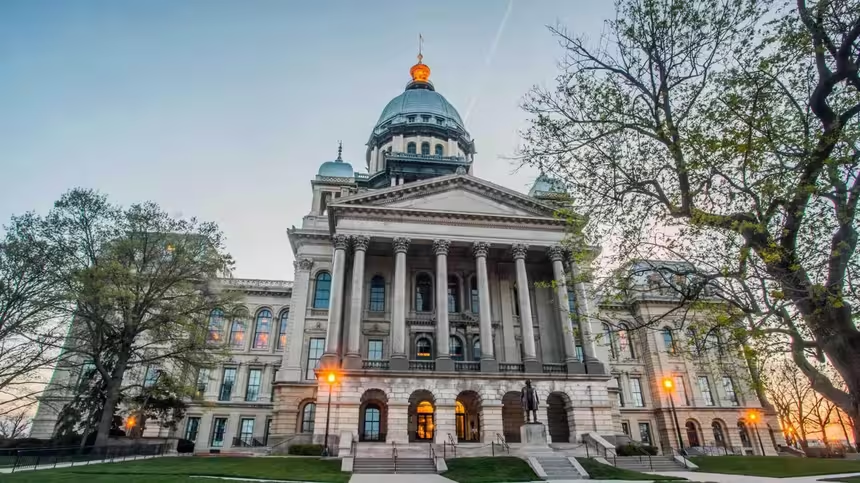
CapitolView
CapitolView is a weekly discussion of politics and government inside the Capitol, and around the state, with the Statehouse press corps. CapitolView is a production of WSIU Public Broadcasting.Providing Support for PBS.org
Learn Moreabout PBS online sponsorship[MUSIC] >> Welcome to Capitol View on WSIU.
I'm Brian Sapp.
Governor JB Pritzker appeared on several network shows earlier this week.
He seemed to make as much news with some topics around his health as with any other state or national policies.
We'll talk about that.
And one year after Operation Blitz, residents and leaders in Chicago and across the state are looking back at the impact by the federal government's enforcement efforts.
We'll talk about these topics and more with our guests today.
Joining us are Mawa Iqbal.
She's the state reporter for WBEZ radio.
And Peter Hancock.
He's a reporter with Capitol News Illinois.
Mawa and Peter, thank you for joining us.
>> Thank you.
It's good to be here.
>> Um, we'll start with Governor Pritzker.
He made a couple appearances this week on CBS and ABC over the weekend, and he has made plenty of appearances.
But he seemed to make some impact or splash this week when he talked about his use of GLP one.
Can you kind of tell us what we learned from the governor this weekend?
>> Yeah, this was probably the first time that he's really opened up about his weight in such a vulnerable and very open way.
Um, he basically offered a sit down interview with, um, one of our colleagues, Chicago Sun-Times reporter Tina Sfondeles.
And she, she basically sat down with him.
They talked for 49 minutes and he told her that essentially when he was visiting the doctors a couple of years ago, like about two and a half years ago, they were testing his glucose levels.
And they found that he his glucose levels were really high, and they diagnosed him with having type two diabetes.
And so because of that, they prescribed him insulin, but then they also prescribed him a GLP one medication, which essentially helps people manage glucose levels and also oftentimes suppresses appetite.
And his, you know, his his whole thing was that he really did not want to be on insulin.
He said that, you know, his goal and this was something he was kind of fighting with his doctors about was to try to get off insulin.
And, and he kept on being told that, no, you're going to have to stay on insulin.
No one comes off of it.
We have to keep you on it.
And his thinking was, well, I don't like taking insulin, but I wonder that if I just keep taking this GLP one and I keep eating better and exercising more, then maybe I can naturally bring my glucose levels down and I don't have to be on it.
And now he doesn't have to take insulin anymore.
You know, he told my colleague Tina that he is eating a lot better.
Like there's this one really memorable portion of their interview where he said that, you know, before he was diagnosed and on GLP one insulin, he would like.
Someone would bring in a box of cake and or a box of cookies.
And his sort of like, like the psychological, um, reaction to that was, I want to eat the whole cake or the whole box of cookies.
And he says he told Tina that ever since he started taking GLP one and he started monitoring his weight and his exercise more, he's also has this sort of like, like thought process that I actually don't want to eat all this food because I want to lose weight tomorrow.
And so, you know, of course.
Right.
Um, Tina obviously was wondering, you know, that this is this is definitely the first time he has opened up this much about his weight loss journey, even though reporters have been asking him for years.
You know, it's been something that reporters, public figures, a lot of people have noticed that he has considerably lost weight.
And he told Tina that he has the total number is £80.
So that's not nothing.
Right.
And and Tina did ask, you know, just just because he's also widely seen as maybe running for or trying to run for president in 2028.
She asked, you know, is this a reason why you're opening up about this now?
Are you slimming down for a potential presidential bid?
To which obviously he said, you know, I'm only focused on the governor's seat, which is kind of, you know, sticking to script where he says, I'm only looking for reelection.
I'm not even thinking about that.
Um, but he did say that the reason why he's opening up about this now is because he wanted to make sure that the GOP ones really stuck, you know, and he was kind of explaining that for a lot of people who are looking to lose weight or on weight loss journeys, so to speak.
Um, it doesn't always work, right?
Like you diet, you try different medications, you exercise, and sometimes people will end up gaining that weight back.
So his thing was he just wanted to make sure that it worked, quote unquote.
And the other interesting thing that he talked about too, was the fact that these GLP one, ah, have been covered by the state health insurance plan for state employees, which is what he is also on.
And I guess a few years ago, I want to say, before even he was diagnosed with having type two diabetes, his administration had expanded GLP one coverage for people who are also looking to lose weight.
So, so not just for people who are on diabetes or who had diabetes or had other medical conditions, that they expanded it to people who wanted to, to, to lose weight.
And, and as a result, you know, it has cost the state a lot of money.
We did a records request, and we found that before the state expanded coverage to people looking to lose weight, it was costing the state around $17 million.
And now it's costing $147 million because the number of people who are going on GLP one for weight loss has completely skyrocketed.
And, you know, of course, like it's hard budget times lawmakers and the governor are grappling with just just a really tough budget cycle, right?
They have to contend with federal cuts from the Trump administration.
They have to contend with higher costs of literally everything.
Um, but but, you know, Pritzker's thinking at least is that with, with at least helping people lose weight, that can also be a preventative measure.
So like, if people are losing weight, then that can help, you know, um, maybe keep them in better health in general so that the, and in a way, eventually it ends up costing the state less because then these state employees are going to the doctors for less severe conditions.
So it was a very wide ranging, wide ranging interview.
Um, and really, you know, it was very illuminating to just to hear this side from from the governor.
>> And Peter, I think there's a couple of things.
Do you think, what sort of impact when we look heading into the election, I'm sure there's lots of issues at play and people have probably already made up their minds.
Is this going to have any impact when we look to November or even beyond, do you think?
>> I don't know how much of an electoral impact it's going to have.
I mean, I guess my first reaction to the story was completely non-political.
It was just, you know, good for you, Governor Pritzker, for taking care of your health, for one thing.
And maybe that can be an example for other people.
Uh, and I think, uh, Mawa brought up an interesting point about how the state spend for these GLP one drugs has increased substantially.
Uh, but I think people at the Department of Healthcare and Family Services would tell you that's actually cost avoidance because for the money that you're spending to help people bring down their weight, uh, is avoiding much more serious and costly medical medical procedures.
Uh, later down the, down the road, uh, these, it really points out how these GLP one drugs Ozempic and all of the others have really been a game changer in the healthcare industry.
Uh, it originally intended to help people manage diabetes, but apparently have other additional benefits of helping people lose weight and substantial amounts of weight.
Uh, so that's all very interesting.
Um, you know, he's running for governor.
He should be watching out for his health.
And of course, if he does choose to run for president, his health will be an issue, just as it was for Joe Biden a couple of years ago.
Uh, just as it currently is for for President Trump.
Uh, people are concerned about the age and the health of the president.
And so that that will be an issue.
Of course, you know, we don't know 100% whether he will announce a bid for the presidency or if he's just going to try to be a player in the presidential race.
Um, but either either way, you know, his health and the health of all candidates, uh, in today's, you know, media environment, it is an issue that people pay attention to.
>> Yeah, definitely.
And one of the things was, as you said, non-political Darren Bailey put out, you know, short social media posts where he, you know, gave his kudos to the governor for taking care of the health.
And maybe we'll just see, you know, people looking to lose weight, they might see this as another good example of how the GLP one might be work for them, if that's what their doctors say.
Um, we're keeping move to something a little more political this week.
President Trump doesn't seem to have a hard time keeping himself in the news, but he could be coming to or he is coming to Illinois this weekend.
The President's Cup is going to be in the Chicago area.
Peter, what can we expect or what do you think we might see when the president comes this weekend?
>> You know, I don't know that we're going to see very much of the president, in part because, uh, he's being very controlling of the media around him.
And that's been a whole other story.
Mhm.
The President's Cup is a golf tournament, uh, that has become kind of popular at between teams.
Uh, there's a team of American players and a team of international players as I understand it.
So it's kind of us against the world, uh, which kind of fits in with Trump's message.
Uh, but President Trump also is a sports fan and he likes attaching himself to sporting events.
You know, we saw the, uh, big some kind of wrestling match on the white House lawn, uh, during the 250th anniversary celebration.
Uh, you know, uh, sponsored a, uh, IndyCar Grand Prix race through the streets of Washington.
Um, he has for a long time, uh, liked attaching his name and his brand to sporting events and to beauty pageants and things like that.
So this is kind of.
Very on brand for him, uh, to get directly involved in, you know.
Carries the name the president's Cup.
So, uh, you know, I think it will be.
It'll be covered by ESPN.
It'll be covered by Sports Illustrated, you know.
All the major sports networks, uh, whether it turns into a political event or not.
You know, probably not.
It's just, uh, him kind of mixing with the crowd.
Uh.
Which overlaps with his political base as well.
Um, but I, I don't expect it to be that much of a political event.
>> That's.
Yeah.
And, you know, I've been covering some local issues here, but I haven't really heard much statewide about it.
Mawa You think, have you seen much in your reporting or just kind of in what you hear in your circles?
>> I have not no, it's I mean, it's interesting because.
>> We, um, I think a week ago or I'm not quite sure when this happened, but, um, Donald Trump was asked by a reporter who actually used to report for a local Springfield TV station.
She's now moved on to be a white House correspondent.
Um, and she, she asked him, you know, first of all, do you endorse Darren Bailey for his run for governor?
He's he's the Republican candidate challenging Governor Pritzker.
And he says, yes, I love that guy.
You know, he's he's a he's a good man.
He also brought up the fact that Darren Bailey's family had suffered a huge loss, um, earlier, um, a few months ago when, when his son and family members were in a helicopter crash.
Um, so he, you know, he said that Darren has suffered a tragic loss, but, you know, I'm all the way in for Darren.
Um, and then he was asked a follow up question if, if he would be in, in, um, Chicago with Darren Bailey, like if Darren Bailey will join him.
And it doesn't seem like we have a straight answer on that, but I'll also, I wouldn't be surprised because as we know, Darren Bailey has been spending a lot of time in Chicago.
This is definitely trying.
Or I guess his campaign's attempt at rebranding from when he ran four years ago against Pritzker and was on the whole, you know, Chicago is a hellhole and it's crime ridden and it's terrible.
Um, you know, I think he's definitely trying to paint himself as like, you know, I'm not just a downstate farmer.
I'm also a city man.
And here's my running mate who has held various positions in local governments around the suburbs.
Aaron del Mar.
So I think a few weeks ago, or maybe not a few weeks ago, a few days ago, Darren and and Aaron Del Mar were at a bears game.
So I yeah, I wouldn't be surprised if, if he does show up to this um, Presidents Cup tournament as well with, with Trump, although it's interesting because his campaign has tried this time around to kind of distance themselves from President Trump did that.
It's a total difference, a total 180 from the first time he ran where he was celebrating Trump's endorsement.
Now he's kind of like, oh, you know, it's great and I appreciate it, but I'm focusing on Illinois and defeating Pritzker.
>> That's yeah, he's been very on message.
I had a chance to talk with Mr.
Del Mar.
And, you know, he said the things to seem to be what the I guess the president's supporters would want to hear.
But he also made sure to sound like he and Mr.
Bailey are their own own man and running their race here in Illinois.
I guess we'll we'll have to see.
And as you said, Peter, some of the decisions.
We'll see who actually covers it, since I don't know that that pool situation has been resolved.
I'm going to jump over a story.
Peter, you wrote an article about the Illinois EPA releasing a comprehensive climate action plan seemed to update a lot of ideas into one kind of look how far we've come when it comes to the climate.
What changes, where we can go and what changes are still needed.
Can you tell us a little bit about this report?
Port.
>> Yeah, it was a very interesting report.
This was funded by a federal grant that Illinois received, uh, from a program back in the in Joe Biden's administration.
Uh, that was part of his inflation reduction plan.
Um, uh, basically they're doing planning for, uh, to spend a whole bunch of federal money, uh, to, uh, lower Illinois overall carbon footprint.
And it talked about how Illinois has reduced its carbon footprint by about a third since 2005, largely by reducing the reliance on coal for power generation.
Uh, that's been a big part of it.
With power plants have transitioned to natural gas and to other kinds of renewable energy, uh, as well as increased fuel economy for automobiles and some, uh, measurable transition From gasoline engines to EV electric vehicles.
Uh, has accounted for most of that.
Uh, but they said if, if we do nothing else, if we just kind of stay on the present course, we are not going to get to, you know, the goal of a net zero carbon emissions, uh, that's going to take significantly more action.
And they laid out really kind of a laundry list of policy options that would have to be approved by the legislature and the governor.
Uh, as, and it also require a lot of buy in from private industry, but, uh, really touching on almost every segment of the economy, uh, from, you know, transitioning to electric vehicles, uh, accelerating that, uh, to the way we develop residential development.
Uh, they proposed, you know, uh, controlling residential development into more concentrated Areas to reduce the number of vehicle miles.
Focusing more on multifamily development rather than single family homes.
Uh, that, you know, is obviously going to touch on a lot of nerves for some people.
Um, and then, you know, in businesses, uh, really focusing on, um, transitioning to other kinds of fuels, uh, trying to get, you know, the, uh, the steel industry and other thing, uh, more electrification of industry rather than relying on fossil fuel for energy production.
Uh, so it's, you know, a long laundry list of policy options, each of which, uh, you know, will require a lot of, you know, substantial investment, uh, not only by state government, but also by private industry and by consumers.
Uh, but they also point out that they have, you know, altogether they have a net economic benefit in terms, you know, especially in terms of public health, by reducing carbon emissions and, you know, smokestack pollution coming out of factories and power plants, uh, improved, you know, public health, uh, fewer, fewer costs for treating asthma and heart disease and things like that.
So, uh, it's a planning document.
Uh, I think it's going to land on the desk of the legislature and the governor, and they're going to look at it and say, hmm, that's interesting.
Uh, we'll see over the course of the next few years how much, if any, of it really gets adopted.
Uh, but, you know, to a large extent, Illinois has been sort of on the cutting edge, at least in terms of state policy, uh, planning, uh, about, you know, planning to reduce the state's overall carbon footprint.
Uh, others California may be, you know, also have, uh, a lot of skin in the game, but a lot of other states have not gone as far as Illinois has in really, uh, taking affirmative action to try and reduce the overall carbon footprint.
>> We'll have to see.
We got they have made lots of strides, and I know that there's still bills out there trying to make changes.
Even this past legislative session, um, and dealing with AI and data centers.
So I'm sure they still have plenty on their plate and they'll find a way to, to tackle this, um, going to change topics.
Mawa.
Last week we talked a little bit about the medical aid in dying, the new law.
Um, I believe it's law and you've done some or are in the process of doing some reporting on this.
Can you talk about your reporting and what you're learning when you look at this topic?
>> Yeah.
So what we're focusing on now is just how this law is being implemented in other states.
So Illinois joins 15 states in legalizing medical aid and dying.
And, you know, it's interesting because obviously this is a very new law in Illinois.
It went into effect about ten, 11 days ago.
And I spoke with this one clinician who has created this Aid and Dying academy.
So essentially, it's an organization that trains clinicians and physicians and nurses, anyone who's in the medical field on how to basically how to carry out this new law.
And in speaking with this, with this person, um, you know, she was saying that it's a really, really difficult thing that not many people know a lot about.
There's a lot of misconceptions and myths out there.
You know, for example, a lot of people assume that when a patient, you know, ingests this medicine, it's a pill.
And in ten minutes they have passed away.
But she says in reality it is, um, it's a sedative mixture with apple juice and cardiotoxins and it takes about two hours for the.
For the medicine to kick in and for the person to pass away.
And so, you know, she said, unfortunately, a lot of physicians, a lot of nurses at your bedside, they're not really trained on how to just administer this or even how to talk about this with the patient.
You know, like you can have a patient who says, man, I'm in so much pain.
I feel like or I wish I was a dog, I was put down.
Um, but maybe, you know, but then if you ask them, well, would you like that?
Then they say, no, no, no, I was, it was just a figure of speech.
So, so she says that there's a whole process of talking about this with the patient in a way that's, that's caring, that's empathetic.
Um, and that's also patient forward.
And you know, it was also interesting is she said that unfortunately, there is a lot of financial, um, barriers.
There's a real, um, issue of access for people wanting to use, utilize this medication.
Um, Medicare doesn't cover it, you know, a lot of people, a lot of patients who might want to utilize this are elderly folks, at least in other states that that that's what she's seen.
Um, she's also seen that, um, it's a lot of people on hospice who are more likely to consider using medical aid in dying, but there aren't as many hospice facilities in general.
She, she says that there are real hospice, hospice deserts is what she calls in a lot of states.
And also the quality of care in hospices is kind of it's kind of scattershot, right?
Depending on where you're at.
Um, and so, so she, she was pointing out these issues and she was saying that what really helps in states is if there's a nonprofit organization that can kind of act as almost like a fund.
So kind of like what we see in Illinois with abortion funds, where there's, you know, the Chicago abortion fund that literally fund raises, raises money and, and donates or offers financial assistance to people who are coming from different states to receive abortion care.
So she says that the states that that have them are able to to, you know, offer this medication more widely are the states that have these nonprofit infrastructures.
And she says that Illinois doesn't really have that yet.
But, you know, that's something that could obviously change as as we get further into this law's implementation.
>> Um, as just hearing you talk about this and plenty of people that have had concern that this was going to just turn into some new cottage industry, that lots of people are just going to choose this and doctors would be pushing on this.
The law really seemed to set forward some some safeguards with that.
What was the feeling you got from the people you talked to in regards to these safeguards?
Are they helpful or are they too much?
What were you what kind of feeling did you get on that?
>> She had said that, you know, the safeguards that are in place are pretty standard and they're pretty good.
You know, in Illinois you would have to get oral and written requests.
If you're a patient, you have to orally and and I guess write your request for this medication multiple times and you have to be sound of mind.
Of course, a lot of disability rights groups have, um, have pointed this out as you know, what if like this puts a person who has disabilities at a disadvantage and that that continues to be a concern for a lot of groups, right?
And of course, we have a lot of religious groups who say that, you know, we don't want physicians who are who practice a certain faith that prohibits them from, from administering this drug to be penalized, right.
That that they would be somehow put in trouble.
Now, my understanding of the law is that it would not penalize physicians who refuse to do this.
Um, that that it would just mean that the patient would have to seek out another provider, whether that be like an independent person or maybe like a different physician to, to help them administer the drug.
But it's, um, but from what I've heard from, from people who are in the field that the standards or the guardrails are pretty standard from what they see state to state And at least in other states, there hasn't been incidents where, you know, someone is pushed into taking the medication that they didn't want to be.
And in fact, it's actually more like the opposite, where people didn't even know that this was a thing.
Like, like, you know, if you're in New Mexico or California where they've legalized medical aid in dying a lot, that this person I talked to said, a lot of physicians there don't even know that it's a thing that they could offer their patients that that they could be interested in.
>> Okay.
It's a pretty complicated topic, and it sounds like we're going to have to work through the court system on some of these.
We have about 45 seconds left, so it's a little squishy time here.
The early voting starts today.
As of the airing of this.
Peter, is there one race that you would suggest our viewers could keep an eye on in like, 20s?
>> Oh, I would keep an eye on all of them.
I think the big story about that is that early voting and mail in voting is going to happen.
Uh, the way it's always happened, that almost wasn't the case because of, um, attempts by the Trump administration for the federal government and the Postal Service to take control over who could or could not cast mail in ballots.
That was halted by, uh, the court system.
And so mail in voting is going to go on just as it always has, you know, for decades now.
And people, uh, should not have to worry about it.
>> That's right.
Encourage people to get out there and vote.
Make sure they have their voices heard.
Mawa and Peter, thank you for joining us on behalf of Mawa Iqbal and Peter Hancock.
I'm Brian Sapp.
Thanks for watching.
[MUSIC]
 New Episode
- News and Public Affairs

Top journalists deliver compelling original analysis of the hour's headlines.

- News and Public Affairs

Today's top journalists discuss Washington's current political events and public affairs.



 New Episode
 New Episode
 Recently Added
 New Episode


 New Episode
Support for PBS provided by:
CapitolView is a local public television program presented by WSIU
CapitolView is a production of WSIU Public Broadcasting.