
Capitol View | October 8, 2026
10/7/2026 | 26m 46sVideo has Closed Captions
Jeff Williams hosts this week’s top stories with analysis from Mawa Iqbal and Charlie Wheeler.
Jeff Williams hosts this week’s top stories with analysis from Mawa Iqbal from WBEZ Radio and Charlie Wheeler from University of Illinois, Springfield.
Problems playing video? | Closed Captioning Feedback
Problems playing video? | Closed Captioning Feedback
CapitolView is a local public television program presented by WSIU
CapitolView is a production of WSIU Public Broadcasting.
Capitol View | October 8, 2026
10/7/2026 | 26m 46sVideo has Closed Captions
Jeff Williams hosts this week’s top stories with analysis from Mawa Iqbal from WBEZ Radio and Charlie Wheeler from University of Illinois, Springfield.
Problems playing video? | Closed Captioning Feedback
Where to Watch CapitolView
CapitolView is available to stream on pbs.org and the PBS app.
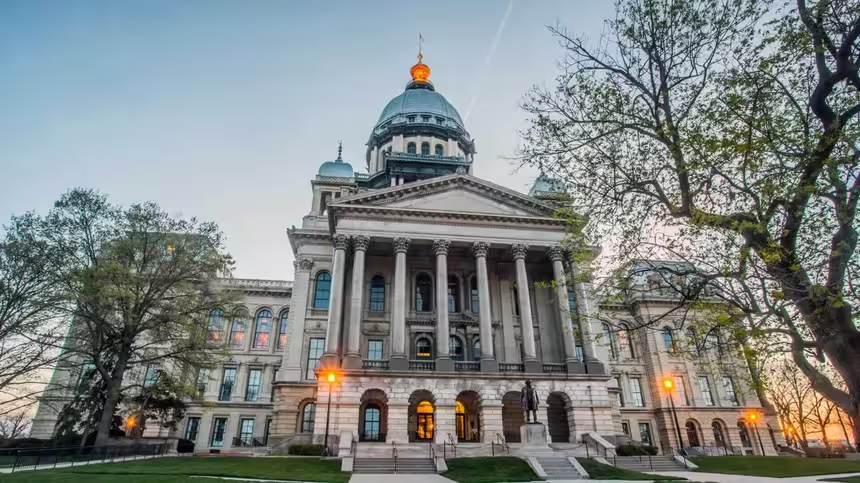
CapitolView
CapitolView is a weekly discussion of politics and government inside the Capitol, and around the state, with the Statehouse press corps. CapitolView is a production of WSIU Public Broadcasting.Providing Support for PBS.org
Learn Moreabout PBS online sponsorship[MUSIC] >> Welcome to Capitol View on WSIU.
I'm Jeff Williams sitting in this week as we take a look at what's making news around the state in Illinois politics this week, Illinois marks the death of a longtime speaker of the U.S.
House and a disgraced Illinois politician.
There's some good quarterly earnings news for the state of Illinois that also comes with a warning.
And a top member of the Illinois GOP endorses Democrat J.B.
Pritzker in the race for governor.
We'll take a look at those stories and likely some more this week on Capitol View.
And to help lead our discussion this week, Mawa Iqbal state House reporter for WBEZ and for our Illinois public radio stations, and Charlie Wheeler, director emeritus of the Public Affairs Reporting Program at the University of Illinois, Springfield and a longtime reporter and state government observer.
Good to see both of you.
Welcome back to the program.
>> It's good to be here.
>> So we start the program today remembering Dennis Hastert.
For two decades, he represented Illinois in Congress, was the longest serving Republican speaker of the U.S.
House of Representatives.
He died over the weekend of natural causes at his Illinois home.
He was 84.
Hastert fell from grace after he left Congress when he was convicted in 2016 on a on federal charges related to allegations that he sexually abused teenage boys in the 1970s while a high school coach.
We reported this week on on on Hastert's passing.
Tell us more.
>> Yeah.
That's right.
He was he had a pretty mixed legacy.
You know, at one point he was considered to be second in line to the president, just like you said, he was the longest ever Republican who served as speaker of the House in Congress.
Um, and, you know, he, he was there in the 90s.
He oversaw or he led the chamber through the nine over 11 attacks.
And then kind of the fallout from that, the war on terror.
So he, he really was there in Congress and a really prominent leadership position at a very pivotal time.
But, you know, in 2016, like you mentioned, um, the FBI had uncovered that he had allegedly, um, sent or not allegedly, but, but they uncovered that he had sent a sort of hush money to, uh, one of his victims.
So, you know, for a while in the 70s, he was a wrestling coach at Yorkville High School in the suburbs of Chicago.
And there while he was coach, you know, it's it's so it's so interesting to read archival articles and interviews with him.
He definitely was celebrated as a coach.
And he was known as kind of like this, you know, high school coach.
Everyone loves him.
He's a pillar of the community.
Then he gets elected into, um, to be a state legislator.
But at the same time, unfortunately, he was also abusing young.
Young boys and during his sentencing hearing, we pulled up a transcript of that hearing where he was ultimately sentenced to 15 months in prison in 2016 for on this on this bank charge.
Uh, he had, you know, many of his victims and the family members of his victims came and offered a public statement or like a victim statement.
And they said that, you know, they described really horrific, horrific instances of abuse and really just how they really trusted him.
They looked up to him as as a, as a mentor, as, as a, as a, as a trusted adult.
And, and, you know, even in his public statement, he does like apologize.
Of course, he says he's very he was deeply ashamed and regretted what he had done.
And, um, that, that, you know, these, these young people, these young boys looked up to him and he took advantage.
Um, it's also worth noting that he at the same time was battling with some illnesses as well.
So, you know, it's he definitely leaves behind a kind of a it certainly is something that he is going to be remembered for that that he had a very long and storied political career that was ultimately sullied by these horrific, horrific abuse allegations.
>> Yeah, yeah.
Charlie Hester, arguably one of the most powerful politicians to come out of the state of Illinois.
And as Marwa referenced, he oversaw an eventful period of of our of our country's history.
Um, you've observed politicians in the state for, for a long time.
How do you think Denny Hastert is is going to be remembered?
>> Well, I knew Hastert when he was a state lawmaker and he was.
He was in the early 80s.
He was in the House, I believe, for six years, 6 or 7 years.
And he kind of got there by accident in 1980.
He finished third in the Republican primary, running for a seat in the House to incumbent Republican Al Chauvelin.
But Chauvelin unfortunately became terminally ill.
Party leaders chose Hastert to replace him.
Now I found him to be a pretty affable guy.
He was.
What's the best way to put in in the legislature?
And I'm sure you've seen this.
There are some lawmakers who are workhorses, and there are other lawmakers who are show horses.
And I considered Hastert a workhorse.
And maybe this was prejudicial on my part, but I thought, well, he's a wrestling coach.
You know, what does he know?
And I was impressed by the fact he took on some very complex issues, Worked across the aisle.
And as I say, I thought he was really a good lawmaker.
Now, I had obviously I had no idea, nor did anyone else of what his background was.
And it didn't come out until much later.
So it's it's sad, but, uh, I believe if I got the quote right that at his trial, the, the judge who was Thomas Durkin.
Stunning than having the words serial child molester and speaker of the House in the same sentence.
And I think there were somewhere like 4 or 5 students who came forward actually to accuse him.
And so that was a remarkable fall from grace and totally unexpected.
But as I say, I had a very favorable impression of him from his time, the work that he did in the legislature.
>> All right.
So we are, um, we're now a little less than a month out from the November election.
Uh, this week, former Republican Illinois House leader Jim Durkin endorsed the Democratic candidate in the race for governor.
The incumbent candidate, J.B.
Pritzker, over over Darren Bailey.
Um, yeah.
Just about anything can and has happened during the course of political campaigns in in Illinois.
Um, Charlie or Iowa.
What do you make of of Durkin stance and what it means for the Republican Party?
>> Well, I'll take a crack at it.
>> Go ahead Charlie.
>> I think in a way.
Durkin looks at it as what has become of the Republican Party since the time that he was in the legislature.
And you look at a time that I covered the General Assembly.
I covered them for, what, 24 years?
And back then, the Republican Party was characterized by people like Dick Ogilvie, Jim Thompson, Jim Edgar, and they were fiscally conservative, but they were socially moderate.
And that has all changed.
And the Republican Party now it's it's become a lot more socially conservative.
And I think Durkan's point is that in the Chicago suburbs and the collar counties in particular.
Republican women, formerly former Republican women, get turned off by all this?
Uh, what did you say?
All this social conservatism.
And they don't really share the same ideas about government as somebody from Clay County.
Like, uh.
Or like Bailey does.
And part of it is the, the rise of, of Donald Trump and his Make America Great Again movement that has become.
Kind of exclusionary.
If, if you don't follow us, we don't want you.
Which is counter to, as I say, what.
When I was a reporter covering the legislature, the Republicans were more open.
Uh, they would work on things.
And there's a certain irony.
I think one of the reporters pointed out that.
Durkin and Pritzker were always agreeable to one another, but they rarely got along, and as a matter of fact, at one point Durkin sued Pritzker over redistricting plan that Pritzker signed into law.
And so it's it's not totally surprising.
And Durkin approaches it, I believe, from the idea that we need to move away from the Darren Bailey's in the Republican Party, in the former, what used to be the Republican Party.
And we have to try and build up the party the way it was when I was in the legislature working with suburban people.
And otherwise, we're going to just continue to be a minority.
Now, Bailey's camp reacted, of course, very unfavorably.
And they suggested, well, Durkin was never a real Republican anyway.
He was a. He was a Rino Republican in name only.
And Aaron Del Mar, who's the Republican lieutenant governor candidate.
His quote is, I think Jim is more concerned about his new position as a lobbyist in Springfield, representing a lot more Democratic organizations than he is about building a two party system here in Illinois and about helping Illinois with affordability, public safety and education.
Del Mar said.
And and I thought Durkin had a pretty clever response.
He said that he.
It was along the lines that, well, De Mar should stick at what he's good at, and he.
And he said that he's a road commissioner somewhere, and he does very well at that.
And that's what he should stick to.
And he also said about Bailey that that Bailey needs to stick to what he's best at.
And that's being a farmer.
>> Yeah.
Marlow was just any raise any surprise in the halls of the of the of the state state Capitol since this was announced earlier this week?
>> Yeah.
It's interesting.
Um, I, I reached out to both Republican leaders in the legislature.
So, so the minority leader in the Senate, Jim Curran, and then the House minority leader, um, Tony Mccombie in the House.
And, um, I was told that they, they probably would not want to respond.
And it really is kind of awkward for them.
I think, you know, Durkin was obviously their colleague, their predecessor combined predecessor, and they really look to him to lead the Republican Party in the legislature.
Um, breaking away from, uh, you know, endorsing the Republican candidate and governor and siding with Pritzker, who?
Yeah.
As Charlie mentioned, they oftentimes would butt heads.
And even now, still with with McConaughey's leadership in the House and current leadership in the Senate, they're not, you know, exactly aligned with Pritzker on really many issues, if not all issues.
Um, but it's, you know, it's, it's something that, that Durkin and his like campaign video, uh, you know, the Pritzker campaign came out with this video where Durkin is saying, I endorsed J.B.
Pritzker and here are the reasons why.
He does point out that, you know, Darren Bailey, kind of what Charlie was saying, that the Darren Bailey represents this faction of the Republicans, and that he also hasn't done anything for Illinois, that that his legislative record is is pretty bleak, that he hasn't been able to pass any legislation or, you know, he's voted no on a lot of like, you know, very crucial pieces of legislation because they were sponsored by Democrats.
And that's also, I guess, a reality of being a legislator in Illinois is, you know, we have this Democratic supermajority.
And if you are a Republican, you either have to kind of play nice with the Democrats to get things passed.
You know, like I, I think about recently, uh, Senator Sue resin, who's a Republican, um, she was able to get a lot of nuclear energy bills passed like pretty landmark bills.
And that was only really because she was able to join forces with some of the more moderate Democrats in the, in the body.
So you either have to, like, sign on with the Democrats to help push your bill forward, or you just don't really get bills passed.
If you're a Republican pushing for more like, uh, especially for more socially conservative policies, because that's just not how that's, that's just yeah, the way that the, the system is set up in Illinois.
Um, so, you know, I wonder if, if we always talk about the October surprise in and in campaigns and elections and stuff.
I wonder if the Pritzker campaign was trying to treat this as an October surprise.
But as Charlie says, it's not so, so surprising just considering where the Illinois Republican Party has been.
You know, how this sort of splintering, this dysfunction, this schism that this has been happening, I would say for for the past several years now.
>> Yeah.
Well, I'm going to date myself, but I'm old enough to remember having, uh, covered the Republican dominance at the top of the ticket through Governors Thompson and Edgar and Ryan over the years.
Um, that said about any other, um, um, revelations in, uh, in, in campaign election related stuff this week at the, at the Capitol that we should, we should know about.
>> Not this week, but I will say like, as far as legislative races go, You know, the Republican Party has been putting a lot of money towards these ads, um, trying to, trying to, to keep this issue of, of the House Speaker, Chris Welch, and how his office handled sexual harassment complaints against two of his Democratic caucus members, and then also allegations that he himself behaved in a very inappropriate manner with one of the complainants.
So, you know, the Republican Party is definitely, definitely taking this issue and running with it, especially in these, uh, more purple legislative districts that could be a Republican taking the seat from a Democrat.
Um, especially, you know, like with a lot of these, these districts, the Democrats who occupied these seats have either come out in support of Welch and saying that, you know, his office did what what he his office should have done.
Um, or they haven't said really anything to the contrary, like nothing about, you know, Welch should step down or, you know, we should see some kind of changes.
You know, so, so they, they're definitely focusing on that.
I, I think that will be something that will come to a head in the coming weeks.
Um, if it hasn't already, but, um, I think as far as the governor's race, you know, I just read that Capitol News Illinois did a sit down with Darren Bailey.
And it's interesting, you know, he's he's sticking to message, right.
I think the the tenor of his campaign this this time around, you know, because he did go up against Pritzker back in 2022 and lost pretty handily.
Um, the tenor of his campaign this time around is definitely that he is more friendly towards Chicago.
Right.
Last time he called Chicago a hellhole, crime ridden.
And this time he is is, um, taking a softer approach to, to Chicago and Cook County, which is where obviously many of the voters reside.
Um, but he also is trying to stay away from these, socially conservative policy issues like abortion, like gun rights.
Um, just because those are pretty unpopular issues amongst a Democratic voters and or just a Democratic heavy, um, state like Illinois.
And, and he's, he's definitely really just hammering home this point that he only cares about, you know, property taxes and, and, um, you know, affordability for Illinois families.
I guess the one thing I'll notice is, of course, I'm sure you guys have talked about this, but, um, the president, President Trump has endorsed Bailey for a second time.
Um, which, which Bailey has said that he's, he's happy to receive his endorsement, but that's not the focus that the focus is on, on Pritzker defeating Pritzker and Illinois and saving, saving Illinois, basically.
>> Sure, sure.
>> So I'm going to shift our focus just a little bit.
The Commission on Government Forecasting and Accountability, or Kova for all you insiders, which is the research branch of the of the state legislature, came out with its latest quarterly report this week, which shows pretty robust growth in corporate income taxes and other sources.
But it also comes with a warning about the risk of the rest of the fiscal year.
Charlie, I know you keep tabs on, on, on.
What's the story with this latest report?
>> Well, I think I would say the quarterly report for the first three months of FY 27, uh, was very upbeat and very surprising.
And revenues into the state's general funds were up more than $1 billion, a billion, 23 million, 8.2% compared to a year ago, the first quarter of FY 26.
The gains were mostly in the corporate income tax.
Sales tax.
And the.
The question is.
How long are we going to have.
Is this an anomaly or is this something that is going to continue because the the, the budget, the budget that was approved last spring basically assumed that we were going to kind of not have much of a gain at all.
And now for the first quarter, we're up 8%.
But the the commission's fiscal gurus issued a warning.
Uh.
Let me see if I can find exactly what their warning was.
Okay.
I'm reading now from the report.
Based on first quarter receipts, the commission is cautiously optimistic that state revenues will surpass the revenue total assumed for the FY 27 budget.
But there are a number of factors that could offset much, if not all, of the revenue gains realized during the first quarter.
And what those, uh, some of those things they mentioned.
One is that the.
Find my factors.
Okay.
One of the things that helped boost the, the amount is the amount of money that came out of the income tax refund that was transferred into the general funds.
Now there's money set aside in a separate fund to pay the refunds on income taxes and at the end of the taxing period.
The money that's left over in the refund fund goes back into the general fund.
And the amount that was put in.
Excuse me.
Was basically what was anticipated for the whole fiscal year.
Mhm.
And so there's there's concern that that isn't is going to bear itself out.
Mhm.
And there's also a strong surge in estate tax receipts 44% higher than last year.
Mhm.
Now.
Which was about, well, double.
The prior year's monthly total.
And.
If I'm looking for the quote here, it says if the monthly total for November returns to near the monthly average over a period of time.
A notable portion of the overall revenue gains during the.
During the reporting period would be offset.
Probably most significantly, the legislation included several new taxes and fees that were expected to bring in several hundred million dollars.
But legal challenges have been filed challenging these fees.
And when these matters will be resolved is not known.
Mhm.
So, Charlie, if the if the state loses those, then that's several hundred million dollars that we won't collect.
So as I say, the bottom line is.
It's very optimistic that during the first three months of this fiscal year, we took in $1 billion more than the first three months of last fiscal year.
But there's all this uncertainty.
So we're really not sure how we're going to wind up.
>> Yeah.
>> So a warning to agencies and lawmakers not to not to necessarily spend money that we we may or may not, may not have.
And it sounds like on that in the minute and a half or so we've got left.
There's one other thing I wanted to wanted to throw in there.
It's the story that never seems to go away.
It's will they or won't they stay in Illinois?
And that's that's the bears.
The NFL commissioner was back in Chicago late last week, I think, meeting with the governor, meeting with some of the bears folks.
We've got the we've got a couple of potential bills out there.
We've got the veto session coming up.
Um, what's what what's your assessment of where that is right now?
>> You know, it's interesting.
>> That the governor's office is pretty optimistic that they will see something in veto session, something soon.
Um, just for people who may not remember, there's two proposals that the General Assembly is sort of wrestling with, but it seems like they're leaning towards the Senate, one, which essentially would create this, um, sports authority that this, this, this kind of sports authority that would apply to municipalities that have a certain threshold of population.
So that would mean Arlington Heights and Chicago would qualify and essentially like the Sports Authority would.
Would this like, like publicly funded sports authority would be able to to fund a new stadium?
Um, and, you know, and with this meeting that, that the governor had, uh, with, with the NFL commissioner, uh, the, the bears, Kevin Warren and George McCaskey.
So the bears leadership were not present, but the lawmakers, um, Senator Bill Cunningham, who's pushing this Sports Authority bill, and then the Kam Buckner who's in the House leading bears negotiations were both there.
So it seems like maybe something could happen in veto, but also maybe something couldn't happen in veto.
So I guess we'll we'll see.
>> All right.
Well we are we are out of time.
Uh, Marla and Charlie, thank you very much for, uh, for joining us this week for Mama Iqbal and Charlie Wheeler.
I'm Jeff Williams.
Thank you for tuning in to Capitol View.
Have a great week.
 New Episode
- News and Public Affairs

Top journalists deliver compelling original analysis of the hour's headlines.

- News and Public Affairs

FRONTLINE is investigative journalism that questions, explains and changes our world.
 New Episode


 New Episode

 New Episode


 New Episode
Support for PBS provided by:
CapitolView is a local public television program presented by WSIU
CapitolView is a production of WSIU Public Broadcasting.