
Capitol View | October 22, 2026
10/21/2026 | 26m 46sVideo has Closed Captions
Jeff Williams hosts this week’s top stories with analysis from Kent Redfield and Olivia Olander
Jeff WIlliams hosts this week’s top stories with analysis from Kent Redfield from University of Illinois, Springfield and Olivia Olander from Chicago Tribune.
Problems playing video? | Closed Captioning Feedback
Problems playing video? | Closed Captioning Feedback
CapitolView is a local public television program presented by WSIU
CapitolView is a production of WSIU Public Broadcasting.
Capitol View | October 22, 2026
10/21/2026 | 26m 46sVideo has Closed Captions
Jeff WIlliams hosts this week’s top stories with analysis from Kent Redfield from University of Illinois, Springfield and Olivia Olander from Chicago Tribune.
Problems playing video? | Closed Captioning Feedback
Where to Watch CapitolView
CapitolView is available to stream on pbs.org and the PBS app.
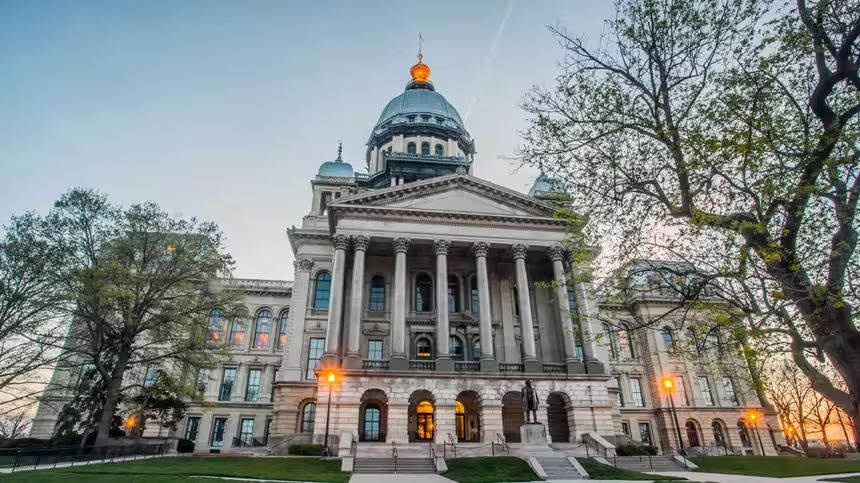
CapitolView
CapitolView is a weekly discussion of politics and government inside the Capitol, and around the state, with the Statehouse press corps. CapitolView is a production of WSIU Public Broadcasting.Providing Support for PBS.org
Learn Moreabout PBS online sponsorship[MUSIC] >> Welcome to Capitol View on WSIU.
I'm Jeff Williams sitting in this week as we take a look at what's making news around the state in Illinois politics.
Well, with two weeks until the midterm elections, the candidates vying for Illinois's open U.S.
Senate seat square off in a TV forum.
We'll take a closer look.
Plus, we'll run down some other aspects of the midterm election season in Illinois and likely some other topics as well.
To help lead the discussion this week, our Kent Redfield, political science professor emeritus at the University of Illinois, Springfield.
And we welcome Olivia Olander, State government reporter for the Chicago Tribune.
Kent.
Olivia, welcome to the program.
Good to see you both.
>> Yes.
Good to be here.
>> The the two major party candidates seeking Dick Durbin's open U.S.
Senate seat met Tuesday night at WTTW.
WTTW in Chicago for what I believe is the only televised U.S.
Senate forum going into the midterm election.
Now, just a little less than two weeks away, Democrat Juliana Stratton, Illinois lieutenant governor, and Republican Don Tracy, the former chairman of the Illinois Republican Party, responded to a wide range of questions.
Olivia, you were you were there.
Um, what's your assessment of the of the candidates following the one and only forum leading up to the election?
>> Yeah, not only the the only forum meeting for the two candidates, but also only their second time meeting.
We learned from Don Tracy yesterday.
So yeah, this was definitely a time for them to get out into the public and make the case to folks who are, you know, not like the three of us and haven't been following this every day.
Um, and, you know, I think, uh, Don Tracy is someone who is a little bit more reserved.
And I think in this, in this setting got the chance to sort of come out and try to make a case against, uh, Juliana Stratton by painting her as a socialist or someone that should be, you know, maybe, uh, feared for that reason.
Of course, she, um, does not describe herself as a socialist or a democratic socialist.
Um, and, you know, Juliana Stratton got to really make the case against Trump and say this is an election where, uh, there's so much on the line at the federal level, and that she's the only one who can really be, um, you know, trusted to stand up to Trump and to be, you know, a fighter for, for, of against him.
So that was really the main message of the, of the two candidates last night.
But of course, we saw plenty of differences on, on foreign policy, um, you know, economic issues and plenty else last night as well.
>> Yeah.
You know, I listened to the audio stream only of the form.
I think it's interesting to, uh, to see how the candidates come off when you're listening as opposed to watching and listening and seeing facial expressions and body language.
I think one of the things that struck me, um, while listening is that for a lot of it, Stratton seemed to be in control of, of, of the, of the form kind of from the beginning.
Um, and whether you agree with her politics or not in listening, you came away with a fairly clear perspective on where she stands and what she's, what she would would be representing.
Um, well, Tracy sounded like he was, um, sometimes a bit defensive in the form.
And I think what surprised me, I think there was a number of missed opportunities for him to really solidify and explain his positions and, and where he is and as well as to, Lay a case, or make an argument to hold Stratton to the fire.
On on on on some of her her perspectives.
Again, just listening to the audio.
But it a couple of things that that just struck me the number of times you mentioned you had a second home in Chicago.
And then the fact that he, you know, he did.
He refers to his opponent as a, as a, as a socialist or a democratic socialist.
So I'm curious, having been there and seen and being able to watch them as well as to listen to them, how well do you think what they said in the forum last night matches up with, um, the profiles that you've done on each of these candidates and their respective campaigns?
>> Yeah.
You know, I think maybe it was because of the, um, the setting being in Chicago, but it did seem like John Tracy was trying to emphasize his, his ties to Chicago, the time that he spent here, of course, mentioning his second home, which isn't necessarily relatable to everyone who's going to be voting in this race.
But it does show certainly that he's spent time here.
Um, you know, it's interesting, um, when he was speaking to me, uh, and I think in a lot of his other sort of campaign appearances and materials, he has emphasized that electing him would actually bring a sort of like geographic diversity to the delegation, which I think is, you know, maybe a more compelling would be a more compelling point for some people, especially downstate, and being able to really play that up and show that, you know, Stratton, as much as she has, of course, traveled around the state as lieutenant governor, doesn't necessarily have that draw.
Um, so that was like a little bit of a difference for sure between, um, what we saw last night and, and what we've seen from Tracy in the past.
I do think that Stratton, for the most part has been consistent, of course, with, um, her opposition to Trump, although I did see her, uh, seemingly back off a little bit in some places, um, compared to the, the forum, the primary forums where she like was calling for a $25 minimum wage, seemingly like right away.
Last night saw a little bit more of a an indication that she would do that incrementally.
So there are definitely some changes when you put them on this in this particular setting compared to the rest of the campaign trail.
Um, but, but for the most part, it was a, it was a pretty consistent showing.
>> Mhm.
>> Let's, let's do some.
>> Yeah.
>> Go ahead.
Yeah.
I, uh, you know, Don Tracy has a couple of problems.
One of them is just name recognition.
Uh, because, uh, you know, he doesn't have statewide visibility.
And so, you know, he has to take every chance, every opportunity to introduce himself and for people to, you know, kind of get a read on him.
So, you know, that is, you know, that's certainly, you know, one of the tasks that he has, uh, he has a geographic problem in terms of the Illinois electorate.
Uh, you know, this will be the first time in a long time.
Uh, we haven't had someone from downstate in the U.S.
Senate because Dick Durbin has been there, you know, seemingly forever.
And that's appealing to downstate voters.
Uh, but if you look at the way Illinois plays out, uh, you know, the elections are decided really in suburban cook and in the collar counties, you you can't run up the score downstate and, uh, lose, uh, the suburbs, lose suburban cook and get killed in Chicago.
Uh, you get the kind of results that Darren Bailey had four years ago.
And so, uh, it is, you know, he has to, you know, He'll make that bridge to, uh.
Suburban voters.
Uh, you know Chicago.
You're not going to win.
But, uh, Republican candidates need to cut, uh, Democratic margins in Cook County, and then they definitely need to, to win the suburbs.
And, and, you know, you need a lot of money to do that.
And he doesn't have a lot of money.
And so, you know, he's, he has a real problem in terms of what he has to do.
And then the headwinds from, uh, the national scene are, you know, obviously working against him, uh, the who's running for the US Senate isn't particularly driving turnout.
Uh, a rerun of, uh, the, uh, J.B.
Pritzker versus Dale and Darren Bailey is not you know, that's not the big draw.
Um, you know, Trump says I'm, you know, think act like I'm on the ballot.
But for his supporters, he really isn't on the ballot.
And, uh, whereas for the Democrats, that's really, uh, you know, driving the turnout is what's happening nationally.
And, you know, just to put that in numbers, Trump did a lot better.
Um.
Four years this time around than he did four years ago.
And we're talking about the, you know, 2024 versus 2020.
But, uh, he did better in Illinois, but not because he got more votes.
He did better in Illinois because Kamala Harris ran 400,000 votes behind what Bohdan Biden got four years previously.
So you've got an awful lot of Democrats who probably stayed home two years ago.
Uh, and, uh, you know, weren't happy with their choice.
We're less happy with the Republican.
And, you know, now's the chance to go to the ballot box.
And so that enthusiasm factor has an impact on turnout.
And it's just not clear what's driving Republicans to the ballot or that there's anything quite like, uh, a lot of Democrats to the ballot is, uh, you know, their reaction to the national scene.
So for Stratton to constantly remind people that, uh, Don Tracy is a Republican and Donald Trump is a Republican, you know, makes perfectly good sense.
And, and so I, I think that's, you know, that her task obviously was much easier than Tracy's.
>> Just a little more ballot box mathematics here.
I know Republicans have really been urging downstate to, to get that vote out, assuming that Stratton will do well in Chicago and some of the smaller counties.
Is there a path forward for Tracy?
If we see.
I mean, would it take an extraordinary downstate turnout or is.
Or is there a path forward?
>> It has to be more than that.
When Bruce Rauner won statewide, uh, he cut, uh, uh, Quinn's vote in the suburbs.
I mean, in Suburban Cook.
He won the collar Counties and, uh, and then had a, you know, a big margin, you know, down downstate.
But, uh, Bailey had a huge margin down state, but he lost DuPage and Lake and Will and Kane probably came pretty close in McHenry.
And so, no, I don't think the math adds up.
You really have to Republican candidate really has to be able to get votes out in, uh, you know, in the suburban collar counties and votes in suburban cook.
If you know, and that's the same, the, the math is even worse for, uh, if people don't know who you are, which is what, it's pretty much sum up everybody running statewide on the Republican ticket except for Dale and Bailey.
>> Yeah.
Yeah.
At that point.
>> With, um, with Don Tracy, I would also say, you know, he, uh, as a, as a Republican, he is certainly in the moderate lane of his party, but he's not necessarily, uh, Driving home, you know, maybe the differences between him and Donald Trump or the policy differences.
There were a few that came up last night on like sanctions on Russia and a couple other things.
But overall, it's, it's, it's not necessarily the case that that's been like a driving force of, of his campaign, which I think could also make it a bit challenging to break through to some, you know, more moderate people who live in the suburbs or wherever else who might, you know, just have a lot of a lot of issues with the president at this point.
>> Yeah.
Olivia, did you hear anything specific either from Tracy or Stratton during during the forum last night that maybe you hadn't expected or was or was something something new or different?
>> Yeah, to some extent.
>> That was something new.
Um, Don Tracy, uh, breaking with the president on sanctions on Russia, I believe.
And I think that was something that was new.
And then again, um, the lieutenant governor sort of taking a slightly more moderate tack on how she would, um, you know, go to a $25 minimum wage, which of course is, is not necessarily a moderate position, but, you know, bringing up, um, that was, was a bit different than at least, um, than some of the earlier um, forums that we saw in the primary.
>> Yeah.
Yeah.
Something we've touched upon before, but we're two weeks out.
You know the saying money talks.
How are the campaign, how is the campaign spending, uh, shaking out in, in, in Illinois this year?
>> Yeah.
I mean, this is a, a case of Democratic dominance for the most part.
Um, you know, uh, Don Tracy, just to kind of, uh, talk a little bit more about him when we're on the subject.
He, um, did give his campaign another, um, $1.5 million, um, going into, um, this, this final fundraising or this final quarter.
Uh, you know, the, the final period of the election.
Um, however, um, you know, that is not necessarily, uh, on par with all the fundraising that, you know, Stratton was able to do in the primary and, um, certainly on the, in the governor's race, um, the, uh, sort of the storyline, I think that, that we sort of saw was that the mega donors that had backed Darren Bailey in the past and, um, you know, have sometimes come in to swoop in and help Illinois Republicans really haven't materialized in this election cycle in the same way, which of course makes it really challenging for, um, you know, Republicans to potentially break through.
But, um, we did definitely see a fundraising advantage for, for Democrats across a lot of these races.
>> Yeah.
No, no outside money.
Uh, in the governor's race, the Senate's race, uh, congressional candidates are not Republican congressional candidates or are not getting any support.
Um, uh, you know, the three incumbent congressional candidates are in solid Republican districts.
They're going to get reelected.
And the Challengers in terms of sets, as they are to the Democratic candidates.
Even with a bunch of open seats, you don't.
There are no national groups that are targeting places in in Illinois.
And then, you know, at, as Olivia says, the absence of a financial angel.
And so Bailey had $50 million plus that was associated with Richard Uihlein.
Um, and he is giving no money or virtually no money.
He backed Bailey's primary opponent in the in the primary.
And, uh, the other person that was holding up the Republicans in terms of, uh, you know, support for statewide and even legislative candidates.
Uh, Ken Griffin, you know, he put $50 million, uh, For Richard Austin from Aurora to run against Bailey in the primary, and he and his business are now in, uh, in Florida.
And so, uh, you don't have that kind of backstop to help the Republicans with the fact that as a minority party, uh, you know, you give more money to the majority because you, you want to, uh, you know, if unless you're intensely partisan, uh, then you're going to write a bigger check to the Democratic speaker than you are to the Republican minority leader in the House.
And the other just briefly, the point is, you know, the changes in in the kind of the makeup of who's giving.
So, for instance, the doctors use the medical society used to be a huge contributor proportionally to other groups.
They still give substantial money, but the major health contributors are hospitals, nursing homes and health facilities.
And they are, all things being equal, really in favour of state government spending money on health care.
And Democrats are usually more enthusiastic about that issue than are Republicans.
And so it is, you know, the voting demographics, the demographics of the state.
It's more diverse, it's more suburban, all of those things.
And then, you know, the political factors and the economic factors, you know.
Now nothing is forever.
But this is a not a great time to be running as a Republican or building up, you know, trying to build a Republican Party.
>> Yeah.
The, the voting demographics, have they changed that much since Mark Kirk or Peter Fitzgerald, or even Chuck Percy Everett Dirksen that had long runs in the Senate.
>> Well, I mean, the the populations have changed in that the suburban area has grown and Chicago has lost population.
Suburban cook is is growing not as fast as the others downstate.
There are a few, not a lot of areas with a lot of of growth and and so that's been a factor.
The suburbs are much more diverse.
Huge immigration differences between 1990 2010.
And, uh, and, and most of that in the suburbs.
So, uh, a million, uh, you know, Asian and Hispanic voters in suburban cook and, and the smaller counties, uh, 1,000,003 actually in that 20 years and a loss of 20 of, of a million, uh, white voters.
And you've got Chicago has lost voters and lost population, but you've got a lot of Democrats that are now in suburban Cook County.
And so that's, you know, that really makes it, you know, difficult, uh, you know, and, and so, you know, Bruce, Bruce Rauner is an example of how one might go about it in terms of winning a statewide race.
>> Mhm.
Yeah.
I want to shift our focus just a little bit.
Once we get past the election, we'll be into the into the into the veto session coming up just a little while after that.
Um, Olivia, we have a better idea of what may be included in the, in the session.
>> Yeah.
I think we actually have a pretty good idea of what will be discussed in the session.
Um, you know, at least from the governor's perspective, perspective, what he wants to see discussed.
I'm just from asking him over the last few weeks.
It sounds like he really wants the legislature to pass data center regulations.
This is a bill, some version of a bill that has been called the Power Act.
Basically asks for data centers to pay for their own energy.
Put some community input in.
It's not, you know, a moratorium.
It's not a pause on constructing them.
Um, that's not something that the governor has backed, but it is, um, you know, some regulation for this issue that's been, you know, a really big for, for a lot of communities.
Um, so that's one.
The other thing that, you know, has come up consistently is the bears stadium issue, which pretty amazing that we are still talking about this, but we are they did not pass anything in the spring.
And now, you know, there have been at least, you know, some meetings, um, very high level meetings on this since the, um, excuse me, since the end of the, since the end of the spring session.
So yeah, this is, um, that's something else that we'll definitely see.
Other things that don't seem like they're going to come up housing.
The governor put forward a major housing proposal.
And, you know, in general, it's just it's only a six day session.
So there's only so much that they can do.
And if theirs is one of them, I think that that's going to be taking up a lot of the the brain space for these legislators and certainly for us as the reporters.
>> Yeah.
Kent, are you still looking for at some point, some some ethics reform and figuring out this mess with the legislative inspector general?
>> Yeah, what a great question.
I actually asked the governor about this yesterday and he said, no, do not pretty much.
Not in so many words.
But he really, really tempered expectations for what could potentially get done, even after everything that we saw in the past year, all the issues that have that have come up with, you know, former Representative Benton and and all the rest.
He really said, this is only a six day session and we can potentially expect some some legislation to come up next year in the full session.
>> And that's not surprising from the governor's standpoint.
This is a legislature problem.
We fixed our did a decent job of fixing corruption in the executive branch after George Ryan, after Rod Blagojevich, the legislature, uh, you know, they are regulating themselves when it comes to ethics.
And, uh, the only people that can seat a member of the General Assembly is the General Assembly.
The only person that can kick out a member of the General Assembly is the General Assembly.
And so, uh, they are very conscious that they run every two years.
And so they don't like, uh, you know, and so the process is, you know, is not designed with a lot of transparency.
Uh, it is, you know, it has worked terribly.
I think that would be, uh, you know, an understatement.
But, uh, from the governor's standpoint, uh, you know, him taking the lead, him trying to, you know, force Don Harmon and, and, and Speaker Welch, uh, Senate President Harmon to, uh, you know, take something up.
You know, the legislature is going to have to deal with this.
And they've got a lot of members that are not very happy, uh, particularly, you know, that women on the Democratic side, women in general that are members.
And so, uh, but to get something through the legislature, you know, that's going to be, you know, that's going to be a tough battle.
Uh, and so, uh, I think that's, you know, Pritzker is, is wise not to be, uh, you know, feeling like, well, I'm governor, I, you know, I, I ought to have a, you know, you know, have put my oar in.
I, I think that's, you know, that that probably would not be a good idea.
>> Yeah.
We've got.
We've got about a minute and a half or so left.
So, um, as each of you kind of look out and gaze into your crystal balls, what are you going to be keeping an eye on in the, in the coming weeks ahead?
Olivia, I'll start with you.
>> Probably that mid term election.
Um, I'll be, I'll be looking to see, you know, um, what happens nationally on this.
And then of course, um, you know, in Illinois, it's not necessarily, um, as exciting in a lot of places, especially in the Chicago area as the primary election.
But, um, we'll be looking to see, you know, what voters are responding to nationwide.
And then that will of course, take us into the fight for 2028, which of course starts on November 4th.
Probably.
>> Yeah.
>> And probably I'm interested in kind of what's going to go on with the legislature in the suburbs.
And there's some seats in the metro East.
And, you know, I think the Democrats may have about maxed out their ability to get majorities, but that's not stopping them.
And so, um, Uh, and then whether or not the ethics issues are going to stick in terms of, you know, we've got two, two House members, uh, with sexual harassment issues or the districts, you know, they're no longer one of them's there.
One of them isn't.
And then we've got a state representative under federal indictment for public corruption.
And, uh, so, you know, this will be interesting to see whether that, uh, you know, causes a ripple with the voters or not.
>> All right, Kent, I'll let you have the last word.
We are out of time for this edition of Capitol View on behalf of Olivia Olander and Kent Redfield, I'm Jeff Williams.
Thank you for tuning in and joining us this week for Capitol View.
Have a great week.
[MUSIC]
 New Episode
- News and Public Affairs

Top journalists deliver compelling original analysis of the hour's headlines.

- News and Public Affairs

Today's top journalists discuss Washington's current political events and public affairs.

 New Episode


 New Episode



 New Episode



Support for PBS provided by:
CapitolView is a local public television program presented by WSIU
CapitolView is a production of WSIU Public Broadcasting.