
Capitol View | October 1, 2026
10/1/2026 | 26m 46sVideo has Closed Captions
Brian Sapp hosts this week’s top stories with analysis from Dan Petrella and Brenden Moore.
Brian Sapp hosts this week’s top stories with analysis from Dan Petrella from Chicago Tribune and Brenden Moore from Capitol News Illinois.
Problems playing video? | Closed Captioning Feedback
Problems playing video? | Closed Captioning Feedback
CapitolView is a local public television program presented by WSIU
CapitolView is a production of WSIU Public Broadcasting.
Capitol View | October 1, 2026
10/1/2026 | 26m 46sVideo has Closed Captions
Brian Sapp hosts this week’s top stories with analysis from Dan Petrella from Chicago Tribune and Brenden Moore from Capitol News Illinois.
Problems playing video? | Closed Captioning Feedback
Where to Watch CapitolView
CapitolView is available to stream on pbs.org and the PBS app.
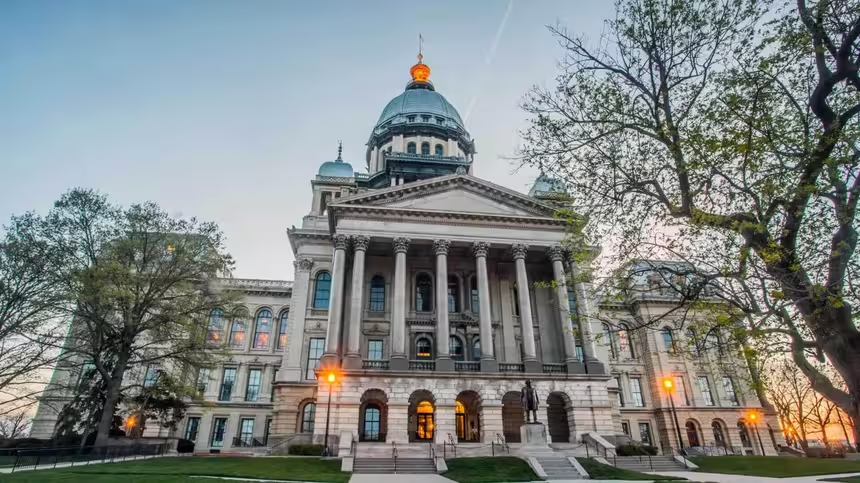
CapitolView
CapitolView is a weekly discussion of politics and government inside the Capitol, and around the state, with the Statehouse press corps. CapitolView is a production of WSIU Public Broadcasting.Providing Support for PBS.org
Learn Moreabout PBS online sponsorship[MUSIC] [MUSIC] >> Welcome to Capitol View on WSIU.
I'm Brian Sapp.
Election day is a little more than a month away, and early voting is already underway here in Illinois.
Following attempts by the Trump administration to take some control over mail in voting and other aspects of voting in the nation, and here in the state, election officials are preparing for a safe and accurate election.
We'll talk.
Let's see what they have to say about this.
And one year after the Trump administration launched Operation Midway Blitz.
Illinoisans are still dealing with the impacts of those enforcements, and they're trying to respond to these continuing federal enforcement actions.
Joining us today to talk about these topics and several more are Dan Petrella.
He's a reporter with the Chicago Tribune.
And Brenden Moore.
He's a statehouse reporter with Capitol News Illinois.
Dan and Brenden, thanks for joining us today.
>> Glad to be here.
>> Good to be with you, Brian.
>> Um, Dan, we'll start with you.
Uh, elections.
We're in election season.
And the President Trump administration tried to, you know, as a take control of mail in voting and then was also filing suit against the states to get voter information.
Last week, a forum by the Citizens Club of Springfield, hosted by our colleague Kent Redfield, was the moderator for that, talked with Matt Dietrich from the Illinois State Board of Elections and segment, County Clerk Don gray to talk about elections and where we stand as we head into this last few weeks.
What did they share?
>> Yeah, the message from, um, from, uh, Mayor Detrick and Don gray and really from election officials all around the state is that, um, the process is secure.
It is working like normal folks should have confidence in, in their votes being counted.
Uh, you know, if they follow the, the rules of, of mail in voting, for example, and get their, get their mail in ballots postmarked by election day.
Um, you know, it's been a very tumultuous, uh, run up to the election in terms of all the litigation, like you mentioned, um, the state Board of Elections fighting the Department of Justice, and in court over, uh, the Trump administration's efforts to get, uh, private information on, on voters in Illinois, including, uh, partial Social Security numbers and things along those lines, which, uh, the, the state was victorious at the at the trial court level earlier over the summer.
Um, so there are, you know, there's still questions.
I think there's a lot of anxiety for folks, um, about what might happen on Election Day and in the lead up to election day.
You know, the US Supreme Court just had a ruling recently, um, allowing the Trump administration in a limited way to use this new combined database, um, at the federal level to try and, uh, question eligibility of, of voters, um, unclear how much impact that will have here in Illinois.
But, um, you know, the, the Trump administration has done a lot.
And, uh, President Trump himself has done a lot since 2020 to really undermine confidence in the voting system.
Um, you know, the big question, uh, maybe not the big question, but a question also is, you know, some folks have raised the specter of whether, um, the administration will attempt to do things like increase, uh, immigration enforcement around polling places, um, or, you know, even possibly activate, try to activate National Guard units again around polling places on Election Day, which, you know, to some folks may seem a little far fetched, but there are other, you know, um, you know, legitimate election security experts who have, have raised those concerns.
So, um, you know, I don't think we've seen any indication that that might happen here in Illinois.
But, um, you know, there's a lot of, I think, anxiety about the, the election and, um, you know, ballots being counted properly.
And I think, you know, the, um, election officials in both parties all across the state have been trying really hard for, for months now and really for years now to ensure folks that there is integrity in the system, that ballots are counted properly, that there's not, um, you know, any huge rush of ineligible voters casting ballots or anything like that.
So, um, I think that's the message they're really trying to hammer home here in the last month and a few days before, uh, the final voters go to the polls on November 3rd on Election Day.
>> Uh, Brenden, I wanted to kind of get your thought on this, I haven't heard.
I mean, other than the president, I haven't heard.
You know, I've been talked to Mr.
Bailey and other candidates, been listening to them.
I've not heard many concerns from them about, um, these election irregularities or worries about that.
Is there, um, do you think we're getting used to this new style of voting with the mail in voting here in Illinois?
>> Yeah.
I mean, if you if you listen to Republicans, especially the Illinois Republican Party, uh, they, they do talk about voter integrity, election integrity, and, you know, that that kind of is a, um, they do kind of parrot some of the, uh, talking points of, of the president, but they also realize that they are, uh, operating in Illinois.
They are, um, where, where there is, there are very, uh, Mail-In voting is, is, is, is widespread.
And, um, it's become a very, um, uh, just a very omnipresent tool for, for people to cast their ballots.
And that if they want to be competitive in elections, they need to get their voters to, to bank their votes essentially.
So then they can go and focus on, on getting other votes.
The Democratic Party has been very good at, uh, encouraging their voters to vote early and to vote by mail.
And, um, you know, I think a consequence of some of the, uh, the doubt that was sown into elections, uh, in 2020 and 2022 is that, uh, that Republicans, you know, were doing most of their voting on election day and not necessarily taking advantage of those early voting options.
Uh, early voting has been happening in Illinois since September 24th.
Uh, that's both, uh, you can go to your county courthouse usually, or you can request a vote by mail ballot.
Um, and and as Dan said, uh, election officials across the state are, uh, are really trying to.
Reassure people that, uh, this is a, this is a safe way to cast your ballot.
Uh, that, that fraud is extremely rare.
Uh, and that, you know, there are processes in place already to, to prevent that from happening.
Um, although I, I, I do think, uh, in the weeks leading up to this election, you're going to see more election officials encourage people that yes.
While you, uh, if it's postmarked by election day, as is normal, uh, your vote will count.
But I think there's going to be some encouragement to, to really ensure that people get their ballot in ahead of election day just to be safe.
Um, you know, because as Dan said, there's really, uh, you know, some uncertainty about what the Trump administration will do, uh, round election day.
And, um, you know what will happen even despite, you know, them losing a lot of these cases in court.
>> Uh, I think that's yeah, being, being practical.
Get those in before take away any of those questions.
Take care of your vote.
And just wrapping up, I had Mr.
Del Mar in the studio a few weeks ago, and he was making sure that there was more talk about getting Republicans out to vote.
They're concerned about, you know, low turnout.
And so just getting people out to vote.
And, uh, yeah, they're trying to push on that.
So we'll see what happens as we go.
Be curious.
Um moving on.
Um, Illinois Comptroller Susana Mendoza announced that, you know, quite a while ago she was not going to seek reelection.
And that means the position will be open.
We have two candidates, Brian Drew.
He is from our area here.
and Margaret Croke are both running for that.
Um, Brenden, you and your colleague Ben Zelensky there at Capitol News Illinois had an interview with them and and talked with them.
What can you tell us about this position that even when I talk with Mr.
Drew, people don't this isn't at the top of their list when they think of statewide positions.
>> No, it is not.
Um, you know, we have a couple of open statewide races this year.
I think the big one people focus on is the US Senate race.
But the comptroller's race is also quite important.
Uh, the comptroller is the chief fiscal officer of the state.
Uh, they make sure that that, uh, that state funds are, are, um, you know, they direct the state funds in and out of, of accounts in the state.
Uh, and they have a lot of other responsibilities too, but that's the main one.
Um, so they, they hold the state checkbook basically.
Um, so, um, Susana Mendoza has been in that office for about a decade now, but she's not running for re-election because she's running for mayor of Chicago.
So so two candidates, as you mentioned, Margaret Croke is a state representative from the north Side of Chicago.
She used to work for Governor Pritzker on his campaign and then in government doing economic development.
Um, and then Brian Drew is an attorney from from Benton.
Uh, and he has some experience in government.
He was an elected trustee of the Rend Lake Community College Board.
And he ran for judge in 2024.
He he came in second in that race.
So, uh, basically, um, the contrast that's been, uh, the candidates are, are, are providing this race is that crook is basically saying that she has been around government.
She knows how this office works.
She, she knows how state finances work.
Uh, and that, you know, she can really hit the ground running.
Uh, if she gets elected to that office, uh, whereas Drew is leaning into his outsider, uh, outsider, uh, persona, I guess, um, that, you know.
Yes.
He doesn't have as much experience with with, uh, with finance.
Uh, you know, he's not an accountant.
I mean, neither is Croke, but, um, but she did work for for DC.
Oh, she's voted for state budgets, uh, been involved in making state policy.
Uh, but Drew says that, you know, I would try to be a true watchdog for the taxpayers, um, you know, try to create more transparency with the website, you know, try to, you know, shine more light on how the state spends its money.
Um, because I think sometimes it gets lost a little bit that, um, the comptroller doesn't set policy, uh, for the most part.
I mean, they, they basically are, you know, kind of directed by, you know, the legislature and the governor.
Um, you know, these are the bills that need to be paid, um, obviously during the budget impasse, uh, they had a little more leeway to decide what got paid when, you know, there was a $16 billion bill backlog.
Um, but we're not really in that place anymore.
Uh, the comptroller can basically pay now the bills as soon as they come in.
Uh, so, uh, the comptroller is not, you know, again, it kind of came into the spotlight a little bit a decade ago, uh, when we had some really, uh, steep fiscal challenges.
Not as much anymore, but, uh, it's still an important office.
And, uh, uh, although a sleepy office, um, you know, it's kind of kind of boring, but, you know, it it does serve an important function.
>> Yeah.
It's interesting too, because, uh, Croke obviously is a pretty strong ally of the governor.
And, uh, Susana Mendoza, while a Democrat is, uh, somebody who has not, um, you know, not, not gone aggressively after Governor Pritzker by any means, but has been one person who is willing to maybe ruffle a few feathers every once in a while with, uh, you know, folks within her own party when maybe she doesn't agree with a certain decision or, um, you know, likes to make her distance on certain things known from time to time.
And so, um, you know, I think one question folks might have is, is whether, um, you know, Kirk will be, there will be any daylight between her and the governor on issues.
But there, to be frank, aren't a lot of issues where, um, the comptroller's office has a, a ton of, uh, you know, say they do, you know, propose legislation and things like that.
Um, so that'll be interesting to see sort of how that dynamic works if it is, uh, Representative Croke who, who's elected to that office.
And, um, you know, when it comes to Mr.
Drew, I think it's just, uh, evidence of sort of the, um, you know, the trouble that Republicans have had to get folks who have experience in state government to run statewide because, uh, you know, it's hard to give up a seat that's much easier to get elected to in the legislature, for example, to run for statewide office.
Whereas the Republican right now your chances are slim of being elected.
>> Um, yeah, we'll see what happens and fill this seat and, uh, look towards election day.
Um, one last story on elections.
Um, Jeremy Gorner, your colleague there at the Tribune, um, did a story about, um, Darren Bailey, who's running against governor JB Pritzker for the spot.
Um, is tried to change up his campaign this year, tried to focus on Chicago.
He's talked about that.
He wants to connect with all illinoisans.
And he felt like he kind of alienated the Chicago and the suburbs up there in the collar counties.
But Jeremy, um, reported that his message on the Safety Act is still pretty much the same.
>> Yeah, this is interesting.
It's the strategy that they pursued very aggressively in 2022 when he was running the first time for governor.
And you heard Republicans all up and down the ballot four years ago talking about this issue.
And it's one where they really haven't changed their tune very much, or at least, uh, Mr.
Bailey has not, uh, despite the fact that, uh, that strategy wasn't successful last time around when, uh, crime was much higher in Chicago than it is now.
Um, and as I said, crime has, has gone down pretty dramatically.
So, um, Jeremy got some numbers from the Cook County court system, um, and Chicago Police Department.
So, for example, uh, in the past four years, homicides are down 49% and shootings, both fatal and non-fatal, are also down 49%.
Um, robberies are down 42%, burglaries are down 24%.
So and this is part of a trend we've seen nationwide since the pandemic is, um, you know, crime really spiked in 2020 and had a couple years after where it was still relatively high, but it's come down and the, uh, you know, I don't know, if folks remember the purge sort of concept that, uh, folks were perpetrating back in 2022 where the, the doors of all the jail houses across the state were going to be thrown open.
Really hasn't come to pass.
And what we've seen is, um, you know, Bailey and other Republicans, um, both candidates on the ballot and just folks, um, sort of in the Republican ecosystem focusing on these, these horrific, um, anecdotal cases where, um, you know, horrendous crimes happened by people who are out on, on, um, on bail, you know, cashless bail.
Uh, but really the, the data that's available so far don't show any dramatic change in, in the situation.
And actually, there are more folks in Cook County jail now than there were, um, before the safety or when the safety act went into effect.
So that folks might say is the result of a Cook County state's attorney who's perhaps a little bit more aggressive in prosecuting than, um, at least the opponents of the former state's attorney, Kim Foxx, would say that she was.
But, um, you know, it's interesting that that the Bailey campaign is, is pursuing this strategy again when, um, a lot of the sort of, um, you know, Chicken little sky is falling kind of arguments that they were making last time around, at least so far have, have proven not to be accurate.
>> It's interesting those numbers aren't bearing that out.
Um, I wanted to wrap up our last, last topic or thing to talk about here as we talk about the elections.
I've been here at SIU or SIU for a little over a year and a half.
Um, this is my first election, you know, by, by annual election.
Um, and so it has seemed quiet to me.
Is that a gentleman?
Bruno, let's start with you.
Is this quiet for us this close to the election?
>> Yeah.
Uh, sleepy is kind of the word I've been been using with people.
Uh, it's been a very.
You wouldn't know that there was an election near almost a month away.
Uh, just just by, you know, the level of, of activity.
Um, I mean, Governor Pritzker, obviously you see his ads on, on television.
Um, you know, he's, he's, you know, running his reelection campaign.
Uh, so people are hearing from him, but they're not really hearing from, from, from Darren Bailey.
Uh, he has no money to, to run a paid media campaign, um, which is hurting his ability to communicate with voters, um, which is hurting his ability to, to, to kind of break through and kind of show that softer, gentler version of himself, uh, that he's trying to portray versus four years ago.
Uh, and, and yeah, and a lot of the other, uh, races, again, it, it is, um, you're not really seeing, uh, a lot, uh, at the legislative level.
Um, I mean, the Republicans are trying to make an issue of, of Speaker Welch's, uh, uh, issues this summer with some ethics concerns with, uh, former rep Harry Benton with indicted rep Carol Ammons, uh, and some of his own personal history, uh, getting dredged up again.
Um, but, uh, but, but again, Republicans are a huge deficit in terms of resources.
President Trump's approval rating is, is, is really low nationally, probably even lower in Illinois.
Uh, so, so, you know, I think a lot of Republicans here are bracing for what could be a pretty bad night, uh, in Illinois in terms of, um, you know, seats in the legislature and obviously, uh, trying to win some of those statewide offices, especially given that Governor Pritzker, uh, has basically unlimited resources and is deploying them.
Um, and also, I mean, there's no, there's no real, uh, congressional races of note in Illinois, we saw a lot of attention.
I think this is why there's such a contrast.
I mean, there was a lot of, a lot of attention back in March, when we had a very competitive primary for U.S.
Senate.
We had five open congressional seats in the Chicago area, and most of those were competitive Democratic primaries.
Millions of dollars being spent.
And, uh, and once once those were over, um, I mean, those were pretty safe Democratic seats.
Uh, the, the Senate seat is viewed as pretty reliably Democratic.
Um, there wasn't a lot of competition.
Uh, and so, you know, we could all be surprised on election night, but, uh, I think a lot of people have kind of written off a lot of the statewide races, uh, as you know, Democrats very, very heavily favored, um, to win those.
Uh, and obviously we have other things on the horizon.
You know, the mayor's race has already started in Chicago, uh, in February.
Uh, and, uh, and obviously Governor Pritzker has talked about as maybe wanting to run for president and, uh, that would happen in a few months too.
So it's kind of a we're kind of in a place where, where people are already looking beyond November 3rd.
>> Yeah.
No, there will be one debate between the governor candidates coming up in October on, on public television.
Um, you know, and they that's um, I think there were questions about whether they were even going to do one.
And so there's just, we're not seeing them out on the trail.
It's just, yeah, like Brenden said, very, very sleepy this time around, especially compared to four years ago when you had the same candidates at the top of the ballot.
>> And you're right, we were very busy with lots of, uh, with the primaries.
So yeah, we'll see.
All right.
Um, I'll move on.
We have one last story for you today.
Um, sorry, Dan, you and some of your colleagues there at the Tribune, uh, dove into what this past year has been like after the Trump administration sent federal agents into Chicago and surrounding areas there for Operation Midway Blitz one year later.
What what did you and your colleagues find out?
>> Yeah, we did a series of stories over the past four weeks, kind of looking at different aspects of the of the blitz.
Um, a year later and our last piece on, on Sunday was about sort of the idea of accountability and what that looks like a year after.
Um, and also sort of the, um, questions that, that it raised about the, uh, the trust act, which governs how local police can interact with, with federal immigration authorities.
And, um, you know, what we found is there, especially in that respect, there continues to be a real lack of clarity and understanding for folks about where that line is, where police officers can get involved or intervened.
When there's an interaction between a member of the public and an, an immigration agent.
Um, you know, there's been disputes between local officials about, you know, certain actions that that officers have taken responding to a call, 911 call from an immigration agent or, um, you know, doing things that are perceived as helping them, um, you know, evade protesters or activists, things like that.
So, um, you know, I think what it also has shown is that the state really is limited in what it's able to do to regulate or govern the activities of federal authorities.
Um, obviously the attorney General's office camera rolls, uh, folks had a lot of success in federal court, um, blocking the deployment of National Guard troops, for example.
Um, but when it comes to, um, you know, accountability for agents who may have crossed the line, um, violated policy or the law during, during the operation, um, there's been very little accountability.
There's one, um, you know, one suburban Chicago case where an off duty officer, uh, got into an altercation with an immigration attorney and activist at a gas station, um, in the near west suburbs here, not far from where I live, actually.
Um, and he, the officer pleaded guilty to a misdemeanor charge.
but that's really been about about it here.
State police still investigating the fatal shooting that happened in Franklin Park in the west suburbs early in the blitz.
But, um, yeah, it's it's, um, you know, an open question whether we'll see any, um, any long term accountability for some of the, um, the things that, that we saw on the streets of Chicago in the suburbs last year that really, I think shocked a lot of people.
>> Um, we have about two minutes left.
Brenden.
I wanted to wrap up earlier.
Um, back in the spring, I remember asking a question, what sort of impact have you seen have legislatures like they passed some bills this, this spring to try to interact.
I mean, things have slowed down.
Is that a success for the state and the legislators when they were trying to counteract this?
>> Yeah.
I mean, they, they, they enacted a package last year, uh, responding midway blitz, Um, you know, for example, uh, they, they, they banned, um, or sought to ban, uh, immigration enforcement in state courthouses and in a buffer area around them.
I believe that is still being litigated.
Uh, I need to double check that, but, um, but they, they, but they tried to do things, uh, like that.
Uh, the, the state government is very limited in what it could do, uh, to, to reign in the federal government.
Um, it's just, there's a, it's a supremacy clause issue.
Uh, they can't stop the feds from enforcing immigration policy.
Um, but they try to do what they could in the limited ways, uh, that, that were available to them.
Um, but, uh, but I think that they, uh, they have tried to at least, you know, show that, you know, at least have a, have a performance in a performative way of, you know, we do not, we do not support this.
Um, and obviously, uh, Governor Pritzker, uh, has done a lot in this, too.
Uh, he had the, uh, he started the accountability commission, uh, kind of documenting, uh, some of what happened during midway blitz.
Um, you know, and, and just, you know, have that available if there is ever to be, uh, some level of accountability for, for, for what happened, uh, on the streets of Chicago and in the suburbs.
So, um, it was very targeted, limited.
But, uh, that's, yeah, what they, what they tried to do.
>> Okay.
Well, we'll see how it continues.
Things have quieted down, but I know they're not done.
So, um, thank you, gentlemen, for joining us.
It was great to talk to you and thanks for sharing your wisdom and insight.
That's it for this week's episode of Capital View.
On behalf of Dan Petrella and Brenden Moore, thanks for joining us.
[MUSIC]
 New Episode
- News and Public Affairs

Top journalists deliver compelling original analysis of the hour's headlines.
 New Episode
- News and Public Affairs

FRONTLINE is investigative journalism that questions, explains and changes our world.

 New Episode
 New Episode
 New Episode
 New Episode
 New Episode
 New Episode


 New Episode
Support for PBS provided by:
CapitolView is a local public television program presented by WSIU
CapitolView is a production of WSIU Public Broadcasting.