
Capitol View | November 26, 2026
11/25/2026 | 26m 46sVideo has Closed Captions
Jeff Williams hosts this week’s top stories with analysis from Jason Piscia and Patrick Pfingsten
Jeff Williams hosts this week’s top stories with analysis from Jason Piscia from University of Illinois, Springfield and Patrick Pfingsten from The Illinoize.com.
Problems playing video? | Closed Captioning Feedback
Problems playing video? | Closed Captioning Feedback
CapitolView is a local public television program presented by WSIU
CapitolView is a production of WSIU Public Broadcasting.
Capitol View | November 26, 2026
11/25/2026 | 26m 46sVideo has Closed Captions
Jeff Williams hosts this week’s top stories with analysis from Jason Piscia from University of Illinois, Springfield and Patrick Pfingsten from The Illinoize.com.
Problems playing video? | Closed Captioning Feedback
Where to Watch CapitolView
CapitolView is available to stream on pbs.org and the PBS app.
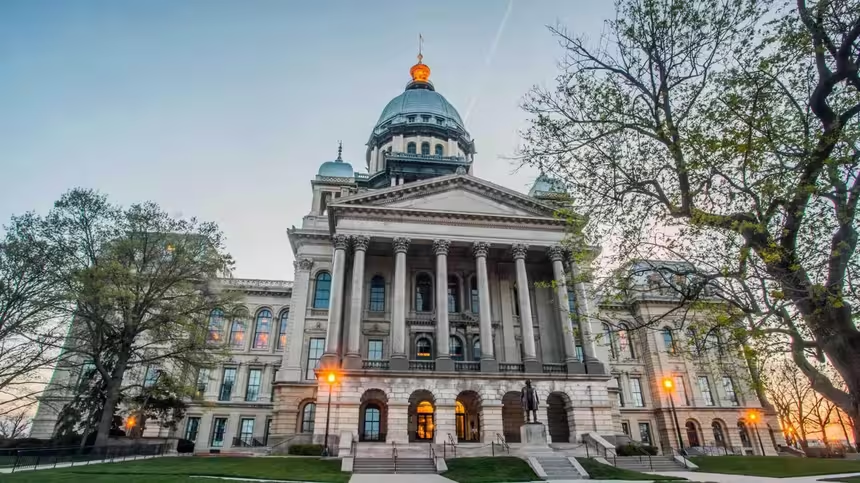
CapitolView
CapitolView is a weekly discussion of politics and government inside the Capitol, and around the state, with the Statehouse press corps. CapitolView is a production of WSIU Public Broadcasting.Providing Support for PBS.org
Learn Moreabout PBS online sponsorship[MUSIC] >> Welcome to capital view on WS See you.
I'm Jeff Williams sitting in this week as we take a look at what's making news around the state in Illinois politics.
Illinois Governor JB Pritzker has opted out of as opted the state out of the Federal Scholarship Tax Credit school voucher program.
And round two of the fall veto session gets underway with some major initiatives still kind of in the works.
We'll take a closer look at those issues and likely some more this week on Capitol View.
To help lead our discussion are Jason Piscia, director of the Public Affairs Reporting Program at the University of Illinois, Springfield, And also a longtime reporter and editor.
And Patrick Pfingsten, the autho of the Illinois Political newsletter and on air host at WMAY radio in Springfield.
Gentlemen, welcome to the program and happy Thanksgiving.
>> Same to you.
>> Happy Thanksgiving to you.
All right.
>> Well, as we as we tape this program on on Wednesday, the governor on Tuesday opted the state of Illinois out of the federal Scholarship tax credit program, a school voucher program.
And there are probably few issues in the state of Illinois that spark more debate than school funding and school voucher programs in Illinois.
So as you might imagine, several groups, both opponents and proponents have, were quick to voice their praise or their concerns.
Just to kind of set the ground base here, my understanding of this, of this program and how it works is that taxpayers can receive up to $1,700 federal tax credit, or $3,400 credit married filing jointly for donating to an approved scholarship granting organization, or SGO, which is a private organization.
The Sgaus can then issue vouchers to help pay private school tuition and public school costs.
The Sgaus also decide who receive a voucher.
The amount where it can be used.
Vouchers are directed at states that opt into the program.
However, any taxpayer can contribute to an NGO and qualify for the federal tax credits even if their state has opted out of the program.
There are also some provisions that I think prohibit states from placing burdensome rules or additional restrictions on the scholarship granting organization vouchers and the rules defined under the under the federal program.
Patrick, we'll start with you.
I know you have some definite opinions on on the governor's decision.
You're smiling from from your perspective, what was his heir in thinking of opting out of the program in this first year for it?
>> Well, I My argument would be, and this is my opinion, this isn't reporting or anything like that.
This, this, this is a this is another move where the governor had a chance to lead a help, a chance to help kids get out of terrible situations in bad and failing public schools and give them an opportunity at a better life, whether it's on the the South Side of Chicago or the South suburbs or or East Saint Louis or or Cairo or wherever it may be.
It gave it gave kids with without the means an opportunity for a better education.
And that isn't necessarily just finding the nearest Catholic school.
There were tutor reimbursement, uh, in, uh, IEP, uh, funding to help with, with special education needs and, and none of this.
Listen, the, the argument that the teachers unions like to make is that this is taking money out of classrooms, out of public schools.
Uh, and this program and I've had a lot of negative things to say about the, the one big, beautiful bill that this was, was lumped into.
This is one of the highlights of it.
One of the few good things that they did in that bill that that it doesn't take.
First of all, the federal government doesn't fund schools specifically.
And two, it allows people to divert their charitable giving to help these kids.
And it makes it a tax incentive for them.
What's the loss there?
Well, the loss is kids in Illinois who are now not going to be able to have that opportunity, kids who aren't going to be able to get out of of Englewood or Harvey or East Saint Louis if they if they wanted to.
And and that's a real shame because we can still write that check to an SGO in another state and get that tax credit.
So so this is money that could be helping kids in Illinois that will not be helping kids in Illinois.
And for a governor that runs around talking about how he's so invested in early childhood development and growth and education, to say, well, too bad if you're stuck in a failing, terrible public school, or even just a public school, that doesn't work for you.
Not all kids learn the same.
You know, and I say this as a kid who grew up in a small, failing rural public high school, that that doesn't exist anymore, that that could have had options somewhere else and more, more educational opportunities.
The reality is here, the governor had a chance to save the Invest in Kids program in Illinois by just speaking up and saying, pass this bill.
He never did.
The speaker let it die at the behest of the teachers unions.
He had a chance here to do what the Democratic governor of New York and the Democratic governor of Colorado did, which was just to simply opt in and give these kids a chance.
The reason isn't because he thinks it's a bad program, and he probably doesn't want to give Trump a win.
Of course, politically.
But this is because JB Pritzker is running for president.
J.B.
Pritzker wants the support of the National Education Association and the teachers unions in South Carolina and Nevada and New Mexico and Michigan and all these early states that he's going to need soldiers on the ground.
And if you do something to make them angry on one of their pet issues, even as as wrong as they may be on it, you're dead in the water.
This is all about political self-preservation.
And that's really sad, in my opinion.
>> Mhm.
Patrick, do you have any any concerns about about how these funds would be issued and implemented?
I know that the teachers union and a couple of others that were proponents of it had suggested that maybe there might be some kids that might be or schools that might be discriminated against in some way because of the lack of structure with these granting organizations, how they find out money.
Any any red flags for you and how this system would work?
>> Not specifically.
And one of the arguments is that that this, you know, helps rich kids use use tax money or, or these dollars to, to get into Catholic schools anyway.
And, and that's just simply not the case.
It's 300% of, of federal poverty level, which, you know, in Springfield was something to the tune of $190,000 a year for a family, which is probably a little higher than I would have picked by by a number.
But it's not like families making $3 million a year are going to be cashing in on, on public dollars.
And, and listen, there is a there's a legitimate argument to places like Texas who are shifting state funding away from public schools to their voucher program.
There's an argument against that.
And I, I, I fully understand that that is just simply not what this program does.
And anyone that tells you different is lying.
>> Yeah.
>> Jason, as Patrick alluded to, the state of Illinois has has experimented with with voucher programs in the past.
You get a feel for if there is a sense, either in Springfield or in the General Assembly, that that this is something that would be that should be tried again in whatever form it may take for the for the state.
Or is this one of those issues that's going to be debated in time in memoriam?
>> Yeah.
I think the fact that, uh, you know, Illinois is a Democratic run state and Democrats rely so heavily on union support, uh, you know, doing anything to make the teachers unions mad as, uh, you know, the third rail of politics or at least one of them.
Uh, so it makes it difficult.
And, you know, it was an interesting dynamic.
Uh, Patrick alluded to the Invest in Kids program that, uh, Governor Pritzker inherited when he first came into office.
If we recall, that was, you know, a rare compromise between Republicans and Democrats.
Uh, back in 2017, Bruce Rauner was governor, Mike Madigan was still the speaker.
Uh, and Democrats wanted, uh, a new revised educator, uh, evidence based funding formula for public schools.
Uh, in order to get that the Democrats compromised and allowed this Invest in kids program, which is similar to this federal program we're talking about today.
Uh, they've, they've approved it for a five year period, a trial period, uh, where people could give money and get a tax credit for giving money to a private school that then in turn, could use that money to, to give a scholarship or some financial support to someone to, to attend that school.
Uh, and again, as Patrick alluded to, uh, Governor Pritzker came into office and, uh, said at the time he was willing to sign a bill to extend that program if one landed on his desk.
Uh, but he really didn't do anything to push for this.
He sort of let it go quietly.
And, you know, as.
>> Profiles in Courage.
>> Yeah, they just sort of let that quietly die and go away and hope we all forgot about it.
Um, and now, you know, we're in a situation to where, again, as Patrick alluded to, you know, Pritzker is reticent to give Trump a win, I think.
And then also reticent to make the teachers unions mad since they, you know, scream out loud anytime, you know, they see one bit of funding being diverted away from from, uh, public school coffers.
>> Yeah.
Yeah.
Uh, Patrick, I think as you referenced, I think what half the states or so opted in this time around.
Uh, my understanding is that states can do so again when the next period opens up again in 2028.
Is there a need or a will to take another look at this program in Illinois to maybe generate some some support for it, or at least maybe have a wider look at it, as opposed to just the governor saying, No.
Is there not?
Is there not?
Is there an opportunity here?
>> I do think there's a second opt in program.
I don't know what what that's going to look like.
I mean, you could see a lot of changes to what was in that that one big beautiful bill statutorily by the the new Democratic Congress in, in in January.
So so certainly there are always opportunities to, to change things, get back into things.
But, you know, this was a chance to help kids now.
And that's, that's the disappointment.
>> All right.
>> Well, we'll continue to watch that certainly.
Uh, fall veto session part two, um, gets underway.
Um, what, what do we expect to see or, or not see?
Obviously, um, bears funding, uh, data center regulations both out there front and center.
I think there's some talk about maybe extending unemployment benefits for striking workers along with, I think maybe some possible supplemental school school funding.
Either one of you, what are you anticipating to, to see and actually happen when this thing winds back up next week.
>> Yeah.
I think, you know, the Bear Stadium I think is front and center at this point.
Um, there seems to be a large sense of urgency surrounding that.
There's been some reporting this week in Crain's Chicago Business about how, uh, maybe the pendulum is starting to swing back toward Arlington Heights.
There's a tax deal being worked out there behind the scenes that may turn into legislation soon.
Uh, but again, I'm, I'm, I'm reluctant to, to believe anything on which way this thing is going until I see a shovel go into the ground.
Or maybe even better, a, a kick off happening at an actual football game or whatever this new stadium turns out to be.
Uh, but I think bears is number one.
And then, uh, data centers as of course, number two.
Um, again, as we were all pining for something to happen at the state House last week.
I think one of the few things that happened, I was planning to have my students be to watch something of substance last week, and there really wasn't much to watch.
But there was a subject matter hearing about data centers where people from both sides were arguing.
And it it seems to me and again, I'm not a complete prognosticator on this, but, uh, that bill doesn't seem ready for prime time just yet.
There's a lot of questions, a lot of holes in the legislation that I think are going to take more than a week to work out.
So I can expect probably there'll be more talk about it, but I don't expect, uh, a bill actually to make it to the finish line this coming week.
But, you know, we still have lame duck session and then all of next spring as well.
So those are the main two things.
And, uh, you know, I also read, you know, the sort of the pipe dream that Chicago Public Schools will squeeze in another $150 million out of the state of Illinois to, to help pick up their budget hole, uh, which, you know, it seems like the governor and others have already thrown cold water on that.
So I don't think that's going to go anywhere.
>> Yeah.
>> Patrick, what are your thoughts?
Are we looking at an active lame duck or special session in early January.
>> It's all eyes on the bears next week and the the evolution of this debate.
And and I mean, it's been chaos right from top to bottom.
The the evolution of this has has been remarkable that that it started with the bears bought the Arlington Park site, the old racetrack in Arlington Heights, and said, we want to build here, but we need property tax certainty, which everybody sort of understood, especially after the.
The outgoing Cook County assessor went and jacked up the, uh, the, the rates and the evaluation on that site because of the perspective of building a stadium and a development there.
And, and it would have cost the bears theoretically 100, 100 or more million dollars a year in property taxes, which is absurd.
Uh, they had this flirtation with a, a lakefront stadium that that Brandon Johnson and Kevin Warren of the bears, uh, stood up and said, hey, we're going to build this stadium and the state's going to do everything for us.
And essentially, at the same time, I was actually with Pritzker.
Don Harmon and Chris Welch that morning at another news conference.
And and they basically said, yeah, we don't know what they're talking about.
We don't we're not we don't have a billion and a half dollars to do this that they're asking for.
So that died a miserable death.
And then we've been in this limbo now for more than two years, working on three years of, of going back and forth on what a stadium bill should look like.
The governor has has stood firm for a long time now, saying there should be no taxpayer dollars used to finance a stadium.
But now we see in this Crain's reporting in in the last week that there's a bond structure being worked out so that Arlington Heights could raise hotel motel taxes, amusement taxes, food taxes, etc.
to help finance a portion of stadium construction, which was never really on the table until like the last couple of weeks.
And we've gone from from what was this pilot bill, this property tax break that that would give them a, you know, instead of $100 million property tax bill, they would negotiate a a $10 million bill with the the Arlington Heights School District.
Right.
That that it would be something more manageable for them.
That's out the door at this point to go to this, this municipal stadium, uh, group or, or, or local authority that could, could own it and, and then would reduce the property tax bill on the stadium site itself to zero.
So instead of potentially tens of millions of dollars more for this stadium site into local schools and, and the forest preserve and the city of Arlington Heights, they're looking at potentially zero on the stadium site itself.
It's it, it's, it's amazing how this has just completely gone full circle.
goal.
I think it's it's it's a zoo trying to get this figured out at the state House.
I don't think it's up yet, but they're seeing this as a deadline because if they wait until January, it looks like the speaker's race is going to take up most of that main week of lame duck session in, in early January.
And, and, uh, as my grandpa used to say, ain't nothing to happen in then.
>> Well, Patrick, since you brought that up, the.
That obviously that will be the prime focus of House.
House Democrats are now, what, seven candidates with a party like that.
And they've got now what, 84 some odd seats.
Okay.
So if you had to handicap this, how does this one sort itself out with all the different factions within the Democratic Party?
>> If I could handicap it, I'd be running.
Carl Scheer Polymarket these days.
Uh, it is, it is the Wild West inside the House Democratic Caucus right now as as there are, are seven pretty varying candidates.
You've got one Latino, one a multiple African American candidates.
Um, you know, one progressive candidate, one downstate moderate ish candidate.
Uh, and it's, it's whoever is able to cobble together the votes that, that they need to, uh, to, to win the speakership inside that really diverse, but also really divided caucus is going to prove themselves to be politically deft here because, because it's, it's going to be really hard.
And, and the problem is the subgroups are even split into subgroups, right?
So, so the Latino caucus isn't voting as a bloc.
The, the women's caucus, which by the way, the women's caucus, with more than 50 votes in the Democratic Women's Caucus, could essentially anoint their own speaker tomorrow.
But they're not voting like a bloc.
The the African American women have split off to two African American candidates.
The Latino women have split off to Latino progressive women, split off to the progressives.
So they haven't come together on a female candidate either.
And you've got progressives and you've got the what used to be called the Mod Squad.
I think they call themselves the New Dems now or whatever that is.
So it is.
It is going to be a mess to try and figure this out before the new General Assembly is sworn in January 13th.
And, uh, if they don't have this figured out, you get 197595 ballot.
Bill Redmond turns out to be speaker after people defect sort of situation.
I mean, it could be it could be a nightmare for Democrats to to if they can't figure this out before the 13th.
>> Yeah.
>> Jason, any thoughts on the, on the topic?
>> Yeah.
As Patrick mentioned, the, the background of these seven candidates, it's all over the place.
Uh, so, uh, And some still didn't even sign on to the letter that most of them didn't sign on to the letter that, uh, that Welch should go in the first place.
So there's that dynamic as well.
Um, you know, I don't know if we can handicap anybody at this point, but, uh, you know, Kam Buckner, um, you know, is sort of taking the lead on the, on the bears stadium talks.
Um, and, you know, puts through a lot of, uh, you know, has a, you know, big resume of, of legislative accomplishments over his time in the House.
Um, you know, we wonder if, uh, if a downstate voice will ever get a chance to be speaker again, given the way the, the, um, the dynamics of the state have changed to where, you know, all the power democratic power is, is centrally located in the Chicago area.
So we wonder if a downstate voice has a chance.
And, you know, we wonder if it is time for a woman, given the reason that Welch is stepping down, or at least, you know, leading up to that decision was, uh, his handling of a sexual harassment case involving a Democratic lawmaker.
Uh, so would a female candidate, you know, sort of, you know, complement that in some way.
So a lot of questions and it's going to be interesting.
I know it's hard for us, you know, who have been watching state government maybe for only 30 or 40 years.
Uh, when we saw, you know, Mike Madigan just ruled the place for, you know, going on 40 some years with a little break in the 90s when, you know, over history, house speakers usually only last two, 4 or 6 years.
Uh, Welch will be at six years by the time he steps down.
So this is kind of more normal that a speaker has a larger turnover rate than once every 40 years.
Uh, and I remember when Madigan stepped down, we all wondered who was going to be the next speaker.
And I don't know if many people had Welch on their radar.
He just sort of emerged one day from, uh, you know, the back room and took it took that role.
Uh, so again, we might be surprised on on who who ascends in this situation.
>> Yeah.
>> We've got about 4.5 minutes left and something I wanted to get both of your your perspective on.
Last week we started a discussion on conversation on Pritzker's viability as a presidential candidate.
And so yes, he's already laid the groundwork.
Yes he's viable.
Yes, he is is likely probably running.
But the other aspect of that, that we were started questioning and I wanted to get your thoughts on is what this presidential run may mean for the upcoming legislative session.
What role do you think the governor is going to take, or might we see an expanded role, potentially for incoming Lieutenant Governor Christian Mitchell?
What what impact, if any, do you think either one of you think that this presidential race may have on the on the upcoming legislative session?
>> I would say that I don't know.
Um, I think that's the I've been talking to a lot of people about that over the last few weeks is what is a, a 2027 general Assembly look like.
And, and Pritzker's people aren't saying anything.
Uh, the, the General Assembly doesn't really have any, you know, any sense from the governor's office how it's going to be.
You know, I, I think we we one need to see what happens to an caprara, uh, Pritzker's chief of staff who, who is a long time national Democratic political hand.
Is she going to step away to go work a national campaign, which, of course, I think we're we're all assuming at this point is going to happen because of course he's running.
Uh, and then does that leave, you know, Andy Minard, the, the deputy governor and former state senator, uh, and Mitchell who, who was a deputy governor, uh, so, and a state representative who certainly knows his way around the hallways.
Are they going to be running things?
I mean, they they don't have the constitutional authority to to run state government.
Who's going to is the governor going to fly back in, in in mid-February and propose a budget and then say, see you in May.
Uh, there are a lot of questions about how it will actually work.
Of course, when Pritzker gets in, but I think we heard that the first debate would be in the spring, I think was the thing I saw from the the DNC last week.
So so my guess is Pritzker is probably in the race sooner than later.
And you're going to have a new speaker, a lot of new faces in the General Assembly.
And and there there's going to be a lot of question.
There are going to be a lot of questions about how do we get all this done, especially when you're looking at a $2.5 billion budget deficit projected for for FY 28.
So so it's it is not an easy question to answer.
And I don't know that that anybody has the answers at this point.
>> Yeah.
Jason.
>> Yeah.
And you know, and beyond the logistics of it, is the governor actually going to be in Illinois during during this upcoming session?
We think about the policy implications as well.
You know, we alluded to it earlier with the federal tax credit where, you know, maybe the decision that Pritzker made was, you know, related to setting himself up to be more of a national figure.
You know, what are what are people around the country going to think about this?
And we have to wonder if that's going to trickle down to, you know, what policies get priority here in Illinois over the next year.
Um, with the way the timing goes.
You know, if you're a presidential candidate, you know, we start hearing presidential candidates starting to declare around the spring, this coming spring before the election, the fall after next.
Um, and that, you know, aligns with kind of aligns with the timing of the governor's budget slash state of the state address.
Um, what will he be saying in that address that may, he want, may want to speak to an audience that's sitting beyond Springfield or beyond Illinois.
Uh, what are the big issues that are national issues, data centers and other things happening around the country that he could take a lead on or make some policy changes to that could make him more appealing or less appealing to a nationwide audience.
So, you know, will he be carrying specifically about Illinois specific issues or or going nationwide and trying to to take in that larger base?
>> Barack Obama's announcement in 2007 was in February.
>> Yeah.
February 10th.
>> Yeah.
>> Well, gentlemen, we are unfortunately out of time for this edition of of Capitol View.
Jason Pesha, Patrick Pinkston, thank you both for joining us and helping out this week.
>> Sure thing.
Happy Thanksgiving.
>> And.
>> And thank you for watching at home.
I'm Jeff Williams.
Have a good week and a happy Thanksgiving.
[MUSIC]
 New Episode
- News and Public Affairs

Top journalists deliver compelling original analysis of the hour's headlines.

- News and Public Affairs

Today's top journalists discuss Washington's current political events and public affairs.

 New Episode


 New Episode






 New Episode
Support for PBS provided by:
CapitolView is a local public television program presented by WSIU
CapitolView is a production of WSIU Public Broadcasting.