
Capitol View | May 7, 2026
5/8/2026 | 26m 46sVideo has Closed Captions
Jeff Williams discusses politics and current events with Hannah Meisel and Brendon Moore
Jeff Williams discusses politics and current events with Hannah Meisel and Brendon Moore
Problems playing video? | Closed Captioning Feedback
Problems playing video? | Closed Captioning Feedback
CapitolView is a local public television program presented by WSIU
CapitolView is a production of WSIU Public Broadcasting.
Capitol View | May 7, 2026
5/8/2026 | 26m 46sVideo has Closed Captions
Jeff Williams discusses politics and current events with Hannah Meisel and Brendon Moore
Problems playing video? | Closed Captioning Feedback
Where to Watch CapitolView
CapitolView is available to stream on pbs.org and the PBS app.
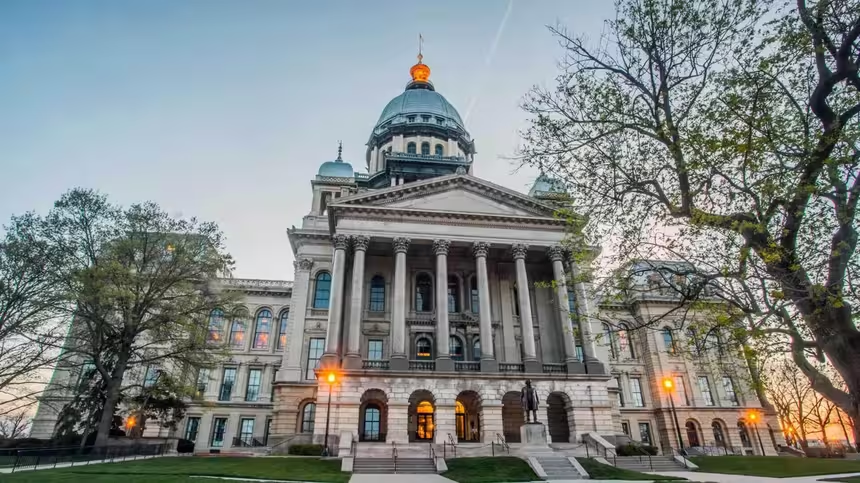
CapitolView
CapitolView is a weekly discussion of politics and government inside the Capitol, and around the state, with the Statehouse press corps. CapitolView is a production of WSIU Public Broadcasting.Providing Support for PBS.org
Learn Moreabout PBS online sponsorship[MUSIC] >> Welcome to capital view on WSIU.
I'm Jeff Williams sitting in this week as we take a look at what's making news around the state in Illinois politics.
Well, there's officially less than a month left in the spring legislative session.
We'll take a look, a closer look at some of the major bills still under consideration and others that may not be, and likely a couple of other topics as well.
This week on Capitol View, to help lead our discussion, our Hannah Meisel Statehouse in Chicago, reporter for Capitol News Illinois, and Brendan More, statehouse reporter, also with Capitol News, Illinois.
Welcome back to the program.
>> Glad to be here.
>> Glad to be here.
>> All right.
Well, the General Assembly's May 31st deadline is rapidly approaching.
There's about 20 or so session days on the schedule over the next four weeks or so.
Um, what do you expect to be the major focus as the as the session plays out.
>> Well, Jeff, every year the budget is always kind of the dominant driver of end of May.
Uh, it's the big thing that they do every year.
So I would expect there to be a lot of discussions over the next few weeks, uh, trying to nail down the details of a budget that will probably end up somewhere around $56 billion or give or take.
Um, the yesterday the Commission on Government Forecasting and Accountability, uh, released, uh, their, uh, the April numbers for income tax and sales tax, some of the other key revenue sources for the budget.
No April surprises this year.
So, uh, no dip or no significant increase.
So kind about what they expected.
So, you know, negotiators now kind of have a baseline from which they can, they can, uh, work, uh, to, to kind of nail down the budget over the next few weeks, uh, a couple of other big items to keep an eye on are the so-called mega Projects bill.
That's also the Chicago Bears bill basically would allow the bears or other large developers to negotiate a payment in lieu of taxes, instead of having to pay annual property taxes and kind of be at the whim of the assessor.
So the House passed a bill a couple of weeks ago.
The Senate is currently, uh, working through, uh, they have that bill over there and they're working through their, there's going to be some amendments.
Um, so we'll wait to see what happens there.
Uh, and then the governor has, uh, his big, uh, building up Illinois developments housing plan that aims to spur home building and try to drive down the cost of housing.
Uh, that, that has really gone up in recent years.
And a lot of that is through, uh, kind of a preemption of, of local zoning to allow more density by.
Right.
Uh, and so, and he's run into some, obviously some significant pushback from, from some local municipalities on that.
So those are some of the bigger issues that that we're kind of following in the four weeks until adjournment.
There's also some artificial intelligence, uh, guardrails that are under debate in both chambers.
So, uh, maybe not the busiest session we've ever had.
It is an election year, but there are still some pretty big issues left to be determined under the dome.
>> Yeah, a couple of things I wanted to quickly maybe unpack right there.
You mentioned the governor's, uh, build housing plan.
The Illinois Municipal League has proposed an alternative to to that plan.
And I know, Brendan, you covered that story this week.
What's kind of up with that?
>> Yeah.
So from the very beginning, the I. ML has been opposed to the governor's, uh, build plan basically because it would take away some power from, from local governments to, to do zoning, which is typically a local function.
Um, and so they would propose more of a a carrot approach instead of the governor's stick approach, which, uh, basically calls for incentivizing, uh, the building up of housing and density would allow for some overlay zones where you can allow, um, you know, accessory dwelling units like granny flats and also more dense housing by.
Right.
Um, and it would give, uh, municipalities, uh, access to, uh, priority access to more funding from the state to do that, to spur housing development.
It would also go after, uh, certain, uh, things like, um, the cost to like, you know, renters, for instance, um, basically would cap, uh, like security deposits can only be, um, the equivalent of one month's rent.
Uh, it would cap, uh, commissions on real estate at 3%.
Uh, there's a lot of stuff in that package.
It's kind of a hodgepodge of proposals.
Um and it should be noted though that a lot of them take aim at, at the real estate industry, uh, which has been the biggest proponent of the governor's build plan.
Uh, and the Illinois realtors, uh, came out voice really voice against the proposal.
Uh, so it'll be interesting to see how that shakes out.
Uh, we, we haven't seen there was a subject matter hearing a few weeks ago on, on the governor's plan, but it hasn't moved out of committee.
They're still negotiating behind closed doors.
Uh, and it's pretty clear, though, that the I. ML, uh, while they don't have the ear of the governor, uh, they do have the ear of a lot of legislators who themselves are former mayors, former, you know, city councilmen and women, uh, and products of local government and, uh, you know, sensitive to some of those concerns that the ML has expressed.
So I would expect there to be, um, some of those, uh, I guess proposals to be incorporated in and whatever comes out.
But, uh, but we haven't even seen it proposed in bill form yet.
So we're, we will likely see that in the coming weeks.
>> Sure, sure.
>> Um, obviously education funding is, is a big part of the state budget.
We talked last week a little bit about the higher ed and K-12 budget.
I haven't seen any real movement, definitive movement there.
So I'm assuming it's still kind of the status quo still in the process of making the suit.
But there was one thing this week that came up that I wanted to ask you, ask you both about, um states.
Republican State Senator Terry Bryant was on the 21st show this week.
They were they were talking about higher education funding.
And one of the things that she brought up was the Equitable University funding bill that she would like to see moved to provide needed funding, especially to the state's so-called directional universities.
I know there's some opposition to that.
Is there is there any possibility of seeing that thing move out of out of committee this this session?
>> No, I would not expect to see that thing move this year.
Um, so this year the governor basically proposed a flat budget for higher education.
Uh, the, uh, the state's, uh, public universities and community colleges.
Um, you know, they, this has been, uh, an area that, uh, um, you know, they've tried to, to increase investment, but it's been difficult, kind of crowded out by other budget priorities.
Um, you know, it, and another big factor here too, is that the University of Illinois is opposed to this, uh, equitable funding plan, uh, because they, they are the most well funded of all the state's universities.
Uh, and, uh, and it's hard to see, uh, a proposal moving forward if they don't at least get U of I to, to neutral.
Um, and it's just a tough budget year.
I mean, any, any institution or any any group that's asking for a funding increase is probably going to be disappointed this year.
And obviously, this would be an over time type of thing, as we've seen with K through 12, which they try to increase by 300 to $350 million every year, the funding for K through 12.
Uh, but, uh, but yeah, for higher ed, it's going to have to wait, uh, for probably a more flush budget.
Uh, when, when, you know, they can actually dedicate the dollars that would be needed to, to, to fund an equitable system.
>> Yeah.
You know, having watched the K through 12, uh, equitable school funding re, uh, legislation go through back in 2017, lawmakers had to wait until the end of the budget impasse that summer for that to actually pass.
So I think Brennan's right that it's hard to do.
Um, you know, when the budget is, uh, you know, extremely stressed at the same time, of course.
Um, the budget stressors are adding to, uh, you know, stressors for K through 12 for higher education.
But, you know, this is, uh, waiting does not, is not neutral.
Um, you know, speaking of the budget impasse, that's when we saw these enrollment numbers start to drastically, drastically fall because higher education was one of the things that suffered most during the budget impasse.
Um, you know, at Eastern Illinois University, for example, in the spring of 2016, campus enrollment was around 7000.
This spring, it is 3600.
That's almost a 50% decrease in the last decade.
And it's the same story for all the directional universities.
And that is really, really hard for the economy because these are the economic hubs, um, of those regions.
Uh, Western Illinois extremely hit hard.
Um, you know, that part of the state has been jokingly, uh, been called, uh, by those residents forgottonia for a long time.
And, you know, we're not doing anything to reverse that trend despite, uh, promises from the Pritzker administration and even when he was campaigning to, uh, you know, restore, revive these rural parts of the state.
And, um, you know, I think that Brendan's right.
We're not going to see anything this year, but, uh, waiting adds extra pressure.
And when you have that, you know, brain drain, it is really, really, really hard to reverse.
>> Yeah, yeah.
>> Um, there are a couple of also this session, there were a couple of constitutional amendments that were making some progress.
One was the so-called millionaire's tax.
It, it did not get out of the house.
The other would have amended the legislative redistricting guidelines.
That one did pass out of the House, but for all practical purposes is now on hold in the Senate.
I think it also maybe missed its deadline as well for getting on the November ballot.
Um, Speaker Welch and Cook County Democratic Party are pushing the Senate to still act as well as they've issued, I think, a condemnation of the U.S.
Supreme Court for its decision last week regarding the Voting Rights Act.
Uh, is there likely to be any movement in the Senate on this session?
On on on that on the proposed amendment, on the on the districting legislative districts?
>> I mean, now that there's not a deadline that they're up against, as you mentioned, we've missed the deadline.
It would have been Sunday for, um, lawmakers to get anything on the ballot, uh, for voters to, um, you know, approve on the, you know, a constitutional amendment, um, for those things.
Maybe, uh, there could be some sort of symbolic hearings in the Senate, but it's going to be very difficult because Senate President Don Harmon all but said, you know, we're not acting on this.
And he gave kind of a standard, um, rationale that we want to do this right if we're going to do it at all.
Um, what, uh, one of the things that would have been in that constitutional amendment was taking part of the voting rights, the federal Voting Rights Act that's now been all but neutered by the Supreme Court in three different, um, decisions since 2013, uh, and insert it into Illinois's constitution.
Um, this is, of course, against the backdrop of, um, pressure from President Trump on Republicans all over the country, um, in, uh, red states to change, you know, for the first time ever, basically, uh, change their districts, um, in between US census, um, you know, the ten years between US census, of course, the last time Illinois did redistricting was in 2021.
We're now halfway through that ten year cycle.
Um, the earliest that this could really be taken up, um, to do anything meaningful is 2028.
Then of course, we'll have another census in 2030.
Um, so I don't know.
I'd be interested to hear if Brendan's hearing anything different.
>> Yeah.
Just to piggyback off you, Hannah.
Uh, you know, in the Senate president and, and folks that were looking at this language that passed over to the House, uh, we're really concerned because it, they're kind of caught off guard by this, but not by the Supreme Court ruling, per se, but, but kind of by the reasoning of it and how, you know, basically the language in the amendment kind of, uh, was pretty much identical to what was in the Federal Voting Rights Act.
And that if that was struck down, then this constitutional amendment, if they put it on the ballot, could have easily been struck down as well.
And, uh, you know, we're basically hearing nothing this year.
Uh, but, you know, in 2028, uh, there may be a push for Illinois to reopen its maps because, uh, as Hannah said, um, I mean, there's been this kind of this mid cycle redistricting battle, uh, where it started in Texas, uh, red states trying to, uh, to shore up their maps to help, uh, the party keep the house.
Uh, and Democrats responded in kind in California, in Virginia, uh, and other places.
Illinois didn't do that this year.
It was kind of late in the cycle to do it.
Uh, and there wasn't a lot of political will under the dome, but I think there's gonna be a lot of pressure from Springfield Democrats to act from Governor Pritzker to act.
Uh, especially if you see a lot of these southern states start to redraw their maps to, to basically draw out these, uh, these minority majority districts.
And Illinois already has 143 map.
Uh, they, they, you know, it's kind of a sport to do gerrymandering in Illinois.
Uh, they, they drew a very good map for their party.
Uh, they could probably do a 152, maybe even a 161.
Uh, if they get really creative with their cartography skills.
And, uh, again, it should be noted that the Supreme Court said that, uh, you can't draw maps based on race, but you can draw reaffirm that you can draw maps based on partisan advantage.
And Illinois Democrats have been very good at that over the years of drawing maps that advantage their party.
And so I don't know about a constitutional amendment, just based on what the Supreme Court said.
Um, it's one of those things.
And, you know, the Tribune had a story this week about, um, how Illinois is not going to do an amendment about abortion rights, even though the governor's talked about that as well.
Um, these are all things that are not really necessarily on the front burner in the sense that Illinois is a heavily Democratic state Democratic governor supermajorities in the legislature, uh, that that, you know, there's really not much of a danger of, of, uh, the, you know, of, of minorities, uh, not being represented in the capital just based on, uh, who controls, you know, state government now.
Uh, and same thing with abortion rights or even like they did the labor amendment last time.
You know, Labor's entrenched here.
So some of these things are are, you know, it may come into question of, you know, do we need this right now, especially given that Illinois kind of, you know, Democrats are kind of entrenched here already.
Uh, but it'll be interesting to see if they try to do it on the ballot or a version of it in 2028.
But I do think there will be a push at least to look at the maps ahead of the new the next redraw, which would be in 20 after the 2030 census.
>> All right.
>> And we'll continue to watch the legislative session unfold.
I do want to take some time to to update a story that's been in and out of the news for several months, and that's the Department of Justice's attempt to gain unredacted.
And all the voter registration information from the State of Illinois.
The state has so far refused to to comply with that.
And I think now some new documents filed in the case indicates that there may be an ulterior motive for the for the Department of Justice's request.
I know you've been kind of following that to some degree.
What what is the latest on that?
>> Right.
The Department of Justice last year had requested this data from not just Illinois, but many, many states.
Um, and I think, uh, the ulterior motive that you referenced was, you know, suspected from the very start, uh, on, you know, the behalf of Democrats who said, you know, uh, we know that the Trump administration is just trying to, um, one take over, uh, voting, which has been explicitly stated, uh, you know, states have always been in charge of their own voting procedures, But there has been this push by Trump to have like a federal takeover of voting.
And number two, of course, this wide suspicion that there are undocumented immigrants on state voter rolls, which is, you know, proven again and again to not be true.
Be very, very rare, be very isolated.
And when it has happened, a result of most of the time, um, administrative error, not anything nefarious.
Regardless, uh, the DOJ has been in pursuit of this data.
Illinois and many other states have, uh, you know, have said, no, we will not give you this unredacted data.
We'll give you, you know, this partial data.
The DOJ in December sued Illinois for not giving it the data.
And as you mentioned, documents, uh, came out in the case last week that, um, let me just read from my colleague Peter Hancocks, uh, Story.
Um, in, uh, one of the documents filed in this case, uh, from an email from the acting chief of the Civil Rights Division of the DOJ.
Um, the voting section rather, uh, quote appears to suggest how the agency should conceal its intentions when they asked why, when asked why it's seeking states, voter registration databases, quote, I believe our reply should always be we will use the data in a manner consistent with federal law and say nothing more.
He also, um.
And none of these federal laws require us to give the states information about why we are going, what we are going to do with the data.
No judge will have authority to limit us beyond a promise of federal law compliance.
Um, the judge in this case, of course, has not ruled, um, on this matter yet.
But I will point out that in other jurisdictions, judges have, uh, you know, dismiss the DOJ's similar cases.
And no judge so far has ruled in the DOJ's favor.
>> Hannah, I also know that, um, last week we learned that the Department of Justice is investigating more than 30 school districts in Illinois related to title nine and gender ideology that schools may be using.
Um, what is the issue with these particular districts?
I looked at the map and the ones in southern Illinois, it seems kind of random, the school districts that they're picking up.
But what's what's the underlying issue here?
>> Well, we don't know actually, um, you know, these 35 school districts plus, uh, Chicago's largest charter school network, um, they're, uh, as you mentioned, I made a interactive map to show just how spread out and random.
It seems these school districts are.
The school districts themselves don't know why they're being targeted for investigation, um, under the auspices of teaching gender ideology, possibly in, you know, the DOJ is interested in whether these districts have opt out policies for parents.
In addition to that, um, it's seeking information about whether, um, trans students are allowed to participate in competitive sports and, you know, having access to single sex bathrooms and locker rooms.
Uh, this kind of stems from the president's, uh, you know, what his, uh, his first weeks back in office last year, um, one of his first executive orders was this, um, keeping men out of, uh, women's sports.
I think that was the official title of the EO.
Um, and, you know, there this has been obviously, um, one of those issues that have broken through to people who might not be that politically inclined.
But if you have a student in, you know, public school or, uh, you know, in competitive sports, this might pique a lot of parents interests.
And, um, you know, the DOJ has not just targeted Illinois in this calendar year.
They've targeted dozens of districts in other states like Michigan, Oregon, California.
Um, the list goes on.
But, um, you know, a lot of the times the school districts don't know why, uh, they've been targeted.
Uh, I will note that in 2019, the governor signed legislation into law that requires, you know, the teaching of, uh, prominent LGBT, uh, folks in history.
Um, you know, this is the same sort of legislation that's also, uh, become quite popular in Illinois in the last decade.
We have similar, uh, you know, laws for, um, I believe, uh, black historical figures, uh, Asian historical figures, Hispanic historical figures.
Um, but the DOJ's, uh, you know, letter did not indicate that's the reason why.
Um, because you know, these again, we in Illinois, we have something like 800 public school districts.
It's one of the most in the country.
Um, in these 35, especially these really tiny rural school districts.
Uh, it's very random.
As I said, um, one, uh, superintendent from, I believe northwest Illinois did have a theory that these districts seem to be consistent with another list of, um, uh, districts that have participated in, uh, a DOJ grant funding program on school safety, things like, you know, metal detectors.
But that's not a solid theory.
And the DOJ has not said why they're targeting these districts.
Um, I have asked and not heard back.
>> All right.
>> In the couple of minutes or so that we have left, what what are each of you going to be watching on your what's on what's in your crystal ball on your radar in the weeks ahead here?
>> Well, most immediately, the mega-projects bill, the bears bill.
Uh, like I said earlier, the House passed a version a couple weeks ago, but it was, uh, by most observers and then quickly confirmed by the bears and by the governor's office and others involved that, uh, it wasn't soup, that it needed work.
Uh, that, uh, this property tax provision that was included in the bill that would basically siphon off 50% of this payment in lieu of taxes to property tax relief, uh, might not be workable for the bears or other developers because it would just heighten the ask from, from local taxing districts.
And at the same time, a report came out this week from the governor's office that showed that if you have, say, like, for instance, a $20 million pilot payment from a large developer, that would equal about maybe a dollar and 29, uh, per taxpayer in terms of a rebate.
So, so the rebate really wouldn't add up to much.
So in the Senate, I think they're really working to try to find a way to give meaningful property tax relief to, to residential property taxpayers, in addition to making this a tool that, uh, the bears and other developers, uh, want to use and something that works for them so they can get shovels in the ground in Arlington Heights this summer.
So that is something that I'll definitely be looking for the next couple of weeks.
>> Hanna.
>> You know, I'm continuing to, uh, follow the legal fallout from this fall's Operation Midway Blitz.
There are two main things I would like to note.
In the case of the so-called Broadview six, the protesters who were, uh, politically active, including former congressional candidate Kat Abu Ghazala.
Um, the feds last week said they were going to drop the conspiracy charge against them, but that would block defense attorneys ability from seeing the grand jury transcripts, which they are very, very interested in seeing.
Um, because they want to know what was said to the grand jury that would make them indict these six.
And then the other one is the fight, uh, to, um, you know, force the Cook County, um, judge to appoint a special prosecutor to investigate and possibly charge federal agents who are accused of wrongdoing, of abuse of power during Operation Blitz.
>> All right.
>> Hannah, I'll let you have the last word.
Hannah Meisel.
Brandon Moore, both with Capitol News Illinois.
Thank you both for joining us this week.
>> Thank you.
>> And thank you for tuning in to Capitol View.
I'm Jeff Williams.
Have a good week.
[MUSIC] [MUSIC]
 New Episode
- News and Public Affairs

Top journalists deliver compelling original analysis of the hour's headlines.

- News and Public Affairs

FRONTLINE is investigative journalism that questions, explains and changes our world.

 New Episode
 New Episode
 New Episode
 New Episode
 New Episode
 New Episode
 New Episode

 New Episode
 New Episode
Support for PBS provided by:
CapitolView is a local public television program presented by WSIU
CapitolView is a production of WSIU Public Broadcasting.