
Capitol View | July 30, 2026
7/29/2026 | 26m 46sVideo has Closed Captions
Jeff Williams discusses Illinois politics with Peter Hancock and Brenden Moore
Jeff Williams discusses Illinois politics and current events with Peter Hancock and Brenden Moore
Problems playing video? | Closed Captioning Feedback
Problems playing video? | Closed Captioning Feedback
CapitolView is a local public television program presented by WSIU
CapitolView is a production of WSIU Public Broadcasting.
Capitol View | July 30, 2026
7/29/2026 | 26m 46sVideo has Closed Captions
Jeff Williams discusses Illinois politics and current events with Peter Hancock and Brenden Moore
Problems playing video? | Closed Captioning Feedback
Where to Watch CapitolView
CapitolView is available to stream on pbs.org and the PBS app.
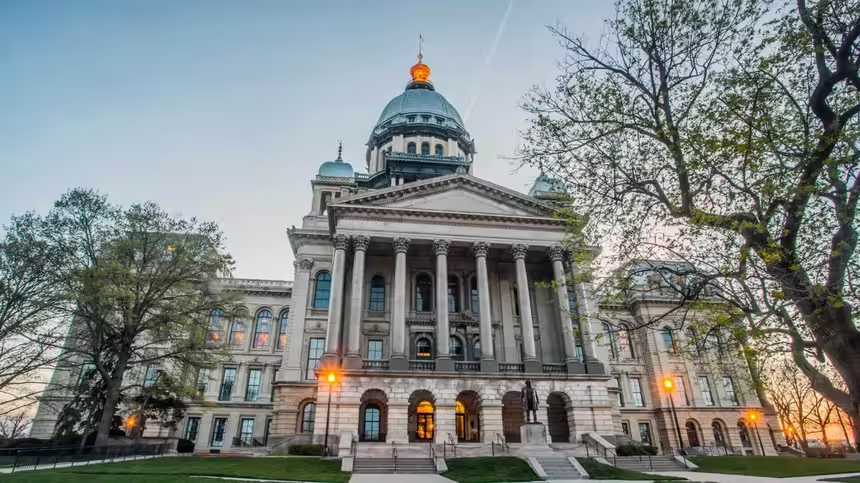
CapitolView
CapitolView is a weekly discussion of politics and government inside the Capitol, and around the state, with the Statehouse press corps. CapitolView is a production of WSIU Public Broadcasting.Providing Support for PBS.org
Learn Moreabout PBS online sponsorship[MUSIC] >> Welcome to Capitolview on.
WSIU.
I'm Jeff Williams sitting in this week as we take a look at what's making news around the state in Illinois politics.
This week, governor JB Pritzker signed the state's bell to bell cell phone ban for Illinois schools, along with several other new laws.
We'll we'll take a closer look at those and likely some more things this week on Capitol View.
To help lead our discussion are Peter Hancock, statehouse reporter for Capitol News Illinois, and Brenden Moore, also statehouse reporter for Capitol News, Illinois.
Gentlemen, welcome back to the program.
Thanks.
>> Great to be with you.
>> Brenden.
Thank you for pinch hitting and sitting in for your colleague this week.
We appreciate that.
Um, on Tuesday, as we tape this on Wednesday, on Tuesday, the governor signed into law new restrictions on cell phone use in the state's public schools.
The so-called bell to bell ban is aimed at reducing distractions in the classroom.
Peter, you've been following the story.
What?
What exactly?
Now that this new law is in place, what exactly does that mean?
What's what's going to be happening now as a result?
>> Well, uh, a lot of people won't notice any change because districts around the state and around the country have been doing this on their own anyway.
Uh, but what the legislation does is establish a statewide minimum policy, uh, of restricting not just cell phones, but also all kinds of wireless communications devices that have become ubiquitous in American culture.
And it's really kind of a case of technology moving faster than the rest of society was able to cope with it.
Uh, these cell phones just became a ubiquitous part of life.
Before we really understood what sort of impact they would have, uh, things like, you know, classroom education.
And so what, what the bill does is it requires every school district in the state to adopt a policy before the start of the 2020 728 school year.
So they have one year to get ready if they haven't done this already.
It basically, uh, bans cell phones entirely, uh, at, you know, the elementary level, uh, at high school, uh, they give a little bit more leeway.
And that was actually kind of a point of contention during debate about the bill.
Some people said, you know, cell phones, uh, should be banned in high school, just like they, they would be in grade school and middle school.
Uh, but for high school, they're giving a little bit of leeway for students to use them during their lunch period or when they're passing between, you know, passing in the hallway between classes, uh, they're allowed to use them.
Uh, the supporters of that said, you know, some high school students are taking dual credit classes, maybe at a junior community college.
Some of them have jobs after school, and some high school students are caretakers for, uh, sick people, family members back home.
Uh, so high school kids are given a little bit more leeway.
Uh, but otherwise, there will be a bell to bell that is, you know, during classroom, uh, during class time hours, uh, from the morning bell to the afternoon bell, uh, to just leave your cell phones, uh, either locked up, uh, in the office or leave them at home.
Uh, but they're just not allowed to have them, uh, in class.
>> Yeah.
And Peter, does this go into effect this school year or is this next school year that this.
>> It's next school year is when the statewide policy will go into effect.
But, you know, like I said, they've already many districts have already done this.
Uh, they did the bill signing at Elgin High School up in the Chicago suburbs, and the superintendent of U46 School District there said, you know, they adopted their policy a year ago, and they've almost immediately noticed the effect that students are paying more attention during class.
Uh, just all kinds of problems that they were having, uh, with this distraction.
And the main thing is teachers no longer feel like they have to compete with, you know, Facebook or Instagram or all kinds of social media or texting messages going on in class.
They no longer have to compete with that to get kids to focus on the things they're supposed to be focused on, which is, you know, studying, uh, their math lessons or English lessons or history or science or whatever.
>> Yeah.
I know down here at this end of the state, we get to see the political campaigns from, from Missouri and from, from Tennessee.
And I've noticed the ones, especially in Tennessee, a lot of the folks running for for their state legislature there are are touting the same kind of thing.
A bell to bell ban on on cell phone usage.
Is Illinois law fairly fairly common or are they have they moved ahead a little bit more a little more proactive in terms of, of, of what the state's done?
>> Illinois is not the first state to do this by any means.
I mean, a lot of other states have done this.
And in fact, you know, the state didn't act until after a lot of Illinois school districts had acted on their own.
Uh, so this is becoming very common throughout the United States.
And I think eventually, uh, you know, it's going to be common everywhere.
Uh, but as I was thinking about this, basically, it means, you know, students are going to be given the same instructions that passengers on an airline are given.
You know, it's time to turn off your cell phones and other electronic devices and don't turn them back on again until the captain tells you it's okay.
>> Yeah, yeah.
Well, um, as is usual for for this this time of year, the governor signed dozens of, of, of new laws last week ranging from consumer protections to provisions for early high school credit and just about everything in between, including one that establishes Emmett Till day in, in Illinois.
Um, Brenden, I know you and Peter both have been been keeping tabs on some of these most recent signings, uh, with Emmett Till that bill now, um, will honor and preserve his life, uh, and place in, in, in state history a little bit, a little bit of background on, on, on that one.
>> Yeah.
So Governor Pritzker signed that bill last week.
Uh, he signed it ahead of what would have been Emmett Till's 85th birthday.
Uh, obviously, he was the 14 year old boy from Chicago who was kidnapped, beaten, and really lynched by, by two white people in Mississippi, uh, back in 1955.
Um, And he had his mom had a open casket funeral for him to show the world what they had done to him.
And it really was kind of viewed as a catalyzing moment in the civil rights movement.
Uh, and so, uh, again, he was from Chicago.
Uh, and there have been other things that have been done to honor his memory and memorialize, uh, the significance of, of, of his death for the civil rights movement.
Uh, obviously, uh, the, um, church where that funeral was, was, had is now part of a national landmark.
Uh, but this now, uh, with Governor Pritzker signature, uh, makes Emmett Till day, uh, every year on on July 25th.
>> All right.
Um, any other other bills in this latest batch that might be of interest or note?
>> Yeah, there there were a lot of I mean, I wouldn't say there are odds and ends, but, uh, there were there were a lot of bills.
There were 78 total in this latest batch, uh, that, you know, most of them probably didn't warrant a bill signing ceremony.
The Emmett Till bill did get one, but, um, there was an interesting one involving voters insurance.
Uh, so basically, uh, owners of boats with at least 50 horsepower engine or at least 21ft long, uh, have to obtain liability insurance or else they're going to face fines.
Um, another one involves, uh, the custody of pets.
Uh, so right now, or, you know, before this law was signed, uh, if you were, uh, married, obviously you would sort out the custody of a pet in your divorce case, but there are a lot of, uh, non-married, uh, cohabitants.
Whether you're, you know, just a roommate or, uh, you have a partner, but you're not married, uh, where they really didn't have a process.
If you broke up and you know, what do you do with the pet?
Who gets the pet?
Uh, so now there is a process for, for how those couples or roommates can, can, can sort that out.
Um, there were a few other, uh, interesting ones.
Uh, one involves service windows.
So, um, you know, we've all been frustrated having maybe like a four hour window, uh, to have, you know, a plumber come out or the cable guy come out.
Uh, well, now there's a bill, uh, a law that says that, you know, if you give it more than a two hour window, uh, you have to provide at least one hour notice via a phone call, uh, before your arrival for that service appointment.
Uh, and if you don't provide that notice, uh, and you show up and the person is not there, then you can't charge any type of fee for a missed appointment.
Um, so again, just trying to help people, uh, maybe, uh, you know, spend their time a little bit better.
Um, and then there was a whole, a whole bunch of bills that involved, uh, uh, schools and teachers and, and I'm sure Peter can go into that a little bit more.
>> Yeah.
Uh, there was, there was kind of an interesting bill, uh, about teacher evaluations and how school districts, uh, review teachers, uh, at the end of their contract to figure out, you know, if they want to be renewed or whatever.
Um, and it has to do with the use of student growth data.
And this has been kind of a controversy ever since I say go, going back to the 1980s when we started using standardized test scores, uh, as a way of evaluating teachers and evaluating schools and holding schools accountable, was the extent to which student test scores and their improvement on test scores would be used to evaluate teachers.
I think the fear has always been that districts or principals could always pack all of the problem kids into one teacher's classroom.
Uh, if that was the teacher they wanted to get rid of or to, you know, make life difficult for, for any reason.
Uh, so anyway, a few years ago, there was a change in the law.
It said instead of she shall use, uh, student growth data, it became a may use student growth data.
And it was subject to negotiation between the district and the teacher's unions.
Uh, and now the latest law is as it's sTill subject to negotiation.
But if the two sides can't agree on a mechanism for using it, then the default position is you just won't use student growth data at all in teacher evaluations.
>> All right.
All right.
I want to check back in on on what's been going on or an attempt by, I guess I should say, the Department of Justice to gain sensitive Illinois voter data to, I guess, in their sense, prevent noncitizen voting in elections.
Earlier this month, the DOJ, I think, even threatened criminal prosecution against election officials not only in Illinois, but apparently in all 50 states and the District of Columbia.
I know, Peter, you've been been kind of following this this ongoing story.
What's the latest with this one?
>> Okay, well, to back up a little bit, the Department of Justice is suing, uh, multiple states, I think about 30 states in the District of Columbia, uh, for access to their complete unredacted voter registration databases.
And that includes things like Social Security numbers, driver's license numbers, dates of birth, uh, very sensitive information.
Uh, that one expert that I've quoted refers to as the Holy Trinity of identity theft, and so far they are.
The Justice Department is zero for 18 in its attempts to gain this data.
Illinois is fighting it to.
The Illinois case is sTill pending.
Uh, but while these cases are pending, uh, the Justice Department sent out letters to chief election officials in all 50 states, reminding them of federal criminal statutes, uh, that are on the books and basically threatening, say, you know, if, you know, if noncitizens are found to be on your voter rolls or if noncitizens, uh, are found to have voted, uh, you, the election officials can be held criminally liable for this.
And then, uh, they demanded to know, uh, what steps are you taking to make sure that non-citizens are not getting on the rolls and that they're not voting?
And what steps are you taking, uh, to, uh, maintain your voter registration list to regularly scrub them of dead voters or voters who've moved or voters who are non-citizens?
Uh, just this week, Illinois actually responded to that letter.
It was kind of interesting.
It was a very, uh, lengthy response.
But they started off by saying, you know, we noticed that you did not provide any evidence whatsoever to suggest that, uh, illegal voting is a problem in Illinois, that it has occurred or that any Illinois officials are failing to meet their obligations.
Uh, but then it did go on to explain that in Illinois, we have a decentralized system, uh, that the voter registration rolls are maintained by 108 local election authorities.
That's in the counties plus, um, about 5 or 6, uh, individual cities have their own local voting boards.
Uh, all the state does is kind of main, uh, it receives that information from the locals and kind of gives them administrative help in processing it.
Uh, but the interesting thing was that I think a lot of people don't realize this is that when you register to vote, uh, under federal law and there's federal standards for voter registration cards, it asks you to attest, under penalty of perjury, that you are a United States citizen, that you are over the age of 18, that you're qualified to vote and you sign that.
That's how we check.
Citizenship is just personal attestation.
And by and large, it works pretty well.
Uh, people who are not U.S.
citizens do not try to sign up to vote.
Uh, they don't actually vote.
It's an extremely rare occurrence.
That's not to say it would be wrong to say that it never happens.
It does, in fact, happen on occasion.
Uh, and in fact, last week there was, uh, something happened in the state of new Jersey, where they have virtually automatic voter registration, just like Illinois does when you go in to get your driver's license.
Some a computer glitch, a software glitch, something happened that allowed about 6600 people who had checked the box.
I am not a citizen, were nonetheless forwarded over and registered to vote.
Uh, and it appears that maybe fewer than 400 of them actually did cast a ballot in some sort of an election.
Uh, the governor of new Jersey immediately made a statement, said, we've fixed the problem.
It's not going to happen again.
Oh, and by the way, it occurred under a previous administration.
Uh, but yeah, a similar thing happened in Illinois back in, I think 2019.
Uh, on a much smaller scale.
It was only a few hundred people, uh, had gotten registered and about a dozen of them, uh, actually had cast ballots.
Uh, but it does kind of show you that, you know, it's we don't have a perfect system, but it works pretty darn well.
Uh, and the incidence of non-citizens voting or illegal voting is extremely rare.
Not to say that it doesn't ever occur, but it is extremely rare.
And so that's kind of the latest.
Meanwhile, we're sTill waiting for a federal judge in Springfield to decide whether or not Illinois will hand over its voter registration list.
Uh, but so far, you know, 18 other federal judges have said, no, that's not the way this works.
>> Um, also wanted to check back in with, uh, developments surrounding the resignation of, of State Representative Harry Benton earlier this month.
Um, last week, the, the ethics committee in the state House voted to release the legislative inspector general's report regarding former Representative Benton.
I know the report has not been has not been made public released yet.
Do we?
Do you know what the timeline is on?
On getting that out to where the public may actually get to see what some of these allegations contained to that report might be.
>> Yeah.
So the the Legislative Ethics Commission voted to release the report.
Now they have to, uh, basically give Benton, uh, the complainant and, uh, legislative Inspector General Mike McCuskey time to review the report and request, uh, any redactions.
Uh, and they said that they expect that process to take no longer than, uh, by July 31st, which is this Friday.
Um, you know, we're taping this on a Wednesday morning.
It's very possible by the time this airs that the report is out there.
Uh, whether it is released by the Ethics Commission or whether maybe it leaks ahead of time, um, we've seen a little bit of that stuff getting out into the news media ahead of time.
Um, so that will probably happen this week, uh, may happen on Friday, but obviously it could drag out into the weekend too.
Um, but I think there are some real questions though, as to whether there will be, uh, how illuminating this report will be.
Because a lot of what was detailed in the Chicago Tribune report from a few weeks ago, uh, was about an incident that happened a few years ago that is technically out of the purview of the legislative inspector general.
Uh, so, uh, it may not be as illuminating as perhaps some of the reporting has been on this, uh, both about Benton's behavior, but also about how House Speaker Chris Welch has has handled this situation.
>> Yeah, I was going to ask, I know last week he met with, uh, several members of his caucus.
Some would say to do to do to do damage control.
Has there been has there been any more fallout or developments since his meetings with, uh, with, with the, with his party?
>> Well, the most recent, uh, I guess piece of fallout would be.
And maybe this isn't the most surprising, but, uh, state Representative Fred Crespo, uh, wrote an op ed in the Chicago Tribune published Wednesday morning, basically, uh, calling for the speaker to resign.
Uh, as I think we've talked about in this show, uh, Representative Crespo is a Democrat, but he was booted from the House Democratic Caucus, uh, last year, uh, for working on a, on a budget proposal that was alternative to, uh, leadership.
Uh, so him and the speaker have kind of been on the outs with one another for a while.
So, so he may not be the most indicative of, of the mood of House Democrats, but, uh, there, there certainly have been House Democrats frustrated with the speaker.
Um, and, uh, as of this recording, there hasn't been a whole lot of new reporting about what the speaker knew or didn't know how he handled this situation, uh, others coming out against him, but it seems pretty clear that, uh, um, him and his team are, are, are bracing for impact, uh, of this report coming out.
Uh, and also if any other news stories come out about perhaps other, uh, uh, other instances of sexual harassment that maybe weren't dealt with in a proper way by the speaker's office.
>> Yeah.
In addition to all that, a special investigative committee was formed or has been formed or is forming to look into.
State Representative Carol Ammons, the Urbana Democrat, and her husband obviously are the focus of a federal indictment.
They both have have pleaded not guilty.
And Representative Ammons maintains that she's done nothing wrong.
Um, has that special investigative committee spooled up?
Have they met?
Has anything transpired there yet?
>> Do you want me to take that one?
>> Go for it, Peter.
>> Okay.
Uh, yes.
The committee has been formed.
It's a six member committee, three Republicans, three Democrats.
Uh, their first meeting is scheduled for next week on August the 6th.
Uh.
Meanwhile, uh, as you mentioned, uh, Representative Ammons is under federal indictment for, uh, what might be described as some kind of low level, uh, corruption charges, uh, converting campaign funds for personal use and, uh, steering public contracts toward non-profit organizations that employed, uh, her daughter.
Uh, but nonetheless, I mean, the government is charging, you know, some serious felonies, uh, with regard to that.
So we have these two processes, uh, moving independently.
One is the judicial process.
Uh, there's a pretrial hearing set for later this month, I think October, August 24th.
Uh, and then, uh, trial is tentatively set for September 22nd, uh, for both she and her husband.
But, uh, we think that that's very tentative and is most likely it's going to be pushed back at some point.
But meanwhile, uh, on this other track, we have the, uh, house disciplinary process moving this special committee that you mentioned, uh, that has its first meeting next week.
And it'll be kind of interesting to see whether or not the committee decides to sit back and wait for the judicial process to play out first, or will they move independently?
Uh, there are arguments on both sides when argument is that, uh, the House is the final arbiter of its own membership, and it has standards for who can and cannot sit in the house independent of the criminal proceedings.
Uh, so they could move independently.
But that's also kind of dangerous because, you know, uh, the, the image of a legislative committee acting to overturn the will of the voters in, uh, Representative Ammons district.
Uh, would not be favorable.
Uh, she does have supporters.
Uh, I was at her initial hearing, uh, a week or so ago.
Uh, those supporters showed up for her hearing.
Uh, so, you know, she, uh, it remains popular within her district, at least, you know, among some people.
Uh, and she is sTill on the ballot, uh, unopposed in this election.
So, uh, it'll be interesting to see whether or not, uh, the committee decides to act independently or if it'll sit back and just wait for the judicial process to play out.
>> All right, in the minute and a half or so that we've got left, what's, uh, what's on both of your radars?
What are you going to be keeping an eye on in the, in the, in the weeks ahead?
>> Well, I.
>> Oh, go ahead Peter.
>> Uh, I am waiting for the state Board of Education to release the, uh, next round of, uh, distribution of evidence based funding.
Funds to the various districts.
Uh, we've been on a trend here.
We have over 300 districts now, are at or above 90% of adequacy funding.
That number has actually been slipping a little bit the last few years.
Uh, there's some indication that maybe the additional money we're putting in each year is not quite enough to keep up with the rising cost of education.
Uh, so that'll be coming out.
Uh, and we'll see.
You know, what districts, uh, are improving in their adequacy funding or whether, you know, how much progress we're making.
>> Brenden.
>> Yeah, just very quickly, I mean, selfishly, I'm looking forward to the Illinois State Fair.
It kicks off in a few weeks here in Springfield.
Uh, it's my favorite part of summer here.
Um, and there's always a pretty heavy dose of politics there.
Uh, we have that.
Democrats and Republicans both have their political days, and candidates are out at the fair.
Um, you know, we kind of see some start to see some more retail politicking going on.
Uh, because believe it or not, we have an election coming up in, uh, what, three, three and a half months and, uh, but hasn't really felt like it, uh, a whole lot, uh, here in Illinois at least.
So hopefully we, we get to see a little bit more of that activity, uh, start to heat up.
>> All right.
And I will say on behalf of my colleague Brian Sapp, we're going to continue down here to watch the development regarding the mental health center in Anna, their state's announcement, they're laying off about half of the of the workforce and moving several of their beds to upstate facility and taking a look at the impact that's have on the on the local community as well as mental health services available.
And we'll continue to, to follow that.
So we're out of time for, uh, Peter Hancock and Brenden Moore.
I'm Jeff Williams, thank you for joining us for this edition of Capital View.
Have a good week.
[MUSIC]
 New Episode
- News and Public Affairs

Top journalists deliver compelling original analysis of the hour's headlines.

- News and Public Affairs

FRONTLINE is investigative journalism that questions, explains and changes our world.
 New Episode
 New Episode
 New Episode
 New Episode
 New Episode
 New Episode
 New Episode


 New Episode
Support for PBS provided by:
CapitolView is a local public television program presented by WSIU
CapitolView is a production of WSIU Public Broadcasting.