
Capitol View | February 19, 2026
2/20/2026 | 26m 46sVideo has Closed Captions
Brian Sapp host this week’s top stories with analysis from Peter Hancock and Jeremy Garner.
Brian Sapp host this week’s top stories with analysis from Peter Hancock of Capitol News Illinois and Jeremy Garner from the Chicago Tribune.
Problems playing video? | Closed Captioning Feedback
Problems playing video? | Closed Captioning Feedback
CapitolView is a local public television program presented by WSIU
CapitolView is a production of WSIU Public Broadcasting.
Capitol View | February 19, 2026
2/20/2026 | 26m 46sVideo has Closed Captions
Brian Sapp host this week’s top stories with analysis from Peter Hancock of Capitol News Illinois and Jeremy Garner from the Chicago Tribune.
Problems playing video? | Closed Captioning Feedback
How to Watch CapitolView
CapitolView is available to stream on pbs.org and the free PBS App, available on iPhone, Apple TV, Android TV, Android smartphones, Amazon Fire TV, Amazon Fire Tablet, Roku, Samsung Smart TV, and Vizio.
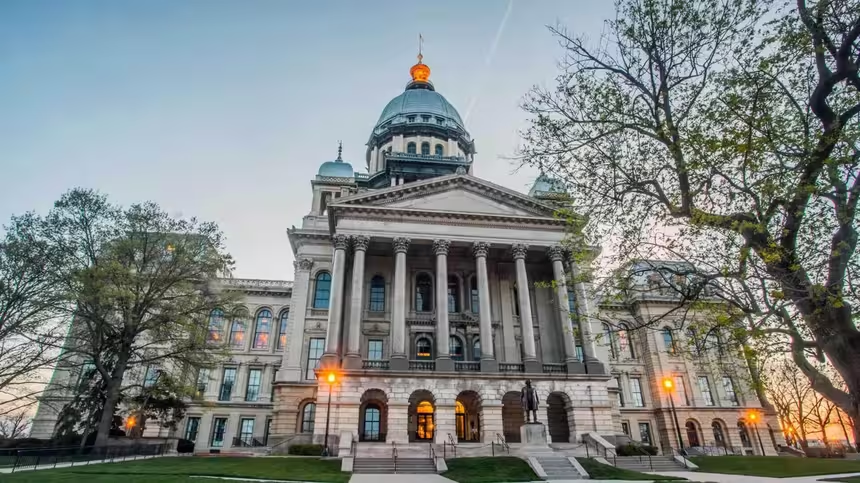
CapitolView
CapitolView is a weekly discussion of politics and government inside the Capitol, and around the state, with the Statehouse press corps. CapitolView is a production of WSIU Public Broadcasting.Providing Support for PBS.org
Learn Moreabout PBS online sponsorship[MUSIC] >> Welcome the capital view on WSIU.
I'm Brian Sapp.
This week, governor JB Pritzker gives his budget address to the General Assembly.
Illinois has already been challenged with a tight budget.
Now the governor and General Assembly have to work through funding cuts coming from Washington, D.C., and early voting is underway, and we're a month away from the primary election.
The Republican Senate candidates took part in a debate trying to make their pitch to primary voters.
Joining us today are Peter Hancock.
He's a reporter with Capitol News Illinois and Jeremy Gorner.
He's a reporter for the Chicago Tribune.
Peter and Jeremy, thanks for joining us.
>> Thank you.
Thank you.
>> Good to see you guys.
It's kind of busy.
I know you guys have been busy there in Springfield, but the pace seems to be picking up.
Um, we normally do record these on Wednesday, so this would have been recorded before the governor gives this address and we're recording even a day earlier because of that address.
But I think there's been lots of talk.
I think we kind of know a lot of things that the governor's going to talk about.
So, Jeremy, let's start with you.
You wrote an article this weekend looking at the challenges.
What are you looking for as the governor gives his address and talks about the budget?
>> Well, I mean, you know, I think let's look at what happened a year ago, right?
I mean, he used his state of the state and budget address, um, as a national platform to to Warne Illinoisans about President Trump's threats to democracy, likening the Trump administration to that of Nazi era Germany.
That obviously, um, raised antennas and, um, you know, Republican from Republicans who roundly criticized the governor for that rhetoric.
Keep in mind, Trump had been in office probably for about a month in his second term at that point.
The difference is, is that, um, the governor and the governor's warnings about President Trump last week, the way he or last year, rather the way he sees it have become the way he sees it have become a reality, you know, in order in addition to the threats to democracy, he's, um, talked about, um, with the Trump administration.
Um, he's also warned about federal uncertainty, um, for funding, um, for Illinois.
Um, you know, by last fall's estimate, the state faced a budget gap of around $2.2 billion.
That's, you know, that is a figure that varies.
But, um, we've seen lawsuit after lawsuit filed by Attorney General Kwame Raoul.
Um, there's been dozens in the last year alone.
Every time President Trump threatens to deprive Illinois of federal funding in areas of education, healthcare, um, you name it.
Um, there's, you know, lawsuits that have been filed to try to to stop that.
Um, and they've been fairly successful so far.
But, um, you know, we're, you know, obviously with this, um, the one big beautiful bill act that was passed by Republicans last year, championed by President Trump.
Um, you know, the big issue that we're going to see there is, you know, cuts to Snap benefits, um, and Medicaid, um, you know, it's, you know, I believe, um, the, um, the bipartisan Commission on Government Forecasting and Accountability came out with a report saying that by, um, I believe in the early 2030s by then, um, you know, Illinois could be on the could by then have lost, you know, lost out on six more than $6 billion, um, in Medicaid benefits because of, um, moves from the Trump administration.
Um, in response, you know, in response, you know, uh, you've had a slew of Democrats who are, um, you know, ringing the bell saying like, okay, well, you know, there's, you know, we need to we basically need to push a message of affordability.
You know, the country, the state of Illinois has become too expensive for illinoisans in the meantime, um, you know, and to that end, you've seen a number of Democrats, um, push to revive a graduated, uh, millionaire's tax.
You know, something that's been, um, passed through advisory referendum on two separate occasions in the last decade or decade and a half or so.
Um, but it has not passed through the General Assembly.
So, you know, we're hearing more calls, um, especially from progressive Democrats to, um, enact a more fair tax system, you know, taxing the wealthy, um, you know, so that, um, you know, new taxes and tax hikes don't fall on the backs of working class families.
That's been really kind of the message from Democrats right now.
And, you know, as as we're seeing prices increase, um, under the Trump administration, from groceries to gasoline.
So we're seeing that and, um, you know, and as far as for education funding goes, um, you know, there, you know, there's Democrats who are pushing for more education funding through the evidence based funding formula, which is, um, supposed to prioritize, um, underfunded, um, public school districts, um, including the Chicago Public Schools, um, for most of, most of the time that this law has been in effect since 2017 or since, rather since the governor has been in office in 2019, he's pushed he's pushed for the minimum mandatory increase of $350 million.
And there's been renewed calls to increase that to up to $1 billion annually.
But, um, so we'll see what happens.
And, you know, they also have the state has also has, um, obligations for the pension fund there.
Right now they have more than $140 billion, 100 more than 144 billion, or around $144 billion in unfunded pension liabilities.
And, um, you know, the governor wants to revive a key policy to address that, um, from 2024, which, um, basically would, um, move the target from 90%, fully 90% to 100% fully funded, um, from to 2048 instead of 2045, for example.
But, um, I know that that's so far received a, a lukewarm reception from at least one of the legislative leaders who, um, who's questioning, um, I know Senate President Don Harmon saying, we'll see how tight this budget is going to be, because again, it goes back to, um, a big part of it is, you know, what is the federal funding picture look like for the next year?
And I think it's it's right now, it's anybody's guess.
>> Okay.
From your seat.
Um, what have you seen in your reporting and some of your coverage areas there?
>> Well, I would agree with a lot of what Jeremy said.
Uh, I think, you know, the overall, uh, message that we're going to get, I think, is that we are living through a time when the total relationship between the federal government and state governments is being redefined.
Uh, arguably right now, it's being redefined in kind of a haphazard, uh, partisan political way.
But it is being redefined, especially when it comes to funding things like health care, education, safety, net services, these kinds of things.
And so in the short term, that has put a big question mark over, uh, the budget that Governor Pritzker is going to present and that lawmakers are going to have to debate during this upcoming session, uh, because, you know, all states, uh, rely on the federal government revenue sharing to fund some of these things that are joint responsibilities of the state and federal government.
And right now, there's a huge question mark over that.
So I think we're probably going to see a budget proposal that is fairly lean, fairly cautious, simply because we don't know what to expect from the federal government over the next year to year and a half or even two years.
Um, so that's going to be the hallmark, I think, of, uh, you know, budget wise, uh, the debate coming up through this session.
>> Okay.
Um, let's stick with the General Assembly.
Um, there's bills making their way as we were getting ready to air, talking about bills just, uh, being brought to committee and whether or not they're going to make it.
And this is that time where people are finding, uh, lots of bills to report on, but one that you reported on, Peter, was the governor talked about this last fall.
Um, was home insurance giving legislators in the state a little more say over and authority over home insurance rates.
Can you tell us what that bill might be and where it stands and whether it could pass?
>> Yeah.
So this came on the heels of, uh, State Farm announcing last year, uh, overall, about a 27, 27.2% increase in homeowner insurance rates in the state of Illinois.
Uh, it upset a lot of people, including Governor Pritzker, who, uh, basically accused the company of cost shifting that is taking, uh, disaster related losses in states like California, the wildfires, hurricanes in Florida and Texas, and shifting those onto the backs of consumers in Illinois, something that the insurance industry strongly denies.
Uh, but it did sort of, uh, highlight the fact that Illinois has a fairly lax regulatory environment when it comes to homeowners insurance.
And so there was this bill came up in the fall that Pritzker had asked for, that would give the state Department of Insurance, uh, Regulatory Authority, uh, to review rate increases, uh, to require that insurance companies give consumers 60 day notice if there's going to be a 10% or more increase in their rates and giving, uh, the department authority to, after the fact, reject rate increases and even order rebates to consumers if they thought the rates were excessive.
And this has the insurance industry, uh, very, very concerned.
Um, it came up in the fall.
It procedurally, it was kind of complicated.
Uh, the Senate took a bill that had already passed the House.
They put this, gutted that bill, put this language into it, passed it, sent it back to the House.
And on the final day, the House was supposed to vote to concur in the Senate amendments.
Somebody didn't do the vote counting in advance.
The vote fell short of the votes it needed to pass.
Uh, so it failed on the floor of the House, which is something you don't see very often.
Um, but there was immediately emotion, uh, filed the next day basically to reconsider that, uh, which you can do under House rules one time.
Uh, so there is, uh, a sense the insurance industry says they have heard, uh, that it could come up, uh, very early this week or possibly next week.
Uh, but they they're confident that there's going to be another attempt to pass this bill.
>> Since it didn't pass last time.
Have they made any changes to try to get it.
More people behind it.
>> Well that's it.
The bill is the same as it was, uh, when it was on the table back in October.
Um, if it fails again, I would suspect that new legislation will be drafted, and it will have to go through the committee process all over again.
Um, but right now, it's the same bill, the same language.
Uh, that, uh, could come up, uh, at any point during, you know, in the first week or so of the session.
>> Okay.
We'll see if anybody's had their mind changed on that.
I wanted to stick with you.
And then, um, we have Jeremy has any thoughts?
Uh, another bill that's been proposed last week was a new power.
It's called the Power Act.
To address some of the concerns that people have had with data centers.
Um, can you give us a little bit of background on what this bill is and where what we could see?
>> Yeah, it's sort of ironic that, uh, there's only a few years ago.
I want to say maybe 2019, 2020, when the state was actively recruiting these data centers.
At the time, these were popping up all over the country.
Uh, they're places basically that house large servers that store, uh, data.
It is essentially the cloud, as they call it, uh, in computer lingo.
Uh, but since then we've seen this explosion in artificial intelligence, uh, development, uh, which is, you know, we all know what it is, but, uh, what a lot of people don't know is that it consumes huge amounts of electricity.
Uh, and so as these data centers are going in to communities, uh, they're putting huge, uh, new load on the power grid, the local power grid, uh, as well as on local water supplies to cool the engines, you know, the electronic equipment that keeps all this stuff running.
And it's caused a lot of concern in a lot of communities where this is happening.
Uh, and fear that these, uh, data centers are ultimately going to drive up electricity rates by putting such, you know, increased demand on the power grid.
And so this bill would essentially make, uh, data centers pay for their own power, uh, or come up with their own, uh, power sources, I suppose, uh, as, as well as, uh, make them more, uh, answerable to their use of water resources.
Uh, so it's kind of it's an amazing sort of turn of events in just a very short period of time.
How, you know, at one time we couldn't wait to get these things into the state, uh, because they are, you know, very valuable developments that could, you know, generate new property taxes and jobs and everything else.
Uh, but now, uh, people are realizing that they actually do come with a considerable social cost in terms of electricity and water resources?
>> Definitely.
It's like like you said, you can think back to, oh, let's bring these here.
Let's, uh, you know, the jobs and ideas like that, but, um, it's I think it's just part of the process and seeing some of the impacts, and we'll see what the legislature is able to come up with on this front.
Uh, Jeremy, I'm going to, um, switch, uh, our topics here.
When we were talking, you said, you guys, you've really been focused on, uh, this budget address and then elections.
And last week, the Senate, three Senate candidates on the Republican side had a debate on Fox 32, I believe, in Chicago.
And you wrote a little bit about that.
Did they were they able to get their message out effectively and kind of set themselves apart?
>> I think it was a little difficult to do that in just, uh, you know, an hour under an hour.
There's so many more questions that we that I'm sure, um, the moderators could have asked, but, um, you know, basically what you have.
And the crux of our story was that, um, you know, was really where the moderators tried to challenge the, um, uh, the, the three candidates to see if they have any disagreements with President Trump.
And, um, none of the three wanted to go there overtly.
Uh, they obviously wanted to talk, you know, more positively about, you know, you know, why they agree with his policies.
I mean, remember, US Senate's a federal office.
They'd be working with the president or with the executive branch.
Um, you know, as far as securing the border, um, as, um, you know, you know, especially and and also, you know, trying to be, you know, fiscally responsible with, you know, especially with this one big, beautiful bill, depending on the Republican perspective of things.
I know that that bill has, you know, been, um, you know, very, you know, a lot of high emotions on both ends of the aisle there.
But, um, but at the same time, you know, we saw, um, we saw that there were, you know, candidates were open to different approaches, um, to how President Trump, you know, is doing things like, for instance, when it came when it comes to elections, you know, they have a thing that's kind of percolating right now in Washington called the the Save act or which would basically it's an omnibus bill that will require photo ID and elections and also require proof of citizenship.
And, um, you know, while, um, you know, the candidates appeared to, um, really favor, favor the legislation in concept, you know, there was some concern about, um, how, um, would elections still be left to the states?
Um, which is the normal practice that's, you know, enshrined in federal law?
Um, you know, because they're worried about how this, you know, the president wants to nationalize elections with this, um, with this law, but, um, you know, but but still we saw I know like, you know, afterwards, um, in the, in the spin room, uh, you know, I saw that, uh, you know, got a little time to get better, to get to know some of these candidates.
Um, Jeannie Evans is is from the South Side of Chicago.
I think she's originally from the West Coast.
Um, she's an antitrust lawyer.
Um, I did ask her about, uh, uh, the 2020 presidential election.
And if, uh, she believes that the election was rigged in favor of Joe Biden, and she really did not want to answer that question other than to say, um, you know, that she's seen no evidence of, uh, that that it was rigged, uh, in Biden's favor, um, and wanted to move on to other topics.
Uh, she said she'd love President Trump's endorsement, as, I'm sure you know, all of them would.
Um, and then you have, uh, Casey.
Casey, who's, um, a Polish immigrant who's run a couple of times for Senate.
it.
Um, he, you know, talked about how, um, you know, he did seem to to support, um, you know, immigration reform as far as, like, you know, following what the law is now.
But, you know, for, you know, for certain folks kind of who've been in the country, you know, without legal permission, maybe, you know, trying to work something, you know, what a lot of you hear from some Republicans and many Democrats, um, you know, try to work something out for people who've lived in the country, um, or who are non-citizens for a long time instead of just kicking them out.
Um, you know, which is what we're seeing, you know, a lot with Customs and Border Patrol and Ice, you know, as they're coming, you know, to Chicago and other, um, Democratic run cities.
Um, so talked about that, um, there were times where, you know, he, he repeatedly asked, um, the moderator to, uh, repeat the question, I believe, when he was asked a question about federal minimum wage.
He kept talking about immigration.
So there were some there were some hiccups from all the, you know, from all the candidates.
That was probably the most noticeable one other than Gene Evans.
Um, it doesn't say on her.
It didn't say on her website at the time.
I haven't checked since that she identifies as a Republican.
So when I when I asked her about that, uh, she's like, that's very slick.
And we will get on that right away.
Um, but, uh, you know, other than that, um, I think that there is an acknowledgment among them that, you know, whoever wins the primary, um, is going to have an uphill battle because Illinois is a blue state.
Um, and, you know, there the Democrats are clearly much, much better funded.
Um, there's and, uh, so they know that it's going to be difficult, but, um, but at the same time, you know, they still feel like, you know, they're best equipped to handle Illinois's interests.
And I know, like, uh, like Gene Evans, for example.
She's kind of branding herself as a fresh face.
She's really pushing for her issues, really, um, deal with, um.
She's really like a champion for small businesses.
I believe she's helped small businesses in her line of work.
Um, and also she calls herself basically a free market capitalist, you know, uh, champion of free markets.
Um, so those are really kind of that's really kind of the platform she's running on.
Um, and then, um, you know, Don Tracy, you know, his former head of the Illinois Republican Party, um, he's got that experience.
He's actually run for office a few times.
So I guess the point is, is that, you know, Evans is trying to say, unlike my two opponents, I'm a fresh face.
These two have run for office unsuccessfully, and I'm the person you should stand behind.
So that's kind of what we've, you know, seen so far, um, from these, these candidates.
But definitely the, the Democratic primary is, has been is really kind of overshadowed anything because, you know, Dick Durbin has held that seat for so long, and he is a Democrat.
So that's obviously the primary that can continues to dominate all the attention in the US Senate race.
>> Definitely.
Yeah, that's the one I keep getting press releases from, from both, um, Lieutenant Governor Stratton and from Mr.
Krishnamoorthi.
And I just wanted to to wrap up what you said there.
I, I watched because I haven't been able to find out much about Miss Evans.
And I had interviewed Mr.
Tracy, and I was struck.
That was the thing I heard that she's a lawyer.
And then, um, Mr.
Shellback, um, how he had to have those questions repeated, and they seemed to be a little pragmatic on that approach.
Like, I think they understand that Illinois is not as, uh, I guess MAGA as, uh, the some of the national politics might, might have it laid out there.
So I guess we'll have to see what happens in Election Day.
>> Right, exactly.
And they were kind of walking a fine line there, right?
Like they were kind of acknowledging different approaches they would have to President Trump, you know, uh, but in concept, you know, but they didn't want to say anything negative about him.
I mean, you know, they um.
>> Yeah.
And it's not to get too far into the weeds, but an interesting way.
It seemed to be a little bit more.
What I think about is, you know the Senate is the deliberative deliberative body.
And so maybe there's a bit of in a way they they're kind of forced into that being deliberative and not, you know, like, like their representatives.
Um.
So all right.
Well, I guess we're going to have to we got an interesting month ahead of us and see who comes ahead.
We have just about two minutes left, and I want to wrap up as we right before overnight, we got news that, um, Jesse Jackson had passed away.
He died at 84.
He, you know, I my lifetime here in Illinois, I live closer to Chicago.
And, you know, I just he was part of, you know, my understanding of of news.
I just wanted to talk to each of you.
Um, Peter, did you ever have a chance to interact with Mr.
Jackson?
>> I did actually.
It was very brief.
I was working in Topeka, Kansas at the time, and I want to say it was around maybe the 50th anniversary of the Brown versus Topeka Board of Education Supreme Court case that desegregated public schools.
Uh, they were dedicating a national historic site in Topeka at the time, and there was a reception.
Uh, I was working at a public radio station.
So I went to this reception, and I remember putting a microphone up to his face and asking him some sort of question and immediately thinking, you know, this man has had so many microphones put in his face.
He's had so many young, naive reporters like me ask him questions.
Nothing I ask him is ever going to be remembered.
Uh, he's not going to remember me 10s after he turns around.
Uh, but he was very gracious.
I asked him some question.
He gave me an answer.
I was able to insert it into a story for the next morning that made it sound like I interviewed this iconic national civil rights leader.
Uh, so it it stuck out in my memory.
I doubt very much that it stuck out in his.
>> Uh, we've got about one minute left, probably about 45 seconds.
Jeremy, you talked a little bit about covering him.
What kind of person was he approachable about?
30s left.
>> Very approachable.
You used to see him in the Chicago Tribune newsroom all the time before we left Tribune Tower.
He was always there.
Um, I mean, and, um, but, yeah, I mean, he always was somebody you'd see around town championing, um, causes, you know, related to, to, to, to to gun violence, um, um, police misconduct allegations.
I mean, I remember him getting arrested outside a pretty well-known gun shop where local law enforcement had traced illegal guns onto Chicago streets.
He was very, you know, that was a big deal down there.
But, um, and I remember seeing him as, you know, 2018, you know, when they had an anti-violence protest on the Dan Ryan Expressway.
I remember talking to him before that, um, you know, about his thoughts there, and even not just Chicago, but you'd see him nationally.
It's for similar causes, um, in cities across America.
So, um, he is somebody who will be sorely missed.
>> Yeah.
Well, thank you, gentlemen, I appreciate it.
And that's it for this week's edition of Capital View.
[MUSIC] [MUSIC]

- News and Public Affairs

Top journalists deliver compelling original analysis of the hour's headlines.

- News and Public Affairs

FRONTLINE is investigative journalism that questions, explains and changes our world.












Support for PBS provided by:
CapitolView is a local public television program presented by WSIU
CapitolView is a production of WSIU Public Broadcasting.