
Capitol View | August 13, 2026
8/12/2026 | 26m 46sVideo has Closed Captions
Brian Sapp discusses Illinois politics with John Jackson and Dan Petrella
Brian Sapp discusses Illinois politics and current events with John Jackson and Dan Petrella
Problems playing video? | Closed Captioning Feedback
Problems playing video? | Closed Captioning Feedback
CapitolView is a local public television program presented by WSIU
CapitolView is a production of WSIU Public Broadcasting.
Capitol View | August 13, 2026
8/12/2026 | 26m 46sVideo has Closed Captions
Brian Sapp discusses Illinois politics and current events with John Jackson and Dan Petrella
Problems playing video? | Closed Captioning Feedback
Where to Watch CapitolView
CapitolView is available to stream on pbs.org and the PBS app.
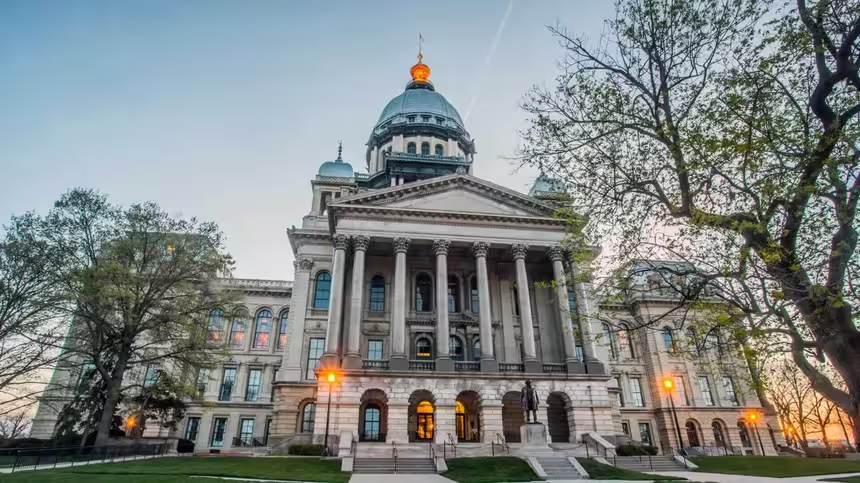
CapitolView
CapitolView is a weekly discussion of politics and government inside the Capitol, and around the state, with the Statehouse press corps. CapitolView is a production of WSIU Public Broadcasting.Providing Support for PBS.org
Learn Moreabout PBS online sponsorship[MUSIC] >> Welcome to Capitol View on WSU.
I'm Brian Sapp.
Students across Illinois are heading back to school this month, or at least they are here in the Carbondale area.
And schools continue to find ways to fund their districts.
The Illinois State Board of Education released the latest evidence based funding calculations showing how they'll distribute that state funding, even though the funding has increased by $350 million this year, ISBE says the.
As we get.
Adequacy gap has grown and Illinois Speaker of the House Chris Welch continues to face calls for his resignation.
In light of the way that people have questions about the way he and his office handled allegations of sexual harassment against former representative Harry Benton.
Joining us this week are John Jackson.
He's the visiting professor for the Paul Simon Public Policy Institute.
And we have Dan Petrella from the Chicago Tribune.
He's here as well.
John and Dan, it's good to see you.
>> Good to be here.
>> Glad to join you.
>> We're going to start with education funding.
The last Friday, the State Board of Education released their numbers for the evidence based funding.
They asked for $350 million.
They got that from the state budget.
But in their calculations, they say that they've fallen behind in meeting the adequacy gap.
Can you kind of let us know where we stand on this, John?
>> Yeah.
And in an academic sense, I'd like to give a footnote to our colleague on this program, Peter Hancock.
He had an excellent article out on this this week, and it was helpful to me to put this all together.
This has been a long running story, though, because this legislation is now about five years old, if I remember correctly.
And the ISBE budget, of course, for K through 12 publics provided, as you said, 9.3 billion total and it was new money, 350 million.
The schools are now releasing their own share and how it falls in most cases below the target and the target would have required over the past, not this just this year, but to the last two years keeping up with inflation, which they've not been able to do.
So they've fallen behind.
A Carbondale here said that they were somewhat under 60% of their funding expectations at this point.
And this creates the so-called quote unquote, adequacy gap.
I want to say in quotes here a direct quote from a Chicago Tribune article of of 10th August, which I think was Sunday.
It says evidence based funding sets, funding targets based on demographics, comma, student enrollments and student needs, then it directs new money to districts with the greatest gaps between those targets and the local resources and what they can raise, unquote.
I thought that was a succinct definition of a very complex process.
It's mind boggling in terms of all the variables, but at any rate, I thought it well worth quoting.
I think it notable that among the critics is the mayor of Chicago.
He has been consistently insisting that Chicago Public Schools should have a lot more money coming from the state of Illinois, and he's been on that constantly.
And this is one part of that bigger argument that he's made.
He's been consistently unhappy with, particularly the governor.
But it's also the governor in the state legislature.
And they've basically stood firm on this.
They've said, we're not going to bail out the public school system And the governor particularly, has gone back and forth with the mayor over that.
And I think that shows that basically, not surprisingly, the governor and the state legislature won that battle.
I want to give a quick footnote that is, this is very important to higher education in ways that may not be quite obvious at this point.
That is, we had a bill which was much debated and talked about, because our funding has been discussed for a long time as to what the base form formula is and what the new bill did was to adopt this paradigm that I just explained from K through 12.
And it essentially, in a nutshell, benefited when you ran the numbers, the so-called regionals, because we met so many of the criteria being behind, having diverse student bodies, all the things that counted, that would be northern NYU, eastern E I, Western W, I, U and SIU, Carbondale, certainly.
And so that, uh, had a lot of support, I'd have to say.
In fact, I don't think there were too many public opponents, but the one that counted was the one that was the biggest of all that is it did not benefit the University of Illinois.
And so they basically came out against it.
And that for this session was the end of the story.
I think it will come back around again, but the need is there.
The next legislature, I think, will redebate all of this because, uh, IBHE Illinois Board of Higher Education and the universities are not going to let it alone.
>> Dan, when it comes to the elementary, high school and the secondary funding, it was a big discussion that it was they were trying to decide this year if they were going to do the progressive taxing and things like that, where where does this go?
And is this a surprise to anybody that we've seen this lack of adequacy?
>> No.
You know, it's really you know, it was a hard fought battle, you know, a decade or so ago, and it took several years to get the formula approved.
And I think it was finally signed into law by Governor Bruce Rauner in 2017.
After some back and forth and some, I think at least one veto of a version and things like that.
But the way that it was set up is that the legislation, the law, set these adequacy targets or set a formula to figure out what the adequacy targets were.
But then they're also put in this baseline minimum of a $350 million increase every year, which everybody knew at the time was a minimum and not enough.
If you only did that to actually reach the adequacy targets.
And so it's sort of a an underfunding that's baked into the system.
I think most people would not argue with the fact that it's an improvement over the previous system.
You know, the governor talks regularly about the, um, I'm blanking on the on the figure, but they've done the 350 million or 300 million at least pretty much every year that he's been in office, save for the pandemic year, where they filled the gap with some federal money that flowed into the formula differently.
But, um, you know, there's still schools that need more resources.
Like you said, $350 million in 2026 doesn't buy the same amount of, of school supplies or go as far for, for teacher salaries as it did in, in 2018.
Um, so there's a lot of ground to be made up and it has been a big flashpoint between, um, between the city of Chicago and the legislature in Springfield.
Um, you know, Chicago rightly looks at what their adequacy numbers should be under the formula and says the state should be sending us more money.
Um, but I believe they are.
They are now in the second tier of priority for funding.
So they're not even really at this point in the front of the line for for who should be getting more, more money went in.
So it's a very thorny debate.
It comes down to the fact that the state does is not choosing to to devote the revenue it has to this area more.
And there hasn't been a consensus on how to generate more revenue.
Um, there was this really late and not really well organized push for a potential millionaires tax constitutional amendment on the ballot in November, which fizzled very quickly, which could have brought in some more money for education.
Um, and so it's an ongoing debate, you know, and Speaker Chris Welch, who you mentioned at the top of the program, had sort of inserted himself into it recently by, by telling folks in Chicago, um, that he would try to try to get the $150 million they're looking for to, to stave off some layoffs that are in the budget for the coming school year.
Um, obviously, the budget they passed in late May, early June has like a $6 million surplus.
And so there's not an extra $150 million on the table anywhere.
So how he he would do that is questionable.
And, you know, he tried to walk that back a little bit in some interviews later, saying he generally supported increased education funding, but it came across to many people as sort of a political face saving or, you know, an attempt to shore up some of, uh, some of his allies while he faces some, some political struggles of his own.
>> Definitely.
Well, talk about those in a second.
Just wrap this up.
Yeah, the Chicagos, the higher tier.
There's plenty of schools.
You look throughout the area and lots of schools are always in need.
And I think I think you said trying to find that consensus is going to have to hope that the legislature can can work through that.
I'm not sure anything is going to happen this fall because the higher threshold for getting a bills passed.
So I think it's going to linger, and we'll just kind of have to kind of play and keep keep an eye on that.
Now, switching to Speaker Welch, this promise that.
He then walked back of fighting for more money for the Chicago schools came after some of the revelations and to the investigation of Harry Benton and the sexual assault accusations.
We had that report.
We talked about that last week.
There's been some new things, a new working group.
Is that correct?
On talking about the dealing with sexual harassment.
Where do things stand in this case?
>> Yeah.
Yeah that's correct.
I will say it was a sexual harassment sexual harassment complaint and investigation.
Um and the speaker attempted to put together a working group to look at these issues, which is a go to tactic in Springfield when an issue comes up is to, to assemble a working group or a task force or, or a special committee to, to look into it.
And then oftentimes, you know, recommendations are made and, and either watered down or not adopted at all.
Um, but the speaker has even struggled with, with putting this working group together, this Democrats only working group representative Kelly Cassidy, who's been outspoken on these issues and actually, um, you know, didn't vote for the speaker when he was first elected, um, because of concerns about some issues in his past dealing with the treatment of women.
Um, and, uh, she, she was named as a member of the working group and then said she wasn't going to participate.
Um, and then Representative Greg Johnson from, from East Moline recently also backed out, uh, believing, saying, telling Capitol news Illinois that he, he had a misunderstanding with the speaker's chief of staff that, um, you know, he thought it was just going to be like a zoom sort of discussion to, to talk about the issue.
Um, so it's, there's been some bumps along the road, there's continued questions about, um, you know, whether he maintains the support to be re-elected, speaker when, when the new legislature is, is inaugurated in January.
Um, you know, I don't know if anybody has a solid roll call on that at this point.
Um, but it's an issue.
You know, it's quieted down maybe a little bit this week, but it's continued to, um, you know, to, to fester a little bit.
Welch apparently told some folks, uh, recently that the reason he continued giving Benton campaign funding, even after a first complaint surfaced in 2023, that was that, you know, he was concerned that labor, you know, labor unions would would, um, would get frustrated with the Democrats or not do their full backing, perhaps if they didn't, uh, put money behind a state rep from the southwest suburbs who happen to also be a union iron worker.
So, um, that seems sort of dubious to some folks, but, um, you know, it's, it's been interesting to see the way that, um, he has sort of struggled over the last few weeks to, um, give explanations that are satisfactory and to come up with a solution.
Um, and the next question is do they pass more legislation to try and address these issues?
You know, there were um me two issues back in Springfield in 2017 and 2018.
That prompted some legislation.
And apparently, you know, obviously it's a problem everywhere, but didn't go far enough for for some folks.
And they want to look at what else they might be able to do.
>> I think it's a long time until that January vote and we have the elections of the midterms.
So lots of things to distract people.
And I know that you guys have done some great reporting on this, and also Capitol News Illinois and other people.
And so we just keep reading that and we'll stay up to date.
One other thing that Speaker Welch is dealing with is representative Carol Ammons.
Um, she is under investigation.
Um, can you kind of fill us in where we stand on that?
>> Yeah.
So this is yet another, uh, struggle in the caucus.
Late last week, the House Special Investigating Committee that was convened, um, actually forced to convene by a Republican petition, um, had its first meeting.
Um, uh, Representative Ammons did not attend that meeting, and the status that they're at is sort of figuring out communicating with the U.S.
Attorney's Office in the Central District of Illinois about how they can proceed with their, um, with their committee investigation while the, the federal criminal investigation is ongoing.
These are allegations regarding, um, state and federal grant money that that Representative Ammons directed to organizations that then, um, hired her daughter and also some allegations involving, um, you know, a kickback scheme with, uh, with, um, contributors and things of that, of that nature.
So, um, it's, it's a thorny issue.
It's one, Ammons was a, was a committee chair and, um, you know, a member of the House Black Caucus, which is sort of Welsh's base of power as well.
So there's going to be interesting to see how this, uh, this committee proceeds.
The last time one of these things happened was back in 2020, when former Speaker Madigan was um, was under scrutiny.
Committee had just admitted in federal court that they had engaged in a years long scheme of bribery to try to influence him, to support their agenda in Springfield.
And actually, then State Representative Chris Welch was the chair of that special investigating committee and was accused by some Republicans on the committee of sort of slow walking the process.
And and, you know, it was an election year then as well and trying to sort of, uh, you know, keep it from really digging into, into what the allegations against the speaker were.
So it'll be interesting to see how robust this this House committee investigation ends up being this time around.
>> Definitely.
And they've got the task of trying to not step on the toes or get in the way of the the federal U.S.
attorney.
They're investigating this.
So yeah, definitely something that we'll keep an eye on.
We're going to change topics, stick with the legislature.
But, um, data centers, John, they've been, it feels like we've been talking about them forever.
AI has not been around that long, but data centers have, you know, that feeds the online world that we're connected to.
Can you kind of tell us where we are this summer with some of the questions around data centers?
>> Well, data centers seem to be the wave of the future, both in Illinois and nationally.
And they've created a lot of interest because to some extent, they power all of this artificial intelligence movement, which is the great unknown in many ways, but certainly a lot of promise.
They promise initially lots of construction jobs.
Then they promise a lot fewer permanent jobs.
And there is the residual they're going to pay some taxes at the property tax rates, wherever they're located.
So there are a lot of people want them.
And those who want them say, if we don't get them another state or another city, we'll get them.
And on this, I want to give another academic footnote.
Our colleague Jerome Gorner had in the Trib.
An excellent article on this, and his article tells the story of this Mark Poulos of Springfield, who is a labor leader and has taken a stepped out front labor position.
That is his paper.
And it's been really quite interesting to others who are trying to figure out what should the state be doing about this.
And the principles in there are, quote, the the data centers have to, quote, bring their own power.
For example, there's a $26 billion AI center now in South Bend, Indiana, and Illinois looks over there and says, they're already getting our bears.
Maybe.
So are they going to get all these data centers because they seem to be out front?
Um Pritzker is being urged to restore a data center text tax incentive that was in place.
And he is said to be considering that the critics are really quite skeptical about all of this.
It's an N, I'm b y not in my own backyard kind of thing.
Lots of backlash, especially about the resources that large amounts of water, the large amounts of electricity, and some claim that there's noise, especially if you're close there.
I get the Chicago Tribune delivered to my front door on Sundays, believe it or not.
And I'm always impressed recently in sort of the inside pages, how many suburban Chicago cities are considering this?
And the debate goes on.
Pros and cons.
Some of them have jumped on board and some have very publicly gotten off board.
We have one here in Carbondale, Jackson County actually on the drawing boards.
And it is at the site of an old electric power generating site.
Interestingly enough, that extends out into the Mississippi River on our side.
It's over in the Shawnee School District, which just south of Murfreesboro.
And I think it's important because it has almost no opposition.
They would really love to get that data center put there, and it'd be sticking out into the Mississippi River.
So anyway, this debate is going to continue, and it'll be very important how every city stands on this.
And we're not the only ones that debates going on nationally as well.
>> Dan, do you think this fall I know this this spring they talked about the Power Act, which was one of those things where adding on to not see it was the new electric bill encouraging or asking these data centers to provide their own electricity.
Is that something that we could see coming back this fall, or is everybody.
Sounds like everybody's really got their own ideas and they haven't come together yet.
>> Yeah, I think it is.
Um, you know, a lobbying push that will continue.
I'm not sure that it will, uh, that it will get done in the fall.
Um, I don't know if there's enough momentum behind it.
You know, we have seen sometimes in the past, you mentioned back in 2016, I believe it was, was an issue that was debated and discussed throughout the spring.
I sat through some very long committee hearings that spring, and then it ended up getting punted and actually passed in the fall, the fall veto session that year.
So it is a possibility, I think, like you said, it's a very complicated issue.
There's a lot of competing interests.
Um, you know, when it comes to issues of energy, even among the sort of Democratic Party coalition, there's often divisions between organized labor and environmentalists and others over these issues.
Um, you know, so I think it's a debate that will continue, whether they will be able to to finalize it this this fall, I think is is a bit of an open question at this point.
Everybody is a little bit more focused on the the election in early November, I think, at this point.
So it's always kind of a question about what's going to get done in in vitro post-election, but it also offers the opportunity in a lame duck session, potentially in January, to deal with it.
But it is interesting, as you said, this is an issue that's being debated everywhere.
Just this week, Mayor Brandon Johnson in Chicago signed an executive order putting some new guardrails around data centers in the city.
Um, tighter air pollution, uh, evaluations, noise restrictions, um, ability for city officials to review the, the electricity and water usage of these facilities.
Um, he doesn't have the power himself to, to ban their construction, but he is pushing for the, for the city council here in Chicago to adopt an ordinance that would, uh, put a moratorium on, on data centers.
And it's interesting how this issue has turned so quickly.
You know, back in 2019, when the governor was first elected, it was a big priority for Republicans, particularly House Republicans in Springfield, to to get this data tax, data center tax credit adopted.
And it was a concession or an agreement that the governor reached with them and was happy to to, you know, be at a bill signing with with folks like former House Republican leader Jim Durkin, if I recall, to talk about.
And now you have both Republicans and Democrats who are raising big questions about, um, about data centers.
It's one of those rare issues where sort of folks on the, the further left of the political spectrum and the further right of the political spectrum seem to have met back in the middle somewhere with some of their skepticism on, on data center construction and how it impacts people's everyday lives.
>> It's.
Yeah.
And it's a national issue that lots of localities, you know, local level, state level, national level.
And, um, I guess we'll just see how we play out and how if there's some sort of consensus that we can come to here in the state.
We're going to finish up with you.
We have just a little over three minutes.
There's a story coming out of Chicago Friday.
From what I understand, some horrific scenes of, um, there were 50 bodies found in a South side chapel there in Chicago, um, at a funeral home.
Um, can you kind of tell us what happened?
>> Yeah.
This is the South Chicago chapel in the South Deering neighborhood on the city's south side.
Um, after a complaint, um, investigators found 56, uh, bodies that were stored in the basement of this funeral home.
Um, and they were not stored properly at proper temperatures and things like that.
Um, and, uh, it turns out that the folks involved in running this funeral home, uh, just were, uh, shut down last year for a crematory that they were running in the south suburbs.
Um, a gentleman named Clark Morgan had his, his funeral directors license suspended, but his wife was, was the licence holder for this um South Chicago chapel.
Um, so there are all sorts of questions about the way state regulation, uh, plays out in the, in the funeral and cemetery industries.
Um, and this is a long running issue in Illinois.
Um, I was just reading through a report yesterday from 2009 when, um, there was a situation at the historic Burr Oak Cemetery, um, which folks might know as the burial place of, of Emmett Till, um, where bodies were being disinterred and dumped in an empty field and graves were sold and things like that.
And then Governor Quinn put together a task force to, to look at oversight of the cemetery industry.
And one of the recommendations at that time was to consolidate funeral home and cemetery regulation under the Illinois Department of Financial and Professional Regulation.
Right now, it's divided between the comptroller's office, which really has oversight of sort of the financial aspects of of cemeteries and pre-need arrangements and, and things along those lines.
And the Department of Financial and Professional Regulation, which licenses the funeral home directors and embalmers.
Um, and obviously that consolidation has not happened.
There are folks that question whether that even now, whether that's the best way to go.
But, um, you know, it's just another example of what I was saying earlier in the show about we, these problems arise and we put together task forces and special committees and things like that to make recommendations.
And often they're put on a shelf.
Um, you know, one thing that was interesting in reading through that report is, is they looked at the regulations in other states at the time.
And one thing that I noticed going through there is many other states require routine inspections either every few years or things like that for the funeral home facilities themselves.
And Illinois system is really a complaint based system.
The licenses are held by the individuals.
Um, and so there's not a, a sort of, it's not like a restaurant where there's routine inspections scheduled and, um, you know, things like that.
So obviously this is a developing situation.
Still trying to piece together the timeline of how these folks managed to have another funeral home going so soon after.
They were just in trouble with the state.
But I would think that this is an issue where we're going to see some legislative debate and proposals coming forward.
Once the picture of what happened here is is a little clearer.
And, you know, they just did a some reform of this system a couple of years ago when there was a situation in Carlinville where, where there were, um, you know, remains improperly stored at a funeral home.
And obviously that didn't address all the issues because these, these situations continue to.
>> To happen to continue to happen.
Well, Dan, it was good talking to you, John.
Thanks for joining us.
That's it for this week's edition of Capitol View on behalf of John Jackson and Dan Petrella, I'm Brian Sapp.
Thanks for joining us.
[MUSIC]
 New Episode
- News and Public Affairs

Top journalists deliver compelling original analysis of the hour's headlines.

- News and Public Affairs

FRONTLINE is investigative journalism that questions, explains and changes our world.
 New Episode
 New Episode
 New Episode
 New Episode
 New Episode
 New Episode
 New Episode


 New Episode
Support for PBS provided by:
CapitolView is a local public television program presented by WSIU
CapitolView is a production of WSIU Public Broadcasting.