
Capitol View | April 30, 2026
4/30/2026 | 26m 46sVideo has Closed Captions
Jeff Williams host this week’s top stories with analysis from John Jackson and Charlie Wheeler.
Jeff Williams host this week’s top stories with analysis from John Jackson of the Paul Simon Public Policy Institute and Charlie Wheeler from the University of Illinois, Springfield.
Problems playing video? | Closed Captioning Feedback
Problems playing video? | Closed Captioning Feedback
CapitolView is a local public television program presented by WSIU
CapitolView is a production of WSIU Public Broadcasting.
Capitol View | April 30, 2026
4/30/2026 | 26m 46sVideo has Closed Captions
Jeff Williams host this week’s top stories with analysis from John Jackson of the Paul Simon Public Policy Institute and Charlie Wheeler from the University of Illinois, Springfield.
Problems playing video? | Closed Captioning Feedback
Where to Watch CapitolView
CapitolView is available to stream on pbs.org and the PBS app.
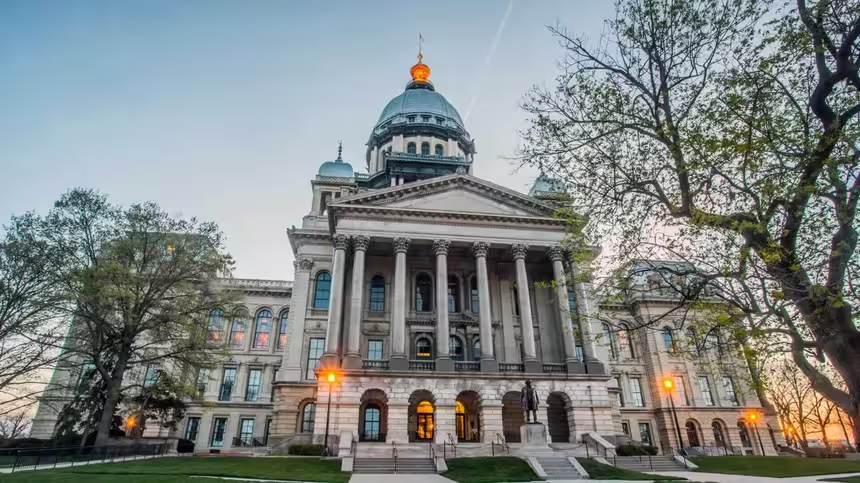
CapitolView
CapitolView is a weekly discussion of politics and government inside the Capitol, and around the state, with the Statehouse press corps. CapitolView is a production of WSIU Public Broadcasting.Providing Support for PBS.org
Learn Moreabout PBS online sponsorship[MUSIC] >> Welcome to capital view on WSIU.
I'm Jeff Williams sitting in this week as we take a look at what's making news around the state in Illinois politics.
At the top of the news this week, the U.S.
Court of Appeals for the Seventh Circuit has upheld the federal conviction on corruption charges for longtime Illinois House Speaker Michael Madigan.
Governor Pritzker continues to push lawmakers to approve his mega projects bill that also provides incentives to help keep the Chicago Bears in Illinois.
We'll take a closer look at those stories, and likely a few more this week on Capital View.
To help lead our discussion this week, our John Jackson, visiting professor from the Paul Simon Public Policy Institute and Charlie Wheeler, director emeritus of the Public Affairs Reporting Program at the University of Illinois, Springfield and a longtime statehouse reporter.
Gentlemen, welcome back to the program.
>> Glad to be here.
>> On.
On Monday, the Seventh Circuit Court of Appeals upheld the conviction of former Illinois House Speaker Michael Madigan.
The 29 page ruling upheld all ten of the bribery and corruption convictions.
Madigan, of course, was found guilty last February in a split verdict on ten of 23 charges against him.
He's currently serving a seven and a half year sentence at the federal prison in in West Virginia.
Um, Charlie and John, what what's your reaction to this seventh circuit ruling?
Any surprises?
>> John?
Or should I go?
Yes.
It's not really surprising in the sense that it was pretty clear the the reception when he his attorneys made the appeal, he got the sense that the appellate justices were kind of listening, but they weren't really taking it in.
And it was some pretty harsh language, actually, in the in the judgment that was handed down.
Uh, let me quote from here.
Michael Madigan spent nearly a decade leveraging his power as one of the highest ranking public officials in Illinois in exchange for over $3 million of financial benefits for his close political allies.
This is from the 29 page opinion.
The linkage was clear and far from fleeting.
He repeatedly facilitated changes to state law impacting countless energy consumers in northern Illinois, all because ComEd funneled money to the right people.
Madigan insists that this was a run of the mill politics.
This was the.
The judge, Michael Scudder, who wrote the.
Who wrote the opinion.
But a jury of 12 Illinois residents saw the evidence differently.
So do we, And so that, uh, in a sense that that writes a final chapter.
Now, the, the options for Madigan, I guess, are he could appeal to the US Supreme Court or the request he made for a pardon from from President Trump is I think it was made last fall.
I think it's still under consideration.
So those are, I guess, his two best options.
Otherwise there's going to be in in prison, uh, for quite some more time.
>> Mhm, mhm.
>> Yeah.
Um, John Madigan's convictions are related to a system of, of influence peddling, specifically a manner for which the former speaker facilitated changes in, in state laws in exchange for, in this case, Commonwealth Edison funneling money to individuals that, that Madigan favored.
Uh, I don't know, kind of, I guess a machine politics type of, of patronage system with now in recent history, two former governors and now the former speaker, all having been convicted on on federal corruption charges.
Has that had any influence on the on the political and legislative process in the state?
>> Do you think?
Well, I think it has I think it's absolutely clear that politics, uh, uh, the quid pro quo, old machine style politics are mostly gone now.
Not entirely.
Uh, but I think, uh, basically it's much better than what we would regard as the urban machine of the Daley era and so forth.
But I would add, in all fairness to the defendants from Gogebic, all the way through Madigan, it still strikes me that there are no bright lines between what is politics as usual and what is corruption.
And I still think the court hasn't, uh, sorted that out because it's very difficult to sort out.
Madigan's one of his sins was placing interns, and of course, that's the kind of detail he'd get involved with.
But we happen to have an intern program that's important.
And, uh, Charlie and his, uh, at his university have long had an important internship.
And, you know, you call up your friends and say, will they take an intern for that particular semester?
Because I've got one available that may be overstretched.
But at any rate, I still think there's some ambiguity.
But by and large, I think we've cleaned it up.
>> Mhm.
John, if you were if you were teaching a course this semester on, on political process or campaign politics, um, would you, what would be the caveat or what, what, what would you stress to students thinking about careers in, in politics in light of, of kind of what we've seen with, with these convictions.
>> Well, I think the bright line that I would tell them is you can't say to a potential donor, if you will vote this way, I'll give you $5 million for your PAC.
Uh, I just, you know, or you, you can buy this vote for $5 million that goes to the PAC.
That's the sort of direct quid pro quo, but it's never that direct anyway.
Most of the time.
>> Mhm.
Sure.
Um, shifting gears a little bit here, the spring legislative session is getting ready to enter its its final month.
There's a lot of significant bills that are are still pending.
Many of those are related to, to the budget.
Uh, one that the governor is now pushing, at least in the Senate, to act quickly on.
Is that mega projects bill that also has economic incentives to help keep the.
The bears in Illinois.
The House passed a plan last week.
It's now in the Senate.
There's, I think, still some discussion on what the support will be in the Senate and what will need to be done to it.
There are a lot of parts to this legislation.
If either one of you.
If you were handicapping the outcome of this bill, how would you what would be your assessment right now?
>> Well, I think they're going to have a bill, and I think the players really want to have a bill.
And I think the Democrats want to have a bill.
So they'll have a bill.
Uh, let me put the caveat in that.
I live an awful long way from Soldier Field.
Uh, so Soldier Field, but I've tried to follow this fairly closely, and I want to give a footnote here, our friend Jeremy Gorner and his colleague wrote this last Sunday in the Tribune.
An excellent article on all of this.
So I've depended on the Trib to keep me up.
And this was a particularly good article.
Um, I think I've really followed this academically for much, much longer and way before the bears, because all cities that have an NFL National Football League team have faced this witness.
Kansas City recently.
Uh, those of us downstate know the saga of Saint Louis and the Rams.
Uh, on and on.
You could go.
Every city, every state faces this issue.
Uh, and the question is, what are the benefits and what are the returns, especially to the public and to the state and local hosts, uh, from having an NFL team.
The players originally were Chicago keeping it and keeping it at Soldier Field.
Arlington Heights, of course, in Hammond, Indiana.
And that's what this article that Jeremy and others wrote.
I think it made clear that the contenders are now probably down to Arlington Heights and Hammond.
Hammond is the beneficiary of the governor and the state General Assembly deciding to go aggressive to kind of kind of make it the Hammond Bears, which doesn't have quite the ring, but they've courted very, very heavily and made some very, very high powered promises.
I did see an earlier Trib article that said that they went and interviewed a lot of people in Hammond, and it turns out that people around and in that area are not nearly as enthusiastic as the legislators and the governor.
But the Trib article quoted Representative Robert Peters, who represents downtown Chicago, and he points out that Soldier Field will still be there.
And indeed, there's still some bond payments to be paid from the latest renovation, which I think was the flying saucer roof on the thing.
But that's not all completely settled.
But his point was that this is going to be a world class facility sitting right down in the loop.
It's going to be a facility that needs to be used.
Uh, the article talked about, uh, big concerts by Taylor Swift and Beyonce, for example.
I think all of that has been one of the reasons the governor has stressed support from the state.
But he stressed support that is limited.
He said, for example, the state ought to build some infrastructure and I'll spend some money on it.
And he's been steady in saying that, but we're not going to directly subsidize the residents in the form of the, uh, Illinois, uh, uh, school teachers, the Chicago school teachers, the school teachers out in the burbs.
Uh, all of them have gotten involved in this discussion.
Uh, Arlington Heights teachers in Arlington Heights, people in general, uh, want to know what's being given to the owners of this NFL team.
Uh, and what's going to be the impact, especially on school systems and other support facilities.
And how much are the taxpayers going to get particularly hit in their, in their pocket, uh, by the, uh, property tax.
So it's gotten to be really, really complicated.
And there are a lot of players, uh, a lot of players, even in the Hammond case, which is easier.
I will close by saying this is a long time public interest kind of study.
Public policy economists, political scientists have looked at this for years, and I think a summary that's a fair assembly of all the research is they don't ever live up to the major promises they have, uh, lots of impact and a lot of it is good.
They also have impact that's very costly to the whole city and the whole state.
And it turns out that it's almost always true that the owners and the supporters will over promise, and then to some extent under delivery and the long haul.
So it's not surprising that it's been a tough season in the legislature, but I think they're going to pass something.
>> Yeah.
Charlie.
>> Yeah.
It's interesting because as I looked at the bill that the House sent to the Senate, two things struck me.
One was the process itself, and then the other was the provisions.
And I say process because the initial reaction from the governor, from the chief Senate negotiator, from the bears, we didn't know anything about this.
Where does this come from?
And the part that they they alleged that they were totally caught unawares was what John was mentioning in terms of the property tax provision.
And Kim Buckner, who was Kam Buckner, who was shepherding the bill through the House.
Representative Buckner said that it was very important for the House Democratic Caucus to have something in their property taxes.
And what the legislation would do is it would.
Allow for the bears or anyone else involved to.
One of these super mega development projects to negotiate with local taxing bodies.
Property tax payments over a long period of time, and half of the special payment that would be coming to the localities from the bears or whoever the developer is, instead of the, say, a school district keeping all of it, half of what they get would go into a local property tax relief fund, in which 60% of the money would be used to generate property tax rebates for homeowners.
In areas where the mega project is located, 40% would be deposited into a statewide property tax relief fund.
Now, that caught everybody by surprise.
And the immediate reaction was, now wait a second.
If I'm the local school district and I was thinking, I'm going to get 100 bucks and I'm only gonna get 50 bucks, I'm going to ask the bears for 200 bucks initially, because then I'll wind up with a 100.
I thought I was going to get.
So the expectation is if this provision becomes law, there's going to be that kind of additional asking up so that the price tag may be larger.
There's also concern about whether or not there would be certain entertainment taxes.
The bears apparently that they don't want to have an entertainment tax.
And Buckner pointed out that that's not particularly relevant because Arlington Heights, as a home rule unit, has the constitutional authority in Illinois to levy a property tax or an entertainment tax if it so chooses.
And there were other things in there, too.
What would you say to attract people?
There was something that Senator Peters liked that would allow basically abandoned railroad yards to be redeveloped.
Funding for that, and apparently it would cover in the South Loop where I think it's Amtrak is moving.
Its staging headquarters is going to be a big empty track.
And also there were provisions in there that would create a economic development, a special economic development district in, in in Springfield and another special medical district in Springfield.
The local reaction was not all that solid because the the setup, as it's proposed in this legislation for the Economic Development District in the city, would be controlled by the county and some of the city aldermen don't like the notion of letting the county be in charge of the city development.
So there are all these working parts.
And as I say, the governor said, well, the framework's there, but it still needs some work.
but I think I agree with John, this is too important an issue for it not to happen.
And Buckner kept stressing that other states are already doing this kind of thing.
And it's not just for the bears, it's for any kind of mega development that might want to come in and refurbish a community with manufacturing or sales or whatever kind of project it might be.
So I would bet money that it will pass.
>> Okay.
>> Obviously another major part of the budget bill, and it sucked up a lot of lot of energy so far in this session.
Education funding is another.
Another major piece of the budget bill.
I think the State Board of Higher Education is asking for, I think, $2.8 billion.
The governor, I think, has proposed 2.7, which I think, if I do the math correctly, is about a 1% increase.
Um, also, I think I believe the governor approved for this fiscal year a 1% increase, but then has been holding back an additional 2%.
Um, and I know that at least as early as last week, Siu system President Dan Mahoney said he wasn't exactly sure what would be in the in the higher education budget for for FY FY 27, um, as whole budget process is playing out.
Any thoughts on ultimately what, what will result in, in terms of, of a higher education budget for the coming fiscal year?
>> Well, my guess it will be a lot closer to what the governor initially proposed than it would be for the ask from higher ed, but that's always been historically the case.
The the board's both the Board of Higher Education and the Board of Education that does the K 12 always come in and request.
Here's what we need.
And then the administrations routinely will cut it back to say, here's what we can afford.
And part of the issue, as you alluded to, is that Pritzker froze money that was originally allocated for this fiscal year for higher ed because of the.
Well, what they thought was the uncertainty, I guess, would be the way to put it.
But what kind of federal money we're going to get with Trump?
And now, the most recent reports and Commission on Government Forecasting and Accountability will come out with it in a couple of days.
At the end of the month will come out with its with its updated revenue forecast and the, the latest one that they did showed that revenues are ahead of what projections were.
So as we head into the end of the of the session to do the budgeting, there's more money there than was originally expected.
But they're also, you know, tons of people requesting it for a lot of good causes.
So my guess is the, the, the education budget for big kids and little kids will wind up somewhere a little higher, maybe than what Pritzker suggested, but not what the agencies would like.
>> Sure, John, any thoughts on on higher education or education funding?
>> No.
Not really.
>> Okay.
>> Shifting gears a little bit, something that, um, I wanted to talk about.
And John, we've talked about this in the past on some programs and that's the, that's the impact of some of the president's policies on, on Illinois.
There's a current blockade of the Strait of Hormuz related to the the situation in Iran.
It's resulted in higher gas prices.
Obviously, we're all all feeling that.
But also for Illinois, a farm, a major farm, agricultural state.
Um, it has resulted also in the decreased availability and obviously incredibly increased price of, of nitrogen rich fertilizers that are obviously a key role in corn production, which we do in the state of Illinois.
So Illinois farmers are seeing some either direct or indirect impacts from from what's going on.
John, how would you assess the the ramifications of the current U.S.
policy in in Iran and what we're kind of seeing?
>> Well, Iraq grinds on and on.
It's coming up on three months now with no end in sight.
Indeed, the question of are we really negotiating is up in the air.
I would say this is by far the most comprehensive and deepest involvement in the Middle Eastern cauldron that we've ever had.
What is different now is that the war has very quickly dominated and had an impact on domestic politics and hitting the pocketbook of the consumers and taxpayers very quickly and very remarkably Clearly we can see cause and effect there.
And the price of gasoline, oil, fertilizer, diesel fuel, jet fuel, groceries all have gone up.
I drive by my filling station every day and yesterday the price of regular was 450 and diesel was 540.
And that's close to the national average.
And it's up there on that billboard for you to see every time you drive by.
Most Americans had no idea what the Gulf of Hormuz was, and couldn't care less about it until all of this hit them.
And all of a sudden, it's terribly important because supply chains all over the world have become involved, and it's become the most strategic, well, weapon that the Iranians have.
They didn't really have it or use it until the way we got involved.
And what we have done for the long run, the massive damage to the Iranian infrastructure, the production of oil and gas, but even domestic infrastructure that has been wrought by the American military as massive.
And it will take years and trillions of dollars to repair.
And they've done the best they can to try to inflict comparable damage around the Middle East and have done some real damage to their neighbors.
So the American, the Iranian and even the world economy have been impacted, and it's going to have an effect for years to come.
I want to quote Joseph Stiglitz, who is a Nobel Prize winner in economics.
He wrote a book on the Iraqi war, and he said that the tree, the $3 trillion war, was just the direct cost and that the real cost were unintended and spread over years, and that they go on and on, and that will be an impact on the American taxpayer.
And it will be a drag on the American and world economy for years to come.
According to an update that he published recently in The Atlantic newspaper.
Uh, I think the most notable thing immediately is its impact on the, uh, coming midterm elections.
It is having an impact already.
The Democrats are doing much better than usual in those early election results.
Uh, and it's going to have an impact, even if it were to be over tomorrow, which is not likely to be.
And I think the interesting thing about this is the commentary on political power and the president, this president has tried to abrogate to himself the most power of any president in American history, and he's largely succeeded.
Uh, I've got a long lecture on what I shared with the class recently, the ways in which he's intruded into all kinds of things that presidents never intruded in, and that the Congress provided a check and balance.
Uh, and there's a lot of that that is now gone.
So the question is, does Trump have any guardrails?
And I think the answer is yes in some sense.
And that is this is going to have an impact on the midterms, which is going to have a big impact on the last two years of his presidency.
And it shows that he knows that.
And he's also an avid user and quota of polls, often misquoting the polls.
But nevertheless, he cares about the polls.
So there is some element of democracy there that we can take some solace from.
>> All right.
John, I'll let you have the last word.
We are.
We're once again out of time for this edition of Capital View.
John Jackson, Charlie Wheeler, thank you very much for joining us this week.
>> My pleasure.
>> And thank you for tuning in to Capital View.
I'm Jeff Williams.
Have a great week.
[MUSIC] [MUSIC]
 New Episode
- News and Public Affairs

Top journalists deliver compelling original analysis of the hour's headlines.

- News and Public Affairs

FRONTLINE is investigative journalism that questions, explains and changes our world.
 New Episode
 New Episode
 New Episode
 New Episode
 New Episode
 New Episode
 New Episode


 New Episode
Support for PBS provided by:
CapitolView is a local public television program presented by WSIU
CapitolView is a production of WSIU Public Broadcasting.