
Readers Club | Ep. 212: Our Favorite Books of 2025
Season 2025 Episode 67 | 47m 55sVideo has Closed Captions
PBS Books Readers Club celebrates the wrap of its second season with a highlight of 2025
PBS Books Readers Club closes out an incredible year, Fred, Lauren, Princess, and Heather look back on the stories, conversations, and unforgettable moments that defined our reading journey. From inspiring interviews and behind-the-scenes memories to moments that made us laugh, this episode celebrates the books that brought our community together.
Problems playing video? | Closed Captioning Feedback
Problems playing video? | Closed Captioning Feedback
Readers Club | Ep. 212: Our Favorite Books of 2025
Season 2025 Episode 67 | 47m 55sVideo has Closed Captions
PBS Books Readers Club closes out an incredible year, Fred, Lauren, Princess, and Heather look back on the stories, conversations, and unforgettable moments that defined our reading journey. From inspiring interviews and behind-the-scenes memories to moments that made us laugh, this episode celebrates the books that brought our community together.
Problems playing video? | Closed Captioning Feedback
How to Watch PBS Books
PBS Books is available to stream on pbs.org and the free PBS App, available on iPhone, Apple TV, Android TV, Android smartphones, Amazon Fire TV, Amazon Fire Tablet, Roku, Samsung Smart TV, and Vizio.
Providing Support for PBS.org
Learn Moreabout PBS online sponsorshipMore from This Collection
The PBS Books Readers Club is a monthly digital-first series that brings its members into conversations behind the stories of your favorite books & shows. You can watch the online on the PBS App, with extended interviews available for PBS members on PBS Passport.
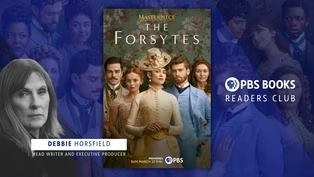
Readers Club- Debbie Horsfield | The Forsytes
Video has Closed Captions
The PBS Books Readers Club takes on John Galsworthy's classic novel series The Forsytes. (32m 36s)

Readers Club | 302 Book Picks for Black History Month with Lauren Smith and Princess Weekes
Video has Closed Captions
PBBS Books Readers Club recommend their favorite Black History Month reads. (16m 16s)
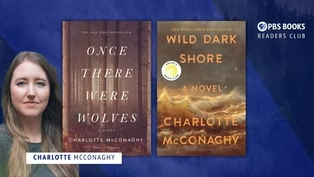
Readers Club | Ep 301: Charlotte McConaghy | Once There Were Wolves
Video has Closed Captions
PBS Books Readers Club hosts author Charlotte McConaghy to discuss her novel Once There Were Wolves. (58m 55s)
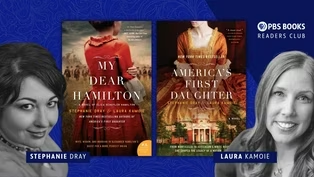
Readers Club | Ep. 211: America's First Daughter | Stephanie Dray & Laura Kamoie
Video has Closed Captions
PBS Books Readers Club welcomes co-authors Stephanie Dray and Laura Kamoie (1h 1m 45s)
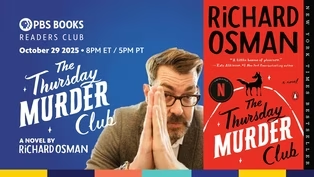
Wed Oct 29 2025 | Readers Club | Ep. 210: Richard Osman | Thursday Murder Club
Video has Closed Captions
PBS Books Readers Club welcomes celebrity writer Richard Osman to discuss his best-selling novel (52m 44s)
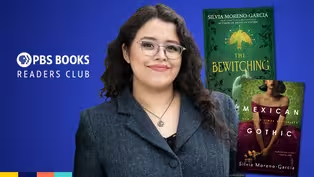
Readers Club | Ep. 209: Silvia Moreno-Garcia | The Bewitching and Mexican Gothic
Video has Closed Captions
PBS Books Readers Club welcomes award winning author Silvia Moreno-Garcia to discuss her new book. (52m 42s)
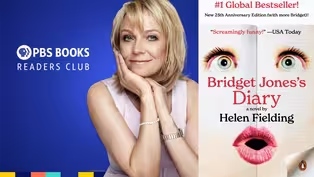
Readers Club | Ep. 208: Helen Fielding | Bridget Jones's Diary
Video has Closed Captions
PBS Books Readers Club welcomes beloved British author Helen Fielding to discuss her iconic novel (59m 30s)
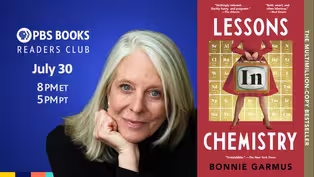
Readers Club | Ep. 207: Lessons in Chemistry | Bonnie Garmus
Video has Closed Captions
PBS Books Readers Club welcomes international best-selling author Bonnie Garmus to discuss her novel (49m 3s)
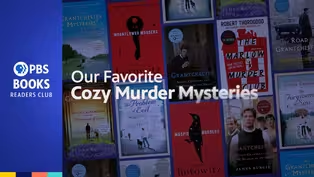
Readers Club | Ep. 206: Our Favorite Cozy Murder Mysteries
Video has Closed Captions
PBS Books Readers Club hosts a special event sharing Our Favorite Cozy Murder Mysteries (52m 32s)
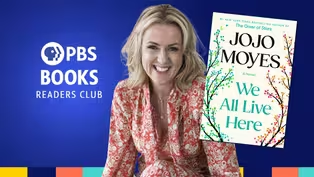
Readers Club | Ep. 205: We All Live Here | Jojo Moyes
Video has Closed Captions
PBS Books Readers Club welcomes international & New York Times best-selling author Jojo Moyes (57m 37s)
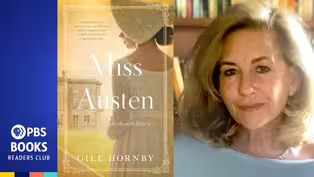
Readers Club | Ep. 204: Miss Austen | Gill Hornby
Video has Closed Captions
PBS Books Readers Club welcomes international best-selling author Gill Hornby to discuss her novel (51m 18s)
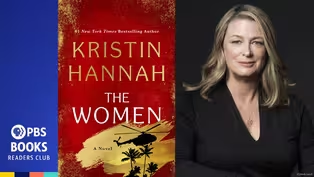
Readers Club | Ep. 203: The Women by Kristin Hannah
Video has Closed Captions
PBS Books Readers Club welcomes international best-selling author, Kristin Hannah to discuss novel. (53m 29s)
Providing Support for PBS.org
Learn Moreabout PBS online sponsorship(upbeat music) - The PBS Books Readers Club is celebrating our favorite books of 2025.
- Do not make it funny.
So I'm writing away the first book and suddenly the characters are making me laugh.
- And it made me mad enough that when I got back to my desk, instead of working on the thing that I was employed to do, I wrote the first chapter of "Lessons in Chemistry."
- Anyone out there is thinking of writing and wondering, "Oh, I need to write a book, and how do I do that?"
Just write.
- There's a point in which I feel I'm full.
I cannot keep reading any more, you know, letters from such and such person to another person.
I just will not do it.
- We're taking a look back at the unforgettable moments from this year's author's interviews.
Insightful conversations, surprising stories, and plenty of inspiration.
Plus we'll reveal our favorite books from the past year.
(upbeat music) - Well, hello and welcome to the PBS Books Readers Club.
- What a fantastic year of reading we have had.
In this special episode, we'll look back at some of the incredible moments we've had with our featured authors, plus we will share our favorite books of the year.
It's almost like a cheat sheet for your holiday book shopping.
- Hi, I am Fred Nahhat here with Lauren Smith.
We're joined by literary expert, award-winning writer Princess Weekes, and our PBS Books national director and resident librarian, Heather-Marie Montilla.
- And of course a big welcome to you, our book clubbers.
We wanna hear from you in the chat.
What was your favorite book that you read this year?
Which of our book picks or author interviews were your favorite?
Let us know.
- We truly, we love reading and responding to your comments in the chat.
And make sure to subscribe to our PBS Books Readers Club Facebook group to share and discuss amazing books all year long.
It really is the best book club ever.
- Your support means the world to us, so please share this event right now.
As we always say, friends do not let friends miss out on great books.
So book buddies, we've had a great year.
What have been some of your favorite books?
- Well, I gotta say being like the goth horror lover, I love "The Bewitching."
I found it to just hit every single mark in what I want from a gothic fiction.
I love talking with Silvia as well about it.
And after I read this book, I went out and I bought five of her other books 'cause she writes a lot.
She's working on like a noir book next.
So like that book, just really the texture of it, the writing, the flow, the different points of view, it was phenomenal and I love her work.
- Okay, so I loved her as well.
(Princess laughs) My favorite- - Twin.
- Mexican Gothic.
- You're black, you like- - I know our dark, yeah, our coven of two.
- You know what, the character development in this was amazing.
I also, I'm not a fantasy horror girl, but I love this and it maybe is my segue into that space.
I love the sisterly love component.
I loved the ability for, she has these undertones addressing colonialism, racial inequality and sexism.
But that's, it's about so much more.
And the house- - Creepy.
Disgusting.
- Is so creepy.
So creepy.
What about you?
- Oh, I've got a good one too.
My favorite was "Lessons in Chemistry."
I just, I've known about this book for a while, but I hadn't read it- - Same.
- And it was so much better than I expected.
It's about Elizabeth Zott, who is this scientist in the 1960s, but as a woman scientist, she's not getting the credit that she's due.
And so she sort of finds herself reluctantly hosting this TV show.
It's about cooking, but she really makes it about chemistry and it sort of helps other women find their own agency and power, and I just, I thought it was a great read.
- And I love the time period of "Lessons in Chemistry," which is also the reason for my favorite, "The Women" from Kristin Hannah.
It invokes a lot of what happened in my childhood.
It was a time of turmoil, the Vietnam War, conflict, but also explores these themes of women serving in war while not receiving recognition, and just some of the cultural references.
I think Kristin and I are probably the same age, just brought back a lot of great memories for me.
- Yeah, and she was great to talk to as well.
- Really, really good.
All right, stick around because we're gonna share our favorite books of the year.
If you've still got holiday shopping to do, what's better than an amazing book?
But the fun does not end there.
We wanna make sure you're connected for all of the great author talks coming up next year.
- First, sign up for our PBS books e-newsletter at pbsbooks.org/subscribe for exclusive book recommendations, author interviews and more.
It's the best way to get the latest updates straight to your inbox.
Then head over to YouTube and hit subscribe.
Our PBS Books YouTube channel features hundreds, literally hundreds of author interviews, including both seasons of the PBS Books Readers Club, with authors like Kristin Hannah on "The Women," Geraldine Brooks on "Horse," Richard Osman on "The Thursday Murder Club," and so many more.
- And if you love the PBS Books Readers Club, consider supporting your local PBS station.
Now more than ever, this program and your PBS station are counting on support from viewers just like you and me.
Do not let this year come to a close without making a difference.
Visit pbsbooks.org/donate to make a gift.
- It's the gift that keeps on giving, and this is really a critical time for PBS.
Your gift can make a real difference.
PBSbooks.org/donate will take you right to your local station's giving page.
You can support this PBS Books program directly by selecting one of our special gifts, like the PBS Books Readers Club book bag.
I love this convertible bag.
You can carry it with the handles, wear it as a cross body.
The main pouch has room for your books, laptop, notebook, plus it's even got pockets for keys, or in my case, a snack for the kiddos and myself.
- Yes, and we also have the official PBS Books Readers Club mug, just like we have here on the set.
It says, "My weekend is booked."
And ain't that the truth?
- Don't forget, PBS members can get access to PBS Passport, the member exclusive section on the PBS app where you can stream full seasons of incredible PBS shows, everything from Masterpiece mysteries, groundbreaking documentaries from Ken Burns and Henry Louis Gates Jr., friendly cooking shows, and all the Jane Austen inspired masterpiece dramas that you could ever hope for.
- Well, and now let's turn to the page to some of our favorite author moments from the past year.
- I am always curious about how our authors got their start.
We always wanna know how they got started.
Did they just fall into writing?
Did they always plan on it?
Their origin stories are so interesting.
- Yeah, for me, Bonnie Garmus who wrote your favorite, "Lessons in Chemistry" really stood out for me because she has started writing from a very young age, knew it was her passion, wrote her own book and put it in the library like around 12 years old.
And I could relate to that so much.
As a young person who always knew she wanted to write, I was writing my little novels and putting them, giving to my friends to read.
I think that joy of wanting other people to read your work is such a like personal visceral part of wanting to be a writer.
And it was just really beautiful to see her like have that passion for so long and have it culminate in such a successful book.
- Yeah, I love listening to Kristin Hannah talk about her origin story because she came to it a little bit later.
She was a lawyer, right?
And her mom was the one that was like, "You should write this book, you should write this book."
And she kind of, you know, put it off, and then it wasn't until she was pregnant with her own child and, you know, stuck on bedrest that she started to write.
And it just seemed like this really cool full circle moment of like her mom encouraging her to do it, but then she didn't actually do it until she became a mom.
And just, there was something really beautiful in that neat little bow.
- For me, hearing about newspapers, like thinking about the writers at the newspapers and Jojo Moyes and also Helen Fielding.
They were even at the same newspaper at the time.
And Helen got her big break for "Bridget Jones," and that really inspired Jojo to keep her hand at writing.
And I think also in writing, that mentorship component is so important, and so as we think of origin stories, I also like to think about that.
- Well, similarly, Gill Hornby, "Miss Austen" did not start writing till her early forties, lost her job at 51, decided to become a novelist.
And this "Austen" series obviously a big TV hit.
But to me it's like lots of women, successful authors starting in newspapers.
- Well, every writer's story has a first chapter.
Let's take a look at how some of our favorite author's journeys began.
- I was one of those little girls who loved to read and always wrote stories, as children do.
But as I grew older, I sensed that writing my own stories was something I wanted to do.
I only knew I needed to write.
So just to be clear, writing fiction is one thing, being published is another.
Of course I hoped to publish stories, but it was more that I hoped to find the time to really produce something that I felt commented on the world or would offer something to someone else.
Because you know what, before I was a writer, I was a reader.
I'm just a reader who writes.
- Then I got column in a national newspaper when I was in my mid forties, and so I had a column and I was very happy.
And then I was 51 and they gave me the sack and then I thought, oh my God, well, nobody else is going to employ me ever again.
There's only one thing for it, I'm gonna have to try and write a novel, so I did.
And I've just finished my fifth.
And I'm really old and I'm now 65.
So really, you know, talk about a late developer.
I really didn't do anything much until I was in my early fifties.
- Well, I wanted to be a lawyer when I was young and my mother told me it was very impractical.
And so I became a lawyer for 10 minutes before I realized that was not for me, and then started pursuing fiction writing.
But it took quite a while to learn my craft and to break into the business.
- I was so unsuccessful for a long time before I was successful.
I would write a book kind of every year to 18 months, and it would kind of just about do okay, but never quite lived up to the early promise.
I don't, do you know, I look back and I think, I have no idea how I did it because I had a full-time job.
I was working on a newspaper, which is not a kind of, you know, relaxing job.
And I had a baby, and I was going home, putting the baby to bed and then writing.
And now I look back and I think, my goodness, you know, I'm asleep on a couch drooling at nine o'clock most nights.
I think I'm just one of these people that I'm gonna keep trying something unless you give me a really good reason why I shouldn't, and nobody gave me a good reason why I shouldn't, so I just kept going.
- No two of our authors had the same start to their writing career, but as we also learned, no two have the same writing process either.
- So I love process, and usually I'm really, really interested in the research process.
But for me, understanding how much Stephanie Dray and Laura Kamoie had to, the research they had to do, the primary source material, all of the letters that they engulfed themselves in was amazing.
- [Lauren] And that was for "America's First Daughter" and "My Dear Hamilton."
- Yes.
- [Lauren] Those were amazing bits of historical fiction work.
- Yes, for sure.
- Certainly.
On the opposite end, I really loved Richard Osman from "The Thursday Murder Club" talking about just kind of going for it, just like, just letting the entire thing unfold and it being very character driven.
Because it's true like a lot of crime novels have very similar plots, but you're in it for the detective, how they grow, how they change, the supporting cast.
And I just thought it was really insightful that he ensures that his characters are really pulling you in every time.
And that he leaves room for like adjusting who the killer is, because if you're doing a good mystery, everyone should have been able to kill the person.
Like, so it's like, it's really like a great who done it mentality.
- I just loved him in general, and like behind the scenes note, we had some technical difficulties with him, and he was so patient and kind and generous, and he hung with us.
And yeah, thank you Richard.
We love you very much.
- Well, talking about process, research, clearly important, but Jojo Moyes and her imagineering to the point of writing down everything that's in the refrigerator of each of her characters, whether they get in a bar fight or not, it's almost, an actor would call it method, but she just sinks herself right into those characters' lives, and it shows through in the writing.
- I really enjoyed talking with Charmaine Wilkerson who wrote "Black Cake" and also "Good Dirt."
And we were asking how she puts her stories together, and she sort of described it as like a wheel, and she takes different bits and bobs from different people and different things that happen in her life, and it all sort of comes together in her characters.
I just found it so fascinating.
And the way she talks, I could just listen to her all day.
- Yeah, she has a beautiful voice.
- Yes, she does.
- [Fred] All right, let's peel back the process and see how some of these great books came to life.
(gentle upbeat music) - It's very much an inimical process.
I talk, I often describe it as caterpillaring, that a caterpillar eats enough leaves and green material, and eventually it's chunky enough to become a butterfly.
And it's like that for me.
There's a point in which I feel I'm full.
I cannot keep reading any more, you know, letters from such and such person to another person.
I just will not do it.
And then I begin the process.
But there's no hard and fast rule.
It's a question of like, do I have enough fuel in the tank?
Am I ready to go?
- With this one, we drafted an outline together, we did a lot of the initial research together, and then we divided it up into chapters that we would each write.
And initially, we actually wrote while we were on a Google video chat together.
So Stephanie would be drafting chapter one, and I would be drafting chapter two, and then we would switch what we had drafted and edit freely.
And I think the editing freely was one part of achieving a seamless voice, and the other was that we almost always accepted 95% of the other person's changes.
- But the one thing I told myself right at the beginning when I thought, "I should write, I want to write a novel, I want to write something."
I thought, "Don't make it funny.
Whatever you do, you know what your instinct is and that's joke, joke, joke.
That's your instinct."
I thought, "Do not make it funny."
So I'm writing away the first book, and suddenly the characters are making me laugh, and suddenly something is happening and Elizabeth says something that makes me laugh.
And then I worked out, okay, I can do this but I have one rule, which is the author is not telling any jokes at any point in this book.
The author does not tell a joke.
The characters are making us laugh.
The characters are saying things in character that are funny, and the juxtaposition between the two are funny.
But at no point am I allowed to do a joke.
- I'm not a big outliner.
I lean toward being what we call a pantser, go by the seat of your pants.
You know, and there's a lot of upsides to that.
I think you stay open to kind of a lot of different scenarios, and you get genuinely surprised by the things that happen sometimes.
That's so fun as the author to be writing along and be surprised by your own plot twist.
- No matter how each author got their start, there is no book without a story.
One of my favorite moments of every episode is learning what inspired the stories that eventually became these authors' novels.
- For me, I always get caught in rabbit holes, and so for Shelby to admit that the reason she wrote "Remarkably Bright Creatures" is because she fell into a rabbit hole about octopuses, I mean that to me, I just was so shocked and inspired myself, impressed.
- Inspiration can come from everywhere.
Like I really love Jane Austen, so when Gill Hornby was talking about not only wanting to shed light on the lesser known figures in Jane Austen's life, but also living in the house- - Yeah, gosh.
- Like can you imagine like waking up breathing the air that you know someone you respected definitely lived in, breathed and did other stuff in there.
But I just thought it was really cool that she could live in the space that she was writing about, you know, 'cause I feel like that is just inherently just like the osmosis of information.
- [Lauren] That's dream right there.
- It's so good.
Like get me at Thomas Hardy's house and I'll have a great time.
- [Lauren] Let's go.
- Well, to me, Charmaine Wilkerson, another example of a great female author who had started as a reporter, in her case a sports reporter.
Now "Good Dirt" and "Black Cake," stories of import and impact, depth of character.
When you think about sports coverage, it has that element of being very descriptive but also involving a lot of humanity.
So it's the personal stories along with the stories of competition, and then the very statistical pursuit of sports.
And it's just another one of the things that makes Charmaine I think amazing.
- Yeah, she's great.
I also loved Richard Osman.
He wrote "The Thursday Murder Club," and he was inspired to write the book because he was visiting his own mother in her retirement community and just thought, ooh, this would be a great place for a murder.
I just, I love that.
It's so funny to me.
- Very British.
- Well, for sure.
Well, from the thought to shelf, let's hear about how these authors came about bringing their big stories to life.
- Well, you know, when I wrote the book, I started around 2013, and I'd been in a meeting that day where I wasn't taken seriously.
It was a meeting of all men.
It was very typical for me because I used to work a lot in technology.
And as I was leaving the meeting that day, I kept thinking to myself, how many other women's talents have been wasted this day this way?
And it made me mad enough that when I got back to my desk, instead of working on the thing that I was employed to do, I wrote the first chapter of "Lessons in Chemistry."
- I first pitched this book to an editor in 1997, so that's a good long time ago.
And I think it's because, you know, I was a child during the Vietnam War, and my best friend, my third grade best friend, her father was a pilot who served in Vietnam, and he was shot down and was lost.
And so I was seeing, you know, how the veterans were treated when they came home, and it all just made this really strong impact on me as a child.
And so I just have been interested in it for a long time.
But it was very clear that for a long time, the country wasn't ready to read about Vietnam either.
And so I was waiting for this perfect moment of me being ready to write it, me being sort of mature enough and old enough to write it, and me sensing that it was the right time to put what I felt could be an important book out into the marketplace.
- Well, really, it wasn't meant to be a book, you see.
It was just meant to be a column for a short time.
And I was writing another rather earnest tome sort of about economic and cultural divides in the Caribbean.
And my publisher took me out for a drink, we got a bit plastered and she said, "This book is unreadable, Helen."
She said, "Why don't you do 'Bridget Jones' instead?"
And I said, "Yeah, okay."
It was as casual as that.
But all I had was all these columns and no structure.
So the BBC was showing "Pride and Prejudice" at the time, and I, like the rest of the country, was in love with Colin Firth.
And then I thought, well, why don't I just steal the plot from "Pride and Prejudice?"
I don't think Jane Austen would mind, and anyway, she's dead.
- But also what happened was Stephanie and I went to yet another writer's conference.
This one was in New York City in the summer of 2015, I believe.
Patsy's book had not even come out yet.
I went with a friend to see this brand new Broadway show called "Hamilton: An American Musical."
And at the intermission, I turned to my friend and then I said, "Eliza has to be the next book."
The next morning, Stephanie and I had a meeting at our publishers.
In the cab on the way there, I like gushed about this.
We brainstormed the novel, we pitched it to our editor that afternoon basically, and then we were off, like before it even exploded into the big phenomenon, we saw the importance of Eliza's story.
- Now books are seriously important to us, but that doesn't mean all of our author conversations were all serious.
We had plenty of laughs along the way.
- We really did.
- Yeah.
- So for me, the funniest was to hear with Bonnie Garmus who wrote the "Lessons in Chemistry" that she didn't know a lot about science.
So she got a book from the 1950s out of the library.
It was like the golden science experiments, and she would do the science experiments, and as you recall, like she had run-ins where they exploded so much that the fire department had to come, and just was hilarious.
And I grew up doing lots of science experiments, so it kind of reminded me of the mayhem that ensued in my home.
- You and mayhem, that doesn't even make any sense.
- It is true.
(everyone laughing) - Ah, oh my gosh.
Oh, I loved Helen Fielding.
She wrote "Bridget Jones," and I had no idea how much of Bridget was based on her own self.
She literally was in the middle of an interview with us and realized that she left a chicken in her oven from like five days ago, and she gets her laptop and she brings it over to show us the chicken.
I can really, I would do that.
It's something I would do.
- That was, she was so excellent.
And I really loved Gill Hornby referring to Mary Austen as batty and a cow.
Like I didn't know, like the multitudes of humanity.
And speaking of cows, my actual absolute favorite moment that we didn't actually show on the show, thank God, was this fly.
I was trying to ask, I was sitting here trying to be very zen, very stoic and it just, and I can feel it on my face- - It was right here.
- Yeah, yeah.
- Right here.
- Flies on the side of my face and then it- - You held it together so well.
- I held it together so well.
And then like it finally flew right here, and then someone, my hero, my gladiator slayed it for me.
It was, thank you.
- I think we were talking about "Pride and Prejudice," and I was just like, outta here Wickham.
Let's go.
(laughs) - Exactly.
- Amazing.
- Savage.
- You're welcome.
I got you.
- [Fred] Yeah, I just think you need to see that for yourself.
(gentle upbeat music) - And she says no twice to like two very viable candidates because she just wants love.
- Okay, I have to get this bug off of your face.
- Thank you.
Thank you.
- Oh my God.
- It keeps- - This fly is attacking.
- I know it really, it's very distracting.
- Hold on.
Gone.
Got it.
- Yay.
- Woohoo.
- Thank you.
You saved me.
It had been harassing me the entire- - I can't believe you got it.
- I was like, get off her face.
(everyone laughing) Oh my God.
- I felt so bad because after my question I was just like, it's in my face.
- Just like that.
All right.
- Wow.
- See you later, Wickham.
- Okay, so I'm no longer allowed to say what the experiments were because they don't want people to copy, like, people are gonna do this.
But I did use this book that has essentially been banned.
It's the children's golden, "The Golden Book of Children's Chemistry Experiments" that it was released in the forties or something, and they had to ban it because kids were blowing themselves up.
Now I know why.
That's the book I used.
And so I did have two accidents in our kitchen in London, and both times the fire brigade came, and the second time they brought me a fire extinguisher of my own.
- Well, I think I always felt that words were the thing I sort of knew what to do with.
And anyone who's seen me cook knows that it's not that far from the movies.
- I haven't, but I would love to.
- No, you really wouldn't.
But I can actually show you here.
There's a chicken that earlier today, I just found in the oven, which- - Oh my god.
(everyone laughing) - Since I think Friday, so I just forgot but- (everyone laughing) - That's fantastic.
- You can to this day go to the Mercado de Sonora in Mexico City and buy, it's a witch market and you can buy ingredients for witchcraft.
Now they're not the same ingredients as 100 years ago.
It has become very commercialized.
And you will go and you, there's this, you can buy, it's very funny.
My favorite ones were the soaps, soaps for you to like take a bath, and it says "Soap for love" for, you know, soap for sexy love, for being more sexy.
Sometimes of a very attractive girl, like, I think I saw Marilyn Monroe one time, you know, like an unauthorized picture in a soap and it says, you know, wash yourself with it and you will become instantly more beautiful and attractive to the opposite sex.
And sometimes you look at that and it's like made in China.
(laughs) - I'm not gonna lie, I just, I recently visited a witch market just because I was trying to get inspired.
I did not buy any love soap.
So, don't worry.
(guest laughs) - Listen- - You don't need it Lauren.
- Yeah, is it available online?
- (laughs) I love a good laugh, but let's round it all out with some quality advice from our writers.
Whether it's about life, or writing, or anything in between, they certainly had some words of wisdom to share.
- Yeah, I loved Gill and I loved, she said, "Life is long" and she really alluded to, you don't need to know what you're doing at 18.
I always ask people, you know, "Hey, what do you wanna be when you grow up?"
And sometimes the people are my age and they're like, oh, like I'm already, and I'm like, no, I still am figuring it out and so can you.
And I think Gill really, her comments really go to all of that, and help us to be the best version of ourself and find ourself.
- Absolutely.
And we're so much better now than we were at 18.
- For sure.
- Thank God for that.
(everyone laughing) I really like Shelby's advice of there's no substitute for sitting your bum down in the chair, because as someone who writes, I have to tape that to my wall because I love to procrastinate, especially 'cause I was like a straight B plus student with procrastination.
So it's like, it takes a lot of me to actually just sit down.
But once you do it and you love what you're doing, it just comes out so much easier than you expect.
So I think just get your butt in the chair and just, even if it's just gibberish, just write something down.
I think that's just so important.
- We can't get out of our chairs 'cause we're strapped in.
- Strapped in, yeah, that's why I'm so productive here.
- With our microphone.
You're doing a great job here.
- Well, the advice from Helen Fielding might help you because she said start small, like you're writing to a friend.
And considering the idea of starting small in her career and her profile has resulted in multiple novels, multiple motion pictures, it makes it even more impactful and probably pretty sage advice.
- [Lauren] Just don't take our word for it, here it is in the words of our favorite PBS Books authors.
(upbeat music) - And my grandfather was a cop when he said to me, "If you're ever called to a fight in a pub, make sure you're second through the door."
And I think that's very good advice for life.
First person gets beaten up.
The second person's the hero.
- Friendships are important, and that they need to be maintained because we all know, especially you guys were talking when we're young mothers, when we're working women, it's really hard, but it's still, friendships require time and care, like a marriage.
And so I wanna put this out there that not only can women help each other the way Frankie does in the end, but women can help each other along the way.
And I think that's sort of a vital message.
- But I will say this, I'm gonna turn it around and say that anyone out there is thinking of writing and wondering, oh, I need to write a book and how do I do that?
Just write, just write one word today and 10 words tomorrow, and just keep going because no one writes a book like that in a day.
No one runs a marathon suddenly without training.
And it can be done, but don't make the mistake I did, which was, oh, well, but I need to be ready, and I need to have more, another degree, and how do I justify it?
Et cetera, et cetera, et cetera.
- About writing, it is not to be afraid to write trash because a lot of times what we call writer's block is your inability to let go of the perfectionist in yourself.
You're afraid to put what you're thinking on the page because you know it's not good.
But that's all right because you can fix something that isn't good.
You can't, I think Nora Roberts said you can't fix blank page.
So that is my best writing advice that I ever received and what I tell others.
- We've had so many unforgettable moments this season on PBS Books, but now it's time for the part you've been waiting for, our favorite reads of 2025.
Heather is the librarian at this table.
I think it's only fitting we begin with you.
- Why thank you.
My first book pick is "Tell Me Everything" by Elizabeth Strout.
She is a Pulitzer Prize winner.
I had the privilege of interviewing her earlier this year with PBS Books.
This book is about a lot of the characters who she's written about earlier, so Bob Burgess, Lucy Barton, Olive Kitteridge, and they're in Maine and they're living their life.
It is building community.
It's about family, intergenerational complexities and murder.
So this is a really amazing book, and it also makes you think about love and what is love, especially as you get older.
Highly recommend.
My next book pick is a little bit different.
It is "The Unexpected Journey: Finding Strength, Hope, and Yourself on the Caregiving Path."
It's by Emma Heming Willis.
And this book is really anyone who is a caregiver or knows someone who is a caregiver of someone, especially someone with dementia, I would highly recommend this.
It's not only a guide about how to care for yourself and how to set boundaries for others, but also how to eat better, how to fit things in for yourself.
It's incredible.
It also has parts that are workbook.
So I strongly encourage this and it's just beautifully written and researched, a lot of research in this as well.
You know, I read this a few years ago when it came out, "Ida B. the Queen."
It's by Michelle Duster, but I read it again.
I actually had the privilege of interviewing Michelle Duster at my library.
She is the great-granddaughter of Ida B. Wells.
This is a non-fic book.
It is beautiful obviously outside and in.
But I delved into this right before those of you who know Veronica Chambers.
This is "Ida in Love and in Trouble."
This is written by an investigative journalist for "The New York Times," Veronica Chambers.
And this is just based on a lot of research, and that's why I revisited this first to really be able to get full understanding.
This is a coming to age story.
And as we think about coming to age, I will suggest this novel, which unlike this, which is historical fiction, this is from Essie Chambers, "Swift River."
It's another coming of age story.
It takes place in New England.
It deals with family dynamics, mother daughter.
It is just incredible and beautifully written, and I think we'll see a lot more by Essie Chambers.
She's incredible.
- Great picks.
- Amazing.
I'd like to pick up that Willis book.
As you know, that's my kind of thing.
- It's incredible.
- Well, unfortunately my book picks were too heavy to fit in my carry on, but I have all of my written notes for you guys right here.
So the first book I really loved reading this year is the "Assassin's Apprentice" by Robin Hobb.
She is a fantasy writer, and this is one of the first trilogies in this giant world building story.
It's about this young boy named Fitz.
He's the illegitimate son of the prince, and he is adapted into the royal family, but he's an ultimate outsider 'cause he can never really be legitimate.
Very big John Snow vibes for those who know "Game of Thrones."
- Yeah, I dig it.
- And his grandfather, the king, decides to raise him to be a royal assassin, who his role will be, you'll never be close enough to being the heir, but you will make sure that the next heirs get to survive and thrive.
So you get to watch him sort of like grow and evolve, but also come into some strange magical abilities.
It's very epic.
It's very interesting.
And there's just something about when female authors write young men, the character Fitz is written so introspectively, and you really deal with his isolation of his status, but also get a picture of a very full world.
Like, it's huge, which is why it's not here with me, but I really enjoyed it.
- I'm writing that one down, "Assassin's Apprentice."
- Apprentice, yeah, it's really good.
The second book is a more recent release.
It's "Katabasis" by R. F. Kuang.
It is a amazing piece about this magical school student named Alice who decides to travel into hell to get a recommendation from her dead professor to complete her thesis.
- Okay!
- And it very much in taking from the kind of, 'cause katabasis means like journey into hell.
It's a kind of story.
So it's pulling from Dante, from Orpheus, and all of this different folklore of crafting hell into a world of its own making to have these characters go on the journey.
So it's not just Alice, but also her main rival who's a boy, and you know what happens when girls and boys go to hell together.
So it's a really great read.
It's very introspective.
My third pick has also came out this year.
It's called "Bury Our Bones in the Midnight Soil" by V. E. Schwab.
It's a vampire book.
It's very much in the vein of say "Interview with the Vampire."
It's very dark, very queer, and it's about these three different women, two of them vampires throughout time.
So it starts off in Spain, in 18th century Spain.
- [Lauren] I thought you gonna say space.
- I know, I know, I know.
I would never do, I would never bring that here.
I would never bring space.
- No.
- No space.
- I would never bring space here.
The ocean so much this year too, all the octopuses.
But it really is a sort of like emotional character driven story about these this woman who becomes a vampire and decides to be her worst self, and I love that for her.
You know, and it really is like that, going through it with different character journeys of like, what is it like to be a woman during these different periods in time, but also when you get power, what do you do with it?
Which I always do love.
And then my last two are a little bit different.
So my fourth pick is "Blood in the Garden" by Chris Herring, and it's about the 1990s Knicks.
And I was born in 1992, which is when the Knicks became good again, and we've been riding that ever since.
I started reading this this past year because we were doing very well.
(everyone laughing) - It's okay, honey.
- Until we weren't.
- It's okay.
It's okay.
- But it's okay.
And then my final pick, sorry I've been talking for so long, is "Troy" by Stephen Fry.
He has been doing this series of adaptations essentially of the different books from the Greek mythology.
It started off with myths, he did heroes, and he did Troy and he did the Odyssey.
I find the story of the Trojan War to be so, it's the ultimate epic.
There's just so much politics behind it.
And he really, with his dry wit and still great sense of humanity, really lets you feel the agony of the moment because this is like a war that goes on.
People are gone from their homes for like 10 years of fighting, and then with Odysseus, 10 more years of being away.
But you really sit in sort of like the darkness of war and the politics of it.
And you get sort of like the inside of how the gods, the Greek gods in this setting were also keeping it going along.
And so it's this completely surreal experience of watching a war through so many different lenses, from Helen's perspective, from the gods, from the Trojans, from the Greeks.
And I just found it to be like very accessible and also elevated.
I would love to like read this with like a family reading time.
Like I feel like it's like a great campfire read.
It just, it's everything.
Highly recommend.
- I love everything.
Okay, I'm looking at your list.
We've got assassin, bones, blood, vampire, war.
- Mythology.
- Yeah, I'm 100% in on this.
Great job.
- Thank you.
- Also inspired by war this year in this case, my first book recommendation, my favorite from 2025, bookommendations, I'm trying to get that going.
Not sure if that's working.
- It's your fetch.
- "The Women" from Kristin Hannah, the first televised war, the Vietnam War.
Frankie McGrath is a young nurse.
She volunteers for Vietnam.
She comes from a military family in San Diego.
Her father, interestingly, with a big honor wall actually didn't serve.
She lost her brother.
And it's the kind of story that really brings the war home.
And since I'm of an age where I remember seeing those images on TV, it was extra, I think extra resonant for me.
And then there's some of the pop culture references.
There's a thing when I was a kid where you would put butter on Wonder Bread and then cover it with sugar and you would eat it.
It was like- - Gross.
- Making your own candy.
In the book.
We all did it, she did it.
Secret society of Wonder Bread, butter and sugar.
- You're like this is accurate.
- Explains a lot.
- That and there are many other reasons, I like this one.
Listen, if you liked "The Nightingale" or "All The Light That We Cannot See," you'll love "The Women" from Kristin Hannah.
All right, next, Jojo Moyes, "We All Live Here."
This was a really incredible story.
I love the characters.
Her stepfather Bill and the estranged father Gene who- - Oh, we loved Gene.
- Was an actor and he rolls into town, and he's everybody's least favorite person.
So we're eyeing some redemption from Gene.
- What about the "Star Trek," pseudo "Star Trek?"
- Oh yeah, the "Star Trek" thing.
It just, it really does reinforce the idea though that anyone can find redemption.
- Yes.
- And that other people, while it may appear from the outside that other people kind of have it going on, like the other parents at pick up or, you know, her husband leaves her for one of the moms at pick up.
Like, everyone else has got it going on, but everybody's struggling.
And you know, the older I get, the more you realize that consciousness is a miracle, but it's also a curse and everybody is struggling with that.
So this is really great, if you're into great characters, both living and dead, this one's for you.
If you like "Remarkably Bright Creatures" or "Lessons in Chemistry," Jojo Moyes, "We All Live Here," awesome.
We talked a little bit about this one, but I love it, "The Thursday Murder Club."
- Oh yeah.
- So good.
- I did love that.
- Richard Osman centering on the four residents of the retiring community, Elizabeth, Joyce, Ron and Ibrahim who meet weekly to investigate these crimes.
It's just plain fun, incredible writer, serious topics woven in.
You know, as you might experience at retirement communities, you know, people dealing with issues of memory care, dealing with healthcare concerns, and of course murder, but also all their backstories.
This is what's really amazing to me is there's a part in the book where she says, "I wouldn't have been friends with her 30 years ago, but since we're thrown together by circumstance, we have made these new friendships," and I think that's super inspiring.
It is a cozy mystery of the genre, so we know what that's about.
If you love "Only Murders in the Building" or "Knives Out-" - Oh yes.
- You will love Thursday- Or "Marlow" too, that's another one- - Yeah, "Marlow" for sure.
- Good connection.
- So my final book, maybe a bit of a surprise, speaking of women writing young men, I got super excited when I heard "The Outsiders" was going to be turned into a Broadway style musical.
So given the films, given the cottage industry in Oklahoma around the film, I felt like the book needed a little bit more publicity and a little bit more love, 'cause that was the original, the original fiction.
S. E. Hinton's story of Ponyboy, and Sodapop, and Darry, and Johnny, and Dally, and the Socs, and the idea of trying to fit in, it's really amazing.
She was just a teenager when she wrote the book.
I mean, that to me is the most incredible thing.
It's a story that shaped my generation and generations heretofore.
So I love reconnecting with this book.
It was really amazing.
If you love "Perks of Being a Wallflower" or "Looking for Alaska," you will love, you will love "The Outsiders."
- That's a great list.
- That's a great list.
- Well done, well done.
Okay, I have three for you.
So the first is "The Girls of Good Fortune" by Kristina McMorris, and this book is really interesting.
It's about a Chinese American woman.
She is living in Portland in the 19 or the 1880s, 1890s, and she is captured and forced into labor on a ship.
And so the book sort of goes back and forth between her trying to escape this situation that she's in, because she's gotta get back to her family, and also sort of reflecting and trying to piece together the events that led her to be there.
So it's like you don't know how she's there or why, and then you're trying to follow along.
It's a little bit of a love story, hopeless love story.
I just felt like the whole time I was reading it, my heart was just aching for this woman who was in all of this trouble for no fault of her own.
But her resilience was really inspiring and I just, I thought it was a really good story.
So "The Girls of Good Fortune," this is a really good one.
My next pick came out this year, it's called "The Great Mann."
If you're someone who loved "The Great Gatsby," this is one you'll find really interesting.
It's really, it's a retelling of "The Great Gatsby" set among LA's Black elite, sort of postwar story.
So take "The Great Gatsby," put it in California and like add the complexities of race and mobility.
It's really fascinating read.
So I read this book and then I wanted to go back to "Gatsby" and sort of like look at all the comparisons.
I thought it was really fascinating.
In a way, it's richer because you have everything that you're dealing with in Gatsby, but then there's this extra layer of complexity, and I just thought it was a really interesting read.
So "The Great Mann," read it.
Okay, last pick.
This one is unique, it's interesting.
It's called "Black Woods, Blue Sky."
It is by Eowyn Ivey.
And she's a Pulitzer Prize finalist.
She's a "New York Times" bestselling author.
She goes back to Alaska in this book, that's where she lives, so she writes about Alaska.
And it's sort of, it's like a modern day fairytale, sort of like take "Beauty and the Beast" and put it in Alaska in a modern day story.
It's really interesting.
It's about this woman, she's a young single mother.
She's trying to take care of her daughter.
She's tending bar in Alaska.
It's just, she has this like wilderness fantasy, which I can relate to, just like escaping to the wilderness and like leaving it all behind.
So she meets this young man who is a little bit odd.
He only speaks in the present tense.
He's really kind to her daughter, but he's just kind of a weird dude.
But they start to form a little bit of a bond, a little bit of a romance.
And she decides to go live with this guy in his cabin that's like way, way, way, way out there in Alaska, in the wilderness.
And everything's going great out there, but then she starts to realize, and her daughter starts to realize that this guy is like a little too one with nature and maybe a little dangerous.
So it sort of combines this fairytale, this folklore with a really modern story about like making ends meet as a mother.
You know, the complexities of the mother-daughter relationship.
You get to see some of it from the little girl's point of view.
And I just, I thought it was, it's really strange and really beautiful and I hope you love it.
- Yeah, I'm gonna check those out.
I trust any woman named Eowyn.
- Yes, agreed.
- That's a good name.
(laughs) - So wilderness, good.
Space, not so good.
- No space, no submarines, not for me.
- All right, book lovers, it's time to share your recommendations.
What was your favorite book this year?
Put your best of list in the comments right now, your favorite book of 2025 might just be the one that makes another book clubber's year in 2026.
And be sure to join the PBS Book Readers Club Facebook group to stay connected all year long.
- Well, those were some great recommendations.
I'm sure our Readers Club members will be all over those.
And remember, please support this program and your local PBS Station at pbsbooks.org/donate.
We've experienced so much joy here on the PBS Books Readers Club, so please give what you can because your support helps keep events like this going.
If you're watching on Facebook or YouTube, just click the link in the description or comments, or visit pbsbooks.org/donate - And you'll be taken to your local PBS station's donation page where you can find some PBS Books swag as our thanks for your donation.
One of the gifts you can receive is an official PBS Books Readers Club book bag.
Classy and durable, the bag is just the right size to carry around your favorite books.
- Yeah, I love to tote it around.
I can fit at least three books, no, probably four, maybe even five.
Five thick novels home from the library myself.
I've tested it.
It's great.
- [Fred] Well, you can also choose the official PBS Books coffee mug, "My weekend is booked."
I'm certain that's true for you as well.
Plus, as a member of your PBS station, you'll gain access to the members only content on the PBS app with Passport and all the incredible shows we shared with you throughout the year and so many more.
- And everyone can help by sharing this video with all your friends and by giving us a like or a love.
And be sure to join the PBS Books Readers Club Facebook group for ongoing book recommendations and discussions.
- And sign up for our e-newsletter at pbsbooks.org/subscribe, and we'll send you lots of book recs, exclusive interviews, and more delivered right to your inbox.
- Including this full list, so you'll have that, yes.
- Yes, yes.
Also subscribe to our YouTube channel to discover an incredible collection of author interviews.
- Thank you for being part of the PBS Books Readers Club.
We'll see you next month.
Happy holidays and happy reading.
- Yay.
(upbeat music)











Support for PBS provided by: