Virginia Home Grown
Harvest for Health
Clip: Season 26 Episode 5 | 7m 50sVideo has Closed Captions
Tour a garden at a rural hospital focused on improving food security and community health
Peggy Singlemann meets Lenora Wright at the Harvest for Health Community Garden in Mecklenburg to see how the Cooperative Extension has partnered with VCU Health Community Memorial Hospital to grow fresh food. Featured on VHG episode 2605, July 2026.
Problems playing video? | Closed Captioning Feedback
Problems playing video? | Closed Captioning Feedback
Virginia Home Grown is a local public television program presented by VPM
Virginia Home Grown
Harvest for Health
Clip: Season 26 Episode 5 | 7m 50sVideo has Closed Captions
Peggy Singlemann meets Lenora Wright at the Harvest for Health Community Garden in Mecklenburg to see how the Cooperative Extension has partnered with VCU Health Community Memorial Hospital to grow fresh food. Featured on VHG episode 2605, July 2026.
Problems playing video? | Closed Captioning Feedback
Where to Watch Virginia Home Grown
Virginia Home Grown is available to stream on pbs.org and the PBS app.
Providing Support for PBS.org
Learn Moreabout PBS online sponsorship>>We're in one of Virginia's farming areas.
Industry is right here, literally surrounding us.
We do something called a community health needs assessment, and after interviewing our community team members and also talking with our employees, we realized that food insecurity continues to be rampant even in a farming region.
So we partnered up with the Virginia Cooperative Extension and said, how might we contribute to addressing food insecurity and improve the health outcomes of those in Southern Virginia?
So we realized that you can accomplish a lot in raised bed gardens and you can actually produce a lot of produce.
Last year alone, we contributed over 2,000 pounds to the local food group distribution network.
So food really is at the core of health prevention, health maintenance, and then even health healing, and this is that shared space for everyone to come and take part of it that lives in Southern Virginia or may just be passing through because they needed some services that we offer here.
>>This started actually in 2024 at a local civic engagement meeting, the Lions Club.
The president of VCU was presenting her 2025 to 2027 community health improvement plan.
>>Uh-huh.
>>And so, as I was sitting there listening, I said, "Wow, VCU actually has a shared vision and mission as Virginia Cooperative Extension."
So when sitting there, I decided, you know, I think this would be an excellent partner to address food insecurity in the area.
>>Well, a community garden is the best place to meet all of those needs, for sure.
>>Yes.
>>You had to have partners.
How did you develop those?
>>So I went out into the community with the message that VCU, CMH, and Virginia Cooperative Extension is embarking upon a mission to create a community garden in the area to address the long-term issues of food insecurity and people not having access to fresh food and produce, and so I shared that mission, and that passion spread across the community through local agencies, local farmers, local vendors, VCE staff, VCU staff, and just residents, the community at large, They all jumped on board to be part of this mission.
>>That is fabulous because I can't think of a better location for a community garden than outside the windows of a hospital.
>>Yes.
>>So how was it decided what to plant and what was planted?
>>So we actually had a meeting with the master gardener and we deliberately decided what vegetables, herbs, and beans that we would plant, and so our end final list was we had some tomatoes, cucumbers, peppers, okra, and the herbs, we had a fresh basil, chives, and sage, and then we had planted a series of beans.
>>Yes, and I also see roses because we've got a nest in one of them, so yes.
>>Yes.
And so our entryway was a beautiful rose awning and we also sourced from local vendors.
So just stressing again the importance of community and civic engagement, and being able to bring them into the fold.
>>That is awesome.
You know, for something particularly so community-based, coming from a site, to be able to then move it out into the community, to me, it's just one of the heralding blessings of this garden.
>>Yes.
>>But there's more because this garden is perfectly situated and there's a sitting area right there and people can see from the windows.
So was this site intentional?
>>Yes.
So, aside from being able to provide fresh produce for the community, this garden is also a place of change and transformation.
It's a place where nutrition education can happen, the sharing of knowledge and resources.
It creates a safe space for the community to come out and enjoy and have food demos and just learn about all the fresh produce that's in this wonderful garden, but aside from that, this community garden, Harvest For Health, is also part of the garden social ecosystem, and it fits into the overall ecosystem.
So it's a place where people can come and not only enjoy the fresh produce, but also just smell the aroma.
We have vegetables, we have beans, we have herbs, and that first raised bed, which is also ADA-compliant.
So it's also for patients that are in wheelchairs.
It provides that space for everyone to come out and smell and just, like in that front bed, we have two baby birds that's in there.
>>Isn't that a joy?
>>I mean, it's just a stress-free, safe environment for the community, and it is for everyone.
>>Yes, and it'd be a great place to come and have lunch.
I would love coming here.
>>Yes.
>>An early morning to come here because of the birds that are singing.
Where are we going with this for the future?
What do you envision or see happening in this site?
>>Well, since Mecklenburg County is, as well as much of the rural areas, we're in a food desert.
So many of the restaurants here are fast food, and my vision for this garden, along with our partnerships, is to be able to create a paradigm shift, a behavioral change, so that, you know, being that this is a SNAP-Ed initiative, is to help low income, is to help SNAP-eligible participants to be able to say, "I can come to this garden with a minimal budget and be able to go home and cook a fresh, healthy meal for my family as opposed to spending maybe $20 in fast food."
And so to be able to create those behavioral changes, it can address the issues and concerns that are in our communities, and maybe have less beds filled in the hospital, because it's all about prevention.
This garden represents transformative change and prevention.
If we learn to make our hand, whichever hand we eat from, our friend or our foe.
>>Yeah.
>>If we learn to take that hand that we eat from and reach into that garden and fix our plate, we can then prevent half of the chronic diseases that exist today.
>>Truly.
>>So my vision is for this garden to expand outward into the broader community and have people think about more healthy living, and one thing I love to mention, something that I learned while I was preparing this whole project, the soil is so important, and I learned not to say dirt.
>>Oh, thank you.
(Peggy laughs) >>I learned to say soil because we used a top-of-the-line soil, which was the VP400, and it was 1,500-pound bags of soil and we went through at least five or six of them.
>>Oh, yeah.
>>And just to know starting from the soil and how this just manifested into an abundance is a magnificent experience for anyone.
>>Definitely.
We'll just start with one community and one garden, and right here is a good place to start.
So thank you, Lenora.
Thank you for your idea and thank you for pushing it through and understanding how we could get this done and then succeeding with it.
>>Thank you for this opportunity to share.
In these small rural communities or larger rural communities, we really have to remember the power of community engagement, the power of civic engagement, and that nothing happens in a vacuum, that it takes a entire community and village to start with an idea and have passion as a driver, and you can manifest that abundance with the garden.
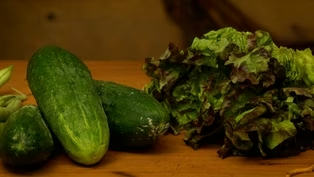
Video has Closed Captions
Clip: S26 Ep5 | 6m 41s | Discover vegetable pairings to grow in your garden for a healthy and bountiful harvest (6m 41s)
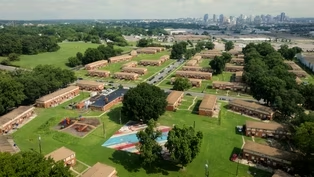
Video has Closed Captions
Clip: S26 Ep5 | 8m 16s | Visit a farm in a public housing community providing fresh food and leadership training (8m 16s)
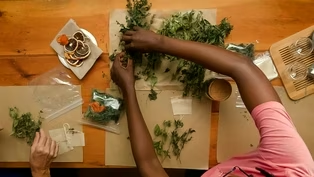
Video has Closed Captions
Clip: S26 Ep5 | 5m 39s | Relax with a refreshing herb infused beverage after a day in the garden (5m 39s)
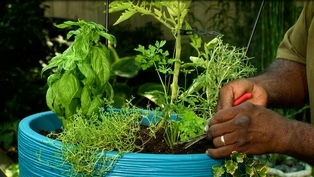
Video has Closed Captions
Clip: S26 Ep5 | 4m 14s | Create a container full of tomatoes and herbs to top homemade pizzas (4m 14s)
Video has Closed Captions
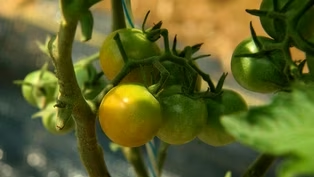
Clip: S26 Ep5 | 3m 33s | Learn why high heat slows tomato pollination (3m 33s)
Providing Support for PBS.org
Learn Moreabout PBS online sponsorship

- Home and How To

Hit the road in a classic car for a tour through Great Britain with two antiques experts.
 New Episode









 New Episode

Support for PBS provided by:
Virginia Home Grown is a local public television program presented by VPM